The European Society for Radiotherapy and Oncology (ESTRO), in collaboration with the EORTC Lung Cancer Group, has published an expert guideline on target delineation and radiotherapy details for stage I–III small cell lung cancer (SCLC).
The new guideline provides updated European recommendations for the use of radiotherapy in limited-stage SCLC, a disease that remains highly aggressive but potentially curable when treated with curative-intent multimodality therapy.
Small cell lung cancer accounts for approximately 10–15% of lung cancer cases and is strongly associated with tobacco exposure. Around 30% of patients are diagnosed with limited-stage disease. For patients with stage I–III SCLC who are fit for curative-intent treatment, concurrent chemoradiotherapy has long represented the standard approach.
The guideline highlights that thoracic radiotherapy remains a cornerstone of treatment in stage I–III SCLC. However, the authors note that variation still exists in staging, target volume delineation, radiotherapy dose prescription, treatment delivery, and integration with systemic therapy. The document aims to provide a standardized framework to support high-quality radiotherapy practice and harmonize care across centers.
Accurate Staging Before Curative Treatment
The guideline emphasizes the importance of accurate staging before treatment selection. Recommended staging includes contrast-enhanced CT of the chest and abdomen, 18F-FDG PET-CT, and brain MRI.
PET-CT is highlighted as an important tool for improving target definition and identifying occult nodal or metastatic disease. When nodal involvement is unclear, mediastinal staging with endobronchial ultrasound may be recommended, while other biopsy approaches can be used depending on the clinical situation.
Brain MRI is considered mandatory before curative-intent therapy to exclude brain metastases. The guideline also recommends respiratory assessment before thoracic radiotherapy, including pulmonary function testing and evaluation for interstitial lung disease, as these factors may influence treatment safety and planning.
Radiotherapy Planning and Target Delineation
The guideline provides detailed recommendations for radiotherapy simulation, planning, and target delineation.
CT simulation should generally be performed with the patient in the supine position using appropriate immobilization and intravenous contrast when possible. Image acquisition should include the relevant thoracic anatomy, including the lungs, heart, and esophagus. Four-dimensional CT is recommended for respiratory motion assessment, particularly for tumors affected by breathing motion.
For target delineation, the guideline recommends co-registration of the planning CT with diagnostic PET-CT and baseline pre-chemotherapy contrast-enhanced CT whenever available. This helps improve accuracy in defining the primary tumor and involved lymph nodes.
The gross tumor volume should include the visible primary tumor and involved lymph nodes. The clinical target volume should account for microscopic disease, while the planning target volume should include margins for setup uncertainty and residual motion.
Importantly, the guideline supports involved-field radiotherapy rather than elective nodal irradiation. Treating uninvolved lymph nodes is not recommended, as it may increase toxicity without improving outcomes.
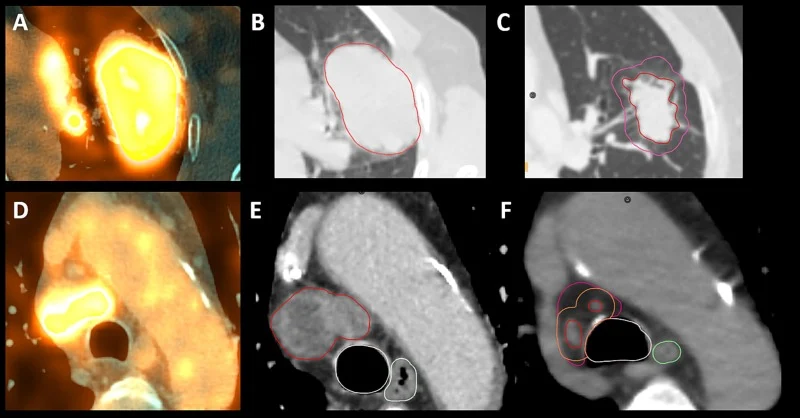
Post-chemotherapy target volume delineation. A–E: A 69-year-old patient with left upper lobe cT4N3M0 small cell lung cancer began thoracic radiotherapy at cycle 3 of platinum–etoposide. Baseline pre-chemotherapy 18F-FDG PET/CT (A, D) and contrast-enhanced CT (B, E) were co-registered for planning. The post-chemotherapy primary tumour (GTVT, red, C) was expanded by 0.5 cm to form the clinical target volume (CTVT, pink). No internal target volume (ITV) was generated, as treatment was delivered in deep inspiration breath-hold (DIBH). The post-chemotherapy nodal GTV (GTVN, red, F) was similarly expanded (CTVN, orange), respecting anatomical barriers (proximal bronchial tree, white), then manually enlarged (pink) to include pre-chemotherapy (E) microscopic extent. (For interpretation of the references to colour in this figure legend, the reader is referred to the web version of this article.). (For interpretation of the references to colour in this figure legend, the reader is referred to the web version of this article.)
Modern Radiotherapy Techniques
The document supports the use of modern conformal radiotherapy techniques, including intensity-modulated radiotherapy and volumetric modulated arc therapy. These approaches can improve dose conformity and help reduce exposure to organs at risk.
Image-guided radiotherapy is considered essential for accurate treatment delivery. Daily cone-beam CT is described as the optimal approach, while surface-guided radiotherapy and motion-management strategies may also be used in selected settings.
For tumors with significant respiratory motion, strategies such as deep inspiration breath-hold, abdominal compression, respiratory gating, or mid-ventilation approaches may be considered, provided that adequate verification protocols are in place.
Standard Dose and Fractionation
The guideline states that the standard thoracic radiotherapy regimen for stage I–III SCLC remains 45 Gy in 30 twice-daily fractions over three weeks. This schedule is supported by key randomized trials and remains a standard of care.
Once-daily regimens, such as 66 Gy in 33 fractions, may also be considered, particularly when twice-daily treatment is not feasible or convenient for the patient or treatment center.
The guideline notes that dose escalation and moderate hypofractionation are under investigation but are not yet considered standard practice in the general stage I–III SCLC population.
Integration With Chemotherapy and Immunotherapy
Concurrent platinum-etoposide chemotherapy remains the systemic treatment backbone for fit patients with stage I–III SCLC. The guideline recommends four cycles of platinum-etoposide, with at least three cycles delivered overall. Cisplatin is preferred when feasible, while carboplatin may be used when cisplatin is contraindicated.
Thoracic radiotherapy should generally begin early during chemotherapy, preferably with the first or second cycle in fit patients. However, chemotherapy should not be delayed solely to start radiotherapy during the first two cycles.
The guideline also incorporates the recent role of consolidation immunotherapy. Durvalumab after concurrent chemoradiotherapy is described as part of the current standard of care for eligible patients without progression, with treatment continued for up to two years.
This reflects the evolving treatment landscape in limited-stage SCLC, where the integration of immunotherapy after definitive chemoradiotherapy is changing clinical practice.
Prophylactic Cranial Irradiation and MRI Surveillance
Prophylactic cranial irradiation remains a standard approach for patients with stage I–III SCLC who respond to chemoradiotherapy. The conventional PCI regimen is 25 Gy in 10 fractions.
However, the guideline acknowledges that the role of PCI is evolving. More accurate baseline brain MRI, concerns about neurocognitive toxicity, and the increasing use of immunotherapy have led to more selective decision-making in some patients.
Hippocampal-sparing PCI is discussed as an emerging approach designed to reduce neurocognitive side effects by limiting radiation dose to the hippocampal regions. MRI surveillance strategies are also being actively investigated in ongoing clinical trials.
Special Clinical Scenarios
The guideline also addresses several special scenarios.
For medically inoperable patients with peripheral T1–T2N0 SCLC, stereotactic body radiotherapy may be considered. Although evidence is more limited than in non-small cell lung cancer, retrospective studies suggest strong local control in selected patients. Accurate nodal staging and close follow-up are essential, and chemotherapy should be offered to eligible patients.
Surgery may be considered only in highly selected patients with very limited disease, particularly clinical T1–2N0M0 disease after thorough mediastinal staging. In these cases, adjuvant platinum-etoposide chemotherapy is recommended.
Postoperative radiotherapy may be considered in selected patients, especially those with positive margins, pN2 disease, or inadequate mediastinal lymph node sampling. These decisions should be individualized and discussed in a multidisciplinary tumor board.
For elderly or frail patients, the guideline emphasizes that chronological age alone should not exclude curative-intent therapy. Treatment decisions should be guided by performance status, comorbidities, pulmonary function, frailty assessment, and patient preference.
Future Directions
The guideline also discusses future directions in radiotherapy and systemic treatment for stage I–III SCLC.
Adaptive radiotherapy may allow treatment plans to be modified during therapy in response to tumor shrinkage or anatomical changes. This could help reduce dose to organs at risk and potentially support safe dose escalation.
Proton therapy may also reduce exposure to normal tissues, although prospective evidence in SCLC remains limited and its use is still investigational.
The authors also highlight the potential role of emerging biomarkers, circulating tumor DNA, transcriptomic subtypes, and novel systemic agents. DLL3-targeted therapies, bispecific T-cell engagers, antibody-drug conjugates, and cellular therapies are being explored, including as consolidation approaches after chemoradiotherapy.
At present, biomarker-guided personalization remains investigational, and further clinical trials are needed.
The ESTRO-EORTC guideline provides a detailed framework for radiotherapy in stage I–III small cell lung cancer, covering staging, target delineation, dose and fractionation, treatment delivery, systemic therapy integration, PCI, and special clinical scenarios.
The recommendations reinforce thoracic radiotherapy as a central component of curative-intent treatment in limited-stage SCLC, while also reflecting major advances in imaging, planning, image guidance, motion management, and systemic therapy.
By standardizing radiotherapy approaches, the guideline aims to support consistent, high-quality care and inform the design of future clinical trials in this aggressive but potentially curable disease.
Article link