





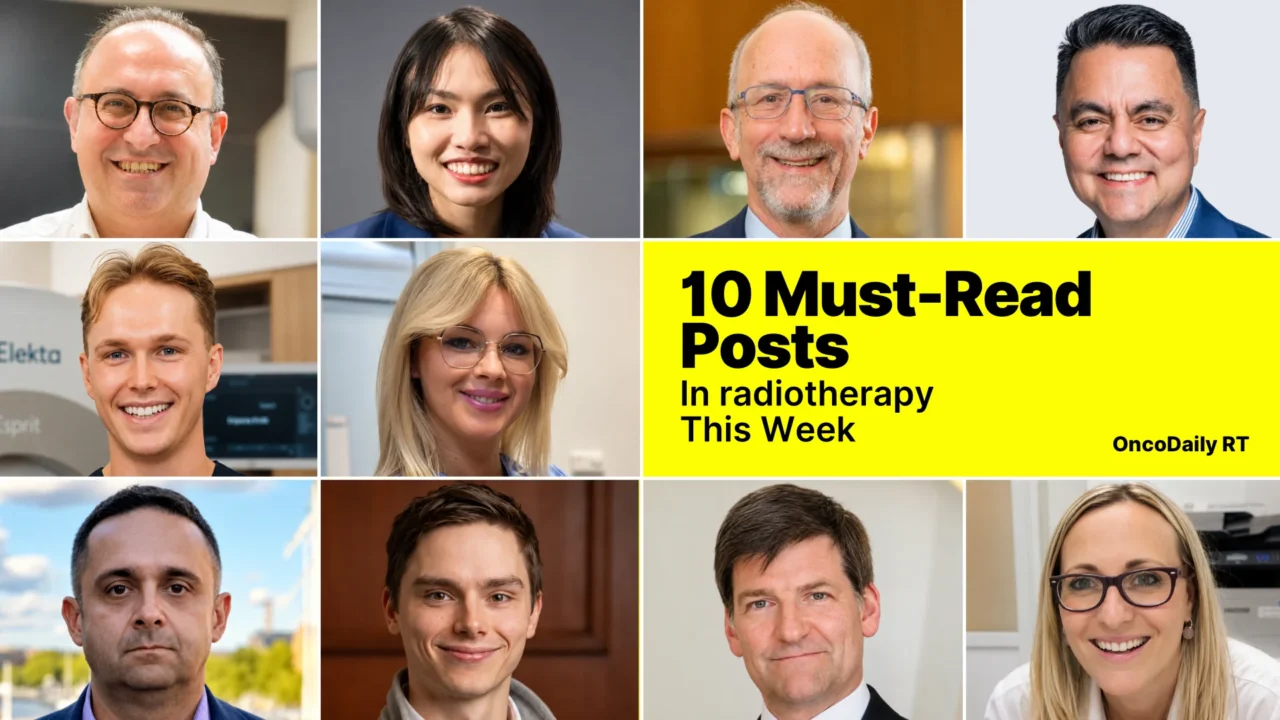
Radiation oncology had another active week with updates spanning rectal cancer trials, translational biomarkers, breast cancer radiotherapy, prostate cancer decision-making, SBRT, SRS physics, MRI-only prostate workflows, Gamma Knife implementation, SGRT training, and safety and quality initiatives.
A clear theme this week was the link between evidence, technology, and everyday clinical practice. From ARISTOTLE trial results and AI-derived tumor cell density in rectal cancer to PMRT data in HER2-positive breast cancer and discussions on elective pelvic radiotherapy in prostate cancer, the posts showed how radiation oncology continues to refine who benefits most from treatment.
Here are some radiation oncology posts worth catching up on this week.
David Sebag-Montefiore – Professor of Clinical Oncology and Health Research at University of Leeds
It is fantastic to see the simultaneous publication of two important papers arising from the Cancer Research UK (CRUK) funded ARISTOTLE phase III rectal cancer trial.
The long-term clinical outcomes are published today in The Lancet Group Lancet Oncology, alongside a translational research paper in eBioMedicine – The Lancet Discovery Science led by Zhuoyan Shen and Maria Hawkins evaluating tumour cell density (TCD) quantified using AI from samples collected from ARISTOTLE patients. https://lnkd.in/eu_3mtwX and
https://lnkd.in/eqQE2yuMKey takeaways include:
45 Gy chemoradiotherapy delivered excellent outcomes in MRI-defined high-risk rectal cancer, with low rates of loco-regional recurrence and low treatment-related toxicity.
The addition of irinotecan to concurrent chemoradiotherapy did not improve disease-free survival and was associated with increased side effects.
ARISTOTLE helped establish a high standard of care for patients with locally advanced rectal cancer through rigorous evaluation in a large, prospective Phase III trial.
The biomarker study found that patients with high tumour cell density (TCD) derived benefit from the addition of irinotecan to standard chemoradiotherapy.
These findings support further validation of AI-derived TCD as a candidate predictive biomarkerTogether, these publications highlight the critical importance of integrating discovery and translational science within clinical trials. While ARISTOTLE has helped define contemporary standards of care, the biomarker work points towards a future in which treatment can be tailored more precisely according to tumour biology.
This is a key focus of radiation research more broadly, and of the Cancer Research UK (CRUK) Radiation Research Centres of Excellence in particular. The biomarker work was supported through a RadNet network grant fostering the collaboration between
University of Leeds and UCL.A huge thank you to the teams who made this possible: the investigators and research teams across the UK, the UCL Innovative Clinical Trials Unit, Cancer Research UK (CRUK) and most importantly the patients who participated in the trial. Without their commitment and generosity, none of this would have been possible. It has been a real privilege to work alongside you all.
#RectalCancer #ClinicalTrials #Biology
#Patients #CancerResearch #PrecisionOncology #ArtificialIntelligence #TranslationalResearch #Radiotherapy
Katarina Kopčalić – Radiation Oncologist & Research Associate at Institute for Oncology and Radiology of Serbia
It was a great honor and pleasure for our team at the Institute for Oncology and Radiology of Serbia to host the distinguished Professor Elena Sperk,a radiation oncologist, from the Faculty of Medicine Mannheim, Heidelberg University, who delivered an outstanding and inspiring lecture on clinical trials.
Following the lecture, we had the opportunity to continue our discussion on this important topic, exchange ideas and experiences, and then introduce Professor Sperk to the historical heart of Belgrade.
We look forward to a fruitful collaboration, exciting joint projects, and many shared successes in the future.
Maria Carmen De Santis – Radiation Oncologist at IRCCS Istituto Nazionale dei Tumori Foundation
Today is more than a publication day.
It is not special because my name appears for the second time in #Lancet. It is special because of what this paper represents.
For years, the role of post-mastectomy radiotherapy in Breast Cancer patients has been questioned in the era of highly effective, next-generation systemic therapies. Our work provides important evidence supporting its continued value in this setting.
Let’s take a closer look at the key findings.
In this large HER2-positive, predominantly node-positive, adjuvant cohort ALTTO trial, PMRT improved locoregional control and conferred a clinically meaningful survival benefit in pN2. In the landscape of personalized treatment and growing interest in axillary de-escalation, future prospective studies are warranted to better define which HER2-positive patients with low nodal burden (particularly pN1 disease) derive meaningful benefit from PMRT.
I am deeply grateful to all the colleagues and collaborators who contributed to this work. This achievement belongs to all of us—and, most importantly, to the patients whose trust and participation make progress possible.
A heartfelt thank you to those who were truly there during the most demanding stages of the revision process, and a special thanks to Serena Di Cosimo—our collaboration has once again shown that when scientific excellence meets mutual trust and friendship, the results can make a real difference.
Carlotta Giandini Riccardo Ray Colciago Serena Di CosimoFiorenza De Rose Bruno Meduri Valentina Appierto Evandro de Azambuja Christos Sotiriou Matteo Lambertini Martine Piccart Antonella Ferro Christine Campbell Maria Grazia Carnevale Paolo VerderioPruneri Giancarlo Fondazione IRCCS Istituto Nazionale dei Tumori di Milano
#RadiationOncology #Radiotherapy #BreastCancer #HER2Positive #ClinicalResearch #BreastCancerResearch #Oncology #CancerCare #PrecisionMedicine #TheLancet
Ian Paddick – Director at Medical Physics Limited. Past President of the International Stereotactic Radiosurgery Society
I had the pleasure of giving a talk on “Variations in BED According to SRS Platform” at the Peter MacCallum Cancer Centre today. This is truly the most beautiful cancer hospital I have ever visited with extraordinary architecture which is centred around patient experience. Many thanks to Michelle Li for organising the event and to Tomas Kron and his team for the lively physics discussions.
Aleksandar Kostovski – MSc in Radiation Technology | RTT at Poliklinika MEDIKOL | ESTRO ROSQ Committee Member
I am honored and thrilled to share that I have recently joined the European Society for Radiotherapy and Oncology (ESTRO) Radiation Oncology Safety and Quality (ROSQ) Committee!
As an RTT, ensuring the highest standards of safety, precision, and quality care for our patients is at the core of everything I do.
I am incredibly excited to bring the RTT perspective to this esteemed group, joining both the long-standing committee members and fellow new additions to collaborate on impactful initiatives for the global oncology community.
A big thank you to European Society for Radiotherapy and Oncology (ESTRO) for this incredible opportunity and trust, and to my team at Poliklinika MEDIKOL for their continuous support .
I look forward to working closely with everyone on the committee, including my fellow new members Fatjona Pupuleku Kraja and Berkay Ergüney , as well as the entire ESTRO team, to advance safety and quality in our field.Here’s to new challenges, shared insights, and making a meaningful difference together!
Learn more about our backgrounds and vision for safer radiotherapy here
#ESTRO #ROSQ #RTT #RadiationTherapist #RadiationOncology #PatientSafety #HealthcareQuality
Serguei Castaneda – Medical Director at CB Oncology Partners
Today I had the opportunity to join the ASTRO Journal Club discussion focused on the editorial “Elective Pelvic Radiotherapy in Prostate Cancer: The Sunset of a Historical Practice,” alongside Dr. Carlos Vargas Moncaleano and Dr. Paula Trujillo.
The discussion centered on an important question in modern radiation oncology:
Should elective whole-pelvic radiotherapy remain standard treatment for localized high-risk prostate cancer?
The editorial reviews decades of prospective clinical evidence and concludes that elective pelvic irradiation has not demonstrated a meaningful improvement in survival or disease control for most patients, while increasing treatment-related toxicity. Instead, it highlights the importance of individualized decision-making supported by PSMA-PET imaging, accurate risk stratification, and precision medicine.
These are the kinds of multidisciplinary conversations that continue to move our specialty forward—challenging long-standing practices and ensuring that our treatment recommendations remain aligned with the strongest available evidence.
Thank you to American Society for Radiation Oncology (ASTRO) Journal Club and everyone who participated in today’s discussion.
#RadiationOncology #ProstateCancer #PrecisionMedicine #CancerCare #CBOncology
Izaak Millen – Radiation Therapist at Icon Cancer Centre Herston – Gamma Knife
Great to be a part of the go-live of Icon Cancer Centre – Australia & New Zealands new Elekta Gamma Knife at Epworth!
Thanks to Ian Paddick & Hidefumi Jokura for sharing your expertise. The entire team learnt so much.
Cem Onal – Professor and Chair at Baskent University
Pleased to share our latest publication in
ctRO – Clinical and Translational Radiation Oncology!Bone-only oligometastatic bladder cancer is a rare clinical entity. SBRT provides excellent local control. But does it truly change the course of the disease? Our multi-institutional study explores this important question.
Grateful to all my co-authors and collaborators for their outstanding teamwork and dedication. It is always a privilege to work with such an excellent group of colleagues.
Burak Tilki, Ozan Cem Güler, Pervin Hurmuz, Aysenur Elmali, Melek Nur Yavuz, Başkent Üniversitesi, Adana Başkent, Hacettepe Üniversitesi.
Jiraporn T. – Clinical Application Specialist SEA
Proud to support the clinical team at Siriraj Hospital, Thailand, during the successful AlignRT InBore training.
With the training successfully completed, the team is now ready for patient treatments using the first installation on a bore-based LINAC system in Southeast Asia.
A big thank you to the Siriraj Radiation Oncology team for their excellent collaboration. Looking forward to supporting the clinical go-live and contributing to the advancement of surface-guided radiotherapy across the region.
#AlignRTInBore #SGRT #Radiotherapy #SIRO #ClinicalTraining #CancerCare #SirirajHospital #Thailand #SoutheastAsia
Marvin Kinz – Rad Onc Fellow @ Harvard, Brigham & Dana | PhD Student in Med Phys @ Heidelberg
Our latest paper is now available online in Practical Radiation Oncology!
We developed and validated an MRI-only simulation and treatment workflow for prostate SBRT that eliminates the need for a planning CT by using a 3 T-derived synthetic CT. By cutting the simulation process down from three machines to two, this approach lowers patient burden and streamlines department logistics, all while preserving the high-field contouring precision and daily adaptive MR-guided delivery that define the SMART protocol.
Read the full open-access article hereThanks to my co-authors and the team across Brigham and Women’s Hospital, Dana-Farber Cancer Institute, Harvard Medical School, and Heidelberg University:
Jennifer Campbell, Cassandra Bullens, Jürgen Hesser, Evangelia Kaza, Yue-Houng Hu, Dianne Ferguson, Hsu Shu-Hui, Zhaohui Han, Jeremy Bredfeldt, Jonathan Leeman, Atchar Sudhyadhom, Kamal Singhrao, Ph.D.