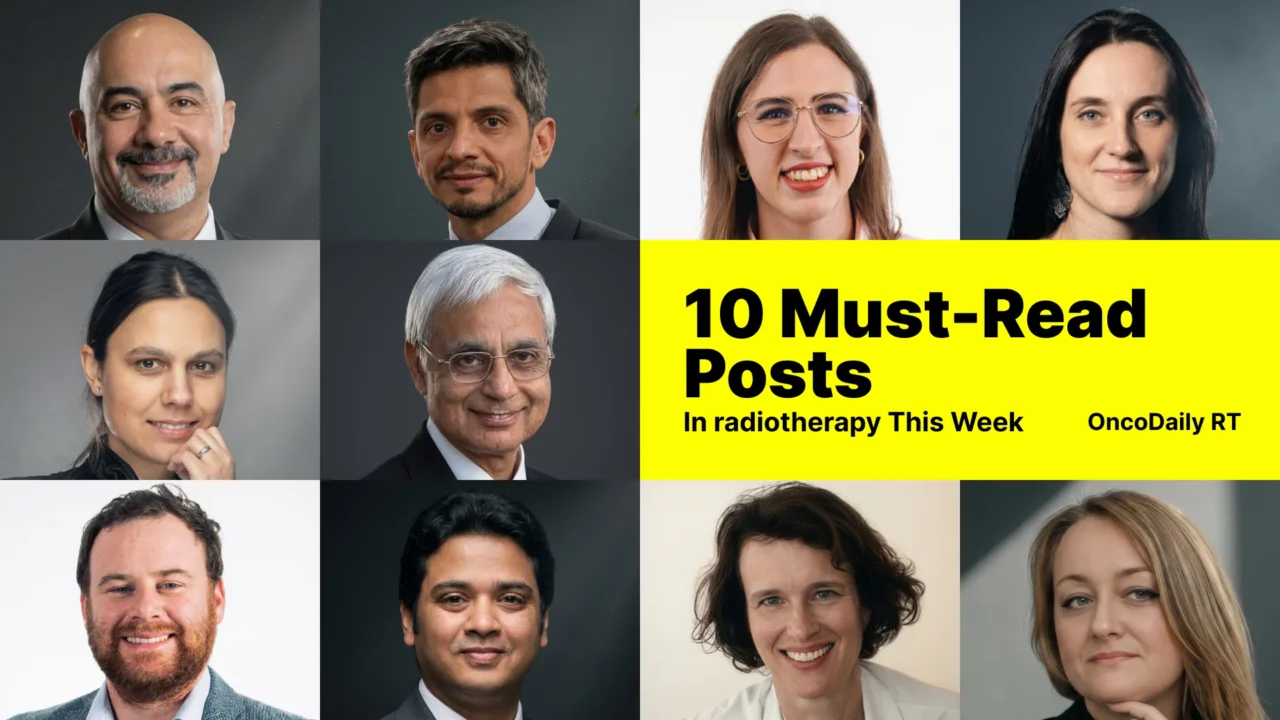
This week’s LinkedIn highlights in radiation oncology covered a wide mix of new papers, practical insights, and community updates from pediatric brain radiotherapy and meningioma imaging to brachytherapy, treatment planning, radiation safety, and international training.
A strong theme this week was precision. Several posts focused on how radiotherapy can be planned more carefully and delivered more safely, especially in complex cases. The IPANEMA protocol looks at hippocampal dose constraints in children treated with brain radiotherapy, while new work on ⁶⁸Ga-DOTA-TOC PET/CT shows how molecular imaging may improve target definition for intracranial meningiomas.
Brachytherapy also had a clear presence. Posts discussed model-based dose calculation, HDR brachytherapy for prostate cancer, and the need for better training and confidence among trainees. These updates were a good reminder that brachytherapy remains one of the most precise tools in radiation oncology, but also one that needs continued education, visibility, and practical support.
Other posts looked at the bigger picture: cumulative radiation exposure from medical imaging, conformity assessment in pelvic radiotherapy planning, and an observership program helping Ukrainian oncology professionals gain hands-on experience with modern radiotherapy workflows in Sweden.
Together, these 10 posts show a field that is moving forward in many directions at once through better imaging, safer planning, stronger training, international collaboration, and a continued focus on improving care for patients.
Anne Laprie – Radiation-oncologist at Institut Universitaire du Cancer de Toulouse-Oncopole
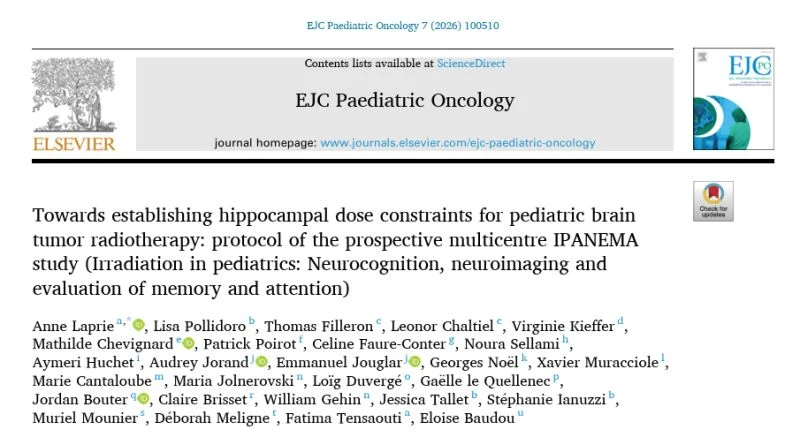
Our IPANEMA protocol is out in EJC Paediatric Oncology in open access
The question driving this work: can we define hippocampal dose constraints to protect memory in children treated with brain radiotherapy?
Cognitive sequelae affect up to 60% of pediatric brain tumor survivors. Evidence-based dose limits don’t yet exist for this population. IPANEMA — a prospective multicentre study across 13 French centres — is designed to fill that gap, combining longitudinal neuropsychological assessment and multimodal neuroimaging at 2 and 4 years post-RT.
Proud to have built this with such a committed team.
IUCT-Oncopole SFCE – cancers pédiatriques UNAPECLE – Enfants atteints de Cancer ou LEucémie ToNIC – Toulouse NeuroImaging Center and French Group of Pediatric Radiotherapy. thanks for support to Institut national du cancerRead article here
Dusanka Tesanovic – Radiology specialist / Radiation oncologist at Institute of oncology Vojvodine
I am very pleased to announce the publication of our review article in Clinical and Translational Radiation Oncology (ctRO):
“Primary adrenal insufficiency in patients with bilateral adrenal metastases treated with curative ablative radiation therapy: A comprehensive review of literature and expert agreements for radiation practice.”
I am honored to have contributed as part of this outstanding international team of authors to a paper addressing important challenges and expert recommendations in radiation oncology practice for patients with bilateral adrenal metastases.
Many thanks to all co-authors for the excellent collaboration, and special thanks to Yazid Belkacemi for the invitation, trust, and professional support.
Furqan Hashmi – Clinical Oncologist at Sultan Qaboos Comprehensive Cancer Center
Excited to share our latest publication in the journal – Annals of Nuclear Medicine:
“Integration of ⁶⁸Ga-DOTA-TOC PET/CT into Radiotherapy Planning for Intracranial Meningiomas: A Precision-Imaging Approach to Tumor Delineation.”
This work highlights the growing importance of advanced molecular imaging in modern radiation oncology, particularly the role of ⁶⁸Ga-DOTA-TOC PET/CT in improving target delineation for intracranial meningiomas. Accurate tumor definition is critical in radiotherapy planning, especially for lesions located near eloquent brain structures where precision directly impacts treatment outcomes and toxicity reduction.
A special appreciation to my colleague and friend Dr. Sharjeel Usmani from Nuclear Medicine, whose expertise and dedication in molecular imaging and theranostics were instrumental in this collaborative work. His contributions continue to strengthen the bridge between Nuclear Medicine and Radiation Oncology, advancing precision-based cancer care.
This study reinforces how hybrid imaging techniques are reshaping radiotherapy planning and enabling more individualized treatment strategies for patients with complex intracranial tumors.
Article link
Madan Rehani – Global Leader in Medical Radiation Protection, Pioneering Expert in Patient Radiation Safety, Harvard Professor
Honored to share my paper published in the ICRP 2023 Proceedings. Large-scale multicenter studies are revealing a sobering reality: millions of patients globally are accumulating cumulative effective doses ≥100 mSv annually from CT, fluoroscopically guided interventions, and PET/CT — and even the best available justification and optimization tools have reached their limits. This is an unprecedented moment in the history of medical imaging, and it demands collective action from clinicians, physicists, professional societies, industry, and regulatory bodies.
Pubmed link
Georgina Fröhlich – Medical Physicist Expert at National Institute of Oncology Centre of Radiotherapy
BRACHYTHERAPY FRIDAY #6
In an era of rapidly evolving oncological treatments, brachytherapy continues to stand out as a highly precise, evidence-based modality with proven clinical impact.
I am launching a weekly initiative across 20 consecutive Fridays to highlight
ongoing innovations and share emerging scientific insights — because
brachytherapy is the coolest discipline in modern radiation oncology.Stay tuned for new data, insights, and real-world experience.
Does model-based dose calculation have impact to dose distribution in brachytherapy?
– Using model-based dose calculation algorythm in dose calculation, significantly lower dose is shown on the surface of the Ir-192 source only, compared to the TG-43 algorithm.
– It results smaller high dose volumes, which has no clinical significance in bronchus and cervix brachytherapy.
– The observed small differences in the dose-volume parameters also do not cause any clinical consequences, although the calculation time is longer with the model-based dose calculation, so further investigations are needed to clarify the role of advanced model-based dose calculation algorithms in routine clinical brachytherapy.
Levent Gönültaş – Medical Physicist at Ankara Yıldırım Beyazıt Üniversitesi
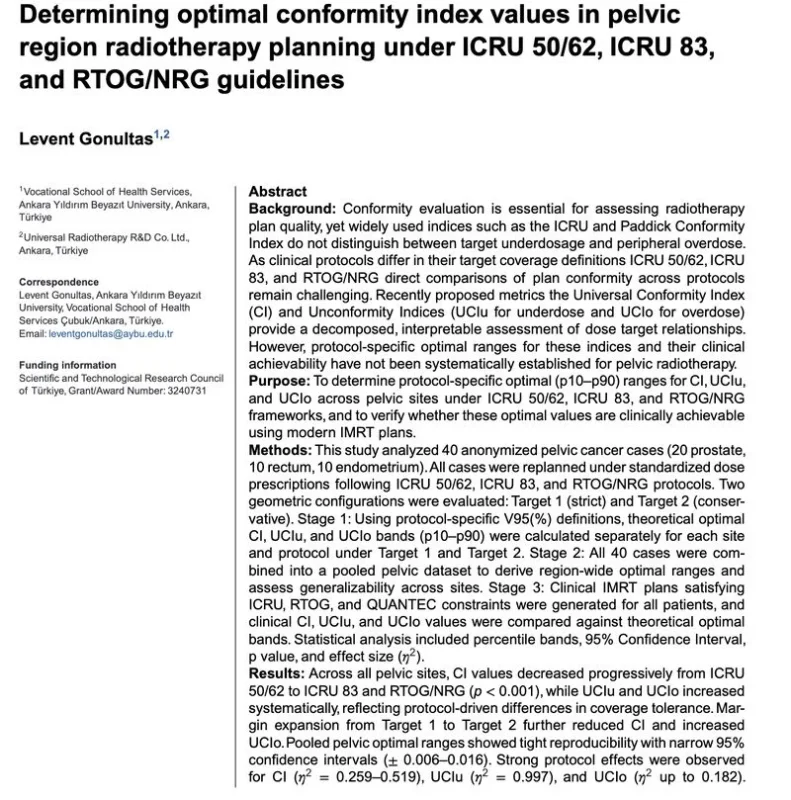
I am delighted to share that our paper, “Determining Optimal Conformity Index Values in Pelvic Region Radiotherapy Planning under ICRU 50/62, ICRU 83, and RTOG/NRG Guidelines”, has been accepted for publication in the Journal of Applied Clinical Medical Physics (Q2).
Conformity evaluation plays a critical role in radiotherapy plan quality assessment, yet direct comparisons across different planning protocols remain challenging. In this study, we established and clinically validated protocol-specific optimal ranges for the Conformity Index (CI), Underdose Unconformity Index (UCIu), and Overdose Unconformity Index (UCIo) across pelvic radiotherapy plans based on the ICRU 50/62, ICRU 83, and RTOG/NRG frameworks.
By combining theoretical modeling, pooled pelvic analysis, and clinical IMRT validation, we demonstrated that these indices provide robust and reproducible benchmarks for evaluating target coverage and dose spill. The proposed optimal ranges may facilitate standardized conformity assessment, improve cross-protocol comparability, and contribute to the development of future quantitative radiotherapy planning guidelines.
I would like to thank all colleagues and collaborators who contributed to this work.
Nataliya Kovalchuk – Clinical Professor at Stanford School of Medicine/Stanford Hospital
🇺🇦 Observership Completed – Bukovynian Clinical Oncology Center 🇺🇦
Help Ukraine Group (HUG) is delighted to announce the successful completion of the observership for the multidisciplinary team from Bukovynian Clinical Oncology Center at Akademiska sjukhuset in Uppsala, Sweden, held from May 20–29, 2026. In addition, the team attended European Society for Radiotherapy and Oncology (ESTRO) 2026 Congress in Stockholm.
The team:
• Marta Popova – Radiation Oncologist
• Вадим Перко – Medical Physicist
• Mariia Bezerko – Radiation Therapist (RTT)During the observership, the team gained valuable experience in modern radiotherapy workflows, treatment planning, quality assurance, image guidance, patient positioning, and multidisciplinary collaboration. Their participation in ESTRO 2026 further expanded opportunities for learning, networking, and exposure to the latest advances in radiation oncology.
Reflecting on the experience, the team shared that the observership was an incredibly valuable and inspiring opportunity that provided new knowledge, ideas, and professional connections that will help advance radiotherapy services at their institution. They expressed deep appreciation for the openness, professionalism, and willingness of the Akademiska team to share their expertise.
We extend our sincere gratitude to the outstanding team at Akademiska sjukhuset for their warm welcome, generosity, and commitment to supporting Ukrainian oncology professionals. Your mentorship and dedication continue to make a meaningful impact on cancer care in Ukraine.
We also thank Swecare, U.S. Department of Energy National Nuclear Security Administration (NNSA)’s Office of Radiological Security (ORS), and Pacific Northwest National Laboratory (PNNL) for making this program possible, and Viktor Iakovenko, Ph.D. for his assistance with the selection process.
We look forward to seeing the knowledge and experience gained during this observership translated into improved patient care and continued modernization of radiotherapy services in Ukraine.
Together, we are building stronger cancer care through education, collaboration, and international partnership
Maria Chiara Lo Greco – Radiation Oncologist, PhD fellow at Ghent University
I am very happy to share our latest publication, result of an inspiring collaboration with the Euro-Ewing Consortium.
I am extremely grateful to all colleagues that were involved in this project and gave their precious contribution
Hertsyk Volha
Sarah Kelly
William Starbuck – MedTech. Clinical Excellence. Commercial Strategy. Sales Growth and Impact
To my LinkedIn community and friends.
Looking forward to the ISRS Congress in Sydney, taking place from 31 May to 3 June 2026.
With the theme “Vivid Horizons: Illuminating the Future of Radiosurgery,”
it’s a great opportunity to connect with colleagues, exchange ideas, and contribute to shaping the future of radiosurgery.Come by the Elekta booth, would love to see you.
Hathal Haddad – Head of Interventional Radiotherapy Unit at Universitätsklinikum Tübingen
New Series: Increasing Awareness of #Interventional_Radiotherapy (#Brachytherapy)
Episode 1 — Prostate Cancer Treatment, HDR Brachytherapy: Monotherapy & Boost#Interventional_Radiotherapy (#Brachytherapy) remains one of the most precise, effective, and underutilized treatment modalities in radiation oncology. Through this series, I aim to bring its science, techniques, and clinical evidence closer to colleagues, trainees, and patients alike.
Today’s focus: A landmark 2026 paper by Taggar et al. — an AMERICAN BRACHYTHERAPY SOCIETY (ABS) -endorsed competency framework for prostate HDR brachytherapy.
As Monotherapy (low & favorable intermediate-risk PCa):
Dose regimens from 6 Gy × 9 to 13.5 Gy × 2, achieving EQD2 of 116–128 Gy — with PSA-PFS rates of 88–100% at 3–5 years.
As Boost + EBRT (intermediate & high-risk PCa):
9.5–11 Gy × 2 or 15 Gy × 1 combined with 46 Gy/23 fx EBRT — significantly improving long-term disease control over EBRT alone.The framework covers 4 key competency domains:
Pre-procedural evaluation & patient selection
Applicator placement & treatment delivery
Treatment planning, DVH & dose constraints
Quality assurance & postprocedural careA recent scoping review found that average confidence and technical proficiency in HDR prostate brachytherapy was less than 50% among trainees globally — this framework is a step in the right direction.
Full paper