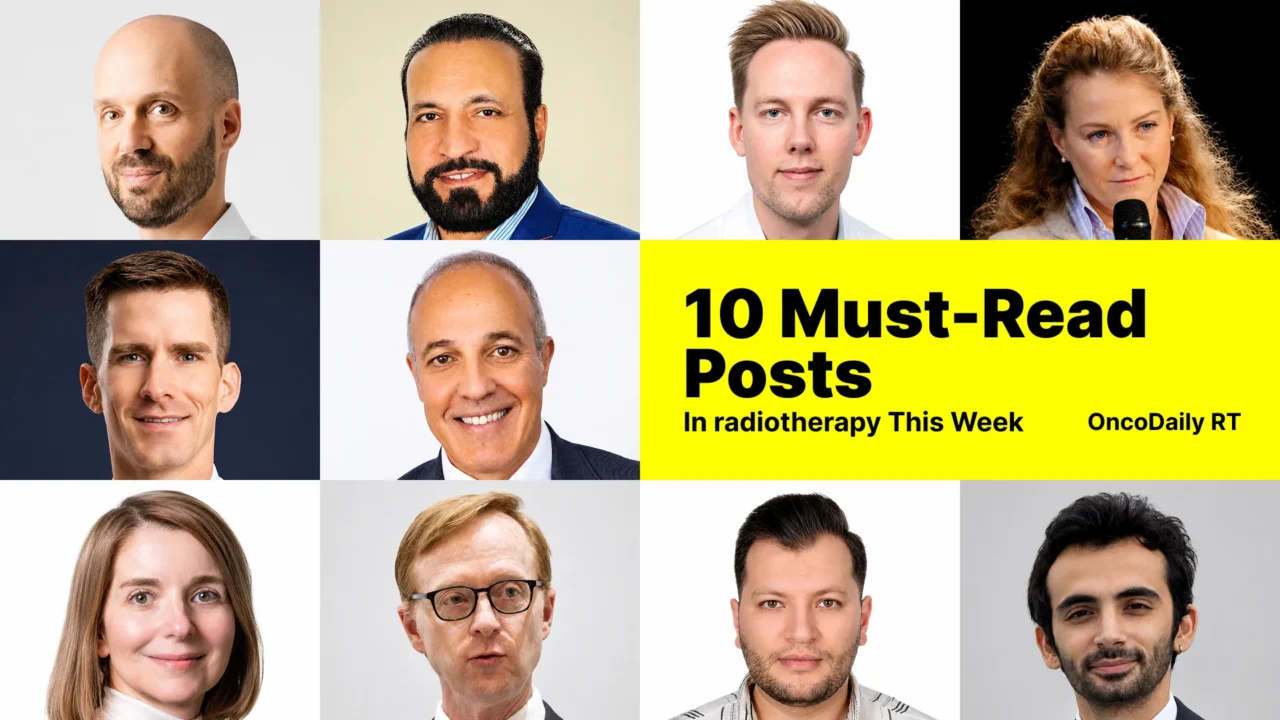
Radiation oncology had a very rich week on LinkedIn, with posts moving across several important layers of the field: new consensus guidance, long-term trial data, technical innovation, education, global advocacy, and the growing role of data science.
One of the major highlights was the publication of an international consensus on reirradiation for recurrent head and neck squamous cell carcinoma in The Lancet Oncology, endorsed by ReCOG, the ESTRO Reirradiation Focus Group, and ASTRO. The week also included updates on World Radiotherapy Awareness Day, AMSTRO’s regional advocacy efforts, long-term randomized data in high-risk low-grade glioma, compact proton therapy systems, focal boosting in prostate cancer, IGABT training in Vienna, TomoTherapy education, and radiomics and machine learning studies presented at iARTIST 2026.
Together, these posts reflect how broad radiation oncology has become: a field where clinical decision-making, technology, physics, education, survivorship, and access all meet.
Here are the radiation oncology posts worth catching up on this week.
Pierre Blanchard – Editor-in-chief at Radiotherapy and Oncology
Reirradiation for recurrent head & neck squamous cell carcinoma — new international consensus, out now in #TheLancetOncology.
Reirradiation is one of the toughest calls in radiation oncology: few therapeutic options, a narrow therapeutic ratio, and wildly variable practice across centres. The rise of modern conformal techniques — IMRT, proton therapy, SBRT — has expanded what’s feasible, yet the role of reirradiation has remained poorly defined.
So we built a shared framework. Endorsed by three scientific societies: the Reirradiation Collaborative Group (ReCOG), the ESTRO Reirradiation Focus Group, and the American Society for Radiation Oncology (ASTRO).
Drawing on an extensive literature review and a formal voting process, we propose 31 practical recommendations spanning:
patient selection
imaging & target delineation
treatment planning & dose accumulation (EQD2)
organ-at-risk constraints & toxicity management
24 of them (77%) reached a high level of consensus.Some genuine clinical uncertainty where research is needed.
Huge thanks to all co-authors and collaborators for this collective effort.
Open access author link
Or permanent link
cc Julian Biau Arnaud Beddok MD PhD Manju S. Nauman Malik sarbani ghosh-laskar Jon Cacicedo Fernandez de Bobadilla Anna Embring Sandra Nuyts Charles Mayo Kelly Paradis, PhD DABR Matthew Ward Pierluigi Bonomo Gregory Gan DR AMIT BAHL Panagiotis Balermpas Melvin L.K. Chua Aron Popovtzer Charles B Simone Eliana Vasquez Osorio Sue Yom
#RadiationOncology #HeadAndNeckCancer #Reirradiation #ReCOG #ESTRO #ASTRO
Nadeem Pervez – Radiation Oncologist MBBS, FFRRCSI, FRCPC, MSc. Karachi Division, Sindh, Pakistan
AMSTRO – WRAD
The Asia and Middle East Society of Therapeutic Radiation and Oncology (AMSTRO) is honored to be recognized by World Radiotherapy Awareness Day (WRAD).Radiotherapy plays a vital role in improving cancer outcomes, and AMSTRO-ASTF Network is proud to support efforts that advance awareness of and access to high-quality radiation oncology care across our region.
We sincerely thank the WRAD team for sharing this memorable moment and for their continued dedication to highlighting the life-changing impact of radiotherapy worldwide.
Sandra Turner Dr Katie Wakeham Darien Laird Lucinda Morris Michelle Leech Sarah Quinlan MBE
#WRAD
#ASTF
#WorldRadiotherapyAwarenessDay #Radiotherapy #RadiationOncology #CancerCare #AMSTRO #Oncology #CancerAwareness
Brigitta G. Baumert – Radiation-Oncologist and clinical investigator at HMC (Haaglanden Medisch Centrum)
We are proud to present our long-term data from an international randomized trial involving patients with high-risk low-grade glioma, featuring a median follow-up of 13 years. This trial is notable for being the first to integrate molecular features as a stratification factor.
The long-term results indicate that these molecular features, as revealed through post-hoc subgroup analysis, play a crucial role in determining clinical outcomes. Patients were randomized to receive either radiotherapy or temozolomide alone.
Our findings are unique, as they enable a focus on specific molecular subtypes that exhibit distinct natural histories and responses to treatment. Importantly, our study demonstrates that the sequence of chemotherapy or radiotherapy does not have an overall effect on outcomes; rather, it is the molecular features that matter.
Additionally, our data do not support the age cutoff of 40 years as a high-risk feature for IDH-mutant low-grade glioma, excluding IDH wild-type grade 2 glioma. This raises questions that warrant further investigation.
Peter Jermain – Medical Physicist at Inova Schar Cancer Institute
Excited to share our latest article published in PMB!
Despite its advantages, widespread clinical adoption of proton therapy has been limited by high costs & large size of the equipment (particularly the 100+ ton gantry).
To improve affordability & accessibility, compact proton systems have been developed with innovative patient positioners and 3D volumetric imaging. In this work, we investigated treatment planning strategies for both supine and upright-seated CNS patients using the compact proton beamline design!
Thomas Willigenburg – Resident (AIOS) Radiation Oncology | MD PhD | Clinical Epidemiologist at UMC Utrecht
Focal boosting in prostate cancer radiotherapy is hot!
Our new paper ‘How to focal boost in prostate cancer radiotherapy: ESTRO clinical practice consensus recommendations’ is out now in Radiotherapy and Oncology!
Focal boosting in prostate cancer has already shown promising outcomes, resulting in improved oncological outcomes while preserving the low side effect rates of our radiotherapy treatments.
Together with a group of international prostate cancer radiotherapy experts, we aimed to provide a set of clinical and technical recommendations to support the integration of focal boosting in prostate cancer into current day clinical practice.
The recommendations cover the following topics:
– Patient selection for focal boosting;
– Definition and delineation of the Gross Tumour Volume (GTV) for focal boosting;
– Planning and treatment techniques to deliver a focal boost;
– Image guidance and motion management during focal boostingFind the full paper here
Jochem van der Voort van Zyp
Alison Tree
Cédric Draulans
Floris (Jop) Pos
Isabel Syndikus
Ann Henry
Monica Buijs, MSc
Barbara Jereczek-Fossa
Simon Spohn
Tobias Pommer
Bradley Pieters
Adam Mitchell
Tyler Seibert
European Society for Radiotherapy and Oncology (ESTRO)
Sandro V Porceddu – Director, Department of Radiation Oncology, Professor, University of Queensland and University of Melbourne
It was a privilege to provide Deputy Premier of Victoria the Honourable Ben Carroll a tour of the Peter MacCallum Cancer Centre Department of Radiation Oncology and explain the importance of #radiationoncology as a cancer treatment modality. We are also a Trans Tasman Radiation Oncology Group (TROG Cancer Research) alliance facility conducting world leading clinically-based research.
Elena Dizendorf – Director Medical Science Brachytherapy and BrachyAcademy at Elekta
More than 18 years ago, Professor Richard Pötter of the Medizinische Universität Wien, one of the pioneering institutions in MRI-based image-guided adaptive brachytherapy (IGABT) for cervical cancer, proposed organizing clinical workshops in collaboration with Nucletron.
These 2-day workshops, designed for small groups, combine theoretical and practical training in IGABT, with a particular focus on combined intracavitary/interstitial brachytherapy. Over the years, they have evolved into a long-standing peer-to-peer educational program that has supported the international implementation of IGABT.
The workshop curriculum includes lectures, hands-on training, live case observation, and profession-specific breakout sessions. In addition to MRI-guided brachytherapy, we also cover CT-based brachytherapy and the role of transrectal ultrasound.
Since July 2008, 31 in-person workshops have been held in Vienna with the support of the Nucletron/Elekta BrachyAcademy. The latest workshop, held on June 29-30, 2026, welcomed 20 radiation/clinical oncologists, medical physicists, and radiographers from 10 hospitals across the UK, Italy, the Czech Republic, Israel, Germany, the United States, India, and Japan.
We are delighted that this edition received an outstanding participant satisfaction score of 9.4/10.
My sincere thanks to the faculty of the 31st workshop: Alina Sturdza, Nicole Eder-Nesvacil, Christian Kirisits, Primoz Petric, Maximilian Schmid, Vincent Dick, and Aleksandra Winkler. I would also like to express my gratitude to the entire brachytherapy team in Vienna, as well as Dragan Misimovic, Stéphanie Van Der Kolk, Wilma Mekking, and Evangelos Prionas, whose dedication and support were essential to the success of the workshop.
If you are interested in attending a future workshop, please contact the BrachyAcademy. We look forward to welcoming you to Vienna.
Pavlos Papaconstadopoulos, Ph.D. Sinead Calvert Alejandra Zepeda Echavarria
Mahmoud Nasif – Clinical Medical Physicist at MEDKO ONCOLOGY
What if you truly understood every parameter behind TomoTherapy?
Every day, thousands of cancer patients are treated using TomoTherapy systems around the world.
Many healthcare professionals know how to operate the system.
Far fewer truly understand why it works the way it does.Why is radiation delivered helically?
Why does TomoTherapy use a Binary MLC instead of a conventional MLC?
How do Pitch, Modulation Factor, and Field Width influence dose distribution?
Why was MVCT integrated into the treatment workflow?
What really happens inside the machine—from the moment electrons are accelerated until the prescribed dose reaches the patient?These questions inspired this educational series.
Not to explain what TomoTherapy does…
But to understand why every component exists, how every parameter influences treatment quality, and how physics becomes better patient care.Throughout this series, we’ll explore one concept at a time, connecting:
Fundamental Physics
Engineering Design
Clinical Practice
Treatment Planning & Dosimetry
Quality Assurance
Practical Tips & Common MisconceptionsWhether you’re a Medical Physics student, resident, clinical medical physicist, radiation oncologist, radiation therapist, or simply passionate about radiation oncology…
I hope this series becomes a valuable educational resource throughout your professional journey.
If you believe more professionals should understand the science behind TomoTherapy…
Share this post with your colleagues.
Follow my profile to join the journey.
And tell me in the comments:
Which TomoTherapy topic would you like us to explore first?This is only the beginning.
Welcome to TomoTherapy from A to Z.
Next Episode
The Problem Wasn’t the Machine.
We’ll discover the clinical challenge that led to the birth of TomoTherapy—and why changing the way radiation is delivered changed radiation oncology forever.TomoTherapy from A to Z
Episode 00 of the Educational Series
—Mahmoud Nasif
Medical Physicist
Jeff White – Director of PR & Strategic Communications: ASTRO American Society for Radiation Oncology
Proud to be an author on this paper & part of the planning team for World Radiotherapy Awareness Day.
There is so much for people to know & understand about today’s RT for cancer and other conditions. So many advances.
Emre Uysal – Radiation Oncology & Data Science & Biostatistics
The International Advanced Radiotherapy Techniques Symposium (iARTIST 2026), held in Istanbul this week, brought together experts from different countries to discuss current developments and future directions in radiation oncology.
I was pleased to contribute to four studies that were selected for oral presentation:
• PET/CT radiomics-based survival prediction in locally advanced esophageal cancer
• MRI radiomics and machine learning for predicting ISH status in HER2-equivocal breast cancer
• Machine learning–based prediction of local recurrence in laryngeal cancer
• Dose–volume predictors of severe lymphopenia during radiotherapy for rectal cancerAlthough these studies focus on different clinical questions, they share a common theme: the use of radiomics, machine learning, and quantitative data analysis to improve decision-making in radiation oncology.
It was a valuable opportunity to present our work, discuss ongoing challenges, and learn from colleagues working in different areas of cancer research and radiotherapy.
Thank you to the Scientific and Organizing Committees of iARTist 2026 for an excellent meeting, and special thanks to Banu Atalar for her efforts in organizing such a successful international symposium.
Mert Hacı Dertli
Talar Ozler
Volkan Demircan#iARTist2026 #RadiationOncology #Radiomics #MachineLearning #ArtificialIntelligence #CancerResearch