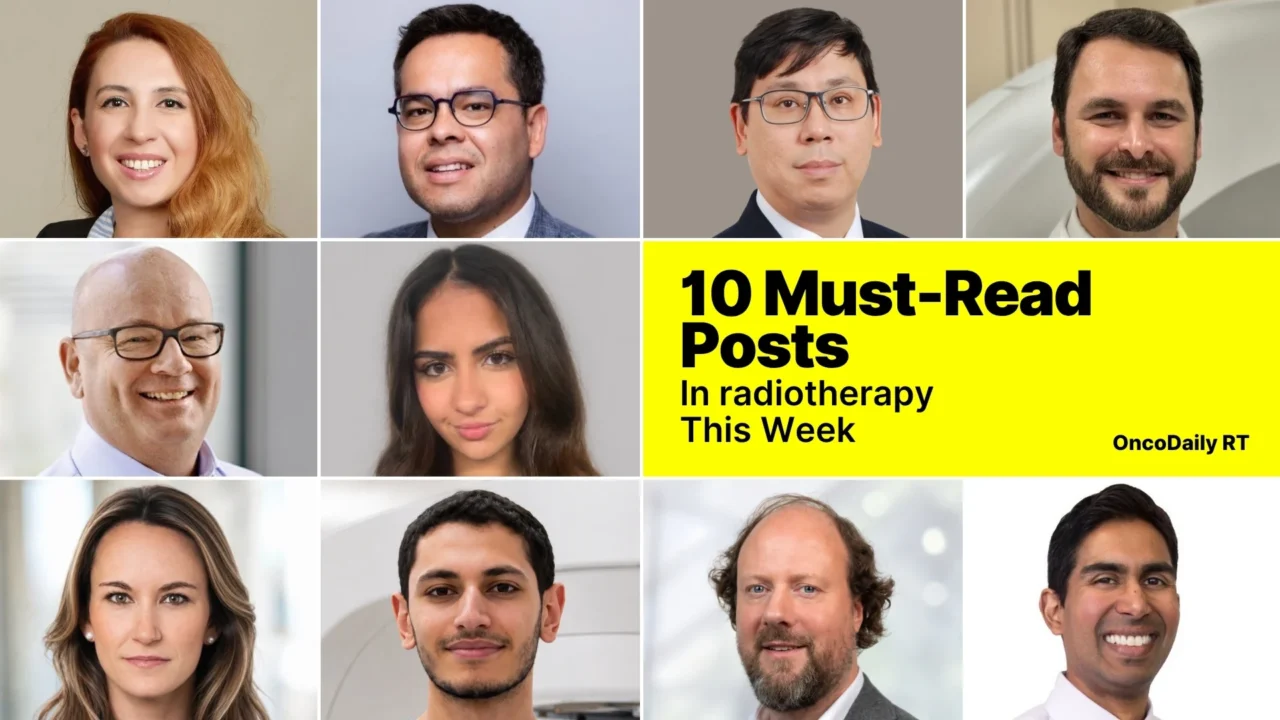
Radiotherapy had another active week on LinkedIn, with updates across glioblastoma, small cell lung cancer, breast cancer, theranostics, pediatric radiotherapy, fellowship training, linac engineering, and precision radiotherapy.
One important theme was the value of asking difficult clinical questions.
The Dutch phase III GOLD trial tested whether radiotherapy for glioblastoma could be shortened from six weeks to two weeks. The shorter schedule did not show non-inferiority, reminding us that negative trials are still essential for patient care.
Another discussion focused on brain-only progression in extensive-stage small cell lung cancer, and whether selected patients may benefit from treating the CNS while continuing an effective systemic treatment.
Other posts highlighted radiotherapy after neoadjuvant chemotherapy in breast cancer, theranostics, pediatric radiotherapy, hands-on linac training, and reflections on how modern radiotherapy combines flexibility with precision.
Together, these updates show a field that is still questioning, testing, learning, and improving.
Here are some radiation oncology posts worth catching up on this week.
Joost Verhoeff – Professor en Head of department Radiotherapy Amsterdam UMC
Can we shorten radiotherapy for glioblastoma from 6 weeks to just 2 weeks?
That was the question behind our Dutch national randomized phase III GOLD trial.
We compared an experimental schedule of 6 × 6 Gy combined with temozolomide with standard 30 × 2 Gy chemoradiotherapy, using a non-inferiority design.
The answer is clear: the shorter schedule failed to demonstrate non-inferiority to standard treatment.
Negative trials matter. Shorter treatment can substantially reduce the burden for patients and healthcare systems, but only if we can maintain outcomes. GOLD shows that, for fit patients with glioblastoma, 6 × 6 Gy cannot replace the current standard.
Proud of the patients, investigators and collaborating centers who made this important trial possible.
#Glioblastoma #Radiotherapy #NeuroOncology #ClinicalTrials #RadOnc
Fabio Ynoe de Moraes – Radiation Oncologist MD, PhD at Faculdade de Medicina da Universidade de São Paulo
Very happy to see our new editorial published in the Journal of Clinical Oncology (JCO): ASCO
“Brain-Only Progression After First-Line Therapy in Extensive-Stage Small Cell Lung Cancer: Treat the Sanctuary, Preserve the Backbone.”The clinical question is simple, but important:
When the brain progresses but extracranial disease remains controlled, does the entire systemic strategy need to change?
Perhaps not.
The emerging data suggest a different way of thinking about brain-only progression in extensive-stage SCLC: isolated CNS progression may represent sanctuary-site failure rather than global systemic treatment failure.
In selected patients, treating the brain with radiotherapy while preserving an otherwise effective systemic backbone may therefore be a reasonable strategy.Our key message:
Treat the sanctuary. Preserve what is still working.
Of course, retrospective evidence is not enough to settle the question. Prospective studies are needed, particularly as new systemic agents with greater intracranial activity enter the SCLC landscape.
Congratulations to Yuchen Li and Lilian Faroni — a pleasure working together on this clinically relevant discussion.#LungCancer #SCLC #RadiationOncology #MedicalOncology #BrainMetastases #JCO #CancerResearch
Tugce Kutuk – Physician at Ohio State University Comprehensive Cancer Center
Excited to share our latest review on radiation management after neoadjuvant chemotherapy in breast cancer!
We summarize the latest evidence, evolving guidelines, and ongoing clinical trials shaping personalized radiotherapy after NAC, including the impact of the NSABP B-51/RTOG 1304 trial and emerging de-escalation strategies.
Grateful to my co-authors and mentors for this work. Looking forward to continued progress toward more personalized breast cancer care. Marshall Harrell, MD Sachin Jhawar
#BreastCancer #RadiationOncology #ClinicalResearch #PrecisionMedicine #Oncology #radonc #cancer #radiotherapy #chemotherapy #meded #ohiostateuniversity
Aadel Chaudhuri – Professor | Founder | Editor | Physician-Scientist | Radiation Oncologist | Liquid Biopsy Researcher at Mayo Clinic
Grateful to host Ravi Patel as a Visiting Professor here at Mayo Clinic Department of Radiation Oncology. We loved learning about theranostics, radiopharm, importance of the tumor microenvironment, and XRT / IO strategies from you!
Hana Elmowafy – Engineering Intern at Siemens Healthineers
I’m excited to share that I’ve joined Varian, a Siemens Healthineers company, as an Engineering Intern in Egypt.
Over the coming weeks, I’ll be working alongside engineers supporting advanced radiation therapy systems, gaining hands-on exposure to linear accelerators, RF systems, and the technologies behind precision cancer treatment.
I’m excited to deepen my understanding of advanced radiation therapy technologies and the engineering behind precision cancer treatment.
Grateful for this opportunity and excited for what’s ahead.
#Varian #SiemensHealthineers #Engineering #MedicalTechnology #RadiationOncology #Internship
Belén Navarro-Rubio – Radiation Oncologist at UT MD Anderson
Everything I know how to do, I learned at Clínica Universidad de Navarra. My residency. Then a staff position. A good contract, a title, brilliant colleagues, and one of Spain’s finest institution in Cancer Research and Care to call home.
I resigned to become a trainee again. In Houston. 4,700 miles from home.
Everyone asked me the same thing: “You already made it. Why start over?”
Not because CUN had run out of things to teach me. Because it had taught me enough to know what I was still missing.One month into the Complex Radiation Oncology Fellowship at UT MD Anderson:
→ Cases most centers never see once, I see weekly
→ What a leading European cancer center sees in a month, we see in a week
→ Reirradiation decisions where the margin for error is a few millimeters
→ A tumor board where my confident answer gets pressure-tested in real timeAnd here’s what nobody tells you about leaving a good job in radiation oncology to train again:
The hardest part isn’t the move, or the hours, or starting over as the least experienced person in the room.
It’s accepting that being good was never going to be enough.
Our patients don’t get a second attempt. They arrive with one disease, one body, one chance at the right decision — and they are entitled to a physician who has done everything possible to be ready for it. Who reads the trial before it changes practice. Who has seen the difficult version of their case before, not just the textbook one.
That’s not ambition. That’s the minimum the job asks for.
Michael Chen – Radiation Oncologist, Paediatric Radiotherapy Consultant at Grupo de Apoio ao Adolescente e à Criança com Câncer
Long post alert, but no #AI involved!
Three days that were truly worth it:
– returning to #CasadeArnaldo after decades (!) away to give a talk alongside the biggest names in #Pediatric #Radiotherapy;
– seeing the work you helped build start to flourish, specifically at the #AnchorCenter at #HCFMUSP, right here in your home country;
– engaging in high-level discussions with colleagues from around the world about advanced radiotherapy techniques and, why not, #protontherapy?;
– reconnecting with friends made through the partnerships your work has fostered!
Thank you to everyone who entrusted us with the task of sharing our experience, questions, and insights about the best to offer to #cure #cancer!
Omar (AbdelAziz) Elnekidy – LINAC Field Service Engineer at Siemens Healthineers / Varian
Every experience is an opportunity to grow, and I’m grateful for this important milestone early in my journey as a Field Service Engineer with Siemens Healthineers .
Working hands-on with the Varian Clinac Linear Accelerator has been an invaluable experience, strengthening my technical knowledge and problem-solving skills while reinforcing the importance of teamwork and continuous learning.
A sincere thank you to Pedro Patrício for sharing your expertise, guidance, and encouragement throughout the journey. Your experience and practical insights made a lasting impact.
I’m also grateful to my teammates Ali Mohamed , Mehdi DAHANI , Kareem Arafa , and youssef Awad. It was a pleasure learning and collaborating with such a dedicated group.
Looking forward to applying these experiences in the field and continuing to grow professionally.
#SiemensHealthineers #Varian #FieldServiceEngineer #LinearAccelerator #Radiotherapy #BiomedicalEngineering #ContinuousLearning
Jochen Schmitz – Chief Financial Officer (CFO) & Managing Board Member at Siemens Healthineers
Financial results from Q3 are in. We showed great order momentum. Our synergetic core of Imaging and Precision Therapy was robust on both top and bottom lines. Due to the revenue weakness in Diagnostics we are decreasing our comparable revenue growth outlook while raising the adjusted basic EPS outlook by the amount of tariff refunds.
Revenue grew by 2.8% on a comparable basis to €5.8 billion after a very strong prior-year quarter (7.6%). Adjusted EBIT in the third quarter was €1.1 billion; adjusted EBIT margin was 19.1%. Tariff refunds had a positive effect on all segments, on the very high free cash flow of €1.0 billion, and on adjusted basic earnings per share of €0.70.
Details from our segments: 𝗜𝗺𝗮𝗴𝗶𝗻𝗴 comparable revenue growth of 2.3%; adjusted EBIT margin of 26.5%. 𝗣𝗿𝗲𝗰𝗶𝘀𝗶𝗼𝗻 𝗧𝗵𝗲𝗿𝗮𝗽𝘆 comparable revenue growth of 9.2%; adjusted EBIT margin of 17.5%. These two segments form our synergetic core, which had 5% revenue growth. 𝗗𝗶𝗮𝗴𝗻𝗼𝘀𝘁𝗶𝗰𝘀 comparable revenue declined by 5.5%, adjusted EBIT margin was 4.1%.
We had an outstanding equipment book-to-bill ratio of 1.27 with customers continuing to rely on our portfolio to care for their patients. We’re expanding our 35-year relationship with Cleveland Clinic through a new 10-year, strategic alliance, and have entered a multi-year, $87-million Value Partnership with Vanderbilt University Medical Center. Together, we foster clinical and workflow innovation that further enhances patient care and operational efficiency across the health system. Thanks to #TeamHealthineers for bringing our strengths in Patient Twinning, Precision Therapy, and Healthcare AI to life!
Also worth highlighting: We expect revenue of our radiopharmaceuticals business to surpass $1billion this year. Varian is expanding its global #1 position with continued innovation momentum. Preparations for deconsolidation by Siemens AG are advancing well.
𝗢𝘂𝘁𝗹𝗼𝗼𝗸: Primarily as a result of the performance of the Diagnostics segment in terms of revenue as well as the impact of refunds of tariffs imposed under the U.S. International Emergency Economic Powers Act (IEEPA) on adjusted basic earnings per share, we update our outlook for fiscal year 2026. We now expect comparable revenue growth between 3.5% and 4.0% over fiscal year 2025 (previously between 4.5% and 5.0%). For adjusted basic earnings per share, we now expect a range of between €2.35 and €2.45 (previously between €2.20 and €2.30).
Victor Goulenko – Physician at Instituto Estadual do Cérebro Paulo Niemeyer
I’ve just been in Switzerland with my son for a soccer tournament. While we were walking around the shops, I realized there are two things the Swiss are famous for that remind me of radiation oncology: the Swiss Army knife and the Swiss watch.
Riccardo: Let me guess… versatility and precision?
Victor: Exactly! As we’ve been discussing, the use of radiation is increasing, and we now treat conditions beyond cancer.
Like a Swiss Army knife, our technology has evolved into a platform with multiple tools. Modern treatment systems can capture onboard images, deliver photons or electrons, perform stereotactic treatments, adapt the plan to the patient’s anatomy, and shape the radiation beam with incredible flexibility. The challenge is choosing the right tool for each patient.
Riccardo: Versatility is important, but we also need precision to deliver treatment exactly where it is needed. The better our imaging becomes, the more accurately we can define the target. We also have sophisticated techniques to account for patient and tumor motion. In lung cancer, for example, we can monitor respiratory motion, incorporate it into treatment planning, and even synchronize radiation delivery with breathing. Precision isn’t just about hitting the target; it’s also about avoiding everything around it.
Victor: Medicine as a whole is becoming more precise. Surgery, chemotherapy, immunotherapy, and targeted therapies are becoming more personalized, and radiation has to evolve alongside them.
Every patient has unique anatomy, a unique disease, and distinct treatment goals. Our job is to select the right combination of technologies, choose the right “Swiss Army knife” tools, and then deliver treatment with the precision of a Swiss watch.
Riccardo: I like that analogy. One gives us flexibility, and the other gives us accuracy. Together, they capture what modern radiation oncology is all about.
Victor: And perhaps they also explain why our field is so fascinating. Behind every treatment lies a combination of engineering, physics, imaging, biology, and clinical decision-making. It’s far more versatile and far more precise than most people imagine.
Riccardo: So now, whenever you see a Swiss Army knife or a Swiss watch, you’ll think about radiation therapy?
Victor: Occupational hazard.
Join our weekly Discussion on Radiation Treatments
Victor Goulenko is a neurosurgeon and radiation oncologist
Riccardo Bevilacqua is a nuclear physicist and a radiation safety specialist#RadiationTherapy #RadiationOncology #PrecisionMedicine #Versatility #MedicalPhysics #HealthcareInnovation #CancerCare #ImageGuidedRadiotherapy #StereotacticRadiotherapy #MedTech #SwissPrecision #EngineeringInMedicine #HealthcareTechnology #PatientCare #ScienceCommunication #InnovationInHealthcare