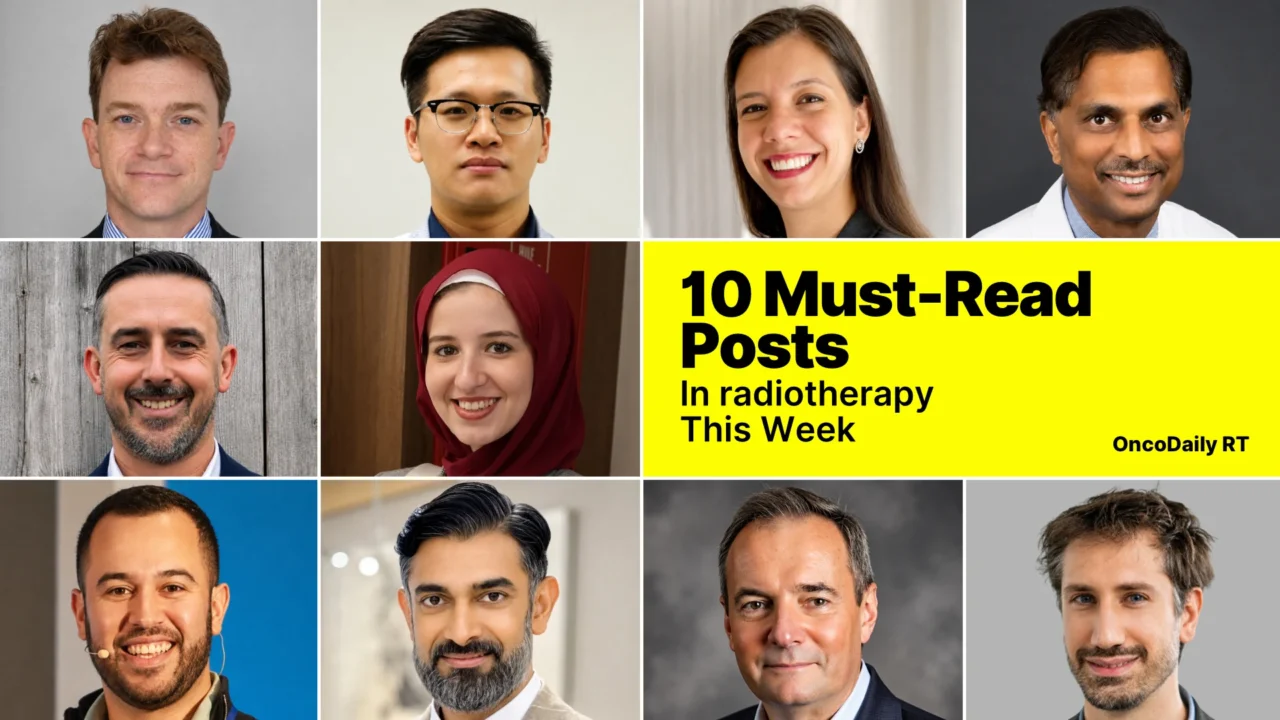
Radiotherapy had another active week on LinkedIn, with updates across prostate ultrahypofractionation, adaptive radiotherapy, late effects care, workplace culture, DCIS decision-making, lattice radiotherapy, inclusive skin care research, low-dose radiotherapy, and technology innovation.
A strong theme this week was how radiation oncology continues to evolve beyond treatment delivery alone. Several posts focused on improving evidence, access, toxicity monitoring, equity, professional wellbeing, and long-term survivorship care.
From Austrian real-world data on 5-fraction prostate radiotherapy and adaptive treatment for cervical cancer to late effects services in England, workplace retention, and inclusive radiotherapy skincare research, these updates show a field thinking carefully about both outcomes and people.
Here are some radiation oncology posts worth catching up on this week.
Falk Roeder – Head of Department of Radiation Therapy and Radiation Oncology, University of Salzburg
A new publication from our group: We present the first results from the Austrian nationwide prospective registry of linac-based ultrahypofractionated radiotherapy (UHFX) for prostate cancer!
Despite the still relatively short follow-up, we observed very low toxicity rates (<1% grade 3+ GU toxicity and 0% grade 3+ GI toxicity) as well as excellent early oncologic outcomes, with no biochemical recurrence within the first year. These real-world data demonstrate the safety and early oncologic effectiveness of ultrahypofractionated radiotherapy for prostate cancer, consistent with the results of randomized phase III trials, although extended follow-up is clearly needed to draw definitive conclusions.Even more importantly, our study shows that most radiation oncology centers in Austria routinely offer LINAC-based UHFX in 5 fractions to suitable patients with prostate cancer following appropriate counseling and shared decision-making.
Many thanks to Natalee Annon-Eberharter and Prof. Frank Wolf from our department for their excellent work in analyzing and preparing the data.
Special thanks to our collaborators from the other participating centers !
Once again, this is an excellent example of what can be achieved through collaboration across the Austrian radiation oncology community.
Ola Farouk – Clinical Application Specialist at Siemens Healthineers – Varian
“There are some professions you choose, and there are others that become a part of who you are. For me, radiation therapy became both”
Before i joined Varian, for 6 years I have had the privilege of working as a Radiation Therapist. Throughout this journey, I have also had the opportunity to train and mentor many undergraduate and postgraduate students in Radiation Therapy and Radiological Imaging. But my connection with cancer treatment became much more personal in 2022.
That year, my little brother became a Hodgkin lymphoma fighter
At first, knowing that someone I loved so deeply was going through cancer made me lose some of the passion I had for my work. Cancer therapy suddenly felt different when the person receiving treatment was my own brother.
Thankfully, I can proudly say that he is cured.But through his journey, I slowly found my passion again — but this time, it was deeper.
By the end of that same year, my mother was diagnosed with breast cancerThis time, I was different..
I had grown stronger. I understood more. I learned more about cancer treatment, about radiation therapy, and most importantly, about the people behind every treatment plan.
What once felt like simply a profession became something much more meaningful to me.Today, as a Clinical Application Specialist, I carry all of these experiences with me.
My goal is not only to support the technology and its applications, but to help train and empower healthcare professionals to deliver the optimal dose, with the highest level of accuracy and care, to every cancer fighter who walks into a treatment room.
I have seen cancer from both sides — as a healthcare professional and as a family member of two fighters🩷
And that has made me love what I do even more.Today, I want to use everything I have learned to help more fighters have a better chance at winning their own battle.
This is more than a career for me.
This is my passion, my purpose, and a part of my story.
And yet to come ..#RadiationTherapy #CancerCare #RadiationOncology #ClinicalApplications #MedicalTechnology #CancerTreatment #Healthcare #RadiationTherapist #ClinicalApplicationSpecialist #PatientCare #CancerAwareness #siemens #Varian #siemens_healthineers
Sushil Beriwal – Vice president Varian Medical affairs
Daily online CBCT based adaptive RT for hypofractionation for cervical cancer – reduced ITV and PTV margin
Better converge and reduce dose to OARs and acceptable side effects . Larger studies ongoing
Daniel Hutton – Network Manager, North West Radiotherapy Specialised Services Clinical Network
New publication
“Radiotherapy Treatment and Beyond: Mapping Late Effects Provision in England”, published in Journal of Clinical OncologyAs more people live longer with and beyond cancer, supporting individuals living with the long-term consequences of #radiotherapy is becoming an increasingly important component of quality cancer care.
Our study highlights significant variation in radiotherapy #LateEffects (RLE) service provision across England , alongside workforce , funding and referral pathway challenges that continue to impact access to specialist support.
We hope the findings and recommendations from this work will help inform policy discussions , commissioning decisions and service development , contributing to more consistent and equitable care for people living with the long-term effects of radiotherapy.
Alex De Caluwé – Radiation Oncologist, MD PhD at Institut Jules Bordet
How do we keep people working in radiation oncology?
Very interesting work from Dylan Callens and colleagues: >50% of radiation oncology professionals had considered leaving their current role in the past year.
Workplace culture, team spirit and – importantly –
feeling able to speak up all matter.In an era of AI and increasing automation, investing in these human aspects of our workplace will become even more important.
I would add another: strengthen multidisciplinary collaboration — within radiation oncology teams, but also across oncology departments — to foster sense of purpose and shared direction.
Great read for managers in radiation oncology.
David Wazer – Professor and Chairman of Radiation Oncology at Brown University Health
Before We Omit Radiation for Breast DCIS: How Much Should We Trust DCISionRT?
A newly published point-counterpoint debate over DCISionRT (citations below) captures a larger challenge in modern oncology: how much evidence should we require before incorporating biologically informed tools into treatment decisions?
O’Keefe and colleagues appropriately remind us that enthusiasm for precision medicine should not eclipse methodological rigor. DCISionRT was developed largely from retrospective, nonrandomized data, and questions regarding training populations, patient exclusions, and performance in randomized datasets such as SweDCIS deserve attention. Their most important challenge is whether the assay provides sufficient incremental value beyond the full spectrum of clinicopathologic information already available to experienced clinicians—and whether ipsilateral breast recurrence, rather than invasive recurrence, is the endpoint that matters most.
Yet Vicini and colleagues make the more compelling clinical argument. Traditional clinicopathologic criteria are imperfect surrogates for tumor biology. In their analysis, DCISionRT reclassified 51%-63% of patients considered low-risk by individual clinicopathologic criteria as biologically elevated-risk; these patients experienced absolute reductions in recurrence of at least 10% with radiation. Conversely, 22%-31% classified as clinicopathologically high-risk were reclassified as low-risk, with low recurrence rates without radiation and no statistically significant RT benefit. That is precisely the type of information needed if we hope to move beyond “one-size-fits-all” treatment.
Importantly, DCISionRT should not be viewed as replacing clinical judgment. Rather, it adds another dimension to shared decision-making by integrating biology with conventional clinical factors. The assay is not the final word, and prospective randomized validation remains essential.
The appropriate response, however, is not to retreat to clinicopathologic criteria alone. It is to rigorously test whether molecular biology can improve upon them. NRG CC-016 provides exactly that opportunity, prospectively evaluating RT omission in DCISionRT low-risk patients.
Precision oncology advances through a combination of skepticism and innovation. DCISionRT has not yet crossed the finish line—but the available evidence suggests it is running in the right direction.
Yang-Wei Hsieh – Adjunct Assistant Professor | Medical Physicist at Kaohsiung Veterans General Hospital
I’m delighted to share our research findings:
ctRO – Clinical and Translational Radiation Oncology“VMAT-based lattice radiotherapy for advanced bulky hepatocellular carcinoma within multimodality treatment: a consecutive feasibility series”
Bulky advanced hepatocellular carcinoma (HCC) remains difficult to treat with conventional homogeneous ablative radiotherapy, as safe dose escalation is limited by hepatic reserve, tumor-to-liver geometry, and adjacent organs at risk (OARs). This study evaluated local control, tumor response, toxicity, and treatment continuity after volumetric-modulated arc therapy (VMAT)-based lattice radiotherapy (VMAT-LRT) in patients with advanced HCC.
Highlights
• Median 3-month tumor-volume reduction was 65% in bulky advanced HCC.
• All 12 treated courses achieved local control without in-field progression.
• Acute toxicity was limited to Grade 0–2 events, with no Grade 3 or higher gastrointestinal toxicity.
• VMAT-LRT supported systemic therapy continuity in selected advanced HCC patients.My sincere thanks to Department Director Dr. Yu-Wei Lin, MD, PhD for his leadership and vision in initiating this important project. It has been an honor to be part of this work.
#latticeRadiotherapy #SpatiallyFractionatedRadiotherapy
#AdaptiveRadiotherapy #Varian #Halcyon #Hypersight
#KaohsiungvVeteransGeneralHospital
Naman Julka-Anderson – Practice Therapeutic Radiographer at Mid and South Essex NHS Foundation Trust
Success .
Proud to share that we have been successful in our College of Radiographers Industry Partnership Scheme (CoRIPS) application.
Five years ago, I found my voice advocating for equity for people of colour experiencing radiotherapy-related skin changes. What started as conversations around inclusive language in consent processes grew into a passion for improving representation of people, not just from the global majority, but people from strategically undervalued communities without a voice in research, education, clinical resources and medical imagery.
Today, I have the privilege of leading RADIANT-4 (Radiotherapy skincare Advice, Disparities, Ingredients and National Trends – Four Nations Study), this brings together an extraordinary team of lived experience partners, charities, clinicians and researchers who share a vision for more equitable, inclusive and person-centred radiotherapy care across the UK.
Team:
Co-production and lived experience partners: Leanne Pero Foundation Black Women Rising UK (Olivia Lond-Caulk), Sakoon Through Cancer (Samina Hussain FRSA), OUTpatients Charity (Stewart O’Callaghan), Radiotherapy UK (Alison Goulding, Lynsey Rice and Sarah Quinlan MBE) and Mouth Cancer Foundation (Karen Liesching-Schroder).
Supervisors and mentors: Dr Bridget Porritt, Prof. Gita Ramdharry PhD and Jo McNamara.
Co-investigators: Nicky Whilde, Joanne Evans, Adrian Ardelean, SARAH O’HARE (NI representative), Josie Cameron (Scotland representative), kerry owen (Wales representative), Sarah Ruane, Eloise Casey, Sarah-Jane Ketterer, Kyle N., Katy Hill and Jessica Dlodlo.
SoR Radiotherapy Officer: Spencer Goodman.
Dissemination partner: Rad Chat.A huge thank you to the College of Radiographers for this incredible opportunity. We are excited to get started and look forward to working together to help shape a better future for people living with and beyond cancer.
Bobby Koneru, MD, FASTRO – Chief of Radiation Medicine @ MercyOne Dubuque and MercyHealth FHN | Asst Prof @ Loyola University | Founder and President, Paramount Oncology Group (POG) | Co-Founder and CMO of JointGlow | Industry KOL
On September 2, I’m joining my colleague David Barron, MD, PhD for a brand-new CE-credit webinar with CQ Medical :
Implementing Low-Dose RT: From Program Development to Clinical Practice
Wed, Sep 2 | 12:00-1:00 PM EDTWe’ll cover:
The clinical rationale and current indications for LDRT
What it actually takes to build an LDRT program
Standardized workflows for reproducible treatment delivery
Positioning and immobilization strategies that drive accuracy
How to set your program up for long-term sustainability and outcomes trackingIf you’ve been curious about LDRT, this is the place to start. Be among the first to attend.
Registration link below.
Beatriz Colenci Bernardi – Head of Marketing LAM at Siemens Healthineers Company
Confira os destaques da nossa participação no 28º Congresso da Sociedade Brasileira de Radioterapia.
Com a mensagem “Elevando o cuidado oncológico. Mais qualidade. Mais eficiência. Menos espera.”, apresentamos inovações que contribuem para transformar a jornada do paciente oncológico e ampliar as possibilidades de cuidado em radioterapia.
Acreditamos que inovação e acesso devem caminhar lado a lado, porque inovar também é tornar o cuidado mais acessível, fazendo com que novas tecnologias e melhores possibilidades de tratamento cheguem a quem mais precisa.
Assista ao vídeo e confira as inovações da Siemens Healthineers apresentadas durante o evento!
#SiemensHealthineers #Varian #Radioterapia