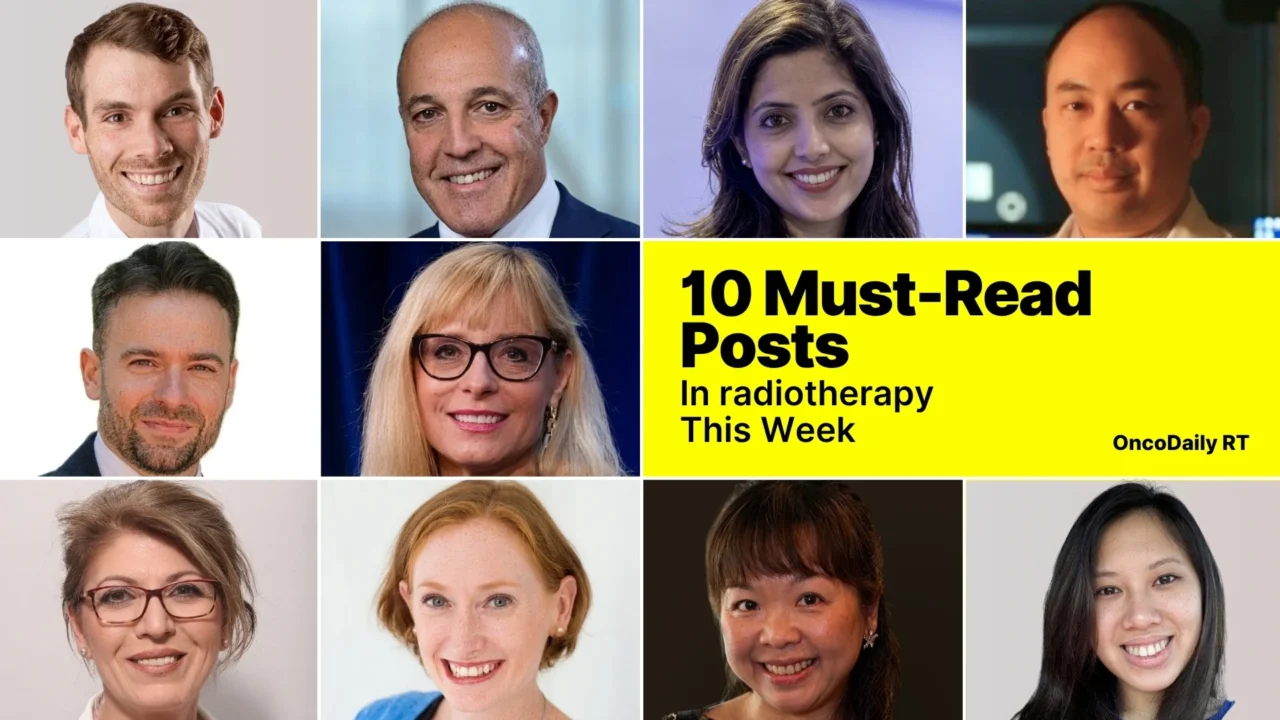
Radiotherapy had another active week on LinkedIn, with strong momentum around ESTRO Meets Asia 2026, World Radiotherapy Awareness Day, patient safety, head and neck oncology, patient-reported outcomes, and technology in cancer care.
Several posts focused on global collaboration, with ESTRO and FARO bringing colleagues together in Singapore to exchange ideas and strengthen links between Europe and Asia. World Radiotherapy Awareness Day was also a major theme, with calls to improve public understanding of radiotherapy, address misconceptions, and highlight its role in curing cancer and relieving symptoms.
Patient-centered care was another clear focus this week. The IAEA shared a new publication on detecting unintended or accidental medical exposures in radiotherapy through patient response, while new research on stereotactic arrhythmia radioablation highlighted the need to better include patient-reported outcomes in emerging radiation-based treatments.
Together, these updates show a field that is advancing through international cooperation, safety, innovation, education, and stronger patient engagement.
Here are some radiation oncology posts worth catching up on last week.
Barbara Jereczek-Fossa – President of ESTRO | MD, PhD | Full Professor of Radiation Oncology, University of Milan | Chair, Department of Radiation Oncology and Proton Center, European Institute of Oncology (IEO)
Looking forward to ESTRO Meets Asia 2026, starting tomorrow in Singapore!
This joint FARO-ESTRO Congress is especially important as we are some days away from celebrating World Radiotherapy Awareness Day
It is an exciting opportunity for colleagues from Europe and Asia to connect, share ideas, learn from one another and build lasting collaborations.
#ESTROMeetsAsia2026
#FARO Federation of Asian Organizations for Radiation Oncology
#ESTRO
European Society for Radiotherapy and Oncology (ESTRO)
#WRAD
Stephanie Loo – Sr Product Marketing Manager | Business Management at Siemens Healthineers
Join us at ESTRO Meets Asia 2026 as Siemens Healthineers showcases integrated solutions designed to elevate cancer care across the entire patient journey from advanced imaging and AI-enabled treatment planning to precision radiotherapy, brachytherapy, and digital oncology.
Visit us at ESTRO Meets Asia 2026 at Singapore EXPO, Booths 35 & 36, from 28–30 August 2026. We look forward to welcoming you.
#CancerCare #SiemensHealthineers #FARO #ESTROMeetsAsia2026 #SingaporeExpo
Vesna Gershan – Professor of Medical Physics at International Atomic Energy Agency (IAEA)
For professionals interested in patient safety in radiotherapy, I am pleased to share that the IAEA has published a new TECDOC “Detection of Unintended or Accidental Medical Exposures in Radiotherapy Through Patient Response”.
This publication provides radiotherapy professionals with an overview of case studies in which unexpected patient responses to radiotherapy led to the identification of unintended or accidental medical exposures. It also presents examples of how such exposures can be minimized or prevented, along with practical approaches for investigating these events and determining appropriate corrective actions. This TECDOC highlights the important role that patient response can play in identifying issues that might otherwise remain undetected and contributes to strengthening safety and quality in radiotherapy practice worldwide.
The IAEA is grateful to all contributors and reviewers whose expertise and dedication made this publication possible.
The IAEA officers responsible for this publication were Dr. Vesna Gershan and Dr. Ola Holmberg.
You may download your copy at
Evan Raptis – Linac Commercialization Manager for Region Europe at Elekta
After five years at GE HealthCare, it is time to turn the page and begin a new chapter.
I would like to sincerely thank everyone who made me admire, love and believe in the company. The people I have met, the customers I have worked with, and the experiences I have gained will stay with me throughout my career.
Now, I am excited to announce that I have joined Elekta as the Linac Commercialization Manager for Region Europe.
A new challenge, a new portfolio, and an opportunity to contribute to a mission that matters deeply:
Bring hope to everyone dealing with cancer.I am looking forward to the journey ahead, working with great people and helping to shape the future of radiation therapy.
Goodbye GE. Hello, Elekta!
Sandro V Porceddu – Director, Department of Radiation Oncology, Professor, University of Queensland and University of Melbourne
It’s showtime…#IFHNOS2026Brisbane pre meeting workshops begin today – all events sold out.
Summary of the conference
-20 society sessions
-35 concurrent sessions
-8 plenaries
-124 verbal abstract presentations
-175 e-poster presenters
-Over 280 presenters
-Delegates from 52 countriesThanks to everyone who will be contributing to the meeting.
Alexander Fabian – PD Dr. med. / MBA at Universitätsklinikum Schleswig-Holstein
Stereotactic arrhythmia radioablation (STAR) is being actively investigated for patients with refractory ventricular tachycardia. But how often do prospective trials actually ask patients about their perspectives ?
Roughly 50%, according to our scoping review just published in ctRO – Clinical and Translational Radiation Oncology: https://lnkd.in/es_D-KXd
6/11 published and 15/27 registered STAR trials assessed Patient-Reported Outcomes (PROs).
PROs were assessed almost exclusively using generic Patient-Reported Outcome Measures (PROMs) (e.g. SF-36); only very few trials used arrhythmia-specific PROMs, and none used a STAR-specific PROM.
No published trial used PROs as a primary endpoint; one registered trial used PROs as a co-primary endpoint.
Of course, STAR is a relatively new treatment paradigm, and early trials may appropriately focus on other endpoints. Still, our findings suggest that future trials could benefit from a more comprehensive assessment of PROs to better understand the impact of STAR on symptoms and quality of life.
Perhaps it is also time to consider developing a STAR-specific PROM that captures aspects particularly relevant to this treatment, including potential radiation-related effects such as oesophagitis or pneumonitis?
Grateful to all collaborators involved in this scoping review conducted within the STOPSTORM.eu consortium and our partners at Hartstichting – especially our Patient Advisory Board, whose insights helped shape this work.
Many thanks to all co-authors: Wiert Hoeksema; Marcin Miszczyk; Pieter G. Postema, MD, PhD; Oliver Weiner; Marta Perin; Matteo Anselmino; Prof. Dr. med. David Krug; Oliver Blanck; Chiara Crico
#STAR #VentricularTachycardia #PatientReportedOutcomes #PROMs #PatientCenteredCare #InnovationHealthcare #EuropeanResearch
Kathy Pope – Radiation Oncologist at Peter MacCallum Cancer Centre
In 7 days, we celebrate World Radiotherapy Awareness Day; let’s celebrate the advances in radiotherapy, share its success stories, and build greater understanding of a treatment that brings cure and eases symptoms for millions around the world.
Radiotherapy is one of the most powerful tools in cancer care, transforming lives through treatment that is safer, more precise, and more effective than ever before. Yet too many patients still miss the opportunity to benefit due to lack of access, limited awareness and enduring misconceptions, not only among the general public and in the media, but sometimes even within our broader healthcare community.
Radiation Oncology: Targeting Cancer remains committed to changing this narrative by raising awareness, sharing evidence-based information, and ensuring more patients can access the benefits of modern radiotherapy.
Learn More
#TargetingCancer #WorldRTDay #WRAD #OneVoiceForRadiotherapy
Sharon Wong – Head, Diagnostics and Therapeutics Division at Singapore Institute of Technology
What a few days it has been at #ESTROMeetsAsia!
I’m truly thankful for the many people who came forward to support #WRAD, asking questions, starting conversations and wanting to know how they could be involved. That really meant a lot.
Thank you to everyone who stopped by, reached out and supported the event. So many meaningful conversations, new connections and possibilities ahead.
Let’s keep the momentum going! Looking forward to working together and counting down to #WRAD2026 celebration on 7th September
#ESTROMeetsAsia #WRAD2026 #WRAD #SiemensHealthineers #RadiationTherapy #Education #Collaboration World Radiotherapy Awareness Day
Ray Mak – Professor of Radiation Oncology at Harvard Medical School
Pleased to share our new study in Annals of Oncology, examining an immune organ that has historically received very little attention in radiation treatment planning for cancer patients: the thymus.
In radiation oncology planning, we routinely limit dose to the lungs, esophagus, heart, spinal cord, and increasingly individual cardiac substructures to prevent toxicity for the patient. The adult thymus, despite its central location, is generally not considered at risk and is ignored.
We built on our recent work showing that thymic health can be quantified from routine CT imaging using hashtag#AI and is associated with important health and cancer outcomes in adults. The current study adds a new dimension: the benefit associated with preserved thymic health may depend in part on whether that organ is preserved or damaged during radiation treatment.
We studied 1,107 patients with locally advanced NSCLC treated with radiation in 3 independent cohorts: RTOG 0617 (a national randomized trial), a real-world chemoradiation cohort, and a contemporary cohort treated with chemoradiation followed by durvalumab (an immunotherapy).
The key finding was the interaction between baseline thymic health and thymic radiation dose. Patients with impaired thymic health had worse survival overall, without a clear relationship between thymic radiation dose and distant metastasis within that group. In contrast, patients with preserved thymic health and lower thymic radiation exposure had the most favorable outcomes. Among these patients, increasing thymic dose was associated with a greater risk of distant metastasis, suggesting that radiation may erode the favorable prognosis associated with preserved thymic health.
Furthermore, among patients with longitudinal imaging, higher thymic radiation exposure was associated with a greater subsequent decline in thymic health.
In a small treatment-planning feasibility analysis, thymic dose could also be substantially reduced while maintaining tumor coverage and standard constraints to other critical organs.
These findings are observational and require prospective validation. The exploratory 35 Gy threshold for the thymus that was associated with worse outcomes should not be interpreted as a clinical dose constraint.
For me, the really fascinating observation here is that unlike our traditional organs at risk, the potential consequence of radiation injury for the thymus isn’t a conventional symptomatic organ-specific toxicity, but rather a direct effect on systemic cancer outcomes.
Congratulations to Vasco Prudente / Simon Bernatz / Hugo Aerts for leading this work, & to our amazing co-authors
Grateful for the collaboration across Mass General Brigham, Harvard Medical School, Dana-Farber Cancer Institute & other centers. Thank you to RTOG Foundation for their generous data sharing.