Results from the phase II Canadian Cancer Trials Group (CCTG) PR21 trial, presented by Daniel J. Khalaf at ESMO 2026 during the Rapid Oral Session: Genitourinary Tumours, Prostate, Penile and Testis, showed that lutetium-177 PSMA-617 (Lu-177 PSMA-617) was associated with better patient-reported quality of life compared with docetaxel in patients with metastatic castration-resistant prostate cancer (mCRPC).
Although the trial previously found no statistically significant difference in radiographic progression-free survival (rPFS) between the two treatments, the new analysis suggests that Lu-177 PSMA-617 may offer an advantage in treatment tolerability and patient experience.
Background
For patients with mCRPC who have progressed after androgen receptor pathway inhibitor therapy, treatment selection involves balancing disease control with toxicity and quality of life. Docetaxel chemotherapy and PSMA-targeted radioligand therapy have different toxicity profiles, making patient-reported outcomes particularly important when evaluating their clinical benefits. The PR21 trial compared these approaches, with the latest analysis focusing on quality-of-life outcomes over the course of treatment.
Study Design and Patient Population
CCTG PR21 was a randomized phase II clinical trial comparing docetaxel with Lu-177 PSMA-617 in patients with mCRPC previously treated with an androgen receptor pathway inhibitor.
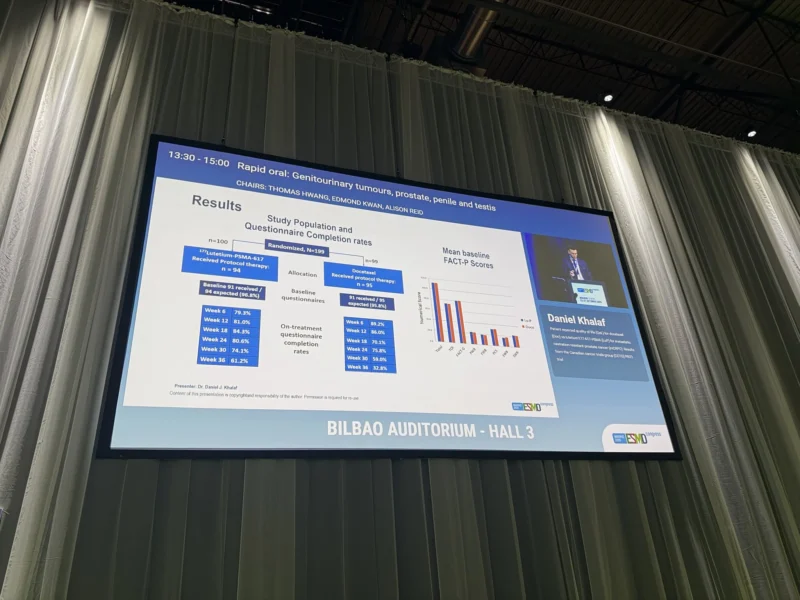
Of the 199 randomized patients, 189 initiated treatment, including 94 receiving Lu-177 PSMA-617 and 95 receiving docetaxel. Quality of life was evaluated using the Functional Assessment of Cancer Therapy–Prostate (FACT-P) questionnaire, administered every six weeks during treatment and every 12 weeks before crossover.
Patients were included in the quality-of-life analysis if they completed a baseline questionnaire and at least one questionnaire during treatment.
The prespecified patient-reported outcome was the FACT-P Trial Outcome Index (TOI), with additional analyses of total FACT-P scores and individual domains over 36 weeks. Questionnaire completion was high, reaching 96% at baseline and exceeding 70% at most subsequent assessments. Baseline quality-of-life scores were comparable between treatment groups.
Quality-of-Life Outcomes
Patients receiving docetaxel experienced greater deterioration in quality of life than those treated with Lu-177 PSMA-617.
For the FACT-P Trial Outcome Index, mean changes from baseline were:
- Week 24: −4.1 with docetaxel versus +0.5 with Lu-177 PSMA-617 (P=0.041)
- Week 30: −7.1 versus +2.8, respectively (P<0.001)
Similar differences were observed in total FACT-P scores:
- Week 24: −4.8 with docetaxel versus +1.2 with Lu-177 PSMA-617 (P=0.024)
- Week 30: −8.3 versus +4.7 (P<0.001)
- Week 36: −8.9 versus +1.5 (P=0.027)
A longitudinal mixed-model analysis showed significant treatment-by-time interactions across most quality-of-life measures, including TOI, total FACT-P, and FACT-G scores (all P<0.01). Overall, quality-of-life scores tended to worsen over time with docetaxel, while remaining relatively stable among patients receiving Lu-177 PSMA-617.
Patient-Reported Treatment Side Effects
The study also assessed patients’ perception of treatment-related side effects using the FACT-P GP5 item, which asks whether patients are bothered by the side effects of treatment.
High levels of side-effect bother were reported at least once by 40.7% of patients receiving docetaxel, compared with 15.4% receiving Lu-177 PSMA-617. These findings were consistent with the broader quality-of-life results, suggesting a lower perceived treatment burden with PSMA-targeted radioligand therapy.
Clinical Implications
The PR21 quality-of-life analysis adds an important patient-centered perspective to the comparison between Lu-177 PSMA-617 and docetaxel.
Although the study did not demonstrate a statistically significant difference in its primary endpoint of radiographic progression-free survival, patient-reported outcomes consistently favored Lu-177 PSMA-617. The findings suggest that radioligand therapy may offer better treatment tolerability and preserve quality of life compared with docetaxel in this population.
However, the trial was a phase II study, and the absence of a statistically significant rPFS difference should not be interpreted as proof of equivalent antitumor efficacy.
Conclusion
The CCTG PR21 trial found that Lu-177 PSMA-617 was associated with better patient-reported quality of life and less perceived treatment-related side-effect burden than docetaxel in patients with mCRPC previously treated with an androgen receptor pathway inhibitor.
With no statistically significant difference in radiographic progression-free survival demonstrated in the trial, these findings highlight the importance of incorporating patient-reported outcomes into treatment decisions and future clinical trials.