
A new phase III randomized, PACE-NODES trial is evaluating whether extending stereotactic body radiotherapy beyond the prostate to include the pelvic nodes can improve outcomes for patients with high-risk localized prostate cancer.
Published in Clinical and Translational Radiation Oncology, the trial addresses an important question in modern prostate radiotherapy: can the benefits of pelvic nodal irradiation be delivered safely in only 5 fractions?
Title: PACE-NODES: A phase III randomised trial of 5 fraction prostate stereotactic body radiotherapy (SBRT) versus 5 fraction prostate and pelvic nodal SBRT
Year: 2026
Authors: Angela Pathmanathan, Suneil Jain, John Staffurth, Stephanie Brown, Stephanie Burnett, Fay H Cafferty, Ananya Choudhury, Monisha Dewan, Peter Hoskin, Ken McBride, Conor K McGarry, Elizabeth Miles, Julia Murray, Vedang Murthy, Olivia Naismith, Yee Pei Song, Isabel Syndikus, Alison Tree, Tim Ward, Emma Hall, Nicholas van As
Background
Stereotactic body radiotherapy has become an increasingly important approach in prostate cancer, offering shorter treatment courses and fewer hospital visits. Previous studies such as PACE-B have supported the safety and efficacy of 5-fraction prostate SBRT in lower-risk disease.
However, evidence is more limited in higher-risk patients, especially when pelvic lymph nodes are included in the treatment field. Pelvic nodal radiotherapy may improve disease control in selected high-risk patients, but it also increases treatment volume and raises concerns about gastrointestinal toxicity.
PACE-NODES was designed to answer this question directly in a randomized phase III setting.
Study Design
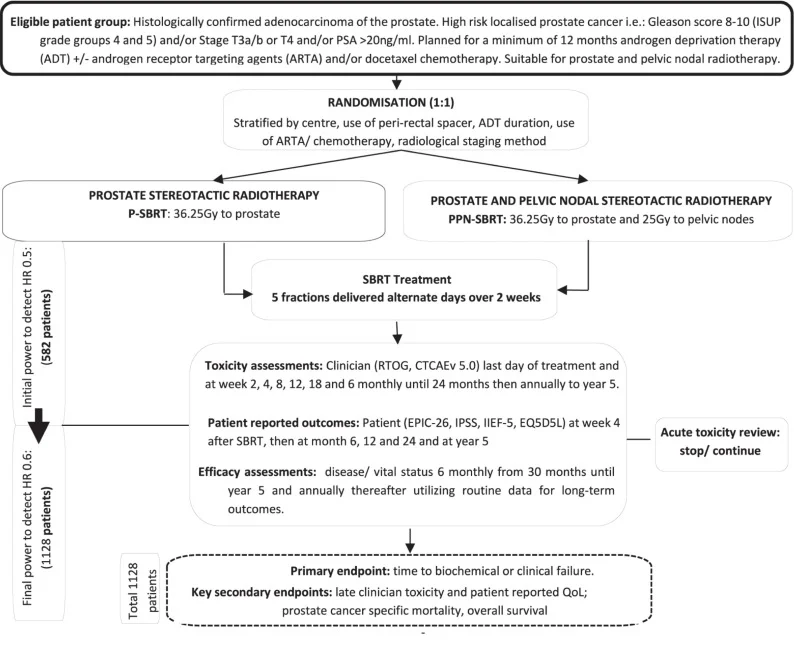
PACE-NODES is a multicenter, phase III randomized controlled trial enrolling patients with high-risk localized prostate cancer planned for radical radiotherapy and at least 12 months of androgen deprivation therapy.
Patients are randomized 1:1 to one of two treatment arms:
Prostate SBRT alone: 36.25 Gy to the prostate in 5 fractions, with 40 Gy to the prostate clinical target volume. Prostate and pelvic nodal SBRT: 36.25 Gy to the prostate, with 40 Gy to the prostate clinical target volume, plus 25 Gy to the pelvic nodes. In both arms, radiotherapy is delivered in 5 fractions on alternate days over 2 weeks.
The primary endpoint is time to biochemical or clinical failure. Key secondary endpoints include acute and late gastrointestinal and genitourinary toxicity, patient-reported quality of life, metastasis-free survival, prostate cancer-specific survival, overall survival, and radiotherapy planning feasibility.
Eligibility and Treatment Context
Eligible patients have histologically confirmed prostate adenocarcinoma and high-risk localized disease, defined by features such as Gleason 8–10, T3/T4 stage, or PSA greater than 20 ng/mL.
All patients receive androgen deprivation therapy for 12–36 months as standard care. Androgen receptor-targeting agents or docetaxel are permitted if used as part of local standard practice, but they are not mandated.
Importantly, patients with N1 or M1 disease are excluded, making this a trial focused on prophylactic pelvic nodal treatment in clinically node-negative high-risk disease.
Why This Matters
PACE-NODES builds on several important developments in prostate radiotherapy: the growing adoption of prostate SBRT, the renewed interest in pelvic nodal irradiation, and improvements in imaging, planning, and image-guided treatment delivery.
Older studies of pelvic nodal irradiation did not clearly show benefit, but many were limited by older staging approaches and less conformal radiotherapy techniques. More recent evidence, including POP-RT, suggests that pelvic nodal radiotherapy may improve disease control in high-risk patients.
The key question now is whether this can be achieved safely and effectively using a 5-fraction SBRT approach.
Trial Status
The trial opened in September 2022 and recruited patients across the UK, Ireland, and New Zealand. Recruitment was completed ahead of target in July 2025. The planned primary efficacy analysis is expected in 2029. Two prespecified interim safety reviews have already been completed, and the Independent Data Monitoring Committee recommended continuation of the trial without changes.
PACE-NODES is an important phase III trial testing whether 5-fraction prostate and pelvic nodal SBRT can improve biochemical and clinical control compared with prostate-only SBRT in high-risk localized prostate cancer.
If positive, the trial could help establish a shorter, more efficient treatment strategy for selected high-risk patients while providing much-needed randomized data on the safety of pelvic nodal SBRT.
Article link.