
The American Radium Society Appropriate Use Criteria provide a first consensus-based guideline on the use of low-dose radiotherapy for osteoarthritis. The guideline concludes that LDRT may provide pain relief, improved joint mobility, and quality-of-life benefit in selected patients with OA, but the overall level of evidence remains limited. The authors emphasize that high-quality prospective, randomized, sham-controlled trials with standardized endpoints are still needed before LDRT can be more firmly established in routine OA care.
Osteoarthritis remains one of the most common causes of chronic pain, stiffness, functional limitation, and disability worldwide. It is especially burdensome in older adults, but its prevalence is also increasing among younger patients. According to the guideline text, OA affects an estimated 7.6% of the global population, corresponding to approximately 595 million people, and its prevalence has increased by more than 130% over the past three decades. The authors also note that OA is projected to continue rising substantially by 2050.
Current treatment options include education, exercise, weight loss, bracing, NSAIDs, COX-2 inhibitors, intra-articular therapies, and surgery. However, these approaches may be insufficient, poorly tolerated, contraindicated, or associated with important risks. NSAIDs, for example, can increase gastrointestinal, renal, and cardiovascular toxicity, while surgical interventions carry procedural risks and may not be suitable for all patients. This creates a need for additional noninvasive treatment options, particularly for patients with persistent symptoms and limited alternatives.
Title: American Radium Society Appropriate Use Criteria Review Low-Dose Radiotherapy for Osteoarthritis
Authors: Austin Dove, Bobby Koneru, William Jr Small, Amanda E. Nelson, Jean L. Wright, Matlock Jeffries, Phillip Bennion, Craig Jones, Rahul Tendulkar, Suzanne Russo, Scott Lester, Krishan Jethwa, Tom Appleton
Why LDRT Is Being Considered?
Low-dose radiotherapy is not a new concept in benign disease. The guideline notes that its use in OA was first reported more than a century ago, with early reports suggesting pain relief in patients with degenerative joint disease. The biological rationale is based on the anti-inflammatory effects of very low radiation doses.
The authors describe several possible mechanisms: LDRT may reduce proinflammatory mediators such as IL-1 and TNF, increase anti-inflammatory pathways, modulate macrophages toward a less inflammatory phenotype, reduce leukocyte adhesion and migration, and influence oxidative stress pathways. In practical terms, the goal is not tumor control, as in oncology, but reduction of inflammation and symptomatic pain.
Methods
The guideline was developed by a multispecialty committee including radiation oncologists, rheumatologists, orthopedic surgeons, and a patient advocate. The authors used the PICOTS framework and assessed evidence using Cochrane and PRISMA methodology. The literature search included studies published from January 1, 2010, to May 10, 2025, across Embase, Medline, and PubMed.
Out of 548 identified articles, 44 studies met inclusion criteria, with 8 additional studies identified through backward citation searching. In total, 52 references were used as evidence, including well-designed randomized or phase II/III studies, moderately designed studies, retrospective studies with limitations, supplemental studies, and one meta-analysis. The expert panel then used the RAND-UCLA modified Delphi consensus methodology to rate appropriateness of treatment options.
Main Findings
The review found that LDRT has been associated with clinical benefit in several retrospective and prospective studies. Reported response rates were often in the range of 60% to 90%, with benefits including pain reduction, improved mobility, and better quality of life. However, the authors are careful to state that these findings must be interpreted cautiously because much of the evidence is retrospective, nonrandomized, and heterogeneous.
The strongest evidence exists for large joints, especially the knee, followed by the hip and shoulder. Smaller joints, such as the hands, fingers, feet, and ankles, may also benefit, but the evidence is more limited. The guideline notes that interpretation is more difficult when studies combine different joint sites, because prognosis, dose distribution, surgical alternatives, and disease severity may differ by joint.
For knee OA, multiple retrospective and prospective studies suggest benefit. One large retrospective series of more than 4,500 patients with knee OA reported pain reduction in 60% of patients at 3 months, with 40% reporting durable pain reduction at 1 year. A randomized prospective study by Makarova et al. included patients with knee OA and suggested long-term benefit, including improved quality-of-life measures and reduced need for knee arthroplasty, but the authors note several limitations, including early-stage patient selection, differences in baseline treatment standards, and geographic factors.
For hand OA, the data are mixed. Some prospective and retrospective studies showed improvement in pain and function, including studies reporting reduced visual analog scale pain scores and functional improvement. However, one small sham-controlled study did not demonstrate a substantial early benefit compared with sham treatment.
Limitations of the Evidence
The guideline clearly states that the level of evidence supporting LDRT for OA remains limited. Many studies are retrospective or nonrandomized and are therefore vulnerable to selection bias, referral bias, and differences in prior therapies. Even among randomized trials, interpretation is complicated by variable dose and fractionation schedules, different follow-up durations, inconsistent endpoints, and different definitions of response.
The placebo effect is another major concern. Because OA pain is subjective and fluctuating, trials evaluating pain-directed treatments may show large placebo responses. For this reason, the authors emphasize that future studies should be sham-controlled, adequately powered, and designed with standardized endpoints.
Only two high-quality sham-controlled trials in the review included patients with knee or hand OA, but both were small, with 55 knee and 56 hand patients, and had short follow-up. These studies did not show a significant difference in pain reduction at early follow-up, although a combined longer-term analysis at 12 months showed numerically higher pain reduction with LDRT compared with sham: 52% vs 44% for knee OA and 31% vs 27% for hand OA. The authors note that these trials have been criticized for small sample size, limited statistical power, lack of reirradiation for nonresponders, and patient selection issues related to chronicity and disease severity.
A third sham-controlled study by Fazilat-Panah et al. included 60 patients with knee OA and reported statistically significant improvement in pain score and reduced analgesic consumption with LDRT compared with sham RT. However, the guideline notes that this study has also been criticized because the magnitude of treatment effect was not clearly described with quantitative data.
Patient Selection
The guideline does not position LDRT as a first-line treatment for OA. Instead, it may be considered in selected patients, particularly those with chronic pain persisting for more than 3 to 6 months despite prior treatments and those with limited treatment options. Ideal candidates are generally adults over the age of 40 with moderate to severe pain affecting quality of life, especially when surgery is contraindicated, limited, or declined.
The authors also discuss OA severity using the Kellgren-Lawrence grading system. LDRT has generally been used in patients with KL grades 1 to 3, although selected symptomatic patients with KL grades 0 to 2 may be considered. Patients with KL grade 4 disease may have lower response rates, but the evidence remains limited.
Safety Considerations
The guideline states that LDRT appears to have limited acute and late toxicity when used with modern techniques and appropriate doses. Mild skin erythema has rarely been reported, and no grade 3 to 4 skin toxicity has been described in the cited studies. The authors also note that no published data have shown that LDRT increases OA progression or prevents later surgery.
The potential risk of secondary malignancy remains an important concern, particularly because radiation-induced solid tumors can occur decades after exposure. However, the estimated risk appears very low, especially in older patients and when small fields and low doses are used. The guideline notes that despite thousands of patients treated with LDRT for OA, no published association with secondary malignancy has been reported, although the absence of long-term data does not prove absence of risk. Long-term registries and follow-up studies are still needed.
Dose and Technique
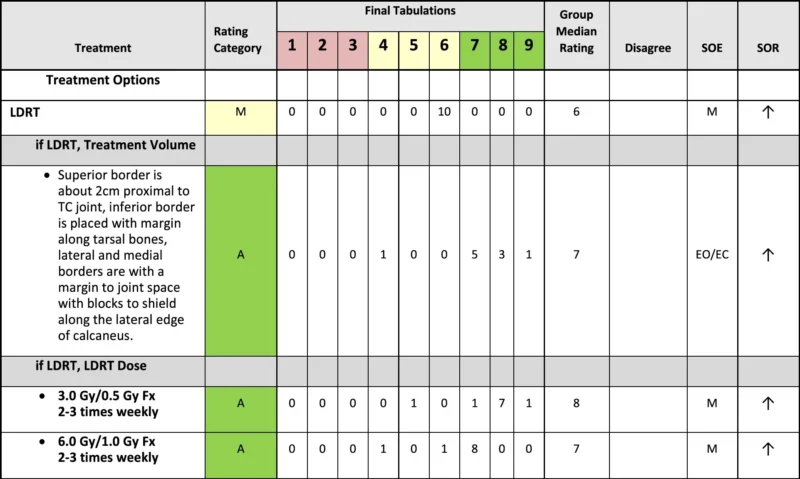
The most commonly used LDRT schedules are 0.5 Gy or 1 Gy per fraction for 6 fractions, for a total dose of 3 to 6 Gy, usually delivered every other day or twice weekly. The guideline notes that 0.5 Gy per fraction has gained support in recent literature, although different regimens have been studied.
For patients with limited or no response after an initial course, a second course may be considered after 8 to 12 weeks, depending on response, prior dose, joint treated, and remaining treatment options. There is no clearly defined lifetime dose limit for retreatment, so decisions should be individualized.
Treatment can be delivered using orthovoltage or linear accelerator-based photon therapy. For larger joints, such as the hip, LINAC-based treatment is generally preferred because of tissue depth. CT simulation and 3D planning are encouraged to improve target delineation and reduce dose to surrounding normal tissues.
Ongoing Trials
Several ongoing studies are expected to clarify the role of LDRT in OA. The LoRD-KneA trial in South Korea is a prospective multicenter sham-controlled randomized trial comparing sham RT, 0.3 Gy in 6 fractions, and 3 Gy in 6 fractions. Preliminary results presented at ASTRO 2025 showed a higher 4-month response rate with the 3 Gy regimen compared with 0.3 Gy, while 0.3 Gy did not differ from sham.
Other ongoing trials include ROGOCO, comparing 3 Gy in 6 fractions with 6 Gy in 6 fractions in knee or hip OA; IMMO-LDRT2, a placebo-controlled double-blind randomized trial of 3 Gy in 6 fractions versus sham RT; and Radio-KO, a Mayo Clinic single-center sham-controlled randomized trial evaluating 3 Gy in 6 fractions versus sham RT.
Bottom Line
The American Radium Society Appropriate Use Criteria present LDRT as a potentially useful, noninvasive option for carefully selected patients with osteoarthritis, particularly those with persistent pain and limited alternatives. The current evidence suggests possible pain relief and functional benefit, but it is not definitive. The authors repeatedly emphasize that the field now needs larger, well-designed, sham-controlled randomized trials with standardized endpoints, adequate follow-up, and careful patient selection.
For now, LDRT should be understood as a promising but still evidence-limited approach in OA care rather than a universally established standard.
Read full article here