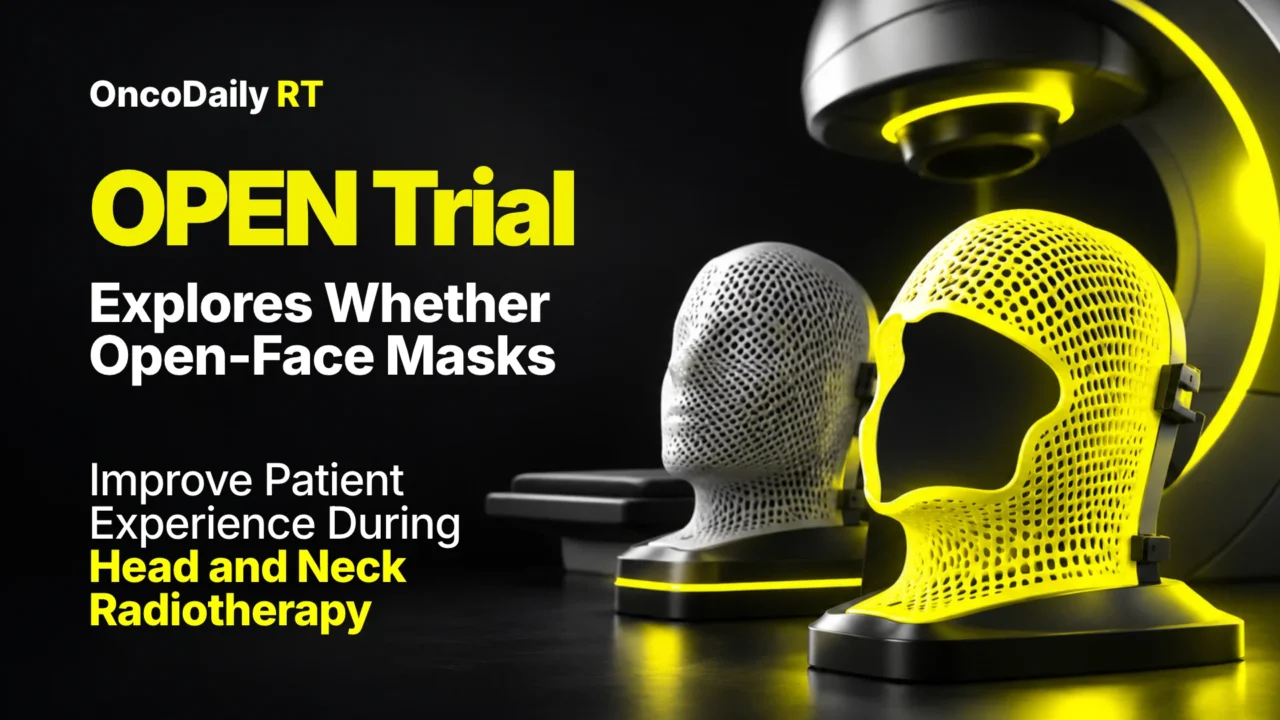
A phase III randomized controlled trial published in Radiotherapy and Oncology has demonstrated that open-face immobilization masks combined with surface-guided radiotherapy (SGRT) can significantly improve patient comfort and reduce psychological distress while maintaining accurate treatment positioning in patients undergoing head and neck radiotherapy.
The study, titled “OPEN: Optimising Patient Experience in Head and Neck Radiotherapy, a Phase 3 Randomised Control Trial Comparing Open Versus Closed Face Masks,” was conducted by Jill Nicholson and colleagues at St. Luke’s Radiation Oncology Network in Ireland.
The findings provide randomized evidence supporting a less restrictive and more patient-centered approach to immobilization during head and neck radiotherapy.
Why Does Mask Design Matter in Head and Neck Radiotherapy?
Thermoplastic immobilization masks are essential for ensuring reproducible positioning during head and neck radiotherapy, where even small setup deviations may affect treatment accuracy.
However, conventional closed-face masks can cause discomfort, anxiety, and claustrophobia, potentially compromising patients’ treatment experience and, in some cases, their ability to complete treatment.
Open-face masks offer a potential alternative by leaving much of the face uncovered, allowing patients greater visibility and reducing the sensation of confinement. When combined with SGRT, these systems also permit continuous monitoring of patient position during treatment.
Until recently, however, evidence demonstrating whether open-face masks could provide equivalent setup accuracy alongside improved patient comfort was largely limited to smaller or nonrandomized studies.
OPEN Trial Design and Patient Population
The OPEN trial was a prospective phase III randomized controlled study conducted across two radiotherapy centers in Ireland.
Between January 2024 and 2025, the investigators randomized 230 patients undergoing radical head and neck radiotherapy to one of three immobilization approaches:
- Arm A: Standard closed five-point thermoplastic mask without SGRT.
- Arm B: Open three-point mask combined with SGRT.
- Arm C: Open five-point mask combined with SGRT.
A total of 199 patients were evaluable for the primary endpoint, including 68 patients in Arm A, 71 in Arm B, and 60 in Arm C.
All patients underwent daily cone-beam computed tomography (CBCT) for positioning verification and were treated using a 3 mm planning target volume margin. The primary endpoint was inter-fraction setup accuracy. Secondary endpoints included psychological distress, mask comfort, treatment tolerability, intrafraction motion, and resource utilization. Patients who were considered unlikely to tolerate conventional closed masks because of claustrophobia were excluded from the study.
Open-Face Masks Maintain Accurate Treatment Positioning
The trial demonstrated that open-face immobilization systems achieved setup accuracy comparable to traditional closed masks. No statistically significant differences were observed between the three groups in vertical, lateral, or rotational positioning. However, longitudinal displacement was significantly greater among patients using conventional closed masks.
The mean longitudinal shifts were:
- Closed five-point masks: 1.4 mm
- Open three-point masks: −0.1 mm
- Open five-point masks: −0.5 mm
These differences were statistically significant (P<0.001).
An interim analysis of 56 patients also demonstrated comparable intrafraction stability between open and closed masks. Importantly, the three-point open mask achieved positioning accuracy comparable to the five-point open design, despite providing less extensive physical immobilization.
These findings suggest that SGRT can support accurate positioning even with less restrictive immobilization systems.
Patient Comfort and Psychological Distress Improve With Open Masks
One of the most important findings was the improvement in patient-reported treatment experience.
At treatment completion, both open-mask groups reported significantly better overall experiences compared with patients using conventional closed masks.
The differences were statistically significant for both the three-point open masks (P<0.001) and five-point open masks (P<0.004).
Patients using open masks also reported improvements in tolerability and comfort.
Psychological distress was assessed using the validated General Health Questionnaire-12 (GHQ-12).
At the end of radiotherapy, the proportion of patients exceeding the study’s distress threshold was:
- 44.3% with conventional closed masks
- 32.9% with three-point open masks
- 18.0% with five-point open masks
Although psychological distress increased during treatment across all three groups, patients using open-face masks generally demonstrated more favorable outcomes.
The five-point open-mask group had the lowest proportion of patients exceeding the distress threshold, while the three-point open-mask group showed the smallest increase in distress from treatment initiation to completion. Notably, six patients assigned to conventional closed masks required replanning with open-face masks because of intolerance, despite the initial exclusion of patients with significant anticipated claustrophobia.
Improved Patient Experience Without Increasing Treatment Workload
The study also evaluated whether implementing open-face masks with SGRT would increase treatment complexity or resource requirements.
The average number of CBCT scans remained comparable across all three treatment arms, at approximately 1.2 scans per fraction. Although treatment times were initially longer during implementation of the new SGRT workflow, they decreased as staff gained experience.
The median treatment time for patients using open-face masks remained below 15 minutes, consistent with routine departmental appointment schedules.
These findings suggest that open-mask immobilization can be integrated into clinical workflows without substantially increasing routine treatment times. However, implementation requires appropriate SGRT equipment, staff training, and standardized positioning protocols.
What Do These Findings Mean for Clinical Practice?
The OPEN trial provides randomized evidence that open-face masks combined with SGRT can improve the experience of patients undergoing head and neck radiotherapy without an observed compromise in setup accuracy.
The results are particularly relevant because radiotherapy for head and neck cancer frequently involves prolonged treatment courses, during which patients must repeatedly undergo immobilization.
Reducing discomfort and psychological distress may improve treatment tolerability and the overall patient experience.
Nevertheless, some limitations should be considered.
The trial compared closed masks without SGRT against open masks with SGRT, making it difficult to determine how much of the observed improvement resulted from mask design versus the addition of surface monitoring.
Furthermore, patients with significant anticipated claustrophobia were excluded, and some patient-experience questions were developed specifically for this trial rather than independently validated. The study also focused on positioning accuracy and patient experience rather than long-term oncological outcomes.
A Step Toward More Patient-Centered Radiotherapy
The OPEN trial demonstrates that improving radiotherapy technology does not necessarily require making treatment more restrictive.
By combining open-face masks with surface-guided monitoring, clinicians may be able to preserve the precision required for head and neck radiotherapy while substantially improving comfort, tolerability, and psychological well-being.
The findings support wider consideration of SGRT-supported open-face immobilization as a patient-centered alternative to conventional closed masks.
As radiation oncology continues to advance toward increasingly precise and individualized treatment, the OPEN trial highlights an equally important priority: ensuring that technological progress translates into a better experience for patients.
Read full article here.