
Results from the first interim safety analysis of the GORTEC 2024-03 IDEAL trial, presented by Yungan Tao at ESMO 2026 (Abstract 1538RO), suggest a manageable early safety profile for induction becotatug vedotin, an EGFR-directed antibody-drug conjugate (ADC), with or without the PD-1 inhibitor pucotenlimab in patients with locally advanced head and neck squamous cell carcinoma (HNSCC).
Among the first 20 patients evaluated, no grade 4 adverse events were reported, although grade 3 treatment-emergent adverse events occurred in eight patients.
Preliminary response data also showed an objective response rate of 71% among the first 15 evaluable patients. However, efficacy results remain immature, and the trial is ongoing.
Background
Locally advanced head and neck squamous cell carcinoma remains challenging to treat, particularly among patients at high risk of recurrence following definitive chemoradiotherapy.
Although concurrent cisplatin-based radiotherapy is an established treatment approach, interest is growing in induction strategies that may improve tumor response and subsequent disease control.
Becotatug vedotin (MRG003) is an investigational antibody-drug conjugate targeting epidermal growth factor receptor (EGFR), a receptor frequently expressed in head and neck squamous cell carcinoma.
Previous studies in recurrent or metastatic HNSCC have reported encouraging activity with becotatug vedotin alone or in combination with pucotenlimab (HX008), an anti-PD-1 antibody. The GORTEC 2024-03 IDEAL trial was designed to investigate whether these treatments could be incorporated before definitive chemoradiotherapy in locally advanced disease.
Study Design and Patient Population
GORTEC 2024-03 IDEAL is a randomized phase II trial evaluating induction becotatug vedotin with or without pucotenlimab before definitive chemoradiotherapy.
The study includes patients with locally advanced squamous cell carcinoma of the larynx, hypopharynx, oral cavity, or oropharynx, including both p16-positive and p16-negative oropharyngeal cancers.
Patients are randomized 1:1 into two treatment arms.
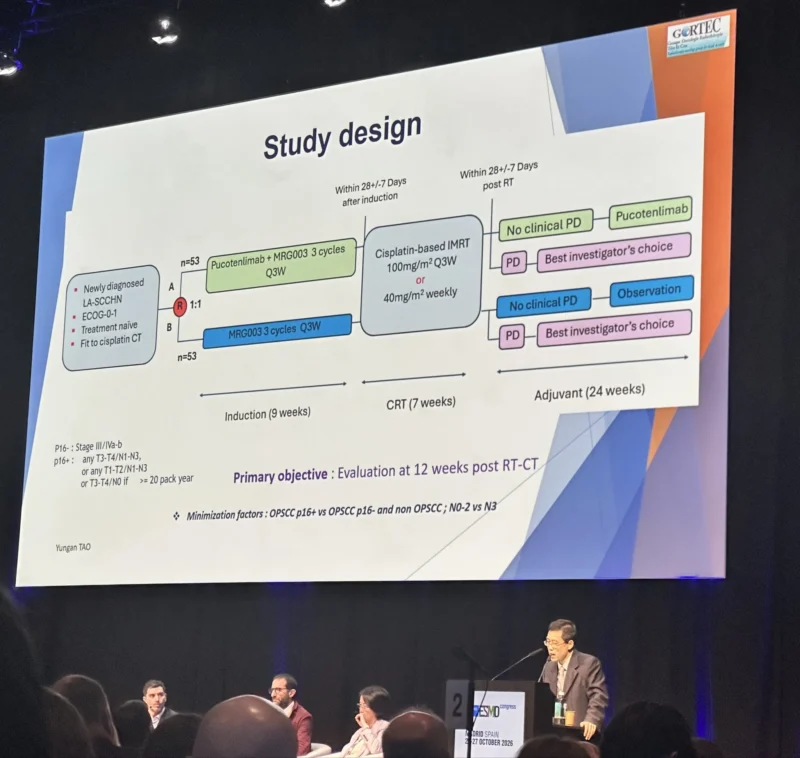
Arm A — Combination treatment
Patients receive three cycles of induction pucotenlimab 200 mg plus becotatug vedotin 2.3 mg/kg every three weeks, followed by definitive chemoradiotherapy and eight additional cycles of adjuvant pucotenlimab.
Arm B — ADC alone
Patients receive three cycles of induction becotatug vedotin alone, followed by definitive chemoradiotherapy.
In both groups, definitive chemoradiotherapy consists of intensity-modulated radiotherapy (IMRT) delivering 70 Gy with concurrent cisplatin.The primary endpoint is complete response at 12 weeks following chemoradiotherapy.
Each treatment arm is evaluated independently using a one-stage Fleming design, with a predefined reference complete response rate of 30%.
The planned enrollment is 106 patients. The first interim safety analysis was scheduled after the first 20 patients completed one treatment cycle.
Interim Safety Results
Between October 23, 2025, and April 21, 2026, 49 patients were randomized into the trial.
Most had oropharyngeal cancer, accounting for 31 patients, including 19 with p16-positive disease. The initial safety analysis included 20 patients, with 10 assigned to each treatment arm.
No grade 4 adverse events were reported in either group.
A total of 11 grade 3 treatment-emergent adverse events occurred in eight patients, including six patients in the combination arm and two in the ADC-alone arm. In the pucotenlimab plus becotatug vedotin group, grade 3 events included elevated ALT, constipation, myalgia, hypertension, neutropenia, diabetes, diarrhea, and hyponatremia.
In the becotatug vedotin-alone group, grade 3 peripheral arterial ischemia and fatigue were reported. One patient in the ADC-alone arm died following a gastrostomy procedure after one treatment cycle. The death was considered unrelated to study treatment.
Although the investigators described the early safety findings as favorable, the small number of patients and limited treatment exposure mean that the full safety profile has not yet been established.
Preliminary Treatment Response
Early efficacy data were also reported from patients evaluated after induction treatment. Among the first 15 evaluable patients, the observed objective response rate was 71%, according to RECIST 1.1 criteria. However, these results remain preliminary.
The abstract does not provide arm-specific response rates or sufficient information to determine whether the addition of pucotenlimab improves response compared with becotatug vedotin alone.
Furthermore, the primary endpoint of complete response at 12 weeks after definitive chemoradiotherapy has not yet been fully reported. Updated response and safety findings are expected as the trial continues.
Clinical Implications
The GORTEC IDEAL trial represents an early investigation of EGFR-directed antibody-drug conjugates as part of multimodality treatment for locally advanced head and neck cancer.
The integration of becotatug vedotin, either alone or with PD-1 blockade, before definitive cisplatin-based chemoradiotherapy is of particular interest given the need for more effective systemic treatment strategies in this population.
The preliminary 71% objective response rate suggests potential antitumor activity during induction treatment. However, the current findings are primarily focused on safety rather than definitive efficacy.
The observation of grade 3 adverse events in eight of the first 20 patients indicates that clinically meaningful toxicity remains possible, even though no grade 4 events were reported.
Importantly, the two treatment strategies also differ in the use of adjuvant pucotenlimab after chemoradiotherapy. Therefore, future comparisons between arms will reflect the overall treatment strategies rather than the isolated effect of adding immunotherapy during induction.
Larger patient numbers, longer follow-up, and mature response and survival data will be needed to determine whether either regimen improves outcomes compared with established treatment approaches.
Conclusion
The first interim analysis of the phase II GORTEC 2024-03 IDEAL trial reported preliminary antitumor activity and a manageable early safety profile with induction becotatug vedotin, with or without pucotenlimab, before definitive chemoradiotherapy in locally advanced HNSCC.
No grade 4 adverse events were observed among the first 20 patients evaluated, while eight experienced grade 3 treatment-emergent adverse events.
An objective response rate of 71% was reported among the first 15 evaluable patients, although the findings remain immature.
The ongoing trial will help determine whether integrating EGFR-targeted ADC therapy and PD-1 inhibition into definitive chemoradiotherapy can improve treatment response and longer-term outcomes in locally advanced head and neck cancer.