A new study published in Radiotherapy and Oncology explores whether FLASH SRS for brain metastases can achieve clinically acceptable dosimetry using proton Bragg peak tracking.
The paper, titled “FLASH Stereotactic radiosurgery for brain metastases using proton Bragg peak tracking can achieve IMPT equivalent dosimetry,” presents a proof-of-concept evaluation of single-energy Bragg peak FLASH proton therapy for patients with multiple brain metastases.
Brain metastases are commonly treated with stereotactic radiosurgery, but as patients live longer and more patients present with multiple lesions, concerns about cumulative normal brain dose, radionecrosis, and neurocognitive toxicity remain important. FLASH radiotherapy has generated major interest because of its potential to spare normal tissues while maintaining tumor control, although its clinical use in intracranial radiosurgery is still early.
Why This Study Matters
FLASH radiotherapy requires ultra-high dose rates, commonly defined as above 40 Gy(RBE)/s. Delivering this with proton pencil beam scanning is technically challenging, especially when trying to maintain the conformality expected from stereotactic radiosurgery.
Traditional proton FLASH approaches often rely on transmission beams, which can sacrifice some of the dose-shaping advantages of the Bragg peak. In contrast, the approach tested in this study uses single-energy Bragg peak tracking, aiming to preserve conformality while reaching FLASH-relevant dose rates.
This is especially relevant for brain metastases, where even small increases in dose to normal brain may matter clinically, particularly in patients with multiple targets, larger cumulative treated volumes, or repeat courses of SRS.
Study Design
The authors developed an in-house planning workflow for single-energy Bragg peak FLASH, or SEBP-FLASH, using a fixed 250 MeV proton beam with a range shifter and range compensator to track the distal edge of the target.
The study included 8 patients with multiple brain metastases. Each patient had 2 targets, with target volumes ranging from approximately 5 to 22 cc. All plans delivered 18 Gy(RBE) in a single fraction, consistent with SRS practice.
For comparison, each case was also planned using standard-of-care intensity-modulated proton therapy, or IMPT. The same beam angles, isocenters, target contours, and organs at risk were used, allowing a direct dosimetric comparison between IMPT and SEBP-FLASH.
Key Dosimetric Findings
Both SEBP-FLASH and IMPT produced conformal dose distributions suitable for stereotactic treatment.
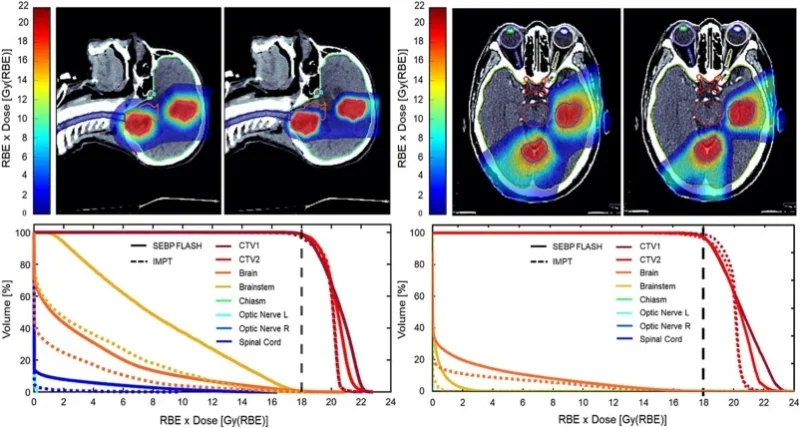
Target coverage was very similar between the two approaches. The average CTV V18 Gy(RBE) was 98.25% with SEBP-FLASH and 98.31% with IMPT. Maximum target doses were also within acceptable limits, averaging approximately 22.46 Gy(RBE) for SEBP-FLASH and 22.24 Gy(RBE) for IMPT.
Organs at risk remained within clinical constraints in both planning approaches. IMPT showed modestly lower organ-at-risk doses overall, but SEBP-FLASH still met accepted SRS planning recommendations.
The main tradeoff was intermediate dose spill to normal brain. SEBP-FLASH had a higher normal brain V12 Gy(RBE) and mean brain dose compared with IMPT. This likely reflects the technical features of the single-energy Bragg peak approach, including the use of range shifters and compensators, which can broaden the lateral penumbra.
FLASH Dose Rate Performance
The major advantage of SEBP-FLASH was its ability to achieve ultra-high dose rates.
Using voxel-based average dose rate analysis, the authors assessed the proportion of targets and organs at risk receiving dose rates at or above 40 Gy(RBE)/s.
At a dose threshold of 5 Gy(RBE), SEBP-FLASH achieved very high FLASH dose rate coverage:
- 97.37% for normal brain
- 99.98% for brainstem
- 100% for spinal cord
- 98.88% for CTV
This suggests that SEBP-FLASH can deliver most of the clinically relevant high-dose region at FLASH-compatible dose rates, while preserving the conformality needed for stereotactic radiosurgery.
What the Figures Show
The representative dose distributions show that SEBP-FLASH can generate focused intracranial dose patterns across multiple beam arrangements, including cases where all beams treat all targets and cases where different beams are assigned to different lesions.
The dosimetric comparison figure shows broadly similar target coverage between SEBP-FLASH and IMPT, while also illustrating the slightly greater low- and intermediate-dose spread with SEBP-FLASH.
The dose-rate maps demonstrate the central technical message of the study: SEBP-FLASH can achieve high ultra-high dose rate coverage in and around the target regions, which conventional IMPT cannot reliably achieve because of delivery time and energy-layer switching limitations.
Important Limitations
This remains a planning and feasibility study, not a clinical outcomes study.
The authors emphasize that the biological FLASH effect is still not fully understood, and current dose-rate metrics are only approximations. The study used physical dose and dose-rate analysis but did not apply a validated FLASH-specific biological model.
Another important limitation is that SEBP-FLASH showed higher intermediate dose to normal brain than IMPT. Whether the potential FLASH tissue-sparing effect can compensate for this dosimetric tradeoff will require biological validation and eventually clinical testing.
The optimal dose, fractionation, and dose-rate parameters for FLASH treatment of brain tissue also remain uncertain.
Clinical Takeaway
This study shows that single-energy Bragg peak FLASH proton therapy can produce stereotactic radiosurgery plans for multiple brain metastases with target coverage and organ-at-risk doses comparable to IMPT, while reaching ultra-high dose rates in clinically relevant high-dose regions.
The approach is not ready to replace standard SRS, but it offers a promising technical pathway for future FLASH intracranial radiosurgery.
For patients with multiple brain metastases, large treated volumes, re-irradiation needs, or lesions close to critical structures, the possibility of combining stereotactic precision with FLASH-mediated normal tissue sparing is an exciting direction for future research.
The next steps will be biological validation, refinement of dose-rate metrics, technical optimization to reduce dose spill, and carefully designed early-phase clinical trials.
Read full article here.