





Few clinical scenarios in modern oncology are as challenging or as thought provoking as treating cancer in patients who have previously undergone solid organ transplantation.
Immune checkpoint inhibitors (ICIs) have fundamentally transformed cancer treatment, producing durable responses and long term survival in diseases once considered uniformly fatal. By releasing inhibitory immune checkpoints such as PD-1, PD-L1, and CTLA-4, these therapies empower cytotoxic T cells to recognize and eliminate malignant cells. For millions of patients worldwide, they have redefined what is possible in cancer care.
Yet this remarkable therapeutic success creates a profound paradox for transplant recipients.
The very immune system oncologists strive to activate is the same immune system transplant physicians have spent years suppressing to protect a donated organ. Restoring immune surveillance against cancer may simultaneously restore immune recognition of the transplanted kidney, liver, heart, or lung, placing patients at risk of acute, and sometimes irreversible, allograft rejection.
This dilemma is becoming increasingly relevant. Advances in transplantation, immunosuppressive therapy, and long term post transplant care have significantly improved survival, allowing more recipients to live long enough to develop age related and immunosuppression associated malignancies. At the same time, immune checkpoint inhibitors have become a standard treatment for an expanding number of cancers, creating a clinical challenge that until recently had very little evidence to guide decision making.
As highlighted by Shun Kawashima, Naoka Murakami, and colleagues in their review Immune Checkpoint Inhibitors for Solid Organ Transplant Recipients: Clinical Updates, recipients of solid organ transplants were systematically excluded from the pivotal clinical trials that established immune checkpoint inhibitors as a standard of care. As a result, clinicians have had to rely on case reports, retrospective analyses, and, more recently, prospective studies to determine whether the potential benefits of immunotherapy outweigh the risk of graft rejection.
Today, the discussion is no longer simply whether immunotherapy should be considered after organ transplantation. The more important question is how clinicians can identify the right patient, choose the optimal timing, and achieve the delicate immunological balance that maximizes antitumor activity while preserving a life saving graft.
In this editorial, we explore the biological paradox that lies at the intersection of oncology and transplantation, examine the latest evidence across kidney, liver, heart, and lung transplant recipients, and discuss how emerging biomarkers, evolving immunosuppressive strategies, and multidisciplinary collaboration may shape the future of cancer immunotherapy in this unique patient population.
A Growing Clinical Challenge
Cancer has become an increasingly important cause of morbidity and mortality among solid organ transplant recipients. This trend reflects the remarkable success of modern transplantation. Improvements in surgical techniques, donor selection, and immunosuppressive therapy have significantly extended graft survival, allowing many recipients to live for decades after transplantation. As a result, long-term complications, particularly malignancies, are being encountered more frequently than ever before.
According to Shun Kawashima and colleagues in Immune Checkpoint Inhibitors for Solid Organ Transplant Recipients: Clinical Updates, chronic immunosuppression not only prevents allograft rejection but also weakens immune surveillance, contributing to a substantially higher incidence of cancer compared with the general population. This growing population of patients has created an urgent need for effective cancer therapies that can preserve both tumor control and graft function.
The Immunological Paradox
The success of immune checkpoint inhibitors lies in their ability to restore antitumor immunity. By blocking inhibitory pathways such as PD-1 and PD-L1, these therapies reactivate exhausted T cells, allowing them to recognize and destroy cancer cells. However, the same pathways also play a fundamental role in maintaining immune tolerance toward transplanted organs.
This creates a unique biological paradox. The immune response needed to eliminate a tumor may simultaneously recognize the transplanted organ as foreign, triggering acute allograft rejection. Unlike conventional treatment-related toxicities, graft rejection is not an unintended side effect of immunotherapy. It is a direct consequence of successfully reactivating the immune system.
As described by Takashi Ito and colleagues in The Immunological Paradox: Immune Checkpoint Inhibitors in Liver Transplantation, the PD-1/PD-L1 pathway is a key regulator of peripheral immune tolerance, particularly in the liver, where continuous immune regulation is essential for graft survival. Blocking this pathway can disrupt the delicate balance between immune activation and immune tolerance, placing transplant recipients at risk of rejection while simultaneously enhancing antitumor immunity.
Understanding this biological conflict is essential for interpreting the clinical evidence. The central question is no longer whether immune checkpoint inhibitors work in transplant recipients, but rather which patients can achieve meaningful cancer control without compromising graft survival.
From Case Reports to Clinical Evidence
For many years, the use of immune checkpoint inhibitors in transplant recipients was guided almost entirely by isolated case reports. Some patients experienced remarkable and durable tumor responses while maintaining graft function, whereas others developed rapid and irreversible allograft rejection after only one or two treatment cycles. This variability made it difficult to determine whether these therapies could be used safely in routine clinical practice.
As clinical experience accumulated, larger retrospective studies and systematic reviews began to provide a clearer picture. In their comprehensive review of 144 organ transplant recipients, Alessandra Rünger and colleagues reported that the ideal outcome, defined as effective cancer control with preservation of the transplanted organ, was achieved in approximately 31% of patients. Overall, nearly 70% retained a functioning graft, while 36.9% achieved an objective tumor response, demonstrating that meaningful antitumor activity is possible without inevitable graft loss. The authors also suggested that immunosuppressive regimens containing mTOR inhibitors may be associated with more favorable outcomes.
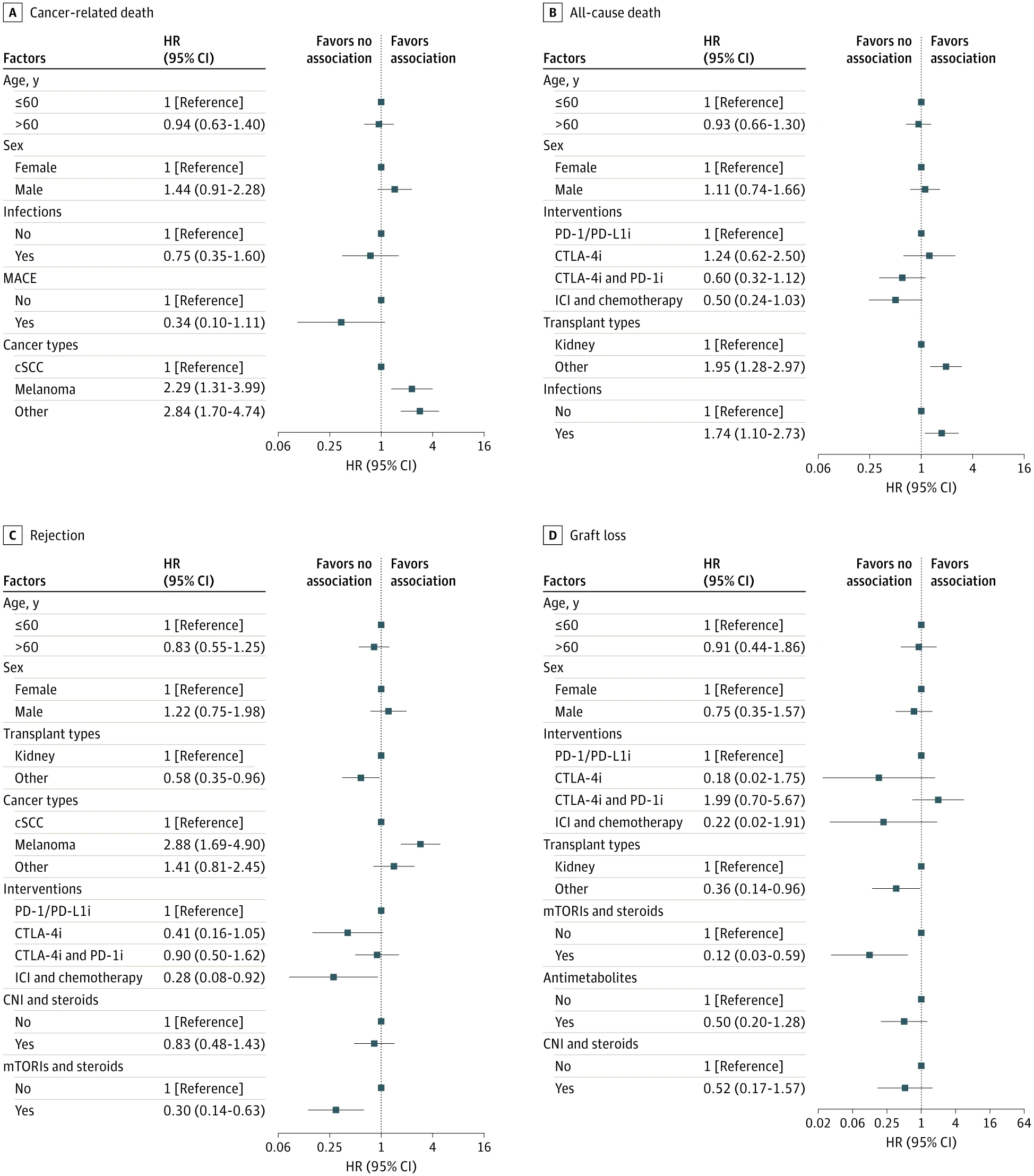
The largest evidence to date came from the 2025 JAMA Oncology individual participant data meta-analysis by Nida Saleem and colleagues, which included 343 solid organ transplant recipients from 128 studies. Acute rejection occurred in 36.2% of patients within one year, while 18.4% experienced graft loss. At the same time, the objective response rate reached 31.6%, with the highest responses observed in cutaneous squamous cell carcinoma. Importantly, maintenance therapy with steroids and mTOR inhibitors was associated with a significantly lower risk of acute rejection, highlighting the critical role of immunosuppressive strategy in patient outcomes.
Although prospective randomized trials remain unavailable, the available evidence has fundamentally changed the clinical perspective. Immune checkpoint inhibitors are no longer viewed as therapies that should automatically be avoided after transplantation. Instead, current research is increasingly focused on identifying the patients who are most likely to achieve durable tumor responses while maintaining long-term graft function.
What Determines Clinical Outcomes?
The growing body of evidence suggests that successful immunotherapy after solid organ transplantation depends on far more than the choice of immune checkpoint inhibitor alone. Clinical outcomes are influenced by a combination of transplant-related, tumor-related, and treatment-related factors.
Kidney transplant recipients represent the largest published experience, largely because graft failure can be managed with dialysis, making clinicians more willing to consider immunotherapy than in recipients of heart or lung transplants, where rejection may have immediate life-threatening consequences.
Tumor biology also appears to influence treatment outcomes. In the JAMA Oncology meta-analysis by Nida Saleem and colleagues, patients with cutaneous squamous cell carcinoma achieved the highest response rates and the most favorable survival outcomes, whereas melanoma was associated with a greater risk of acute rejection. These findings suggest that the expected benefit of immunotherapy may differ substantially across cancer types.
Perhaps the most clinically actionable observation is the role of immunosuppressive management. Across multiple studies, maintenance regimens incorporating mTOR inhibitors, particularly when combined with corticosteroids, were consistently associated with lower rejection rates while preserving meaningful antitumor activity. Although prospective validation is still needed, these findings provide a practical direction for optimizing treatment strategies in carefully selected patients.
Collectively, these studies demonstrate that transplantation itself should not be viewed as the sole determinant of outcome. Rather, successful treatment depends on careful integration of tumor biology, graft characteristics, immunosuppressive management, and multidisciplinary clinical decision-making.
Balancing Benefit and Risk
The accumulated evidence has shifted the clinical conversation from whether immune checkpoint inhibitors can be used after transplantation to how they can be used more safely. Instead of applying a universal approach, clinicians are increasingly adopting individualized treatment strategies based on cancer type, transplant characteristics, immunosuppressive therapy, and patient-specific risk factors.
Although important uncertainties remain, recent studies demonstrate that durable cancer responses and long-term graft preservation are not mutually exclusive goals. Achieving this balance requires careful patient selection, close monitoring, and collaboration between oncologists, transplant physicians, surgeons, pathologists, and immunologists.
Expert Perspective: A Transplant Surgeon’s View
To complement the current evidence, OncoDaily IO invited Dr. Alessandro Anselmo, MD, PhD, FEBS, Consultant Surgeon, Department of Surgery, Liver and Kidney Transplantation Unit, Fondazione PTV Policlinico Tor Vergata, to share his perspective on one of the most challenging intersections between transplantation and cancer immunotherapy.
From a transplant surgeon’s perspective, how do you approach the difficult balance between preserving the graft and treating life-threatening cancer?
“Balance is very difficult to achieve. Of course, from a doctor’s point of view, cancer care has the highest priority. However, we must remember that former dialysis patients have a real fear of returning to dialysis. The type and stage of the tumor are also key factors. More aggressive neoplasms require higher priority than low-grade ones.”
What role should the transplant surgeon play in the multidisciplinary decision-making process when immunotherapy is considered for an organ transplant recipient?
“Within the multidisciplinary team, every specialist should play an active role. The transplant surgeon and/or nephrologist should work closely with the oncologist to modify the immunosuppressive regimen accordingly. For example, reducing mycophenolate mofetil (MMF) may be necessary to allow immunotherapy to work more effectively.”