
Combining DNA-damage response inhibitors with immune checkpoint blockade has been an attractive strategy in thoracic oncology. Poly(ADP-ribose) polymerase inhibitors can increase DNA damage and potentially enhance tumor immunogenicity, providing a biological rationale for combining PARP inhibition with PD-1 or PD-L1 blockade. Early-phase activity with niraparib and pembrolizumab provided sufficient justification to test this hypothesis prospectively in advanced non–small cell lung cancer.
The phase III ZEAL-1L trial now provides a definitive result for this maintenance strategy. Published in the Journal of Thoracic Oncology by Suresh S. Ramalingam and colleagues, the randomized study found that adding niraparib to pembrolizumab after first-line platinum chemotherapy plus pembrolizumab did not improve progression-free survival in patients with advanced or metastatic NSCLC without a known targetable driver alteration.
The negative primary endpoint was clear: among patients who had achieved a complete or partial response to first-line chemoimmunotherapy, median PFS was 5.55 months in both treatment groups, with a hazard ratio of 1.00. Subsequent efficacy endpoints, including overall survival and CNS progression, also showed no evidence of benefit, although they could not be formally tested after the primary endpoint failed under the study’s hierarchical statistical design.
The results add to a growing body of evidence suggesting that PARP inhibition should not be added empirically to checkpoint blockade in biologically unselected metastatic NSCLC.
ZEAL-1L Tested a Maintenance Intensification Strategy
ZEAL-1L was a multicenter, randomized, double-blind, placebo-controlled phase III study enrolling patients with stage IIIB or IIIC NSCLC not suitable for definitive chemoradiotherapy, or stage IV disease, without a known targetable driver alteration. Both squamous and nonsquamous histologies were eligible.
Importantly, patients had already completed four to six cycles of first-line platinum-based chemotherapy with pembrolizumab and were required to have achieved complete response, partial response, or stable disease before entering the maintenance phase. ECOG performance status had to be 0 or 1, and patients with asymptomatic brain metastases could participate. A total of 666 patients were randomized:
- 331 to niraparib plus pembrolizumab
and
- 335 to placebo plus pembrolizumab.
Niraparib was administered orally once daily at 200 mg or 300 mg according to baseline weight and platelet count, while pembrolizumab was given at 200 mg intravenously every three weeks. The central clinical question was therefore straightforward: after initial disease control with chemoimmunotherapy, could adding a PARP inhibitor deepen or prolong the benefit of pembrolizumab maintenance?
The Primary Endpoint Was Unequivocally Negative
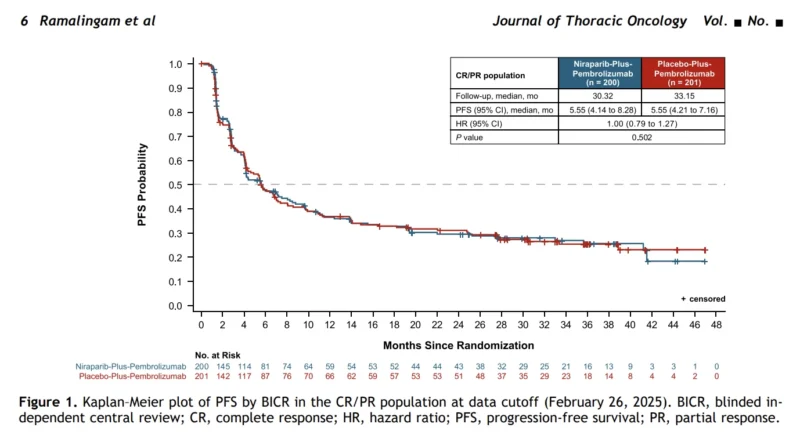
The primary endpoint was blinded independent central review–assessed PFS among patients who entered maintenance treatment with a complete or partial response to first-line therapy. This population included 200 patients in the niraparib arm and 201 in the placebo arm.
Median PFS was:
- 5.55 months with niraparib plus pembrolizumab
versus
- 5.55 months with placebo plus pembrolizumab.
The hazard ratio was:
- HR 1.00; 95% CI, 0.79–1.27; one-sided P=0.502.
The Kaplan–Meier curves shown on page 6 of the paper are almost completely overlapping, visually reinforcing the absence of a maintenance benefit. This was not a near-negative study with a numerical trend in favor of experimental therapy. For the primary population, the median PFS values were identical and the HR was exactly 1.00.
The Broader ITT Population Showed the Same Result
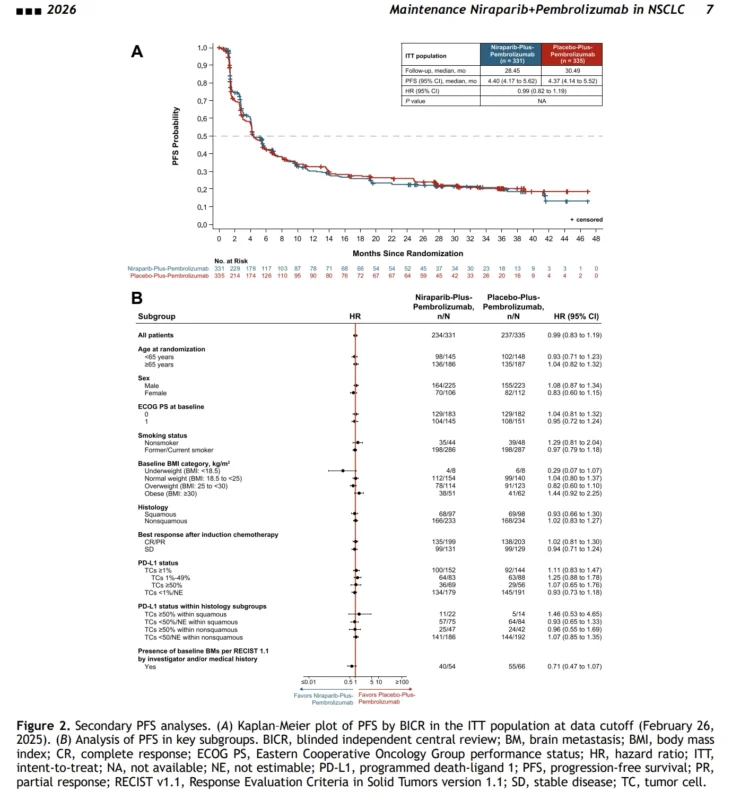
The lack of activity was not confined to patients who had achieved an objective response during induction. In the full intention-to-treat population, median PFS was:
- 4.40 months with niraparib plus pembrolizumab
versus
- 4.37 months with placebo plus pembrolizumab
The HR was 0.99; 95% CI, 0.82–1.19. This near-identical result strengthens the conclusion that adding niraparib did not meaningfully alter disease control during maintenance. Because ZEAL-1L used a prespecified hierarchical testing strategy, failure of the primary endpoint meant that subsequent key endpoints were analyzed descriptively rather than formally tested for statistical significance. That statistical distinction is important when interpreting the survival results.
Overall Survival Did Not Suggest a Hidden Benefit
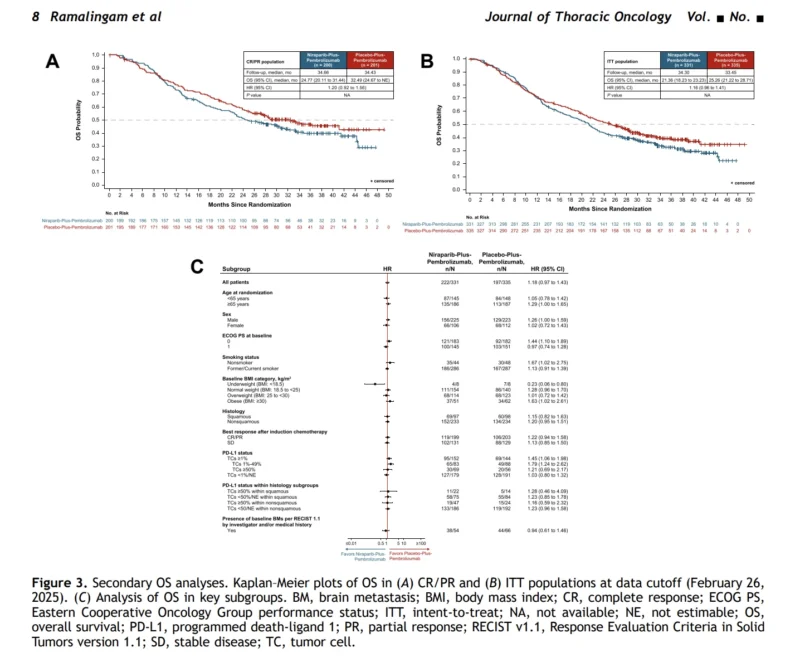
The descriptive OS results likewise did not favor the niraparib combination. Among patients with a CR or PR after induction, median OS was:
- 24.77 months with niraparib plus pembrolizumab
versus
- 32.49 months with placebo plus pembrolizumab, with an HR of 1.20; 95% CI, 0.92–1.56.
In the full ITT population, median OS was:
- 21.36 months
versus
- 25.26 months, with an HR of 1.16; 95% CI, 0.96–1.41.
These endpoints were not formally tested after the failure of the primary endpoint, so they should not be interpreted as demonstrating statistically worse survival with niraparib. Nevertheless, there was clearly no suggestion that a meaningful survival benefit had been missed by the PFS analysis.
No Clinical CNS Advantage Despite Blood–Brain Barrier Penetration
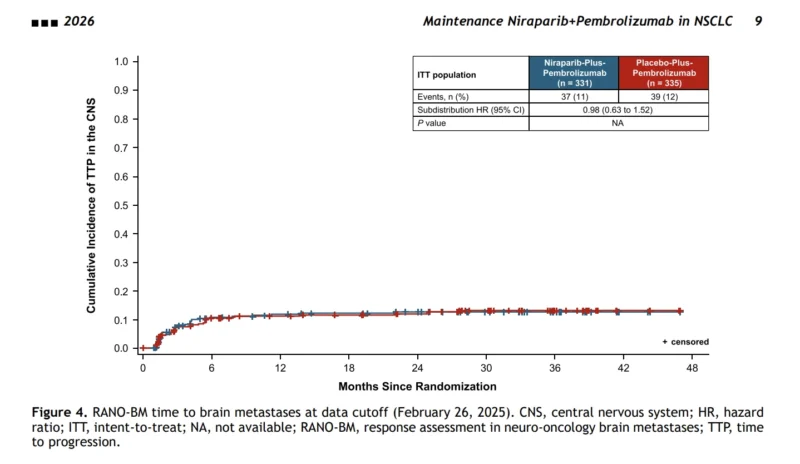
ZEAL-1L also prospectively evaluated time to CNS progression. This was biologically interesting because niraparib is capable of crossing the blood–brain barrier, creating the possibility that maintenance PARP inhibition might provide additional control of intracranial disease.
That hypothesis did not translate clinically. The subdistribution HR for time to CNS progression was:
- 0.98; 95% CI, 0.63–1.52. PIIS155608642600540X
The CNS curves shown on page 9 of the publication are again essentially overlapping. The authors therefore concluded that niraparib’s pharmacologic CNS penetration did not provide a measurable clinical advantage in this population.
Subgroup Analyses Did Not Identify a Clear Benefiting Population
The negative result was generally consistent across the major clinical subgroups. For PFS, the HR was:
- 0.93 in squamous NSCLC
- 1.02 in nonsquamous NSCLC
- 1.02 among patients with CR/PR
- 0.94 among patients entering maintenance with stable disease
There was also no convincing differential effect according to PD-L1 status. Among patients with PD-L1 expression ≥1%, the PFS HR was 1.11, while in patients with PD-L1 <1% or non-evaluable status it was 0.93.
One exploratory signal appeared among patients with baseline brain metastases, where the PFS HR was 0.71, compared with 1.08 among patients without brain metastases. However, the confidence interval for the brain-metastasis subgroup crossed 1, and the overall CNS endpoint was negative. The study therefore does not support selecting niraparib maintenance on the basis of these routine clinical characteristics.
PD-L1 Did Not Rescue the Strategy
The OS subgroup analysis produced another observation that requires caution. Among patients with PD-L1 expression ≥1%, the descriptive OS HR was 1.45, compared with 1.03 in those with PD-L1 <1% or non-evaluable status. These analyses were not part of the formally tested hierarchy after the primary endpoint failed, and they should not be used to claim a detrimental treatment interaction according to PD-L1 status.
What they do demonstrate is the absence of a clinically identifiable PD-L1-defined population in which niraparib clearly improved outcomes.
This is relevant because earlier development of PARP–checkpoint inhibitor combinations was partly based on the possibility that increased DNA damage could enhance immunogenicity. ZEAL-1L provides little evidence that baseline PD-L1 expression can identify patients in whom that biological hypothesis becomes clinically meaningful.
The Cost of Intensification Was Additional Hematologic Toxicity
The experimental strategy also increased toxicity. Any treatment-related treatment-emergent adverse event occurred in:
- 74% with niraparib plus pembrolizumab
versus
- 66% with pembrolizumab alone
Grade 3–5 treatment-related events occurred in:
- 31% versus 14%
As expected from the known safety profile of niraparib, the major additional toxicities were hematologic.
In the niraparib arm:
- Anemia occurred in 25% overall and 8% at grade 3–5
- Thrombocytopenia occurred in 21% overall and 7% at grade 3–5
- Neutropenia occurred in 10% overall and 5% at grade 3–5
Any-cause grade 3–5 adverse events occurred in 44% of patients receiving niraparib compared with 35% receiving placebo. Thus, maintenance intensification increased treatment burden without improving the primary efficacy endpoint.
Rare AML and MDS Events Were Observed
Two hematologic malignancies were reported in the niraparib group:
- one case of acute myeloid leukemia
- one case of myelodysplastic syndrome
Neither was reported in the placebo group. Four treatment-related deaths occurred overall: two in each study group. Events in the niraparib arm were sudden death and pneumonitis; those in the placebo arm were colitis and pneumonia.
The investigators reported no new safety signals, and discontinuation of niraparib or placebo due to treatment-emergent adverse events was relatively similar at 17% versus 15%. Patient-reported global health status and quality of life also did not differ meaningfully between treatment groups.
ZEAL-1L Fits a Broader Pattern of Negative PARP–Immunotherapy Trials in NSCLC
The importance of ZEAL-1L extends beyond niraparib. The investigators place the trial within a broader series of studies evaluating PARP inhibition with checkpoint blockade in metastatic NSCLC. In the phase II ORION study, olaparib plus durvalumab produced a numerical PFS increase but did not demonstrate a statistically significant efficacy advantage.
In KEYLYNK-006, olaparib plus pembrolizumab did not outperform pemetrexed plus pembrolizumab as maintenance therapy in metastatic nonsquamous NSCLC. The phase III KEYLYNK-008 study in squamous NSCLC also failed to meet its prespecified statistical boundaries for PFS or OS.
Taken together with ZEAL-1L, these findings substantially weaken the strategy of broadly combining PARP inhibition with PD-(L)1 blockade in unselected NSCLC.
The Problem May Be Biological Selection Rather Than the Drug Class Alone
The negative result does not necessarily demonstrate that PARP inhibition has no therapeutic role in lung cancer. Rather, the authors suggest that the central problem may be the use of the strategy in a biologically unselected population.
PARP inhibitors are most effective in tumors with specific deficiencies in homologous recombination repair. In NSCLC, those biologically relevant DNA-repair phenotypes may represent only a subset of patients. ZEAL-1L did not select patients according to homologous recombination deficiency or a specific DNA repair biomarker.
The investigators are therefore conducting additional tumor biomarker analyses to determine whether homologous recombination repair deficiency might identify a population with greater sensitivity to PARP inhibition. This may represent the most important translational question emerging from the study.
Instead of asking whether PARP inhibitors should be combined with immunotherapy in NSCLC generally, future research may need to ask whether a molecularly defined subset of NSCLC possesses sufficient DNA-repair vulnerability to make PARP inhibition clinically meaningful.
Maintenance Intensification Needs a High Evidentiary Bar
ZEAL-1L also illustrates a broader principle in metastatic NSCLC. Patients entering a maintenance trial have already demonstrated disease control with first-line therapy. Adding another drug therefore needs to produce sufficient additional efficacy to justify new toxicity, monitoring requirements, and treatment burden.
In ZEAL-1L, the addition of niraparib increased hematologic toxicity but left median PFS completely unchanged in the primary population. This is particularly informative because the trial enriched the primary efficacy analysis for patients who had already responded to platinum-based chemoimmunotherapy, a group that might theoretically have been more likely to retain platinum sensitivity and potentially derive benefit from PARP inhibition.
Even in that selected clinical population, the strategy was ineffective. The result suggests that response to platinum chemotherapy alone is not an adequate biomarker for PARP inhibitor sensitivity in NSCLC.
The Bottom Line
The phase III ZEAL-1L trial provides a clear negative result for maintenance niraparib plus pembrolizumab in advanced or metastatic NSCLC without a targetable driver alteration. Among patients who had achieved a complete or partial response to first-line platinum chemotherapy plus pembrolizumab:
- Median PFS: 5.55 vs 5.55 months
- HR 1.00; 95% CI, 0.79–1.27
- P=0.502
The full ITT analysis similarly showed no PFS advantage, while descriptive OS and CNS progression results did not suggest benefit. The experimental strategy also increased treatment-related toxicity, particularly anemia, thrombocytopenia, and neutropenia.
ZEAL-1L therefore argues against empiric addition of PARP inhibition to pembrolizumab maintenance in an unselected NSCLC population. More broadly, when considered alongside ORION and the KEYLYNK program, the trial suggests that PARP–immunotherapy combinations are unlikely to succeed in metastatic NSCLC without substantially better biological selection.
The remaining question is no longer whether every patient responding to platinum therapy should receive a PARP inhibitor. It is whether molecular profiling can identify the smaller subset whose tumors actually possess the DNA-repair vulnerability required for the strategy to work.
Reference
- Ramalingam SS, Velcheti V, Altan M, de Castro G Jr, Thomas M, Sanborn RE, Maziéres J, Schuler M, Isaksson J, Schenker M, Poddubskaya E, Kim YJ, Parakh S, Liu W, Whipple Neibauer M, Aghera V, Chiu G, Peters S. Phase III Study of Niraparib Plus Pembrolizumab as Maintenance Therapy for Advanced or Metastatic NSCLC (ZEAL-1L). Journal of Thoracic Oncology. 2026. doi:10.1016/j.jtho.2026.104087.