A large nationwide Korean study suggests that patients with advanced non-small cell lung cancer who complete 2 years of immune checkpoint inhibitor therapy may experience durable treatment-free survival after stopping treatment.
Published in Lung Cancer, the study analyzed real-world outcomes using the Korean Health Insurance Review and Assessment Service database. Investigators evaluated patients with advanced NSCLC who received immune checkpoint inhibitors after platinum-based chemotherapy between 2017 and 2022.
The key question was clinically important: what happens after patients stop immune checkpoint inhibitor treatment at 2 years?
This question matters because many pivotal immunotherapy trials used a fixed 2-year treatment duration, and reimbursement policies in several health systems follow this approach. In South Korea, reimbursement for post-platinum immune checkpoint inhibitor therapy has been limited to 2 years since 2017.
The study found that among patients who completed 2 years of immunotherapy, median treatment-free survival was 32.8 months, and median overall survival was not reached.
Why This Study Matters
Immune checkpoint inhibitors have changed the treatment landscape for advanced NSCLC.
Agents such as pembrolizumab, nivolumab, and atezolizumab can produce durable responses in a subset of patients. However, the optimal treatment duration remains a major practical question.
For patients who are still responding after 2 years, stopping treatment can create anxiety. Patients and clinicians often wonder whether disease control will continue without therapy.
This is especially relevant in health systems where reimbursement limits treatment duration.
Treatment-free survival is an important endpoint in this setting. It captures the time a patient remains alive and free from new systemic treatment after completing immunotherapy. For patients with advanced disease, this period can mean less toxicity, fewer hospital visits, lower financial burden, and improved quality of life.
Study Design
The investigators used the Korean Health Insurance Review and Assessment Service database, which captures nearly all reimbursed healthcare utilization in South Korea.
They identified 10,275 adults with lung cancer who initiated post-platinum immune checkpoint inhibitor monotherapy between 2017 and 2022.
The study included patients treated with pembrolizumab, nivolumab, or atezolizumab. Patients who received immune checkpoint inhibitors for at least 2 years were classified as 2-year completers. Patients who stopped before 2 years were classified as discontinuers.
The main outcomes included treatment-free survival, overall survival, subsequent treatment patterns, and new-onset comorbidities after immune checkpoint inhibitor initiation.
Treatment-free survival was defined as the time from ICI completion to subsequent therapy or death among 2-year completers.
Patient Population
Among the 10,275 patients included in the analysis, 78.0% were male, and the median age at ICI treatment initiation was 67 years.
Most patients had no known actionable driver mutation based on claims-derived treatment history. Overall, 7.7% had known driver alterations.
Most patients had a Charlson Comorbidity Index score of 3 or higher at ICI initiation.
The most commonly used ICI was atezolizumab, received by 4,709 patients. Pembrolizumab was used in 3,289 patients, and nivolumab in 2,277 patients.
Only a Small Fraction Completed 2 Years of Immunotherapy
Overall, 786 patients completed 2 years of immune checkpoint inhibitor therapy, representing 7.6% of the full cohort.
Completion rates differed by ICI agent.
Pembrolizumab had the highest 2-year completion rate at 12.8%. Nivolumab had a completion rate of 8.0%, and atezolizumab had a completion rate of 3.9%.
These differences likely reflect South Korea’s PD-L1-based reimbursement structure during the study period. Pembrolizumab was reimbursed for patients with PD-L1 tumor proportion score of at least 50%, nivolumab for TPS of at least 10%, and atezolizumab regardless of PD-L1 status.
Because individual PD-L1 values were not available in the claims database, ICI agent served as an indirect marker of PD-L1 category.
What Happened After ICI Discontinuation?
The post-treatment patterns were very different between completers and discontinuers.
Among 2-year completers, 68.2% did not receive further systemic therapy after ICI completion. Only 9.5% of those without post-treatment systemic therapy died within 42 days after completion.
By contrast, among discontinuers, 43.8% received no additional systemic treatment, and 60.0% of these untreated patients died within 42 days of discontinuation.
In addition, 47.1% of discontinuers started subsequent anticancer therapy within 42 days.
These patterns suggest that most early discontinuations were probably related to disease progression, although claims data could not directly confirm radiographic progression or distinguish progression from toxicity-related discontinuation.
Durable Treatment-Free Survival After 2 Years
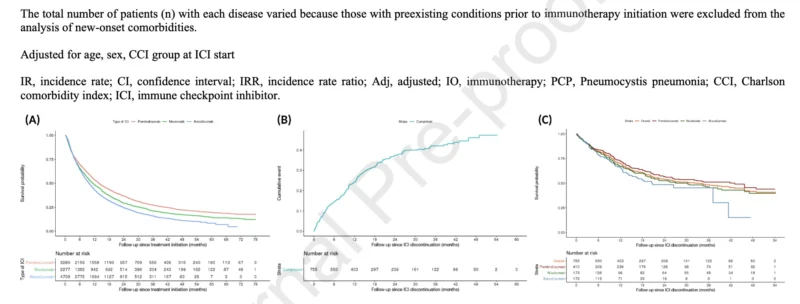
Among 2-year completers included in survival analyses, median overall survival from ICI initiation was not reached.
Median follow-up among completers was 44.6 months.
After completing ICI therapy, 90.2% of patients were alive at 1 year, and 77.1% were alive at 2 years.
The median treatment-free survival was 32.8 months.
This means that many patients who completed 2 years of immunotherapy remained alive without starting new systemic treatment for a prolonged period.
The cumulative rates of subsequent chemotherapy or radiotherapy initiation were 24.2% at 1 year, 37.4% at 2 years, and 42.1% at 3 years after ICI completion.
Similar TFS Across ICI Agents
Treatment-free survival did not differ significantly across ICI agents among 2-year completers.
Median TFS was numerically longest with pembrolizumab at 43.0 months, followed by nivolumab at 30.2 months and atezolizumab at 20.7 months.
However, these differences were not statistically significant.
This finding suggests that once patients reached the milestone of completing 2 years of ICI therapy, durable benefit could be observed across different ICI agents.
The authors cautioned that direct comparison between agents should not be made from these data, because treatment assignment was not randomized and was influenced by PD-L1-based reimbursement criteria.
Comorbidities Were Not Increased After Person-Years Adjustment
The study also examined new-onset comorbidities and infections after ICI initiation.
In crude unadjusted comparisons, 2-year completers appeared to have higher rates of several new comorbidities. However, this was expected because completers lived longer and had more time for new diagnoses to be recorded.
After adjusting for person-years of follow-up, most new-onset comorbidity rates were similar or lower among 2-year completers compared with discontinuers.
Adjusted incidence rate ratios were significantly lower in 2-year completers for several conditions, including congestive heart failure, cerebrovascular disease, dementia, chronic pulmonary disease, type 2 diabetes, hypertension, liver disease, paraplegia or hemiplegia, and Pneumocystis pneumonia infection.
For example, the adjusted incidence rate ratio was 0.430 for congestive heart failure and 0.581 for type 2 diabetes.
This reversal after person-years adjustment highlights an important methodological point: longer survival can make crude adverse event comparisons misleading.
Thyroid Hormone Use Requires Attention
Use of thyroid hormone replacement after ICI initiation was numerically higher among 2-year completers in the person-years analysis, although this difference was not statistically significant.
In a landmark analysis restricted to patients who survived at least 2 years, thyroid hormone use was significantly more frequent among 2-year completers.
This finding is consistent with known immune checkpoint inhibitor-associated thyroid dysfunction.
It also supports the need for long-term endocrine monitoring in patients with prolonged ICI exposure, including after treatment discontinuation.
Long-Term Survivorship Surveillance Is Still Needed
Although comorbidity rates were not increased overall after person-years adjustment, the timing of new comorbidities is clinically important.
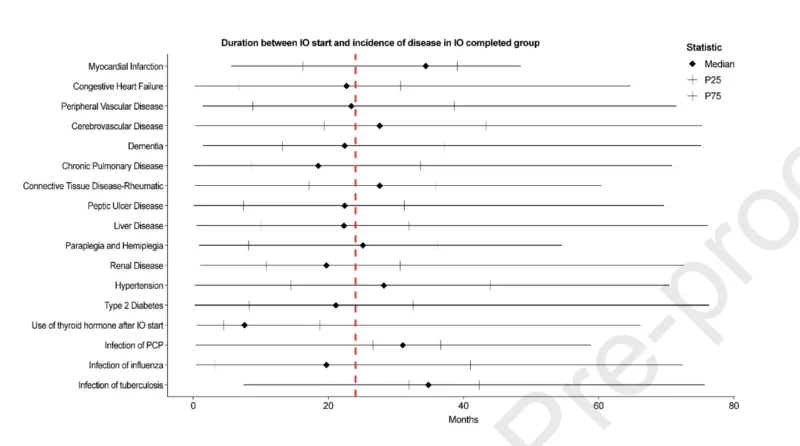
Among 2-year completers, most new-onset comorbidities emerged gradually. Median onset times ranged from 18 to 35 months after ICI initiation.
Hypertension had a median onset of 28.2 months, type 2 diabetes 21.1 months, and myocardial infarction 34.4 months. Infections also had variable timing, with Pneumocystis pneumonia and tuberculosis tending to occur later, while influenza occurred earlier.
The authors emphasized that events were broadly distributed across follow-up, including some early events.
This means survivorship care should not end when immunotherapy stops. Patients who complete long-term ICI treatment still require monitoring for delayed immune-related adverse events and new medical conditions.
Clinical Meaning
This study provides important real-world evidence for time-limited immunotherapy in advanced NSCLC.
For clinicians, the findings support the idea that completing 2 years of ICI therapy can be followed by a meaningful treatment-free interval in selected patients.
For patients, the median TFS of 32.8 months provides a practical counseling point. Some patients who complete 2 years of ICI may remain off treatment for years.
For policymakers, the study offers data from a natural experiment created by South Korea’s 2-year reimbursement limit.
The results are consistent with prior Western real-world evidence suggesting that fixed-duration immunotherapy can be feasible for long-term responders.
Limitations
The study has important limitations.
First, it used claims data, which lack several clinical details. Individual PD-L1 expression values, tumor mutational burden, ECOG performance status, smoking history, imaging response, and cause of treatment discontinuation were not available.
Second, driver mutation status was inferred from targeted therapy reimbursement history, which may underestimate the true prevalence of actionable alterations.
Third, mortality data came from in-hospital death records, so deaths outside healthcare facilities were not captured.
Fourth, the study focused on second-line or later ICI therapy because first-line pembrolizumab reimbursement began in South Korea only in March 2022. Current practice increasingly uses immunotherapy in the first-line setting, so future studies will be needed in first-line populations.
Finally, the study cannot prove that 2 years is the optimal treatment duration. It shows that patients who were able to complete 2 years had durable outcomes after stopping therapy.
Key Takeaway
In this nationwide Korean real-world cohort of 10,275 patients with advanced NSCLC receiving post-platinum immune checkpoint inhibitor therapy, 786 patients completed 2 years of treatment.
Among 2-year completers, median treatment-free survival was 32.8 months, and median overall survival was not reached. Treatment-free survival did not differ significantly across pembrolizumab, nivolumab, and atezolizumab.
After person-years adjustment, new-onset comorbidity rates were not increased among 2-year completers, although long-term monitoring remains important because comorbidities and delayed adverse events may occur throughout follow-up.
The findings support the clinical appropriateness of time-limited ICI strategies in selected patients with advanced NSCLC and highlight the need for structured survivorship care after immunotherapy completion.