Osimertinib remains a cornerstone of first-line treatment for EGFR-mutant non-small cell lung cancer. Yet even among patients with common sensitising EGFR mutations, the duration of benefit can vary widely.
Concurrent TP53 alterations have long been associated with poorer outcomes on EGFR tyrosine kinase inhibitors. But TP53 is not one biological entity. Some mutations simply impair the tumor-suppressor role of p53, while others may actively create new oncogenic functions.
A multicentre retrospective study published in ESMO Open suggests that this distinction matters.
In patients with EGFR-mutant lung adenocarcinoma treated with first-line osimertinib, TP53 gain-of-function mutations were associated with significantly earlier progression than either TP53 wild-type disease or tumors carrying non-gain-of-function TP53 mutations.
The findings are exploratory and require prospective validation. Still, they may help explain why some tumors initially respond to osimertinib but progress much sooner than expected.
What Are TP53 Gain-of-Function Mutations?
TP53 is one of the most frequently altered genes in cancer.
In its normal form, the TP53 gene produces the p53 protein, which helps regulate cell-cycle arrest, DNA repair, apoptosis, and genomic stability. When TP53 is altered, this tumor-suppressor function can be lost.
However, certain missense TP53 mutations do more than remove p53 activity.
These mutations can create a protein with new cancer-promoting properties. They are referred to as gain-of-function, or GOF, mutations.
In this study, GOF mutations included specific TP53 hotspot variants such as R175H, R248Q, R248W, R249S, R273H, R273C, R273L, R282W, G245S, and R282Q.
The authors investigated whether these functionally distinct mutations could help identify a subgroup of EGFR-mutant NSCLC at higher risk of early resistance to osimertinib.
How Was the Study Conducted?
The multicentre retrospective analysis included patients with advanced or recurrent EGFR-mutant NSCLC treated with first-line osimertinib monotherapy across eight institutions in Japan.
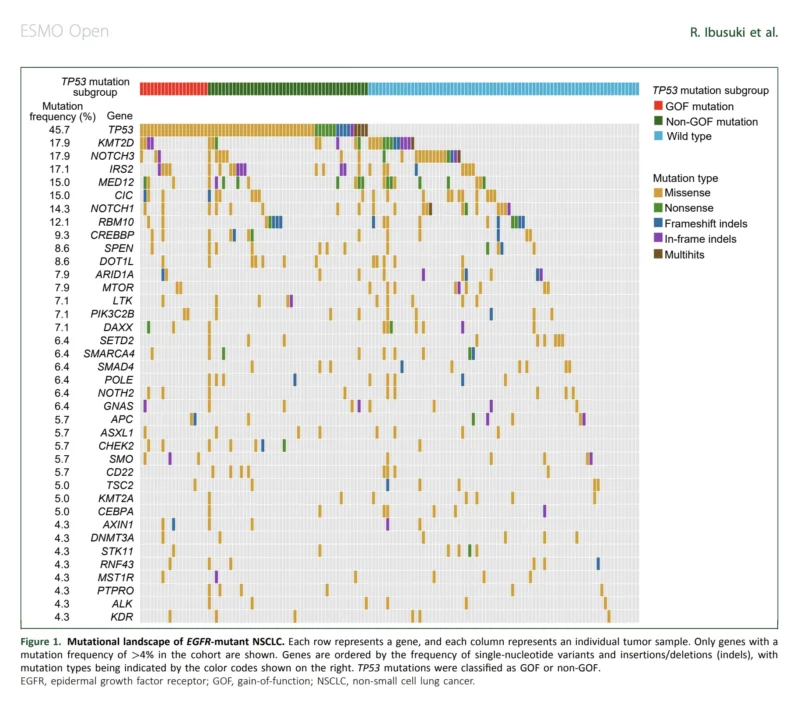
The initial cohort included 221 patients. Tumor material from 140 patients was suitable for comprehensive genomic profiling.
Only patients with common EGFR mutations were included:
- EGFR exon 19 deletions
- EGFR L858R mutations
- TP53 mutations were present in 64 of 140 patients, or 45.7%.
Among the full cohort:
- 19 patients, or 13.6%, had TP53 GOF mutations
- 45 patients, or 32.1%, had TP53 non-GOF mutations
- 76 patients, or 54.3%, had TP53 wild-type tumors
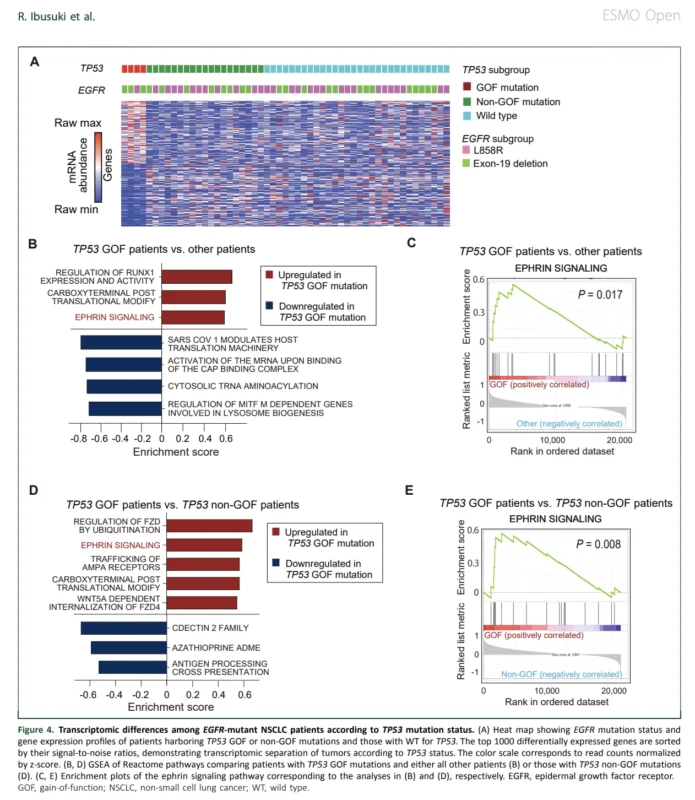
The investigators also performed RNA sequencing in a subset of 53 patients to explore biological pathways associated with TP53 GOF mutations.
TP53 GOF Mutations Were Linked to Earlier Progression
The central finding was a large difference in progression-free survival.
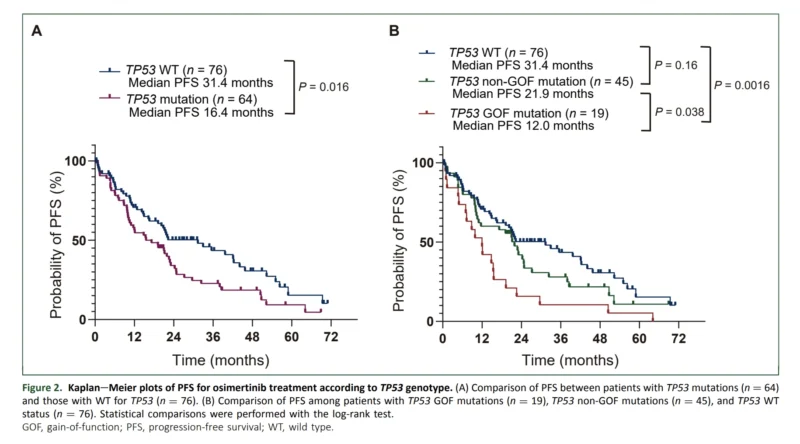
Patients with TP53 GOF mutations had a median PFS of 12.0 months on first-line osimertinib.
This compared with:
- 31.4 months in patients with TP53 wild-type tumors
- 21.9 months in patients with TP53 non-GOF mutations
The difference between TP53 GOF and wild-type disease was statistically significant, as was the difference between TP53 GOF and non-GOF mutations.
The study also found that TP53 GOF mutations were independently associated with poorer PFS in multivariable analysis:
- Hazard ratio: 2.42
- 95% CI: 1.34–4.38
- P = 0.0036
This suggests that the association was not explained only by baseline clinical features, EGFR mutation subtype, or performance status.
Response Rates Were Similar, but Resistance Developed Earlier
One particularly important detail is that TP53 GOF mutations were not associated with a lower initial objective response rate.
In other words, tumors with TP53 GOF mutations could still shrink on osimertinib.
However, those responses were less durable.
Even among patients who achieved a complete or partial response, median PFS was shorter in the TP53 GOF group:
- 14.8 months with TP53 GOF mutations
- 35.5 months with TP53 wild-type tumors
- 24.7 months with TP53 non-GOF mutations
This pattern suggests that TP53 GOF mutations may not drive primary resistance to osimertinib. Instead, they may contribute to the earlier emergence of acquired resistance after an initially favorable response.
That distinction is clinically relevant.
It suggests that the question may not be whether osimertinib works at all in these tumors, but rather how long disease control can be expected to last and whether treatment intensification or closer monitoring should be considered in the future.
A Potential Biological Clue: Ephrin Signaling
To better understand the resistant phenotype, the researchers conducted transcriptomic analyses in tumor samples from 53 patients.
Tumors with TP53 GOF mutations showed distinct gene-expression patterns compared with non-GOF and wild-type TP53 tumors.
The most notable finding was upregulation of the ephrin signaling pathway.
Ephrin pathways are involved in cell migration, invasion, proliferation, and resistance to anticancer therapies. In the TP53 GOF subgroup, the investigators identified higher expression of genes including:
- EFNB1
- EFNB3
- SRC
The pathway signal was also observed in an independent analysis of the TCGA lung adenocarcinoma dataset.
This does not establish ephrin signaling as a clinically actionable resistance mechanism today. However, it offers a biologically plausible direction for future research.
The study also identified possible involvement of RUNX1-related and Frizzled/Wnt-associated pathways, both of which have been linked to epithelial–mesenchymal transition, tumor progression, and treatment resistance.
What Could This Mean for Molecular Testing?
Current molecular testing in EGFR-mutant NSCLC is essential for identifying the primary driver mutation and selecting targeted treatment.
This study suggests that a more granular interpretation of concurrent mutations may also matter.
A report showing “TP53-mutant” disease may not provide the full picture. The functional class of the TP53 mutation could carry additional prognostic information.
For example, a patient with an EGFR exon 19 deletion and a TP53 GOF hotspot mutation may have a different risk profile from a patient with the same EGFR alteration but a non-GOF TP53 mutation or no TP53 mutation.
However, this does not mean TP53 GOF status should yet alter standard first-line treatment.
Osimertinib remains an appropriate standard option for eligible patients with common EGFR mutations. The current results should be viewed as a potential prognostic and biologic signal rather than a validated treatment-selection biomarker.
Important Limitations
The study was retrospective and relatively small, particularly for the TP53 GOF subgroup, which included only 19 patients.
Genomic profiling used a targeted panel rather than whole-exome or whole-genome sequencing. Imaging schedules were not standardized across centers, and the transcriptomic analysis was available for only 53 patients.
The results are therefore not sufficient to establish a new standard of care or to determine whether patients with TP53 GOF mutations should receive a different first-line strategy.
Prospective studies will be needed to confirm the findings and test whether combination strategies can delay resistance in this molecular subgroup.
The Bottom Line
TP53 gain-of-function mutations may identify a biologically distinct subgroup of EGFR-mutant NSCLC with earlier resistance to first-line osimertinib.
In this study, median PFS was 12.0 months in patients with TP53 GOF mutations, compared with 31.4 months in TP53 wild-type tumors and 21.9 months in tumors with non-GOF TP53 mutations.
The findings do not change current treatment standards. But they reinforce an increasingly important idea in EGFR-mutant lung cancer: concurrent genomic alterations are not all equal, and the function of a mutation may matter as much as its presence.