
The rapidly expanding antibody-drug conjugate landscape in lung cancer has gained another important candidate.
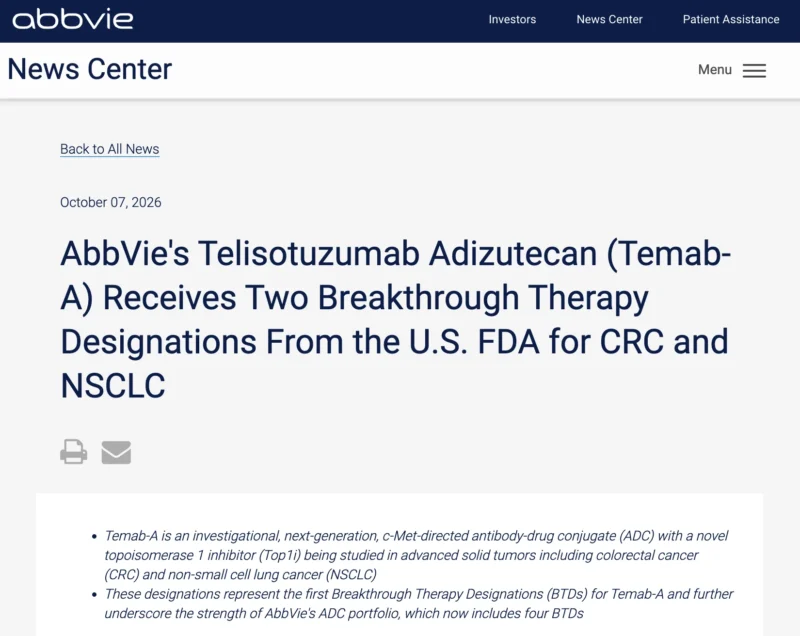
On October 7, 2026, AbbVie announced that the U.S. Food and Drug Administration granted Breakthrough Therapy Designation (BTD) to telisotuzumab adizutecan (Temab-A; ABBV-400) as monotherapy for adults with locally advanced or metastatic, EGFR wild-type, c-Met protein-expressing, nonsquamous non–small cell lung cancer previously treated with platinum-based chemotherapy and an anti-PD-(L)1 antibody.
The designation was primarily based on results from the first-in-human M21-404 trial (NCT05029882) and represents the first FDA Breakthrough Therapy Designation for Temab-A in NSCLC (AbbVie, 2026). Although the announcement does not provide detailed efficacy data from M21-404, the regulatory decision reinforces a broader trend in thoracic oncology: cell-surface protein expression is increasingly being used as a therapeutic address for ADCs, even when the target is not necessarily defined by a classic oncogenic driver alteration.
What Is Telisotuzumab Adizutecan?
Telisotuzumab adizutecan is an investigational, next-generation c-Met-directed antibody-drug conjugate. Its design combines a humanized bivalent IgG1 antibody with high affinity for c-Met protein and a topoisomerase I inhibitor payload. The cytotoxic payload is connected through a cleavable valine-alanine linker with a stable bromoacetamide attachment, a design intended to facilitate targeted delivery while limiting premature systemic payload release (AbbVie, 2026).
Conceptually, the ADC uses c-Met as a delivery address. After the antibody binds c-Met on the tumor cell, the ADC is intended to deliver its Top1 inhibitor payload preferentially to the cancer cell rather than exposing the entire body to an equivalent concentration of cytotoxic therapy.
This makes Temab-A part of the increasingly important shift from simply asking whether a tumor is “target addicted” to asking whether a tumor expresses enough of a cell-surface protein to serve as an effective ADC target.
The NSCLC Population Is Highly Specific
The FDA designation applies to a defined clinical population:
- locally advanced or metastatic
- nonsquamous NSCLC
- EGFR wild-type
- c-Met protein-expressing
with prior treatment including:
- platinum-based chemotherapy
and
- an anti–PD-(L)1 antibody.
This detail is important because the biomarker in the announcement is c-Met protein expression. The press release does not state that patients must have a MET exon 14 skipping alteration or another specific genomic MET abnormality. The therapeutic strategy therefore appears centered on surface protein expression as the ADC target, rather than restricting treatment only to a particular MET genomic driver. That distinction illustrates how ADC development is broadening the meaning of precision oncology.
Why c-Met?
c-Met—also referred to as MET protein, is expressed at increased levels in several solid tumors and has been associated with tumor progression and treatment resistance. AbbVie describes elevated c-Met expression as one reason the protein represents an attractive therapeutic target across multiple malignancies, including NSCLC and colorectal cancer (AbbVie, 2026).
In conventional targeted therapy, MET is often discussed primarily in the context of actionable genomic alterations. ADCs create another therapeutic possibility. The target can potentially function as a cellular docking site, allowing cytotoxic therapy to be delivered selectively even when inhibition of that protein alone may not fully explain the antitumor effect.
This distinction has become increasingly important across oncology as HER2, TROP2, B7-H3, DLL3, HER3, and other surface proteins are developed as ADC targets. c-Met may now be joining that expanding group.
Breakthrough Therapy Designation Is Important, but It Is Not Approval
The terminology requires careful interpretation. FDA Breakthrough Therapy Designation is intended to accelerate the development and regulatory review of investigational therapies when preliminary clinical evidence suggests the drug may provide substantial improvement over available therapy on one or more clinically significant endpoints.
It does not mean that the drug has been approved. AbbVie explicitly states that telisotuzumab adizutecan remains investigational and has not been approved by global regulatory authorities. Therefore, the October 2026 announcement should be interpreted as an important regulatory development supporting accelerated clinical development, not as a change in the current standard of care.
The Evidence Comes From M21-404
Both Breakthrough Therapy Designations announced for Temab-A, one in NSCLC and one in colorectal cancer, were based primarily on the first-in-human M21-404 study. For lung cancer, the designation specifically concerns monotherapy in previously treated EGFR wild-type, c-Met protein-expressing nonsquamous NSCLC. The source provided here does not report numerical outcomes such as:
- objective response rate
- median progression-free survival
- duration of response
- overall survival
- detailed treatment-related toxicity.
Those data therefore cannot be inferred from the Breakthrough Therapy announcement alone. The most defensible conclusion is that the FDA considered the available clinical evidence sufficiently promising to grant expedited-development status. Whether Temab-A ultimately changes practice will depend on mature trial results and confirmatory development.
A Topoisomerase I Payload Adds Temab-A to a Crowded ADC Field
The choice of a Top1 inhibitor payload places Temab-A within one of the most active areas of ADC development. Topoisomerase I payloads have become increasingly prominent because they can provide substantial cytotoxic potency and, depending on the construct, may generate a bystander effect capable of killing neighboring tumor cells.
But this also creates an important future issue for sequencing. As patients begin to receive multiple ADCs, potentially targeting different surface antigens but carrying mechanistically similar payloads, the field will need to determine how much cross-resistance exists at the payload level.
For Temab-A, the future clinical question may therefore not simply be: Does c-Met targeting work?
It may also become: Where should a c-Met-directed Top1 ADC be placed relative to other ADCs using similar cytotoxic mechanisms?
The current press release does not answer that question, but it will become increasingly relevant as the NSCLC ADC landscape expands.
EGFR Wild-Type Selection Is Clinically Meaningful
The designation is limited to EGFR wild-type nonsquamous NSCLC. That matters because patients with oncogenic EGFR alterations follow a different therapeutic pathway and may have distinct treatment sensitivity, resistance biology, and sequencing considerations.
Temab-A is therefore being positioned here within the broader population of previously treated nonsquamous NSCLC without an EGFR driver, following platinum chemotherapy and checkpoint blockade. This is a setting in which new treatment options remain needed despite substantial improvements in first-line therapy.
Once disease progresses after chemoimmunotherapy, therapeutic choices can narrow considerably, particularly when there is no established actionable genomic alteration. A biomarker-defined ADC could potentially create another treatment pathway within that population.
c-Met Protein Expression Could Become a New Selection Strategy
One of the most interesting aspects of Temab-A is therefore not simply the ADC itself but the biomarker strategy surrounding it. Historically, precision medicine in NSCLC has largely been dominated by genomic biomarkers:
- EGFR
- ALK
- ROS1
- BRAF
- MET exon 14
- RET
- NTRK
- KRAS G12C
- HER2,
and others.
ADCs are expanding that model toward quantitative protein-expression biomarkers.The biological question is no longer only:
What mutation drives this tumor?
It can also be: What surface protein does this tumor express strongly enough to deliver an effective payload?
If validated in prospective trials, c-Met expression could become one such biomarker.
Biomarker Definition Will Be Critical
A future challenge will be determining exactly how c-Met protein expression should be measured and what level of expression predicts meaningful benefit. The AbbVie announcement describes the Breakthrough Therapy population as c-Met protein-expressing but does not provide, in the source supplied here, the detailed assay methodology or expression threshold used to define eligibility.
That information will be important for clinical translation. For any protein-directed ADC, the practical questions eventually become:
- How is the biomarker tested?
- What assay should pathology laboratories use?
- What threshold defines positivity?
- Is efficacy proportional to expression level?
- Does expression remain stable after prior treatment?
- Should tumors be retested at progression?
These questions will determine whether a promising biomarker can become a reproducible clinical decision tool.
Temab-A Is Being Developed Beyond Lung Cancer
The FDA simultaneously granted Temab-A another Breakthrough Therapy Designation in refractory metastatic colorectal cancer, where it is being developed in combination with bevacizumab. AbbVie is also studying the ADC across several other advanced solid tumors, including:
- head and neck squamous cell carcinoma
- gastroesophageal adenocarcinoma
- pancreatic ductal adenocarcinoma
- ovarian cancer
The broader development programme includes multiple phase II and phase II/III studies evaluating Temab-A as both monotherapy and in combination strategies. This pan-tumor development strategy reflects the underlying therapeutic concept: if c-Met expression can reliably function as an ADC target, its relevance may extend beyond a single organ of origin.
What We Still Need to Know
Breakthrough Therapy Designation raises expectations, but several questions remain unanswered from the announcement alone. The first is the magnitude and durability of response in the defined NSCLC population. The second is safety. Top1-containing ADCs can carry clinically significant toxicities, and the specific therapeutic window of Temab-A will need to be understood from complete trial data.
The third is biomarker performance: whether c-Met expression truly enriches for benefit and what threshold should be used. The fourth is sequencing, particularly in an era when increasing numbers of patients with NSCLC may be exposed to other ADCs before or after Temab-A.
And finally, randomized evidence will ultimately be needed to determine whether encouraging early activity translates into improved clinically meaningful outcomes compared with available therapy.
The Bottom Line
The FDA has granted Breakthrough Therapy Designation to telisotuzumab adizutecan (Temab-A; ABBV-400) as monotherapy for adults with locally advanced or metastatic EGFR wild-type, c-Met protein-expressing nonsquamous NSCLC, previously treated with platinum chemotherapy and an anti-PD-(L)1 antibody.
The designation was based primarily on evidence from the first-in-human M21-404 study. Temab-A remains investigational and is not yet approved. But the development is significant because it reinforces a changing model of precision therapy in lung cancer.
Genomic alterations remain central. Increasingly, however, cell-surface protein expression may provide another route to precision treatment, not by inhibiting the target itself, but by using it to deliver a potent cytotoxic payload directly to the cancer cell. For c-Met expressing NSCLC, Temab-A may be one of the next major tests of that strategy.
Source
- AbbVie. (2026, October 7). AbbVie’s telisotuzumab adizutecan (Temab-A) receives two Breakthrough Therapy Designations from the U.S. FDA for CRC and NSCLC.