For decades, small-cell lung cancer (SCLC) was defined by a frustrating therapeutic paradox: exceptionally high initial sensitivity to platinum-based chemotherapy followed by rapid relapse, treatment resistance, and poor long-term survival. Unlike non–small cell lung cancer, where genomic discoveries rapidly generated multiple targeted therapies, SCLC remained largely dependent on cytotoxic chemotherapy. That landscape is beginning to change.
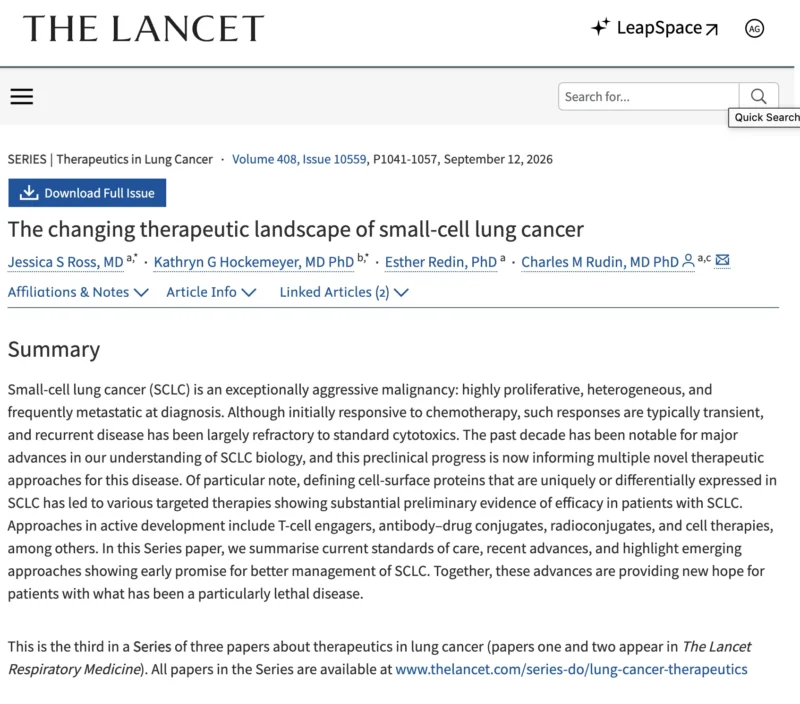
A major 2026 Lancet Series describes a disease moving from broadly applied chemotherapy toward increasingly sophisticated strategies based on immune activation, cell-surface targeting, antibody–drug conjugates, radioconjugates, cellular therapy, and molecular subtype-specific vulnerabilities (Ross et al., 2026).
The central shift is important: SCLC may not have the classic oncogenic drivers that transformed NSCLC, but it does have exploitable biology. In particular, proteins enriched on the tumor-cell surface, such as DLL3, B7-H3, and SEZ6, are creating opportunities to deliver immune cells, cytotoxic payloads, and even radiation directly to SCLC cells. The result is one of the most active periods of therapeutic development the disease has seen.
SCLC Remains an Aggressive Disease Despite Recent Progress
SCLC accounts for approximately 10–15% of lung cancers globally and is characterized by rapid proliferation, early metastatic dissemination, and extensive biological heterogeneity. Around 70% of patients present with metastatic disease, and as many as 50–60% ultimately develop brain metastases during the disease course (Ross et al., 2026).
Long-term outcomes remain poor. The review notes that 5-year overall survival for stage IV SCLC increased from only 3.6% in the late 1970s to 6.8% during 2010–2019. More recent therapies are beginning to alter that historical picture, however, with reported 3-year survival reaching approximately 57% in limited-stage disease treated with durvalumab after chemoradiation and 16–18% in extensive-stage disease treated with chemoimmunotherapy (Ross et al., 2026). The improvement remains modest in absolute terms, but it signals that SCLC is no longer therapeutically static.
Durvalumab Changed the Limited-Stage Paradigm
For most patients with limited-stage SCLC, concurrent platinum–etoposide chemotherapy and thoracic radiotherapy remain the foundation of treatment. The major recent change came from the phase III ADRIATIC trial, which established consolidation durvalumab after chemoradiotherapy.
According to the review, durvalumab for up to 24 months improved median overall survival from 33 months to 56 months and median progression-free survival from 9 months to 17 months compared with placebo (Ross et al., 2026). Importantly, timing appears to matter.
The phase III LU005 trial, which incorporated atezolizumab concurrently with chemoradiotherapy and continued it as maintenance, did not improve PFS and produced a numerically shorter median OS of 31.1 months versus 36.1 months. The review places this observation alongside similar experience in NSCLC and raises the possibility that irradiating tumor-draining lymph nodes during checkpoint inhibition may adversely affect antitumor immune responses (Ross et al., 2026).
The emerging message is therefore more nuanced than simply “add immunotherapy”: sequence and timing may determine whether immunotherapy improves outcomes.
Extensive-Stage SCLC Is Also Moving Beyond Chemoimmunotherapy Alone
Platinum–etoposide plus PD-L1 blockade remains a central first-line strategy for extensive-stage SCLC. IMpower133 and CASPIAN demonstrated that adding atezolizumab or durvalumab to chemotherapy produces a relatively modest improvement in median survival, but the medians do not tell the entire story. In CASPIAN, the review highlights an increase in 36-month survival from 5.7% to 18%, illustrating that a small subset of patients can achieve unusually durable benefit from immunotherapy (Ross et al., 2026).
More recently, IMforte tested whether maintenance could be intensified after initial chemoimmunotherapy. Adding lurbinectedin to maintenance atezolizumab improved median PFS from 2.1 to 5.4 months and median OS from 10.6 to 13.2 months, although cytopenias were more frequent with the combination.
The interpretation is not entirely straightforward. Only 9% of patients in the control group subsequently received lurbinectedin, largely because of limited global access, leaving uncertainty over how much of the observed advantage reflects early maintenance use versus simply ensuring that patients receive the drug at all. That distinction will become increasingly important as SCLC gains more active agents and treatment sequencing becomes more complicated.
Tarlatamab Established DLL3 as a Therapeutic Target
Perhaps the clearest proof that SCLC can be treated through its surface biology comes from tarlatamab. DLL3 is highly enriched on SCLC cells and is directly linked to neuroendocrine differentiation. Tarlatamab is a bispecific T-cell engager that simultaneously binds DLL3 on the cancer cell and CD3 on T cells, physically bringing the immune effector cell into proximity with its target and triggering tumor-cell killing. In the randomized phase III DeLLphi-304 study described in the review, tarlatamab improved:
- Median PFS: 4.2 vs 3.7 months
and, more importantly,
- Median OS: 13.6 vs 8.3 months
compared with investigator-choice chemotherapy after progression following first-line platinum-based therapy. Patient-reported symptoms including cough and dyspnea also improved. For recurrent SCLC, a setting where topotecan, irinotecan, and other cytotoxic therapies have historically produced relatively limited disease control, an improvement of this magnitude establishes a different therapeutic benchmark.
Tarlatamab May Also Have Meaningful CNS Activity
Brain metastases are particularly important in SCLC, affecting as many as half of patients during their disease course. Historically, systemic treatment options with reliable CNS activity have been limited. Platinum–etoposide can induce intracranial responses, but they are frequently short lived, and neither IMpower133 nor CASPIAN clearly reduced the development of new brain metastases.
Tarlatamab appears different. The review describes intracranial response rates reaching 63% in predominantly pretreated brain metastases, while 56% of patients with measurable brain metastases in DeLLphi-304 experienced at least 30% intracranial tumor shrinkage. Real-world evidence has additionally suggested response or stability among some patients with untreated brain metastases, although dedicated prospective studies remain necessary (Ross et al., 2026). If confirmed prospectively, CNS activity could become an important differentiating feature of DLL3-directed treatment.
The Price of T-Cell Engagement Is a Distinct Toxicity Profile
Tarlatamab also introduces toxicities unfamiliar to many traditional SCLC regimens. Cytokine-release syndrome occurred in 56% of patients in DeLLphi-304, although most events were grade 1 or 2. Grade 3 CRS occurred in approximately 1%. Immune effector cell-associated neurotoxicity syndrome occurred in approximately 6%, with most events low grade but one fatal event reported. Because these toxicities occur predominantly around the initial doses, treatment has often required substantial monitoring and sometimes inpatient administration.
The next development question is therefore not only how to improve efficacy but how to make T-cell engager therapy operationally easier. Outpatient administration, prophylactic approaches, and rapid access to agents such as tocilizumab and dexamethasone may ultimately determine how widely these therapies can be deployed.
The SCLC “Surfaceome” Is Becoming a Therapeutic Map
DLL3 is only the beginning. One of the most important concepts emphasized by Ross and colleagues is the SCLC surfaceome: the collection of proteins preferentially expressed on the surface of SCLC cells that can be exploited as therapeutic addresses. The review identifies several major targets:
- DLL3, expressed in roughly 80-90% of SCLC
- SEZ6, reported in approximately 90%
- B7-H3, approximately 65%
- SSTR2, approximately 48%
- GD2, approximately 39%
- TROP2, approximately 20%
These targets are being pursued through T-cell engagers, bispecific antibodies, ADCs, radioconjugates, and CAR T-cell platforms (Ross et al., 2026). This approach differs fundamentally from EGFR or KRAS targeting in NSCLC. DLL3 and several other SCLC surface proteins may not be oncogenic dependencies themselves. Instead, they serve as molecular addresses that allow a therapeutic payload or immune effector to find the tumor cell. That distinction opens a much broader range of drug-development strategies.
ADCs Could Become the Next Major SCLC Drug Class
Antibody-drug conjugates are among the most advanced surface-targeted approaches. No ADC is yet described by the review as approved for SCLC, but several candidates targeting DLL3, B7-H3, SEZ6, and TROP2 are advancing clinically. Early-phase studies have produced response rates of approximately 40–70%, while the review’s key summary highlights response rates reaching 40–75% across some DLL3-, SEZ6-, and B7-H3-directed programmes (Ross et al., 2026).
A particularly striking early result came from the bispecific ADC izalontamab brengitecan, which targets EGFR and HER3. The review reports responses in 15 of 20 patients, or 75%, in a phase I study, without reported interstitial lung disease in that early dataset. These data remain preliminary. Early response rates should not be equated with phase III survival benefit. SCLC has already provided a cautionary example.
Rovalpituzumab Tesirine Is a Reminder That the Target Is Only Part of the ADC
The DLL3-targeted ADC rovalpituzumab tesirine initially generated enthusiasm after a phase I response rate of 38% in DLL3-high disease. It subsequently failed to improve survival in phase III testing.
The review attributes the failure to several potential factors: substantial toxicity from the pyrrolobenzodiazepine payload, a relatively low drug-to-antibody ratio, and possible linker instability causing premature systemic payload release. Grade 3 or worse adverse events occurred in as many as 63% of patients in the later programme. The lesson is critical for the current ADC era. A good target does not guarantee a good ADC. Antibody specificity, internalization, linker stability, drug-to-antibody ratio, payload potency, and the therapeutic window all matter.
The review also highlights another future challenge: many SCLC ADCs currently in development use topoisomerase-I inhibitor payloads. If tumors develop payload-level resistance, sequential use of multiple ADCs carrying the same class of cytotoxic agent may produce diminishing benefit. Payload diversification may therefore become just as important as target diversification.
Radioconjugates Could Turn SCLC’s Radiosensitivity Into Precision Therapy
Another emerging strategy uses the SCLC surfaceome to deliver radiation rather than chemotherapy. Radioconjugates combine a tumor-targeting molecule with a radioactive isotope, potentially allowing highly localized radiation delivery while limiting exposure to normal tissues.
The concept is particularly appealing in SCLC because the disease is inherently radiosensitive. DLL3-directed radioconjugates are being explored using radionuclides including lutetium-177 and actinium-225, while somatostatin receptor-targeted approaches and GD2-directed pretargeted radioimmunotherapy are also under investigation.
Radioconjugates also create a potential theranostic strategy: one isotope could visualize whether the tumor expresses and binds the target, while another could subsequently deliver therapeutic radiation. This could eventually allow imaging to determine whether a patient is likely to benefit before treatment is administered.
CAR T Cells Are Also Reaching SCLC
Cell therapy remains substantially earlier in development, but the review highlights the first signals of activity. In a phase I study of DLL3-directed CAR T-cell therapy, three of 17 patients responded and 13 of 17 achieved disease control. CAR natural killer-cell strategies are also under preclinical investigation.
These results are far from establishing CAR therapy as a standard for SCLC, but they demonstrate that the same surface markers driving bispecific and ADC development can potentially be exploited by engineered cellular therapies. The challenge will be determining whether durable cellular immune control—already possible in selected hematologic malignancies, can be reproduced in a highly heterogeneous solid tumor.
SCLC May Finally Become a Biomarker-Defined Disease
Perhaps the most consequential long-term change involves molecular classification. SCLC has historically been treated as a relatively uniform diagnosis. Modern transcriptomic studies instead identify multiple cellular states characterized by transcriptional programmes involving ASCL1, NEUROD1, POU2F3, and an inflamed phenotype.
These are not necessarily fixed categories. The review emphasizes that SCLC cells demonstrate substantial plasticity and can evolve from one state to another during disease progression and treatment resistance. Yet these states may reveal exploitable vulnerabilities. DLL3 is enriched particularly in high-neuroendocrine SCLC-A and SCLC-N disease.
SCLC-N models may be sensitive to BET or Aurora kinase inhibition. SCLC-P has demonstrated preclinical vulnerabilities to PARP inhibition and the mSWI/SNF complex. SLFN11 may identify tumors with particular sensitivity to DNA damage-directed therapies. These hypotheses are increasingly moving into prospective clinical testing.
PRISM Is Testing Whether SCLC Can Be Treated by Subtype
The ongoing PRISM trial represents an important conceptual milestone because it is the first trial described by the review as prospectively testing subtype-tailored treatment in SCLC. Patients with SCLC-A or SCLC-N and SLFN11-positive disease are being randomized between durvalumab and durvalumab plus the PARP inhibitor saruparib.
Patients with SCLC-I, the inflamed subtype, are being assigned to durvalumab with or without monalizumab, which targets an inhibitory pathway affecting CD8-positive T cells and natural killer cells.
Whether these combinations succeed is not yet known. But the trial itself marks an important change in thinking: SCLC biology is beginning to determine trial enrollment and treatment strategy rather than serving only as a research classification.
Replication Stress Creates Another Therapeutic Vulnerability
Near-universal loss of TP53 and RB1 removes key cell-cycle checkpoints in conventional SCLC, allowing rapid proliferation despite extensive genomic damage. To survive that instability, tumor cells become dependent on the ATR–CHK1–WEE1 replication stress pathway. This creates a potential synthetic-lethal vulnerability.
ATR, CHK1, and WEE1 inhibitors are now being explored, both alone and in combinations with chemotherapy or immunotherapy. The review cautions that monotherapy activity may be limited, but the biological rationale is strong because normal cells retain checkpoint mechanisms that SCLC cells have lost.
Several Major Questions Remain
Despite the enthusiasm surrounding these new approaches, the review makes clear that the therapeutic transformation of SCLC is incomplete.
The field still needs to determine which surface-targeted strategy is optimal, whether one DLL3-directed agent will emerge as best in class, how ADCs should be sequenced, whether payload resistance will limit serial ADC treatment, which molecular subtypes genuinely predict benefit, and whether promising CNS activity can be confirmed prospectively.
Even familiar aspects of care remain unsettled. The role of prophylactic cranial irradiation is increasingly questioned in the MRI-surveillance era. Optimal treatment of SCLC transformed from driver-positive NSCLC remains unclear, and the review notes particularly limited evidence in EGFR-mutated transformed disease. The challenge is therefore shifting.
For many years, the problem was the absence of effective drugs. The coming problem may increasingly be how to choose and sequence a growing number of active therapies.
The Bottom Line
SCLC remains one of the most aggressive malignancies in thoracic oncology, but its therapeutic landscape is changing faster than at any previous point. Durvalumab has changed management after chemoradiation in limited-stage disease. Chemoimmunotherapy has created a long-term survivor population in extensive-stage disease. IMforte has introduced intensified maintenance.
Tarlatamab has established DLL3-directed T-cell engagement as an effective strategy in recurrent disease. And behind these established advances is a rapidly expanding pipeline of DLL3-, SEZ6-, B7-H3-, and TROP2-directed ADCs, next-generation T-cell engagers, radioconjugates, CAR therapies, replication-stress inhibitors, and subtype-selected combinations.
Ross and colleagues note that the past seven years have produced more SCLC drug approvals than the preceding decades, while emphasizing that optimal sequencing and biomarker selection remain unresolved.
The most important change may therefore be conceptual. SCLC is beginning to move from a disease treated largely according to stage and chemotherapy sensitivity toward one increasingly defined by surface antigens, immune biology, cell state, and molecular vulnerability.
For a cancer that remained therapeutically static for decades, that transition may be the beginning of an entirely different era.
Reference
- Ross, J. S., Hockemeyer, K. G., Redin, E., & Rudin, C. M. (2026). The changing therapeutic landscape of small-cell lung cancer. The Lancet, 408(10559), 1041–1057.