Combining simultaneous PD-L1 and VEGF-A blockade with docetaxel has produced an encouraging early efficacy signal in metastatic non-small cell lung cancer progressing after first-line chemoimmunotherapy.
First results from the global phase II ROSETTA Lung-107 trial, presented at ESMO Congress 2026, showed that pumitamig plus docetaxel achieved a confirmed objective response rate of 36.7% and disease control rate of 90.0% among response-evaluable patients.
Median progression-free survival was 6.9 months, while responses were observed across PD-L1 expression categories, including PD-L1-negative tumors.
The safety profile was considered manageable, with 18% of patients experiencing grade ≥3 pumitamig-related treatment-related adverse events, no dose-limiting toxicities, and no treatment-related deaths.
These results are notable in a setting where treatment options after progression on platinum-based chemoimmunotherapy remain limited. However, ROSETTA Lung-107 is a small, single-arm phase II study with short follow-up, and the current data should be interpreted as an early signal rather than evidence that pumitamig has established superiority over existing second-line therapy.
A Difficult Treatment Setting After Chemoimmunotherapy
For metastatic NSCLC without an actionable oncogenic driver, PD-1 or PD-L1 inhibition combined with platinum-based chemotherapy has become a central first-line strategy. The problem begins when disease progresses.
In many patients, treatment options narrow to cytotoxic chemotherapy or chemotherapy combined with anti-angiogenic therapy, with efficacy substantially lower than what is typically seen during first-line treatment.
The historical phase III REVEL trial provides useful context. In patients with stage IV NSCLC progressing after platinum therapy, median PFS was 3.0 months with docetaxel alone and 4.5 months when ramucirumab was added to docetaxel.
Those data predated routine first-line immune checkpoint inhibition, so direct comparison with ROSETTA Lung-107 is inappropriate. Nevertheless, they illustrate the persistent need for more active second-line strategies.
Pumitamig is being developed to address that need through a different form of combined immune and anti-angiogenic therapy.
What Is Pumitamig?
Pumitamig, also known as BNT327 or BMS986545, is an investigational bispecific immunomodulator targeting PD-L1 and VEGF-A within a single molecule. The biological rationale is to combine checkpoint blockade with inhibition of VEGF-driven angiogenesis and immune suppression.
VEGF does more than promote tumor blood-vessel formation. VEGF signaling can contribute to an immunosuppressive tumor microenvironment, affecting immune-cell trafficking and function. Combining VEGF inhibition with PD-(L)1 blockade has therefore become an established therapeutic concept across several malignancies.
Pumitamig attempts to integrate both mechanisms into one bispecific molecule rather than administering two separate antibodies.
BioNTech and Bristol Myers Squibb are jointly developing the agent across multiple tumor types and treatment settings, including several lung cancer programs. ROSETTA Lung-107 asks whether this dual mechanism can restore or enhance antitumor activity after tumors have already progressed on conventional chemoimmunotherapy.
ROSETTA Lung-107 Enrolled Patients After First-Line Progression
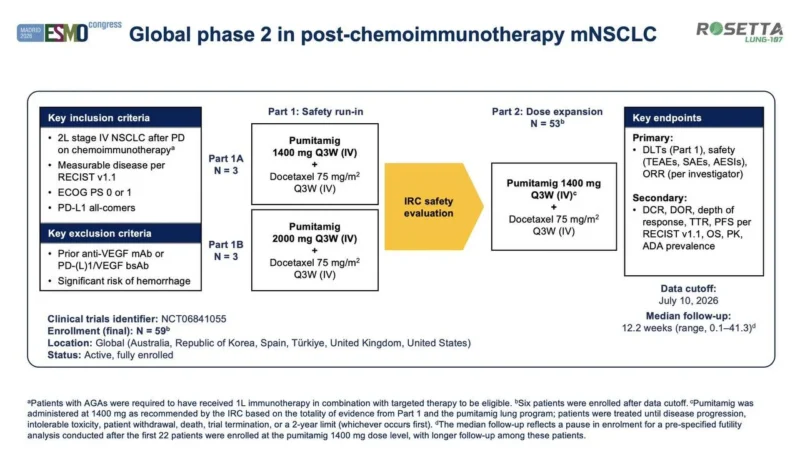
The global, open-label phase II study enrolled patients with stage IV NSCLC whose disease had progressed after first-line chemoimmunotherapy. Patients required measurable disease by RECIST 1.1 and ECOG performance status 0 or 1.
Importantly, enrollment was PD-L1 unselected, allowing evaluation across tumors with TPS below 1%, between 1% and 49%, and at least 50%. Patients with previous anti-VEGF monoclonal antibody therapy or prior PD-(L)1/VEGF bispecific therapy were excluded, as were patients with clinically significant hemorrhage risk.
The safety run-in initially evaluated pumitamig at 1400 mg or 2000 mg every three weeks in combination with docetaxel 75 mg/m² every three weeks.
The subsequent dose-expansion regimen used:
Pumitamig 1400 mg IV every three weeks plus docetaxel 75 mg/m² IV every three weeks.
Final study enrollment was 59 patients, while the July 10, 2026 analysis included 50 patients treated at the 1400-mg pumitamig dose. The median follow-up at that point remained short at 12.2 weeks.
Confirmed Response Rate Reached 36.7%
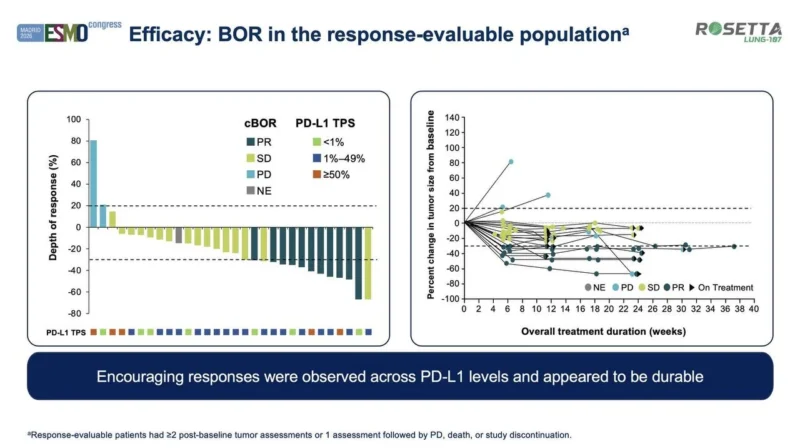
Among 30 response-evaluable patients, 11 achieved confirmed objective responses, producing a confirmed ORR of 36.7%. The confirmed disease control rate was 90.0%.
Median time to response was only 1.4 months, indicating that tumor reduction could occur relatively quickly after beginning treatment. The updated presentation also showed substantial tumor shrinkage across a number of responding patients, with some responses continuing beyond six months at the time of data cutoff.
Because follow-up is still immature, however, the durability of these responses cannot yet be considered established. The early activity signal is nevertheless relevant because the study population had already progressed after both chemotherapy and immune checkpoint inhibition.
Responses Were Observed Across PD-L1 Expression Levels
A potentially important feature of the data was that activity did not appear limited to tumors with high PD-L1 expression. Among the small response-evaluable PD-L1 subgroups, confirmed ORR was:
42.9% in PD-L1 TPS <1% disease, 33.3% in TPS 1%–49%, and 40.0% in TPS ≥50%. Disease control rates were 85.7%, 94.4%, and 80.0%, respectively.
These subgroup numbers are very small, only seven patients had PD-L1-negative disease and five had TPS ≥50%, so they should not be used to conclude that PD-L1 expression has no predictive role.
But the current pattern does suggest that pumitamig activity is not obviously restricted to PD-L1-high tumors. That is biologically interesting because VEGF blockade may potentially modify an immunosuppressive microenvironment even where conventional checkpoint sensitivity is limited.
Whether that mechanism meaningfully broadens activity across PD-L1 categories will require a much larger randomized dataset.
Median PFS Was 6.9 Months
Median PFS in the initial analysis was 6.9 months, with a 95% confidence interval extending from 4.2 months to not reached. That number compares favorably with historical docetaxel results, but several cautions are essential.
This was not a randomized comparison against docetaxel alone. Only a limited number of patients had mature follow-up. The median follow-up of 12.2 weeks was considerably shorter than the reported median PFS estimate, reflecting unequal follow-up created partly by a prespecified enrollment pause and longer observation among the earliest treated patients.
The 6.9-month estimate is therefore encouraging but immature. A randomized trial will be necessary before concluding that adding pumitamig meaningfully prolongs PFS compared with contemporary second-line options.
The Safety Profile Appeared Manageable
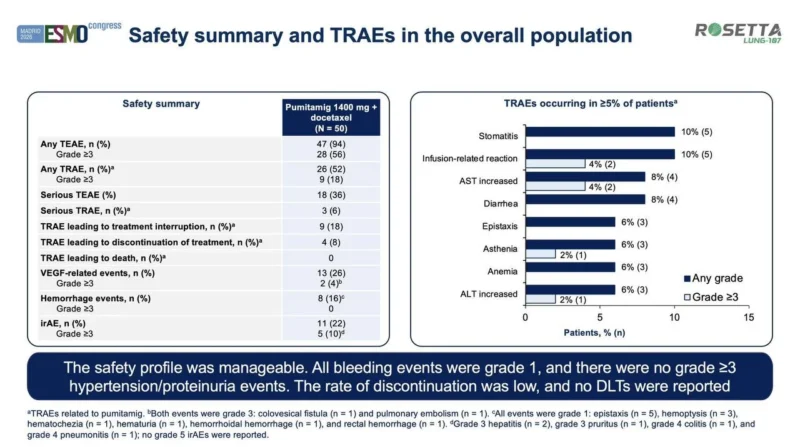
Safety data were available for 50 patients receiving pumitamig 1400 mg plus docetaxel. Any treatment-emergent adverse event occurred in 94%, with grade ≥3 events in 56%.
When investigators assessed events considered related specifically to pumitamig, any-grade treatment-related adverse events occurred in 52%, with grade ≥3 events in 18%. Serious treatment-related adverse events occurred in 6%.
Pumitamig-related adverse events led to treatment interruption in 18% and treatment discontinuation in 8%. There were no treatment-related deaths and no dose-limiting toxicities.
The most frequent pumitamig-related adverse events included stomatitis and infusion-related reactions, each occurring in 10% of patients, followed by increased AST and diarrhea in 8%, and epistaxis, asthenia, anemia and increased ALT in approximately 6% each.
The overall profile suggests that the addition of dual PD-L1/VEGF-A targeting did not produce an unexpectedly high discontinuation rate during early follow-up.
VEGF-Associated Toxicity Requires Continued Monitoring
Because pumitamig neutralizes VEGF-A, vascular toxicity is particularly important. VEGF-related events occurred in 26% of patients, with grade ≥3 events in 4%. The two high-grade events were a colovesical fistula and pulmonary embolism. Hemorrhagic events occurred in 16%, but importantly, all were grade 1 in the updated presentation.
These included epistaxis, hemoptysis and several other minor bleeding events. No grade ≥3 hypertension or proteinuria was reported. This early profile is reassuring, particularly in a lung cancer population where hemoptysis can be clinically important, but the trial deliberately excluded patients at significant bleeding risk.
The observed safety therefore should not automatically be extrapolated to patients with central tumors, major vessel involvement or other high-risk hemorrhagic features who would not have qualified for the study.
Updated Immune-Related Toxicity Was Lower Than in the Abstract
The final ESMO presentation reported immune-related adverse events in 22% of patients, with grade ≥3 events in 10%. These presentation values are lower than the preliminary percentages contained in the earlier abstract and should be considered the updated dataset.
High-grade immune events included grade 3 hepatitis, grade 3 pruritus, grade 4 colitis and grade 4 pneumonitis. No grade 5 immune-related events were reported.
The presence of immune-mediated toxicities despite previous checkpoint-inhibitor exposure confirms that pumitamig retains meaningful immune activity after prior PD-(L)1 therapy, although efficacy cannot be inferred from toxicity alone.
Can VEGF Blockade Re-Sensitize Tumors After Immunotherapy?
This is ultimately the most interesting biological question raised by ROSETTA Lung-107. Every patient had already progressed after immune checkpoint inhibition. Yet a regimen containing another PD-L1-targeting agent generated responses in more than one-third of evaluable patients.
That suggests the activity cannot be understood simply as conventional checkpoint “rechallenge.” One hypothesis is that VEGF-A blockade alters the tumor microenvironment in a manner that makes renewed immune activation possible.
Another is that the bispecific architecture generates different local pharmacology than sequential or separate checkpoint and anti-angiogenic agents.
Docetaxel itself also contributes substantial antitumor activity, meaning the effect of pumitamig cannot be isolated in this single-arm trial. That is precisely why randomized confirmation is essential.
The Historical Comparator Question Is Important
Docetaxel remains an important comparator when assessing the signal. In REVEL, docetaxel alone produced median PFS of approximately 3 months, while docetaxel plus ramucirumab improved median PFS to 4.5 months.
Retrospective experience after prior immune checkpoint blockade has sometimes shown longer outcomes with ramucirumab plus docetaxel, including median PFS around 6.6 months in a small single-center series. These differences demonstrate why cross-trial comparisons can be misleading.
ROSETTA Lung-107 therefore should not be interpreted as proving superior efficacy simply because its median PFS currently appears higher than older docetaxel datasets.
Its more meaningful contribution at this stage is the response signal across PD-L1 groups together with an apparently manageable dual checkpoint/anti-VEGF safety profile.
The Study Is Still Early
Several limitations should remain prominent. ROSETTA Lung-107 is single-arm and open-label. Only 30 patients were response evaluable at the current analysis. Median follow-up was just 12.2 weeks.
Overall survival data are not mature. The PD-L1 subgroup analyses involve extremely small numbers. Patients with previous anti-VEGF therapy were excluded, which may influence how broadly the results can eventually be applied.
And because all patients received docetaxel, the specific incremental contribution of pumitamig cannot yet be quantified. These limitations do not invalidate the signal, but they determine how strongly the study can influence practice today.
OncoDaily Takeaway
ROSETTA Lung-107 provides an encouraging early signal for pumitamig plus docetaxel after progression on first-line chemoimmunotherapy in metastatic NSCLC. Among 30 response-evaluable patients, confirmed ORR reached 36.7% and DCR reached 90%.
Median PFS was 6.9 months, although this estimate remains immature given the short follow-up. Responses were observed across PD-L1 categories, including a 42.9% confirmed ORR among the small PD-L1-negative subgroup.
The safety profile was manageable in the current dataset. Grade ≥3 pumitamig-related adverse events occurred in 18%, treatment discontinuation attributable to pumitamig-related toxicity occurred in 8%, and there were no treatment-related deaths or dose-limiting toxicities.
VEGF-associated adverse events occurred in 26%, but all recorded bleeding events were grade 1. Updated presentation data showed immune-related events in 22%, including grade ≥3 events in 10%.
The biological concept is compelling: dual PD-L1 and VEGF-A blockade may provide a way to re-engage antitumor immunity after conventional chemoimmunotherapy failure.
But the current evidence remains exploratory.
ROSETTA Lung-107 shows that pumitamig deserves randomized development in post-chemoimmunotherapy NSCLC; it does not yet establish a new second-line standard.
Source
- Cho BC, et al. A global phase 2, open-label trial of pumitamig (PD-L1 × VEGF-A bsAb) + docetaxel post-chemoimmunotherapy in metastatic NSCLC: First data from ROSETTA Lung-107. Presented at ESMO Congress 2026, October 25, 2026. Abstract LBA76. Clinical trial identifier NCT06841055.