A first-in-human study of rilvegostomig, a bispecific antibody designed to simultaneously target PD-1 and TIGIT, has reported preliminary antitumor activity with a manageable safety profile in patients with previously treated, checkpoint inhibitor-resistant advanced or metastatic non-small-cell lung cancer (NSCLC).
Results from the Phase I/II ARTEMIDE-01 trial showed that rilvegostomig at the recommended Phase II dose of 750 mg every 3 weeks produced an objective response rate of 5.6%, a 6-month disease control rate of 31.5%, and a median progression-free survival of 3.8 months.
Importantly, the study involved a difficult-to-treat population. All patients had previously received PD-(L)1 inhibitor therapy, nearly all had received platinum-based chemotherapy, and participants had documented primary or secondary resistance to their previous checkpoint inhibitor regimen (Rohrberg et al., 2026).
The findings provide an early clinical test of whether two inhibitory immune pathways, PD-1 and TIGIT, can be targeted within a single bispecific antibody after resistance to conventional checkpoint inhibition has developed.
What Is Rilvegostomig?
Rilvegostomig is an Fc-reduced, monovalent, bispecific humanized IgG1 antibody targeting both PD-1 and TIGIT.
PD-1 is an established immune checkpoint and the target of several widely used immunotherapies. TIGIT, or T-cell immunoreceptor with Ig and ITIM domains, is another coinhibitory receptor expressed on activated T cells and natural killer cells.
Both pathways can suppress antitumor immune responses. Rilvegostomig is designed to block the two receptors simultaneously within a single antibody construct (Rohrberg et al., 2026).
The drug was built using the DuetMab antibody platform and incorporates reduced Fc activity. According to the investigators, the bispecific structure is intended to provide coordinated inhibition of PD-1 and TIGIT while its Fc-reduced configuration limits depletion of immune effector cells expressing the targeted receptors (Rohrberg et al., 2026).
Preclinical work cited in the study showed that rilvegostomig enhanced CD8-positive T-cell activation in patient-derived NSCLC tumor models compared with either individual checkpoint blockade or co-administration of separate PD-1- and TIGIT-targeting antibodies. These findings provided part of the rationale for clinical evaluation, although preclinical observations do not establish comparative clinical superiority (Rohrberg et al., 2026).
Why Target PD-1 and TIGIT Together?
Checkpoint inhibitors targeting PD-1 or PD-L1 have become an important part of treatment for metastatic NSCLC without actionable oncogenic driver alterations.
However, not every patient responds, and disease progression eventually occurs in many patients who initially benefit. Treatment options after progression following checkpoint inhibitor-based therapy remain limited, creating interest in strategies capable of overcoming or bypassing immune resistance (Rohrberg et al., 2026).
TIGIT has emerged as one potential additional inhibitory pathway.
The biological rationale for combined blockade is that PD-1 and TIGIT can independently contribute to suppression of antitumor T-cell function. Simultaneously targeting both receptors could therefore produce a broader immune effect than inhibiting only one pathway.
Rather than administering separate antibodies, rilvegostomig brings both functions into one molecule.
ARTEMIDE-01 was designed to determine whether that concept could be translated into acceptable safety, pharmacodynamic target engagement, and preliminary clinical activity in patients whose tumors had already demonstrated resistance to checkpoint inhibitor therapy.
How Was ARTEMIDE-01 Designed?
ARTEMIDE-01 (NCT04995523) is a multicenter, open-label Phase I/II trial evaluating rilvegostomig monotherapy.
The analysis reported by Rohrberg and colleagues included Parts A and B, which enrolled checkpoint inhibitor-experienced patients with PD-L1-positive advanced or metastatic NSCLC.
Part A was the dose-escalation component and enrolled 51 patients. Patients received intravenous rilvegostomig at:
- 70 mg every 3 weeks
- 210 mg every 3 weeks
- 750 mg every 3 weeks
- 1,500 mg every 3 weeks
Part B was the dose-expansion component and enrolled an additional 32 patients after the recommended Phase II dose had been determined.
Overall, 83 patients were treated across Parts A and B (Rohrberg et al., 2026).
Eligible patients had unresectable stage III or stage IV squamous or nonsquamous NSCLC, ECOG performance status 0 or 1, measurable disease according to RECIST 1.1, and tumor PD-L1 expression with a tumor proportion score of at least 1%.
Patients also had to have received previous checkpoint inhibitor and platinum-based chemotherapy and to have demonstrated primary or secondary resistance to their previous checkpoint inhibitor regimen.
Patients with sensitizing EGFR mutations, ALK fusions, or other genomic alterations for which an approved first-line targeted therapy was available were excluded. Previous anti-TIGIT therapy was also not permitted (Rohrberg et al., 2026).
Who Was Enrolled in the Study?
Between September 2021 and March 2023, 83 patients were treated at 15 sites across seven countries.
The median age was 63 years, and 47.0% of participants were aged 65 years or older.
Histologically:
- 72.3% had adenocarcinoma, while
- 22.9% had squamous cell carcinoma.
Nearly half of the population, 47.0%, had a locally reported PD-L1 tumor proportion score of at least 50%.
All patients had previously received a PD-(L)1 inhibitor, while 96.4% had received platinum-based chemotherapy. The median number of previous cancer-treatment lines was two.
Resistance to prior checkpoint inhibition was categorized as:
- 37.3% primary resistance
and
- 62.7% secondary resistance (Rohrberg et al., 2026).
These characteristics are important when interpreting the efficacy findings because ARTEMIDE-01 was not evaluating rilvegostomig in untreated disease. It was testing the drug in a population in which previous checkpoint inhibitor therapy had already failed.
Why Was 750 mg Every 3 Weeks Selected?
One of the most informative features of ARTEMIDE-01 was how the recommended dose was chosen.
No dose-limiting toxicities were observed during dose escalation, and the maximum tolerated dose was not reached.
Instead of selecting the recommended Phase II dose solely on the basis of toxicity, investigators integrated safety, pharmacokinetic, pharmacodynamic, antitumor activity, and receptor-occupancy data.
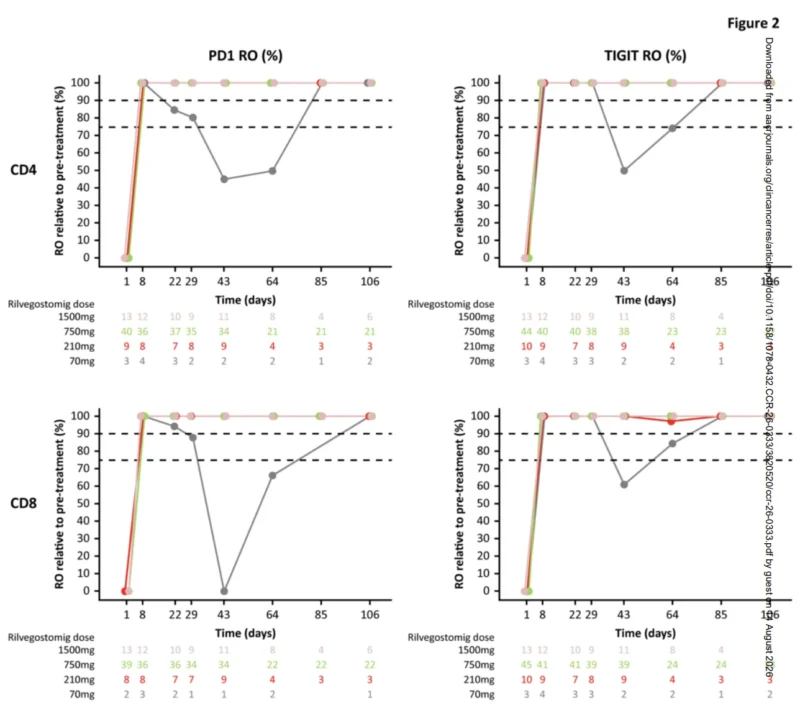
Rilvegostomig produced sustained ≥90% PD-1 and TIGIT receptor occupancy in peripheral CD4-positive and CD8-positive T cells at doses of at least 210 mg every 3 weeks.
Pharmacodynamic modeling further indicated that 750 mg every 3 weeks was the lowest tested dose predicted to achieve ≥90% intratumoral occupancy of both PD-1 and TIGIT.
Based on the combined evidence, 750 mg every 3 weeks was selected as the recommended Phase II dose (Rohrberg et al., 2026).
This approach illustrates an important feature of modern immunotherapy dose development: the biologically appropriate dose does not necessarily correspond to the maximum tolerated dose.
What Antitumor Activity Was Seen With Rilvegostomig?
Clinical activity was modest at the population level but included several durable responses.
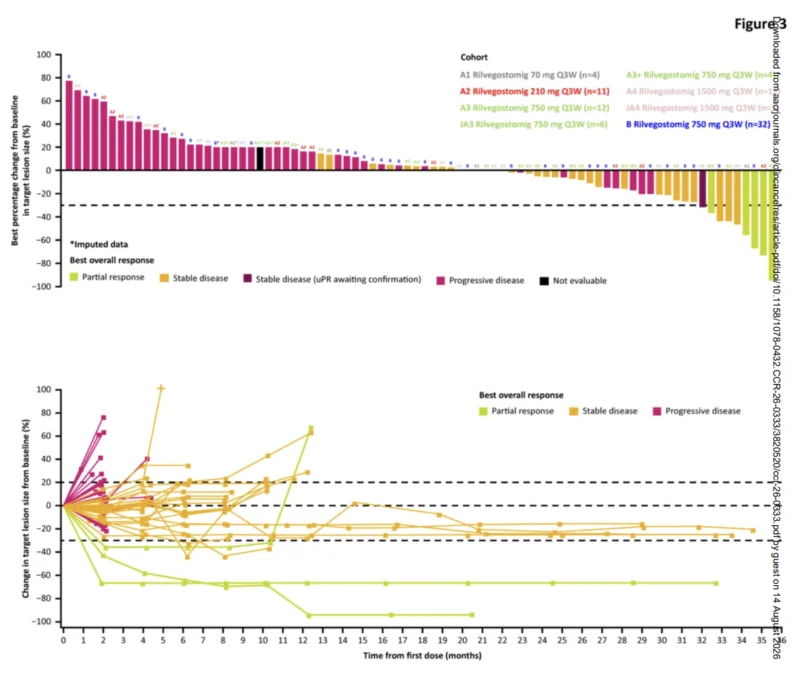
At the recommended Phase II dose of 750 mg every 3 weeks, the objective response rate was:
- 5.6%
- 95% CI, 1.2–15.4
The 6-month disease control rate was 31.5%, with a 95% CI of 19.5–45.6.
Median progression-free survival was:
- 3.8 months
- 95% CI, 2.0–4.2
The estimated 12-month progression-free survival rate was:
- 11.9%
- 95% CI, 4.9–22.2 (Rohrberg et al., 2026).
Across all 83 patients treated at any dose, five patients achieved confirmed partial responses, corresponding to an overall objective response rate of 6.0%.
No complete responses were reported.
Some Responses Were Durable
The relatively low overall response rate does not fully describe the response pattern observed in ARTEMIDE-01.
Across the overall study population, median duration of response was 14.5 months. At the recommended Phase II dose, median duration of response was 10.3 months.
Four patients had confirmed responses lasting at least six months.
Their individual duration of response/progression-free survival values were:
- 9.0/25.3 months
- 14.5/16.4 months
- 32.2/36.1 months
and
- 10.3/12.4 months.
All four durable responders had tumors with PD-L1 TPS ≥50% (Rohrberg et al., 2026).
Three of the four had adenocarcinoma and one had squamous NSCLC. Three had secondary resistance to previous checkpoint inhibition, while one had primary resistance.
These observations are intriguing but should not be interpreted as demonstrating that high PD-L1 expression predicts rilvegostomig benefit. The trial was small, nonrandomized, and not designed to establish a predictive biomarker for response.
What Was the Safety Profile?
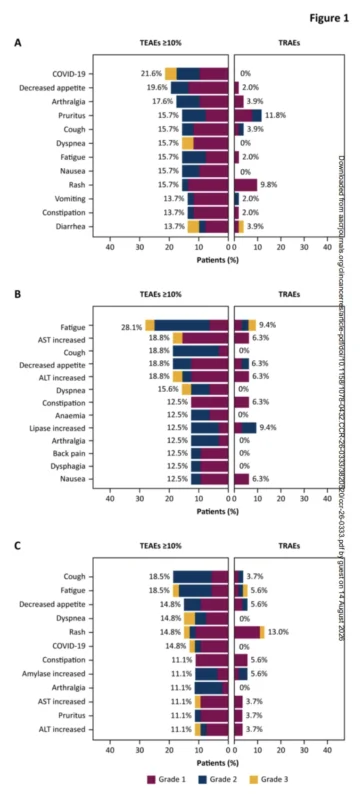
Across all 83 patients, 90.4% experienced a treatment-emergent adverse event of any grade.
Treatment-related adverse events occurred in 54.2% of patients.
Grade 3 treatment-related adverse events occurred in 8.4%, and importantly, no Grade 4 or Grade 5 treatment-related adverse events were reported.
The most common treatment-related adverse events were:
- Rash: 8.4%
- Pruritus: 7.2%
- Infusion-related reaction: 6.0%
- Increased lipase: 6.0% (Rohrberg et al., 2026).
Individual Grade 3 treatment-related events included acute hepatitis, increased ALT, increased AST, colitis, diarrhea, fatigue, an immune-system disorder, infusion-related reaction, pneumonitis, and rash.
Each occurred in one patient.
How Common Were Immune-Mediated Adverse Events?
Investigator-assessed immune-mediated adverse events occurred in 18.1% of patients.
Grade 3 immune-mediated events occurred in 4.8%, with no Grade 4 or 5 immune-mediated events reported.
Reported immune-mediated events occurring in more than one patient included pruritus, infusion-related reactions, maculopapular rash, and pneumonitis.
Systemic corticosteroids were used to manage immune-mediated adverse events in 7.2% of patients (Rohrberg et al., 2026).
Treatment-related serious adverse events occurred in 7.2%.
Two patients, or 2.4%, discontinued rilvegostomig because of treatment-related adverse events: one because of Grade 1 myocarditis and another because of Grade 3 acute hepatitis.
No treatment-related deaths were reported.
What Did Pharmacokinetic Testing Show?
Rilvegostomig systemic exposure increased in a near dose-proportional manner between 70 and 1,500 mg.
Treatment-emergent antidrug antibodies were detected in 41.0% of patients. High-titer treatment-emergent antibodies were associated with approximately a 42% lower steady-state area under the concentration-time curve.
However, the investigators reported that the available study data did not demonstrate clear evidence that antidrug antibody development affected safety or clinical efficacy across the evaluated doses (Rohrberg et al., 2026).
This remains an area that can be characterized further as rilvegostomig is evaluated in larger populations.
How Should the Efficacy Results Be Interpreted?
ARTEMIDE-01 is an early-phase trial, and its findings require appropriately cautious interpretation.
The study was open-label and nonrandomized, and its analyses were descriptive. No formal statistical comparisons between dose groups were performed.
The objective response rate at the recommended Phase II dose was 5.6%, meaning most patients did not experience an objective tumor response.
At the same time, the population had already been exposed to checkpoint inhibitor therapy, and all patients had documented primary or secondary resistance. The observation that several responses were durable provides a signal for further investigation rather than evidence that rilvegostomig has established efficacy in this setting.
The trial also cannot determine whether rilvegostomig is superior to conventional second-line therapy, checkpoint inhibitor rechallenge, or separate PD-1 and TIGIT antibodies.
Those questions require randomized trials.
Why Is the Bispecific Structure Important?
The scientific question surrounding rilvegostomig extends beyond simply adding another immune checkpoint inhibitor.
The drug’s architecture allows coordinated PD-1 and TIGIT inhibition within the same molecule.
According to the study authors, this could provide more synchronized target engagement than administering two separate antibodies. Its reduced Fc function is also designed to minimize unwanted depletion of PD-1- or TIGIT-expressing effector immune cells (Rohrberg et al., 2026).
Whether these biological characteristics translate into a meaningful clinical advantage remains unresolved.
That distinction is especially important because TIGIT-directed drug development has produced mixed results across the broader lung cancer field. ARTEMIDE-01 therefore provides evidence that the biological concept can generate target engagement and clinical responses, but Phase III studies will ultimately determine whether the bispecific strategy improves outcomes.
Where Is Rilvegostomig Going Next?
The development program has already moved beyond the checkpoint inhibitor-resistant population evaluated in the present analysis.
Parts C through E of ARTEMIDE-01 are evaluating rilvegostomig in checkpoint inhibitor-naïve NSCLC, including patients with squamous and nonsquamous disease and PD-L1 tumor proportion scores of at least 1% or at least 50% (Rohrberg et al., 2026).
Rilvegostomig is also being studied in several Phase III programs.
ARTEMIDE-Lung04 (NCT06868277) is evaluating rilvegostomig against pembrolizumab monotherapy as first-line treatment for metastatic NSCLC with PD-L1 expression ≥50%.
ARTEMIDE-Lung02 (NCT06692738) and ARTEMIDE-Lung03 (NCT06627647) are evaluating rilvegostomig against pembrolizumab plus chemotherapy in first-line metastatic squamous and nonsquamous NSCLC, respectively, with PD-L1 expression ≥1%.
TROPION-Lung10 (NCT06357533) is evaluating rilvegostomig in combination with datopotamab deruxtecan, or Dato-DXd, compared with rilvegostomig or pembrolizumab monotherapy in first-line locally advanced or metastatic nonsquamous NSCLC with PD-L1 expression ≥50%.
TROPION-Lung12 (NCT06564844) is evaluating rilvegostomig with or without Dato-DXd against standard-of-care therapy in the adjuvant setting after complete resection of stage I adenocarcinoma NSCLC (Rohrberg et al., 2026).
These studies represent a considerably different clinical question from ARTEMIDE-01: not whether rilvegostomig can generate activity after resistance to previous immunotherapy, but whether dual PD-1/TIGIT targeting can improve outcomes when introduced earlier.
The Bottom Line
The first-in-human ARTEMIDE-01 study provides an early clinical assessment of rilvegostomig, a bispecific antibody designed to inhibit PD-1 and TIGIT simultaneously.
Among 83 checkpoint inhibitor-experienced patients with PD-L1-positive advanced or metastatic NSCLC, no dose-limiting toxicities were observed and the maximum tolerated dose was not reached.
Integrated pharmacodynamic, pharmacokinetic, safety, and receptor-occupancy analyses established 750 mg every 3 weeks as the recommended Phase II dose.
At this dose, rilvegostomig produced an objective response rate of 5.6%, a 6-month disease control rate of 31.5%, median progression-free survival of 3.8 months, and a 12-month progression-free survival rate of 11.9%.
The overall response rate was low, but several responses were prolonged, including four responses lasting at least six months across the full study population.
Treatment-related adverse events occurred in 54.2% of patients, Grade 3 treatment-related events occurred in 8.4%, and no Grade 4 or 5 treatment-related adverse events were reported.
ARTEMIDE-01 does not establish rilvegostomig as a new standard of care. Instead, it provides the dose, safety, pharmacodynamic, and preliminary efficacy foundation for the larger studies now testing the PD-1/TIGIT bispecific strategy in checkpoint inhibitor-naïve, first-line, combination, and earlier-stage NSCLC.
The central question now moves to randomized development: can coordinated PD-1 and TIGIT inhibition translate from target engagement and isolated durable responses into a clinically meaningful advantage for patients with lung cancer?
References
- Rohrberg KS, Brandão M, Castañón Álvarez E, Felip E, Gort E, Hiltermann TJN, et al. Rilvegostomig for Metastatic Non-Small-Cell Lung Cancer: A First-In-Human Phase I/II Clinical Study. Clinical Cancer Research. 2026. ClinicalTrials.gov identifier: NCT04995523.
- Banta KL, Xu X, Chitre AS, et al. Mechanistic convergence of the TIGIT and PD-1 inhibitory pathways necessitates co-blockade to optimize anti-tumor CD8+ T-cell responses. Immunity. 2022;55:512-526.e9.
- Chauvin JM, Pagliano O, Fourcade J, et al. TIGIT and PD-1 impair tumor antigen-specific CD8+ T cells in melanoma patients. Journal of Clinical Investigation. 2015;125:2046-2058.
- Goebeler ME, Stuhler G, Bargou R. Bispecific and multispecific antibodies in oncology: opportunities and challenges. Nature Reviews Clinical Oncology. 2024;21:539-560.
- Ratiu J, Chariou PL, Connor T, et al. Rilvegostomig enhances ex vivo immune activation in patient-resected NSCLC tumors over PDx or PDx/αTIGIT combination therapy. Presented at the IASLC 2025 World Conference on Lung Cancer.