A post-hoc analysis of a prospective randomized trial comparing passive-scattering proton therapy (PSPT) with intensity-modulated photon radiotherapy (IMRT) in locally advanced non-small-cell lung cancer provides a more mature look at toxicity, disease control, and survival after concurrent chemoradiotherapy.
The study, reported by Su, Xu, Chen et al., evaluated long-term outcomes in 149 patients randomly assigned to IMRT or PSPT, with 147 patients completing the assigned treatment. The central question was whether proton therapy could reduce clinically meaningful toxicities while maintaining tumor control in a population where radiation dose to normal lung, heart, and esophagus remains a major treatment-limiting issue (Su et al.).
Why This Question Still Matters In Locally Advanced NSCLC
Concurrent chemoradiotherapy remains a key treatment approach for patients with locally advanced NSCLC. However, toxicity continues to shape outcomes. Radiation pneumonitis, esophageal injury, and cardiac events can substantially affect quality of life, treatment tolerance, and survival.
Proton therapy has long been attractive in thoracic oncology because of its ability to reduce exit dose and potentially spare normal tissues. In theory, this could mean less radiation to the lung, heart, and esophagus. But whether this physical dose advantage consistently translates into better clinical outcomes has remained uncertain, especially when modern IMRT plans already meet strict dose-volume constraints.
This trial is important because it directly compared PSPT and IMRT in a randomized setting, both delivered with concurrent chemotherapy.
What The Trial Showed
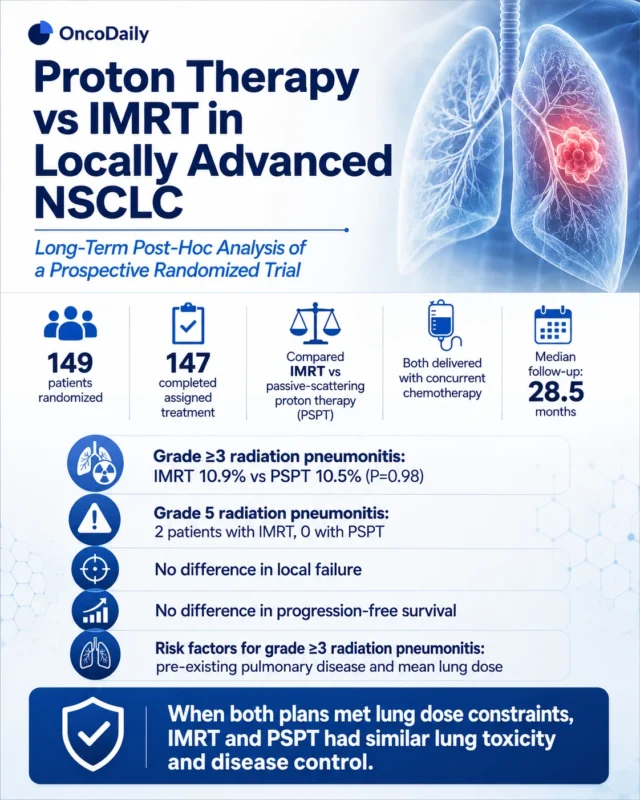
After a median follow-up of 28.5 months, the analysis found no significant difference in severe radiation pneumonitis between the treatment groups. Grade 3 or higher radiation pneumonitis occurred in 10.9% of patients treated with IMRT and 10.5% of patients treated with PSPT, with a P value of 0.98. Two patients in the IMRT group experienced grade 5 radiation pneumonitis, while no grade 5 radiation pneumonitis events occurred in the PSPT group (Su et al.).
The authors identified pre-existing pulmonary disease and mean lung dose as factors associated with grade 3 or higher radiation pneumonitis. This reinforces a familiar but clinically important point: lung toxicity is driven not only by radiation modality, but also by baseline lung health and the actual dose received by normal lung tissue.
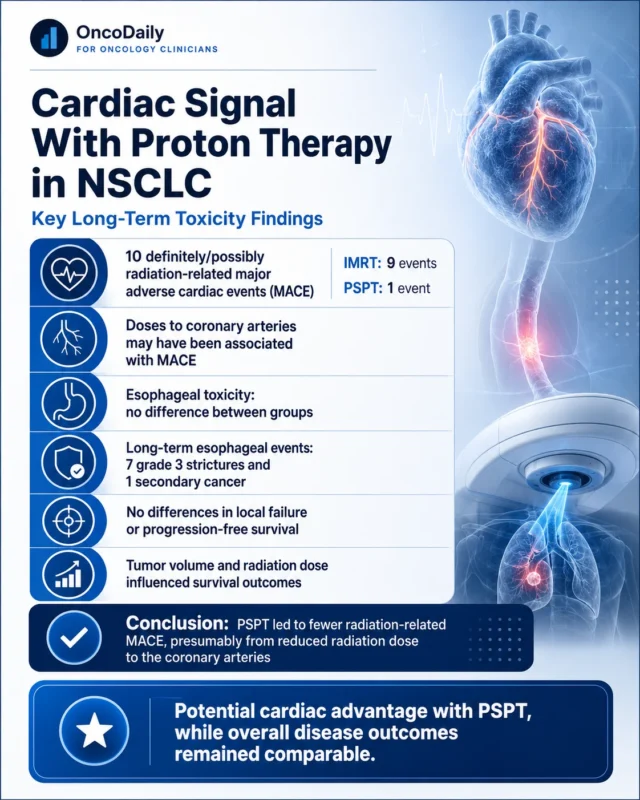
Esophageal toxicity was also similar between the two groups. Long-term esophageal events included seven grade 3 strictures and one secondary cancer, with no meaningful difference between IMRT and PSPT (Su et al.).
The Most Interesting Signal Was Cardiac
The most notable difference appeared in cardiac toxicity. Among 10 definitely or possibly radiation-related major adverse cardiac events, nine occurred in the IMRT group and one occurred in the PSPT group. The authors reported that radiation dose to the coronary arteries may have been associated with these events (Su et al.).
This finding is important, but it needs careful interpretation. The analysis suggests a potential cardiac advantage for PSPT, likely related to reduced coronary artery dose. However, this was a post-hoc analysis and not primarily designed or powered to definitively prove a cardiac toxicity reduction. Still, the signal is clinically meaningful because cardiac dose is increasingly recognized as an important factor in thoracic radiotherapy.
For locally advanced NSCLC, where many patients have smoking history, older age, and baseline cardiovascular risk, even modest reductions in cardiac exposure may matter.
Disease Control Was Similar
The study did not show differences in local failure or progression-free survival between IMRT and PSPT. This suggests that when high-quality treatment plans meet lung dose constraints, both modalities can provide comparable tumor control in this setting.
Survival outcomes were influenced by tumor volume and radiation dose, which is consistent with the broader understanding that disease burden and effective dose delivery remain key drivers of outcome in locally advanced NSCLC (Su et al.).
The authors also noted that survival outcomes were comparable to those reported in RTOG 0617, a phase III trial that included patients with stage IIB–IIIA disease and good performance status. This contextualizes the results within a major benchmark trial in locally advanced NSCLC.
What This Means For Clinical Practice
The findings do not support a broad claim that passive-scattering proton therapy is superior to IMRT for all patients with locally advanced NSCLC. When both treatment plans meet accepted dose-volume constraints, severe lung toxicity and local control appear similar.
However, the cardiac toxicity signal is important. It suggests that proton therapy may be most relevant for selected patients in whom photon plans expose the heart, coronary arteries, or other cardiac substructures to higher radiation doses. This is especially relevant for patients with baseline cardiovascular risk or tumors located near critical mediastinal structures.
The trial also highlights that the value of proton therapy is not simply about the label “proton” versus “photon.” The real question is dosimetric: which plan better protects the individual patient’s normal tissues while maintaining tumor coverage?
Important Limitations
Several limitations are important. This was a post-hoc long-term analysis of a randomized trial, and the study used passive-scattering proton therapy, not newer pencil-beam scanning proton therapy. Proton technology and planning methods have evolved, so these results may not fully reflect what is achievable with contemporary proton techniques.
The sample size was also modest, and only a limited number of cardiac events occurred. Therefore, the cardiac findings should be viewed as hypothesis-generating rather than definitive.
Still, the randomized design and long-term toxicity reporting make this analysis valuable for understanding where proton therapy may offer the most meaningful clinical advantage.
Key Takeaway
In locally advanced NSCLC treated with concurrent chemotherapy, PSPT and IMRT produced similar rates of severe radiation pneumonitis, esophageal toxicity, local failure, and progression-free survival when lung dose-volume constraints were met.
The most notable difference was a lower number of radiation-related major adverse cardiac events with PSPT, likely related to reduced coronary artery dose. These findings support a more selective and anatomy-driven approach to proton therapy in NSCLC, especially for patients in whom cardiac sparing is clinically important.