For patients with advanced non-small cell lung cancer and very high PD-L1 expression, one of the most persistent first-line questions has been whether pembrolizumab alone is sufficient or whether platinum-based chemotherapy should be added from the beginning.
The randomized phase III PERSEE trial (GFPC 01-2020) presented at ESMO Congress 2026 provides the clearest prospective head-to-head answer yet.
Among patients with previously untreated advanced NSCLC and PD-L1 tumor proportion score ≥50%, pembrolizumab plus platinum-based chemotherapy significantly prolonged progression-free survival compared with pembrolizumab monotherapy.
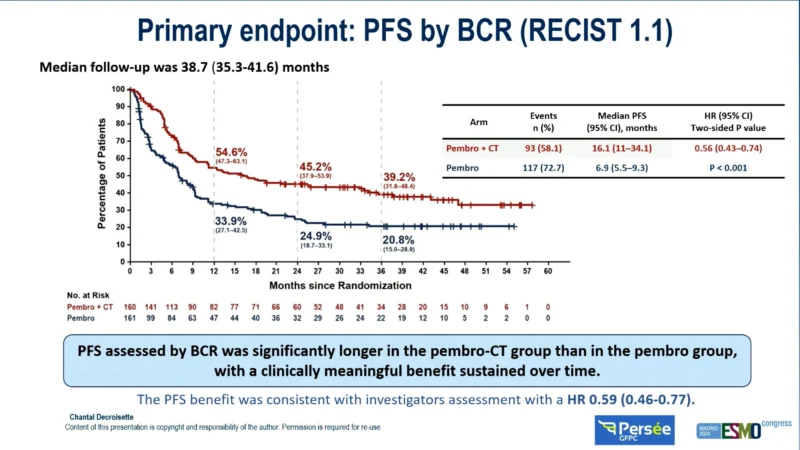
Median PFS by blinded central review was 16.1 months with pembrolizumab plus chemotherapy versus 6.9 months with pembrolizumab alone, corresponding to an HR of 0.56 (95% CI 0.43–0.74; P<0.001).
The benefit was sustained over time. At 12 months, 54.6% of patients receiving the combination remained progression free compared with 33.9% receiving pembrolizumab alone. At 24 months, the corresponding rates were 45.2% and 24.9%, and at 36 months they were 39.2% and 20.8%. Objective response rate also favored combination therapy, reaching 77.5% versus 50.3%.
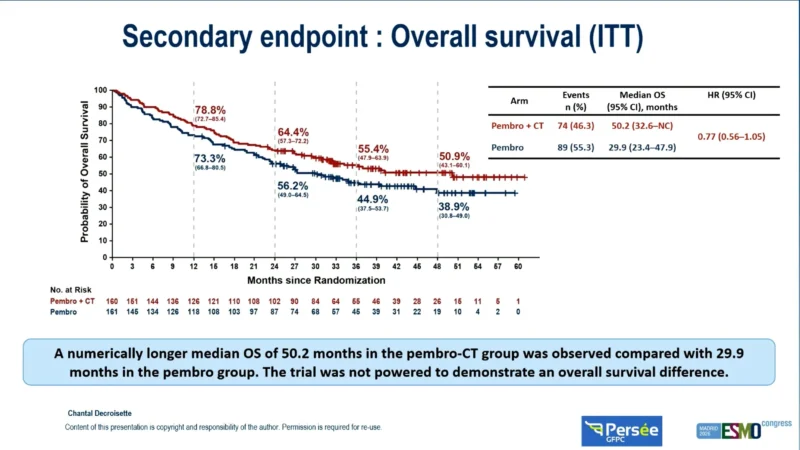
Median overall survival was numerically longer with pembrolizumab plus chemotherapy at 50.2 months versus 29.9 months, although the trial was not powered to demonstrate an OS difference and the confidence interval crossed unity, with an HR of 0.77 (95% CI 0.56–1.05).
PERSEE therefore does not establish that every patient with PD-L1 ≥50% should automatically receive chemotherapy. Instead, it provides randomized evidence that adding chemotherapy substantially improves disease control while introducing considerably more toxicity. That trade-off may now become central to first-line treatment selection.
A Question Left Open Since KEYNOTE-024
Pembrolizumab monotherapy fundamentally changed first-line treatment for patients with metastatic NSCLC and PD-L1 TPS ≥50%. The landmark KEYNOTE-024 trial established pembrolizumab as an effective chemotherapy-sparing strategy, with long-term follow-up showing a median OS of 26.3 months and a 5-year survival rate of 31.9%.
This created a highly attractive treatment option: durable survival for a subset of patients without the immediate toxicity of platinum-doublet chemotherapy. But as pembrolizumab plus chemotherapy also became established across metastatic NSCLC, clinicians faced a practical problem.
For a fit patient whose tumor expresses PD-L1 at 70%, 80% or 100%, should one use pembrolizumab alone because the tumor is highly immunogenic, or should chemotherapy be added to increase the probability and speed of tumor control?
Until PERSEE, that question had largely been answered using indirect comparisons, subgroup analyses, real-world studies and clinical judgment rather than a dedicated randomized phase III trial.
PERSEE Directly Compared the Two Accepted Strategies
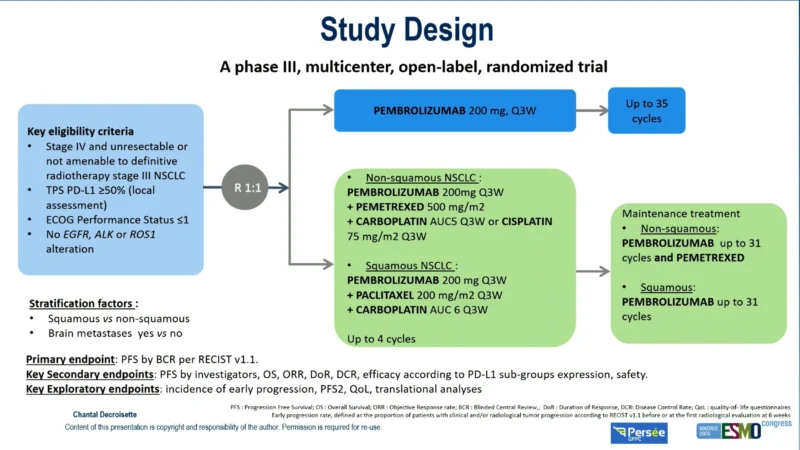
PERSEE was a multicenter, open-label phase III study conducted across 28 centers in France. The trial enrolled 321 patients with previously untreated stage IV NSCLC or unresectable stage III disease not amenable to definitive radiotherapy.
All patients had PD-L1 TPS ≥50%, ECOG performance status 0 or 1, and no actionable EGFR, ALK or ROS1 alteration according to the ESMO presentation. Patients were randomized 1:1 to pembrolizumab monotherapy or pembrolizumab combined with histology-appropriate platinum chemotherapy.
Patients with nonsquamous NSCLC received pembrolizumab plus pemetrexed and either carboplatin or cisplatin for up to four cycles, followed by pembrolizumab and pemetrexed maintenance.
Patients with squamous NSCLC received pembrolizumab plus paclitaxel and carboplatin for four cycles, followed by pembrolizumab maintenance.
Pembrolizumab monotherapy was administered at 200 mg every three weeks for up to 35 cycles. The primary endpoint was PFS according to blinded central review. Overall survival, investigator-assessed PFS, response, response duration and safety were key secondary endpoints. At the April 7, 2026 data cutoff, median follow-up was 38.7 months.
Median PFS More Than Doubled With Chemotherapy
The primary endpoint was clearly positive. Median PFS was 16.1 months with pembrolizumab plus chemotherapy compared with 6.9 months with pembrolizumab alone. The HR of 0.56 represents a 44% reduction in the hazard of progression or death.
The difference was not limited to an early chemotherapy effect. At three years, approximately 39.2% of patients in the combination arm remained progression free compared with 20.8% in the monotherapy group.
This sustained separation is clinically important. A common concern with adding chemotherapy to immunotherapy in PD-L1-high disease is that chemotherapy might simply produce more rapid early tumor shrinkage without fundamentally changing long-term disease control.
PERSEE suggests the effect extends substantially beyond the initial treatment period. Investigator-assessed PFS was consistent with the centrally reviewed analysis, with an HR of approximately 0.59 in the final presentation.
The Benefit Persisted Even at Extremely High PD-L1 Levels
Perhaps one of the most clinically relevant findings was that increasing PD-L1 expression did not eliminate the apparent benefit of chemotherapy.
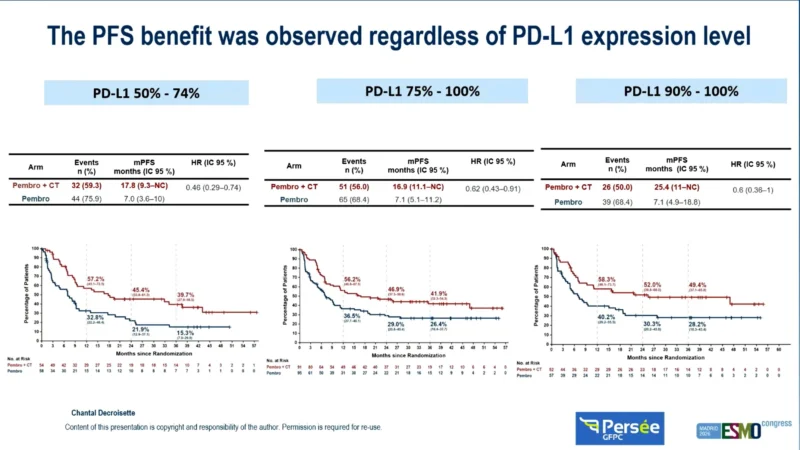
Among patients with PD-L1 TPS 50%–74%, median PFS was 17.8 months with pembrolizumab plus chemotherapy versus 7.0 months with pembrolizumab alone, with an HR of 0.46. Among patients with PD-L1 TPS 75%–100%, median PFS was 16.9 versus 7.1 months, with an HR of 0.62.
Even in the particularly immunotherapy-sensitive PD-L1 TPS 90%–100% subgroup, median PFS was 25.4 months with the combination versus 7.1 months with pembrolizumab alone. The HR was 0.60, although the 95% CI reached 1.00, so this subgroup should be interpreted cautiously.
The direction of effect is nevertheless important. Extremely high PD-L1 expression did not identify a population in which chemotherapy clearly became irrelevant.
That challenges the intuitive assumption that a tumor with PD-L1 TPS close to 100% necessarily derives little additional benefit from chemotherapy.
Response Rate Increased From 50% to Nearly 78%
The improvement in PFS was accompanied by substantially greater tumor shrinkage. Objective response rate was 77.5% with pembrolizumab plus chemotherapy versus 50.3% with pembrolizumab alone.
That difference may be particularly relevant for patients with symptomatic disease, high tumor burden, threatening organ involvement or rapidly progressive cancer where early tumor reduction is clinically important. Median duration of response was also longer numerically at 30 months with the combination versus 15.6 months with pembrolizumab alone.
Taken together with the PFS results, the trial suggests chemotherapy contributes not only to a higher probability of initial response but also to prolonged disease control.
Overall Survival Favored the Combination Numerically
Median OS reached 50.2 months with pembrolizumab plus chemotherapy compared with 29.9 months with pembrolizumab alone.
The HR was 0.77. At 12 months, overall survival was 78.8% versus 73.3%. At 24 months it was 64.4% versus 56.2%, and at 36 months it was 55.4% versus 44.9%. By 48 months, approximately 50.9% of patients in the combination arm remained alive compared with 38.9% in the pembrolizumab-alone arm.
The pattern is therefore clinically interesting. However, PERSEE was powered for PFS rather than overall survival. The 95% CI for the OS HR was 0.56–1.05, meaning a statistically definitive OS advantage has not been demonstrated.
This distinction is essential for interpretation. The trial proves that combination therapy improves PFS. It shows a favorable numerical OS trend. It does not prove an OS advantage. The same caution applies when discussing the 20-month difference between the reported median OS values.
The Cost of Better Disease Control Is More Toxicity
The efficacy benefit came with a substantial toxicity increase. Grade ≥3 treatment-related adverse events occurred in 53.8% of patients receiving pembrolizumab plus chemotherapy compared with 19.3% receiving pembrolizumab alone.
That difference cannot be treated as a secondary detail. Pembrolizumab monotherapy remains one of the most attractive first-line strategies precisely because it avoids many of the hematologic, gastrointestinal, renal, neurologic and constitutional toxicities associated with platinum-doublet chemotherapy.
For some patients, avoiding chemotherapy may remain more important than maximizing PFS. The appropriate interpretation of PERSEE is therefore not that monotherapy has become obsolete.
Instead, it provides much stronger evidence for discussing the efficacy-versus-toxicity trade-off with individual patients.
Pembrolizumab Alone Remains a Highly Effective Treatment
The PERSEE result should also be viewed in the context of the durable benefit already established with pembrolizumab monotherapy. KEYNOTE-024 demonstrated long-term survival in a subset of patients receiving pembrolizumab alone, with nearly one-third alive at five years.
Large real-world datasets have subsequently confirmed that durable long-term survival with pembrolizumab monotherapy is reproducible outside clinical trials. A recent international registry involving more than 1,000 patients with PD-L1 TPS ≥50% reported a 5-year survival rate of approximately 27%.
Therefore, the clinical question is not whether pembrolizumab monotherapy works. It clearly does. The question is whether a particular patient’s probability of deeper and longer disease control justifies adding chemotherapy. PERSEE makes that discussion substantially more evidence based.
Not Every Attempt to Intensify Pembrolizumab Has Worked
The PERSEE findings are also interesting in the broader history of treatment intensification for PD-L1-high NSCLC. Simply adding another immune checkpoint inhibitor has not necessarily improved outcomes.
In KEYNOTE-598, adding ipilimumab to pembrolizumab in patients with PD-L1 TPS ≥50% failed to improve either PFS or OS and increased toxicity. Median OS was 21.4 versus 21.9 months, while median PFS was 8.2 versus 8.4 months.
PERSEE therefore suggests that the benefit of intensification may specifically come from adding cytotoxic chemotherapy rather than simply increasing immune checkpoint blockade.
The biological explanation may include rapid reduction in tumor burden, release of tumor antigens, elimination of immunosuppressive cell populations and improved control of resistant tumor clones. But the trial itself establishes the clinical result rather than proving the mechanism.
Which Patients May Be Most Likely to Need Chemotherapy?
PERSEE does not provide a single biomarker that resolves treatment selection. PD-L1 level alone clearly does not appear sufficient. Even the 90%–100% subgroup showed a directionally favorable PFS result with chemotherapy. Clinical factors may therefore remain central.
A patient with extensive visceral disease, symptomatic metastases, rapid progression or an immediate need for tumor shrinkage may reasonably favor combination therapy because of the markedly higher response rate and longer PFS.
Conversely, an asymptomatic patient with limited-volume disease, important comorbidities or a strong preference to avoid chemotherapy may still be an appropriate candidate for pembrolizumab monotherapy.
Age, performance status, tumor burden, metastatic sites, smoking history, molecular characteristics and the patient’s priorities all remain relevant.
Importantly, PERSEE enrolled patients with ECOG PS 0–1. Its efficacy-toxicity balance cannot automatically be extrapolated to frailer populations.
PERSEE Changes the Conversation Rather Than Eliminating Choice
Before PERSEE, clinicians could reasonably argue that there was no prospective phase III evidence demonstrating that adding chemotherapy to pembrolizumab meaningfully improved outcomes in the PD-L1 ≥50% population.
That argument is now much harder to sustain for PFS. The combination significantly prolonged centrally reviewed PFS, increased ORR from approximately 50% to nearly 78%, and produced a consistent direction of benefit across increasingly high PD-L1 categories.
At the same time, grade ≥3 treatment-related toxicity was almost three times as frequent. That means first-line treatment selection may become more individualized rather than more uniform. PERSEE strengthens the case for combination therapy when maximizing disease control is the priority.
Pembrolizumab monotherapy retains an important role when avoiding chemotherapy toxicity is a major goal.
OncoDaily Takeaway
The phase III PERSEE trial directly addresses one of the longest-standing treatment decisions in PD-L1-high advanced NSCLC. Adding platinum-based chemotherapy to pembrolizumab increased median PFS from 6.9 to 16.1 months, producing a 44% reduction in the risk of progression or death.
The advantage remained directionally consistent across PD-L1 expression levels, including tumors with TPS of 90%–100%. Objective response rate increased from 50.3% to 77.5%, while median duration of response was numerically prolonged from 15.6 to 30 months.
Median OS was also numerically longer-50.2 versus 29.9 months, but the trial was not powered to establish an OS difference, and the HR of 0.77 had a 95% CI crossing 1. The price of intensified disease control was substantial toxicity: grade ≥3 treatment-related adverse events occurred in 53.8% with combination therapy versus 19.3% with pembrolizumab alone.
PERSEE therefore should not be read as showing that every patient with PD-L1 ≥50% needs chemotherapy. Its more important contribution is that the choice can now be framed with randomized phase III evidence.
For fit patients in whom maximum tumor control and response probability are priorities, pembrolizumab plus chemotherapy has demonstrated a clear PFS advantage.
For patients in whom minimizing toxicity is more important, pembrolizumab monotherapy remains an effective option capable of producing durable long-term survival. In PD-L1-high NSCLC, the question is no longer simply whether chemotherapy adds efficacy. PERSEE shows that it does.
The next question is which patients need that additional efficacy enough to justify its toxicity.
Source
- Decroisette C, et al. Pembrolizumab with or without platinum-based chemotherapy as first-line treatment in advanced NSCLC with PD-L1 ≥50%: PERSEE phase III trial (GFPC 01-2020). Presented at ESMO Congress 2026, Madrid, October 25, 2026. EudraCT 2020-002626-86.