The final analysis of the phase III PEARLS/KEYNOTE-091 trial has confirmed a persistent disease-free survival (DFS) advantage with adjuvant pembrolizumab in patients with completely resected stage IB–IIIA non-small cell lung cancer (NSCLC). However, despite more than seven years of follow-up, the improvement in disease control did not translate into a statistically significant overall survival (OS) benefit.
Presented by Mary E. O’Brien, MD, at the ESMO Congress 2026 in Madrid, the randomized, triple-blind study evaluated one year of pembrolizumab versus placebo following complete surgical resection, with adjuvant chemotherapy administered when indicated.
Among 1,177 patients, median DFS was 58.7 months with pembrolizumab versus 43.3 months with placebo, corresponding to a hazard ratio (HR) of 0.85 (95% CI 0.73–0.98). At six years, DFS rates were 44.0% and 39.2%, respectively.
In contrast, six-year OS was 68.5% versus 66.4%, with an HR of 0.98 (95% CI 0.81–1.18; p=0.41826), demonstrating no statistically significant improvement in survival.
The findings provide an important long-term perspective on adjuvant immunotherapy, raising questions about the magnitude and clinical meaning of sustained recurrence prevention when a corresponding survival advantage remains unproven.
Why PEARLS/KEYNOTE-091 Matters
Despite complete surgical resection, patients with early-stage NSCLC remain at substantial risk of recurrence, particularly those with larger primary tumors or lymph node involvement.
Platinum-based adjuvant chemotherapy has historically provided a modest survival benefit in appropriately selected patients. The introduction of immune checkpoint inhibitors expanded postoperative treatment options, aiming to eliminate residual microscopic disease and reduce recurrence.
Pembrolizumab, a PD-1 inhibitor, entered the adjuvant setting following positive DFS results from PEARLS/KEYNOTE-091. The trial previously demonstrated a significant reduction in disease recurrence or death in the intention-to-treat (ITT) population, supporting regulatory approval.
At the second interim analysis, the DFS HR was 0.76 (95% CI 0.63–0.91; p=0.0014). Among patients who had received adjuvant chemotherapy, the HR was 0.73 (95% CI 0.60–0.89). However, the long-term consequences of preventing or delaying recurrence remained uncertain.
Because adjuvant treatment exposes potentially cured patients to additional therapy and toxicity, long-term survival and treatment-related harm are especially relevant when evaluating its overall clinical value. The final analysis addresses this central question after a median follow-up exceeding seven years.
Study Design and Patient Population
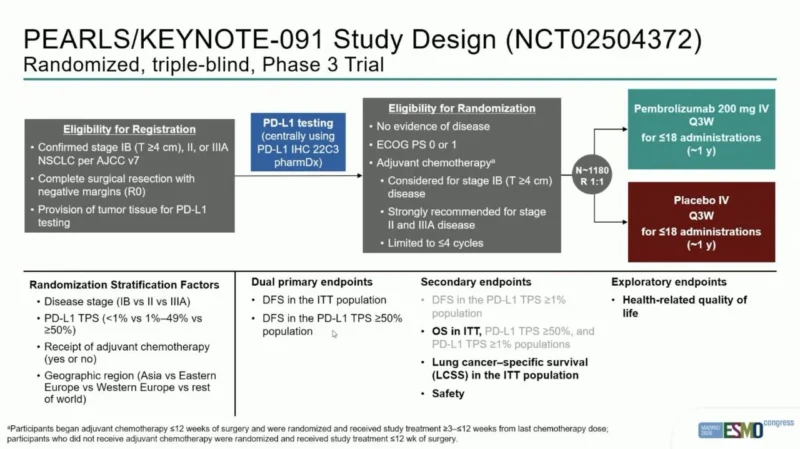
PEARLS/KEYNOTE-091 (NCT02504372) was a randomized, triple-blind, placebo-controlled phase III study conducted in patients with completely resected stage IB, II, or IIIA NSCLC, according to the seventh edition of the AJCC staging system.
Stage IB eligibility required a primary tumor measuring at least 4 cm. All patients had undergone complete surgical resection with negative margins and had ECOG performance status 0–1.
Adjuvant platinum-based chemotherapy was considered for stage IB and strongly recommended for stage II–IIIA disease, with a maximum of four cycles permitted.
Patients were randomized 1:1 to receive pembrolizumab 200 mg intravenously every three weeks for up to 18 administrations, approximately one year, or matching placebo.
Randomization was stratified by disease stage, PD-L1 tumor proportion score (TPS), receipt of adjuvant chemotherapy, and geographic region. The trial included 1,177 patients in the ITT population, with 590 assigned to pembrolizumab and 587 to placebo.
Of these, 1,010 patients had received adjuvant chemotherapy, including 506 in the pembrolizumab arm and 504 in the placebo arm. The dual primary endpoints were investigator-assessed DFS in the ITT population and in patients with PD-L1 TPS ≥50%. Secondary endpoints included OS, lung cancer–specific survival (LCSS), and safety.
The final analysis used a January 21, 2026 data cutoff, with a median follow-up of 87.7 months, equivalent to approximately 7.3 years.
Disease-Free Survival: Long-Term Benefit Persists, but the Effect Is Modest
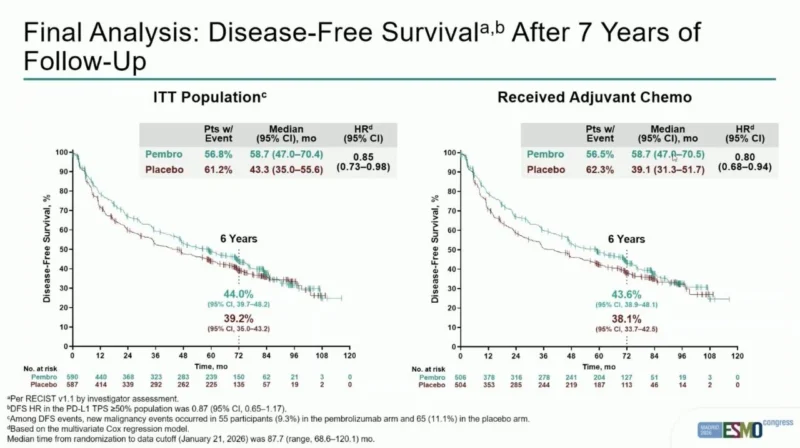
At the final analysis, pembrolizumab continued to demonstrate a favorable DFS effect in the overall randomized population. Median DFS was 58.7 months (95% CI 47.0–70.4) with pembrolizumab compared with 43.3 months (95% CI 35.0–55.6) with placebo.
The HR was 0.85 (95% CI 0.73–0.98), indicating a 15% lower estimated hazard of recurrence or death over follow-up. DFS events occurred in 56.8% of patients receiving pembrolizumab and 61.2% receiving placebo.
At six years, estimated DFS was 44.0% (95% CI 39.7–48.2) versus 39.2% (95% CI 35.0–43.2), representing an absolute difference of 4.8 percentage points.
Although these findings confirm that the treatment effect remained favorable over extended follow-up, the magnitude of the relative benefit was smaller than at the earlier interim analysis, when the HR was 0.76.
The change from 0.76 to 0.85 should not automatically be interpreted as a loss of treatment efficacy, because hazard ratio estimates evolve as additional events accumulate. Nevertheless, it underscores the importance of assessing long-term outcomes rather than relying exclusively on earlier analyses.
The difference between median DFS estimates was 15.4 months, but this should not be interpreted as every treated patient gaining more than one year without recurrence. The more clinically informative six-year landmark analysis showed a modest absolute improvement in the probability of remaining disease-free.
Prior Adjuvant Chemotherapy: A More Favorable DFS Estimate
Among patients who received adjuvant chemotherapy before randomization, the DFS advantage appeared somewhat more pronounced. Median DFS was 58.7 months (95% CI 47.0–70.5) with pembrolizumab compared with 39.1 months (95% CI 31.3–51.7) with placebo.
The corresponding HR was 0.80 (95% CI 0.68–0.94), representing a 20% lower estimated hazard of recurrence or death. At six years, DFS rates were 43.6% versus 38.1%, an absolute difference of 5.5 percentage points.
These findings suggest a sustained benefit following adjuvant chemotherapy, although receipt of chemotherapy was not itself randomized, and differences between subgroups should not be interpreted as definitive evidence that chemotherapy modifies the pembrolizumab treatment effect.
Because most patients in PEARLS/KEYNOTE-091 received postoperative chemotherapy, the trial’s results are particularly relevant to the sequence of surgical resection, adjuvant chemotherapy, and subsequent pembrolizumab.
Overall Survival: No Statistically Significant Advantage After Seven Years
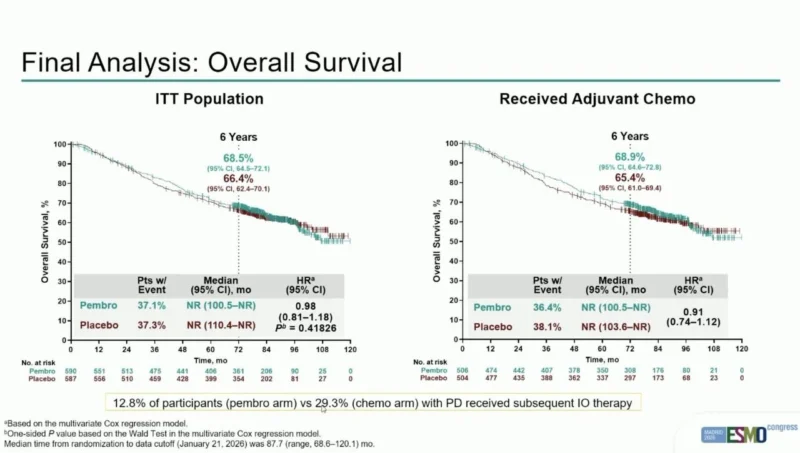
The most consequential result of the final analysis was the absence of a statistically significant OS improvement. In the ITT population, median OS had not been reached in either treatment arm.
At six years, OS was 68.5% (95% CI 64.5–72.1) with pembrolizumab and 66.4% (95% CI 62.4–70.1) with placebo. The HR was 0.98 (95% CI 0.81–1.18; p=0.41826), indicating no demonstrated reduction in the hazard of death.
The absolute difference in six-year OS was only 2.1 percentage points. Death events occurred in 37.1% and 37.3% of patients in the pembrolizumab and placebo arms, respectively. Among patients who previously received adjuvant chemotherapy, six-year OS was 68.9% with pembrolizumab compared with 65.4% with placebo.
Although this represented a numerical difference of 3.5 percentage points, the HR was 0.91 (95% CI 0.74–1.12), again without a statistically significant survival advantage.
The absence of an OS signal is particularly important given the prolonged follow-up. Although the trial was not specifically powered to demonstrate a survival benefit, the final analysis does not establish that adjuvant pembrolizumab extends life in the overall study population.
Equally, a nonsignificant result does not prove that pembrolizumab has no survival effect. The confidence interval still allows for some potential benefit or harm. The central conclusion is therefore not that adjuvant pembrolizumab is ineffective, but that its established DFS advantage has not been accompanied by a demonstrated OS benefit.
Lung Cancer–Specific Survival: A Favorable but Nonconfirmatory Signal
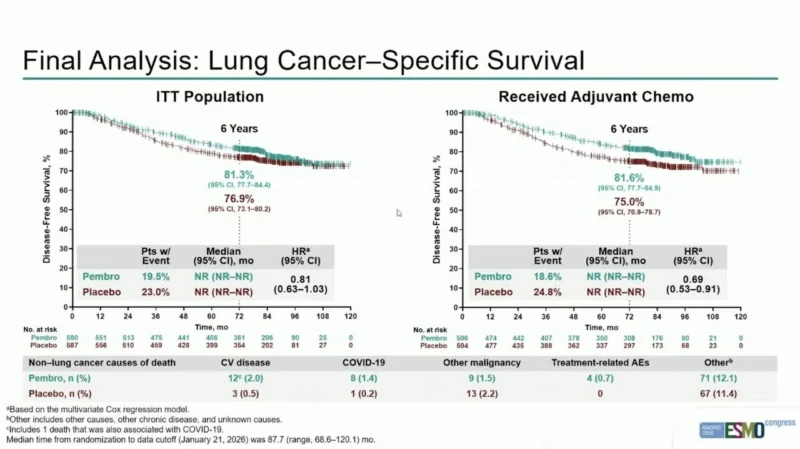
Lung cancer–specific survival offered additional insight into whether pembrolizumab might influence deaths attributable directly to lung cancer. In the ITT population, six-year LCSS was 81.3% (95% CI 77.7–84.4) with pembrolizumab compared with 76.9% (95% CI 73.1–80.2) with placebo.
The HR was 0.81 (95% CI 0.63–1.03), representing a favorable numerical trend that did not establish a statistically significant reduction in lung cancer–specific mortality. Among patients who received adjuvant chemotherapy, the corresponding six-year LCSS rates were 81.6% and 75.0%, respectively.
The HR in this subgroup was 0.69 (95% CI 0.53–0.91), suggesting a potentially larger reduction in lung cancer–related mortality.
However, this subgroup finding must be interpreted cautiously. It was a secondary analysis without evidence of a separately controlled confirmatory statistical test and should be regarded as supportive and hypothesis-generating rather than proof of a survival benefit.
The distinction between lung cancer–specific and overall survival may reflect the influence of subsequent treatments, competing causes of death, or other factors affecting long-term mortality. These potential explanations cannot be established from the available results.
PD-L1 Expression and Patient Selection
PEARLS/KEYNOTE-091 also raises questions about the role of PD-L1 expression in identifying patients most likely to benefit from adjuvant pembrolizumab. The trial incorporated DFS in the PD-L1 TPS ≥50% population as a co-primary endpoint, yet this population did not demonstrate a statistically significant DFS advantage at the earlier analysis.
At the final analysis, the DFS HR in the PD-L1 TPS ≥50% population was 0.87 (95% CI 0.65–1.17), again without clear evidence of benefit in this biomarker-defined population. These findings are notable because high PD-L1 expression is an established predictor of immunotherapy benefit in several advanced NSCLC settings.
However, the biological and clinical context of postoperative minimal residual disease differs from metastatic disease, and biomarkers predicting treatment benefit may not behave identically across disease stages.
PEARLS/KEYNOTE-091 therefore does not establish increasing PD-L1 expression as a reliable predictor of greater adjuvant pembrolizumab benefit.
Future biomarker strategies incorporating molecular residual disease assessment, circulating tumor DNA, oncogenic drivers, and additional immune markers may help improve postoperative treatment selection.
Safety: Additional Toxicity Must Be Weighed Against DFS Benefit
Long-term benefit must also be considered alongside the risks of exposing potentially cured patients to immune checkpoint blockade. Grade 3 or higher adverse events occurred in 34.0% of patients receiving pembrolizumab compared with 25.6% receiving placebo.
Grade 3 or higher immune-mediated adverse events and infusion reactions were reported in 7.9% and 1.9% of patients, respectively. The final analysis also documented imbalances in several non–lung cancer causes of death.
Cardiovascular deaths occurred in 12 patients (2.0%) receiving pembrolizumab versus three (0.5%) receiving placebo. COVID-19 deaths occurred in eight (1.4%) versus one (0.2%), respectively. Four deaths (0.7%) in the pembrolizumab group were classified as related to treatment-associated adverse events, compared with none in the placebo group.
These descriptive findings warrant attention, although the relatively small numbers and absence of additional causal analyses preclude definitive conclusions about individual mortality categories.
Importantly, adjuvant immunotherapy differs fundamentally from treatment of established metastatic disease. Many patients are already disease-free after surgery and chemotherapy, and some would never experience recurrence without additional therapy.
Consequently, even relatively uncommon serious or persistent immune-mediated toxicities can materially influence the balance between benefit and harm.
Clinical Interpretation: DFS Improvement Without Demonstrated Survival Extension
The final PEARLS/KEYNOTE-091 results arrive in an evolving early-stage NSCLC treatment landscape. Pembrolizumab received US regulatory approval for adjuvant treatment following resection and platinum-based chemotherapy in eligible patients with stage IB (tumors ≥4 cm), II, or IIIA NSCLC, based on earlier DFS findings.
The new analysis does not negate that previously demonstrated DFS benefit. However, it provides a more mature perspective on the extent of benefit and the uncertainty surrounding survival improvement.
Meanwhile, perioperative treatment approaches incorporating immunotherapy before and after surgery have become increasingly important. These regimens address a different clinical question and cannot be directly compared with postoperative pembrolizumab monotherapy without head-to-head evidence.
Nevertheless, treatment selection now requires consideration of disease stage, histology, molecular alterations, PD-L1 expression, prior systemic therapy, recurrence risk, comorbidities, and patient preferences.
The PEARLS/KEYNOTE-091 results reinforce the importance of separating demonstrated recurrence reduction from proven survival extension.
Limitations and Remaining Questions
Several limitations remain relevant to clinical interpretation. Although follow-up was extensive, OS was a secondary endpoint, and the study was not powered specifically to detect an OS benefit.
The final DFS HR was less favorable than the earlier interim estimate, suggesting a more modest long-term relative effect than initially observed.
The PD-L1-high population did not demonstrate a clear benefit, limiting the ability to use PD-L1 expression alone to identify patients with the greatest expected treatment advantage.
Furthermore, the trial was designed before the widespread adoption of contemporary neoadjuvant and perioperative immunotherapy strategies. Its results therefore cannot directly determine the optimal approach for patients who have already received immunotherapy before surgery.
Finally, subsequent systemic treatment, competing mortality, and immune-related adverse events complicate interpretation of the relationship between DFS, lung cancer–specific survival, and overall survival.
OncoDaily Takeaway
The final PEARLS/KEYNOTE-091 analysis provides a clinically important distinction: adjuvant pembrolizumab can delay recurrence or death after complete resection of early-stage NSCLC, but a statistically significant overall survival benefit has not been demonstrated after more than seven years of follow-up.
The DFS advantage persisted, with median DFS of 58.7 versus 43.3 months and a six-year DFS difference of 4.8 percentage points. However, the long-term HR of 0.85 indicates a more modest relative benefit than observed at the earlier interim analysis.
Overall survival remains the critical unresolved outcome. Six-year survival was 68.5% versus 66.4%, with an HR of 0.98. The favorable lung cancer–specific survival findings, particularly among patients who previously received chemotherapy, are encouraging but do not replace a demonstrated OS benefit.
For oncologists, the results strengthen the case for individualized adjuvant treatment decisions. Disease recurrence risk, the absolute magnitude of expected benefit, toxicity, alternative perioperative treatment strategies, and patient priorities must all be incorporated into the discussion.
PEARLS/KEYNOTE-091 remains a positive DFS trial, but its final analysis does not establish an overall survival advantage. The broader lesson is that delaying recurrence and extending survival are related but distinct therapeutic goals—and long-term randomized evidence remains essential when evaluating adjuvant immunotherapy in potentially curable lung cancer.
Source
- O’Brien ME, et al. Final Analysis of Adjuvant Pembrolizumab in Resected Early-Stage Non–Small-Cell Lung Cancer: Phase III PEARLS/KEYNOTE-091 Study.