A multicenter retrospective cohort study published in Lung Cancer suggests that nivolumab plus ipilimumab with chemotherapy may provide a sustained long-term survival advantage over pembrolizumab with chemotherapy in patients with PD-L1-Negative Advanced NSCLC, defined in this study as advanced non-small cell lung cancer with a PD-L1 tumor proportion score below 1%.
The study compared two widely used first-line immunotherapy-based regimens in advanced NSCLC without actionable driver mutations: nivolumab plus ipilimumab with chemotherapy, referred to as NICT, and pembrolizumab with chemotherapy, referred to as PCT.
The analysis included 457 patients treated across 13 institutions in Japan between January 2019 and December 2022. Patients were stratified into two groups based on PD-L1 tumor proportion score: PD-L1-Negative Advanced NSCLC with PD-L1 TPS below 1%, and PD-L1 TPS 1% or higher disease.
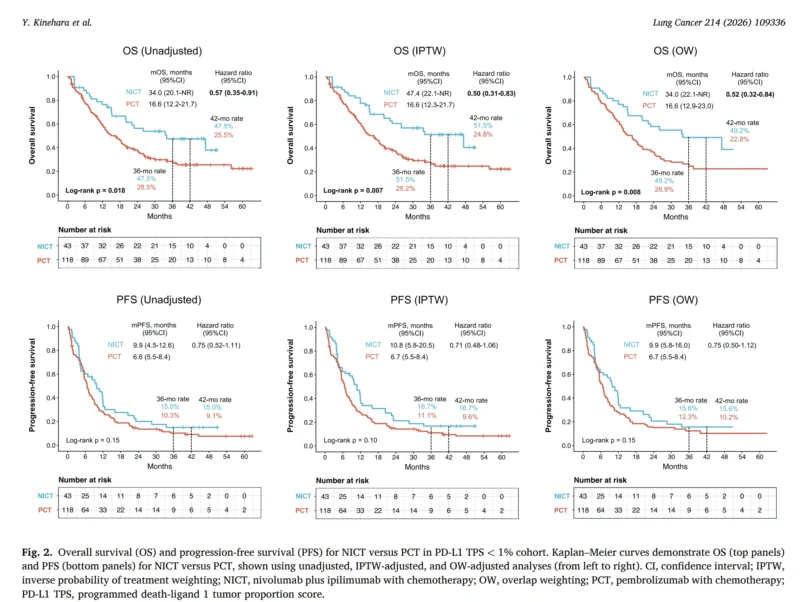
With a median follow-up exceeding 40 months, NICT showed significantly longer overall survival than PCT in the PD-L1-Negative Advanced NSCLC cohort. Median OS was 47.4 months with NICT compared with 16.6 months with PCT. The adjusted hazard ratio was 0.50, and the 36-month OS rate was 51.5% versus 28.2%, respectively.
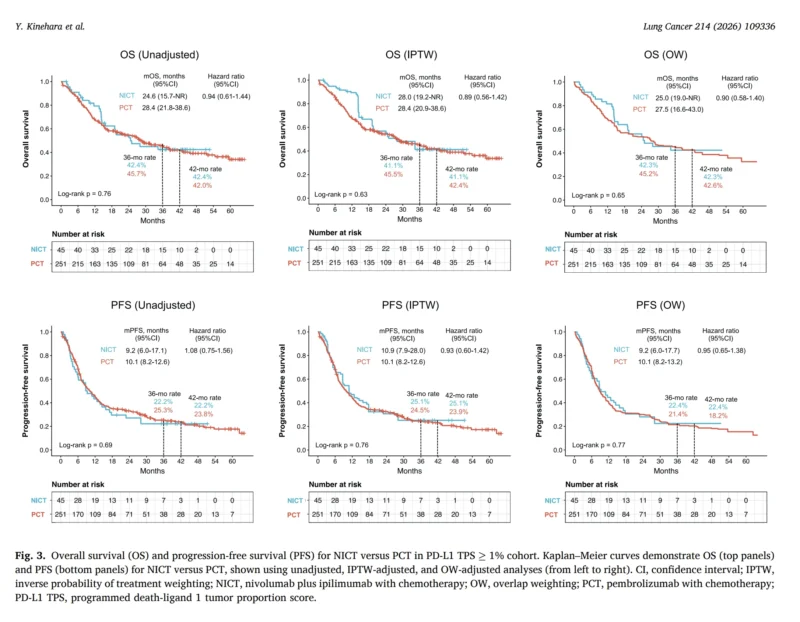
In contrast, among patients with PD-L1 TPS 1% or higher, survival outcomes were similar between the two regimens.
Why This Study Matters
First-line immunotherapy-based combinations have changed treatment for advanced NSCLC without actionable driver mutations.
Pembrolizumab plus chemotherapy is widely used across histologic subtypes based on studies such as KEYNOTE-189 and KEYNOTE-407. Nivolumab plus ipilimumab with chemotherapy is another established option, supported by CheckMate 9LA.
Both approaches are active. However, choosing between them can be difficult in real-world practice, especially for patients with PD-L1-negative tumors.
PD-L1-negative NSCLC remains a clinically challenging subgroup. These tumors may be less dependent on PD-1/PD-L1 signaling alone, raising the question of whether dual checkpoint blockade with anti-PD-1 and anti-CTLA-4 therapy can provide deeper or more durable immune activation.
This study directly addresses that question in a real-world cohort with long-term follow-up.
Study Design
This was a multicenter retrospective cohort study conducted at 13 medical institutions in Japan.
Eligible patients had pathologically confirmed advanced or recurrent NSCLC and received first-line treatment with either NICT or PCT between January 2019 and December 2022.
Patients with major EGFR mutations, ALK rearrangements, unknown driver status, unavailable PD-L1 TPS data, or missing baseline information were excluded.
The final analysis included 457 patients.
Among 161 patients with PD-L1 TPS below 1%, 43 received NICT and 118 received PCT. Among 296 patients with PD-L1 TPS 1% or higher, 45 received NICT and 251 received PCT.
The primary endpoints were median overall survival and 36-month overall survival rate in each PD-L1 cohort. Safety was assessed through treatment-related adverse events, treatment discontinuation, and treatment-related deaths.
To reduce baseline imbalance, investigators used propensity score methods, including inverse probability treatment weighting and overlap weighting. The model adjusted for 10 clinically relevant covariates, including age, sex, smoking history, ECOG performance status, clinical stage, histology, liver metastasis, brain metastasis, steroid use, and body mass index.
Survival Benefit in PD-L1-Negative NSCLC
The clearest signal was observed in patients with PD-L1 TPS below 1%.
In this cohort, median follow-up was approximately 40 months in both treatment groups.
After IPTW adjustment, median overall survival was significantly longer with NICT than with PCT:
- NICT: 47.4 months
- PCT: 16.6 months
- Hazard ratio: 0.50
- 95% CI: 0.31–0.83
- p=0.007
This means that NICT was associated with an approximately 50% lower risk of death compared with PCT in the adjusted analysis.
The long-term survival difference was also notable.
The 36-month OS rate was 51.5% with NICT and 28.2% with PCT. At 42 months, OS rates were 51.5% and 24.8%, respectively.
These findings remained robust in the overlap weighting sensitivity analysis.
Progression-free survival also favored NICT numerically, although the difference did not reach statistical significance. Median PFS was 10.8 months with NICT versus 6.7 months with PCT.
The objective response rate was also higher with NICT, at 65.1% compared with 49.2% for PCT, although this difference was not statistically significant.
No Clear Difference When PD-L1 TPS Was 1% or Higher
The findings were different in patients with PD-L1 TPS 1% or higher.
In this cohort, median follow-up was 42.5 months for NICT and 38.8 months for PCT.
After IPTW adjustment, median PFS was similar between regimens:
- NICT: 10.9 months
- PCT: 10.1 months
- Hazard ratio: 0.93
- p=0.76
Median overall survival was also similar:
- NICT: 28.0 months
- PCT: 28.4 months
- Hazard ratio: 0.89
- p=0.63
The 36-month OS rate was 41.1% with NICT and 45.5% with PCT. The 42-month OS rate was 41.1% and 42.4%, respectively.
Objective response rates were also comparable, at 66.7% with NICT and 68.1% with PCT.
These results suggest that the advantage of dual checkpoint blockade plus chemotherapy may be most relevant in PD-L1-negative disease.
Why Dual Checkpoint Blockade May Matter
The authors discuss a possible biological explanation for the PD-L1-negative signal.
Nivolumab targets PD-1, while ipilimumab targets CTLA-4. Adding CTLA-4 blockade may broaden antitumor immune activation beyond what is achieved with PD-1 inhibition alone.
Ipilimumab may reduce regulatory T-cell activity and support memory CD8-positive T-cell responses. Chemotherapy may further contribute by inducing immunogenic cell death and increasing antigen availability in the tumor microenvironment.
Together, these effects may be particularly important in PD-L1-negative tumors, where PD-1/PD-L1 dependence may be lower.
This may help explain why OS separated more strongly than PFS. A modest PFS difference but larger OS difference could reflect delayed and durable immune benefit in a subset of patients.
Safety and Tolerability
Overall safety was comparable between the two treatment strategies.
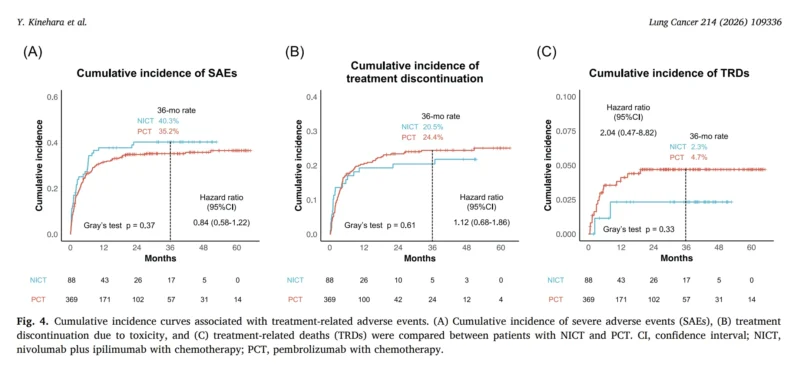
Severe treatment-related adverse events occurred in 39.8% of patients treated with NICT and 34.7% of those treated with PCT. This difference was not statistically significant.
Treatment discontinuation due to toxicity occurred in 22.7% of patients receiving NICT and 24.1% receiving PCT.
Treatment-related deaths occurred in 2.3% of the NICT group and 4.6% of the PCT group.
The 36-month cumulative incidences of severe adverse events, treatment discontinuation, and treatment-related deaths did not differ significantly between groups.
However, some toxicities were more frequent with NICT. Severe skin toxicity occurred in 10.2% with NICT versus 3.3% with PCT. Adrenal-pituitary disorders occurred in 6.8% versus 2.4%, respectively.
No significant difference was seen in pneumonitis rates across severity grades.
These findings suggest that NICT can be tolerable in real-world practice, but clinicians should carefully monitor immune-related skin and endocrine toxicity.
Clinical Meaning
This study provides important long-term real-world evidence for first-line regimen selection in advanced NSCLC without actionable driver mutations.
The main clinical message is that PD-L1-negative disease may be the setting where nivolumab plus ipilimumab with chemotherapy has the strongest comparative value over pembrolizumab with chemotherapy.
The OS difference in the PD-L1-negative cohort was large and clinically meaningful. Median OS was nearly three times longer with NICT than with PCT after adjustment, and more than half of NICT-treated patients were alive at 36 months.
At the same time, the findings should be interpreted carefully.
This was not a randomized trial. Treatment selection may have been influenced by physician preference, patient characteristics, institutional practice, or unmeasured clinical factors. The NICT group was smaller than the PCT group, and nearly all patients were Japanese, which may limit generalizability to broader populations.
Still, the long follow-up period and multiple propensity score sensitivity analyses strengthen the relevance of the findings.
Limitations
The authors acknowledged several limitations.
First, the study was retrospective, meaning selection bias cannot be fully excluded. Second, the NICT-treated population was relatively small, particularly in the PD-L1-negative cohort. Third, the cohort was largely Japanese, and the results may not fully apply to other ethnic or geographic populations.
Finally, although the study adjusted for many clinically important variables, unmeasured confounders may still have influenced survival outcomes.
Further validation in larger prospective cohorts is needed.
Key Takeaway
In this multicenter real-world analysis, nivolumab plus ipilimumab with chemotherapy was associated with significantly longer overall survival than pembrolizumab with chemotherapy in patients with advanced NSCLC and PD-L1 TPS below 1%.
Median OS was 47.4 months with NICT compared with 16.6 months with PCT, and 36-month OS rates were 51.5% versus 28.2%.
No survival advantage was observed in patients with PD-L1 TPS 1% or higher.
Safety outcomes were broadly comparable, although severe skin toxicity and adrenal-pituitary disorders were more frequent with NICT.
These findings suggest that dual checkpoint blockade plus chemotherapy may be a promising first-line option for selected patients with PD-L1-negative advanced NSCLC.