For years, PD-L1 expression of 50% or higher has supported first-line PD-1 or PD-L1 inhibitor monotherapy for many patients with advanced non-small cell lung cancer.
The logic has been clear. In selected patients, immunotherapy alone can produce durable disease control while avoiding the early toxicity of platinum-based chemotherapy.
But high PD-L1 expression does not guarantee response. Some patients progress early, especially when tumor burden is high, symptoms are present, or rapid disease control is needed.
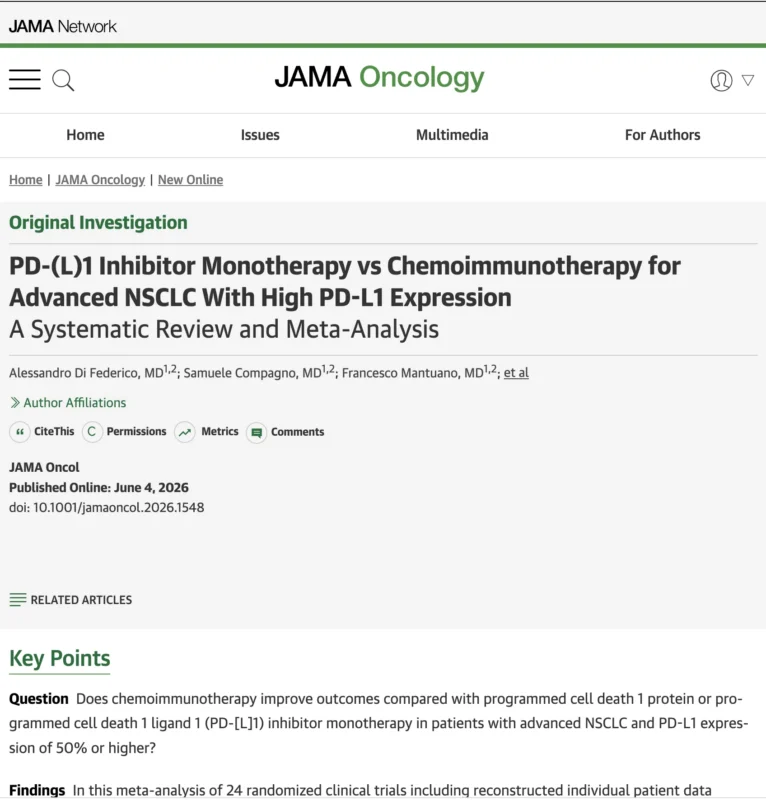
A systematic review and meta-analysis published in JAMA Oncology revisits this central question: in treatment-naive advanced NSCLC with PD-L1 expression of at least 50%, does adding chemotherapy to immunotherapy improve outcomes compared with PD-(L)1 inhibitor monotherapy?
The analysis suggests that it may.
Across 24 phase 3 randomized clinical trials including 5,546 patients, chemoimmunotherapy was associated with longer overall survival and progression-free survival compared with PD-(L)1 inhibitor monotherapy.
The conclusion is clinically important, but it should not be read as the end of immunotherapy monotherapy in PD-L1–high NSCLC. This was not a direct randomized trial comparing the two approaches. The findings come from meta-analysis, network meta-analysis, meta-regression, and reconstructed individual patient data.
Why This Question Still Matters
PD-L1–high advanced NSCLC is often treated as a group with strong expected sensitivity to immune checkpoint inhibition.
That is true for many patients, but not for all.
First-line monotherapy can spare chemotherapy toxicity. This matters for patients with indolent disease, limited symptoms, comorbidities, older age, or strong preference to avoid chemotherapy.
At the same time, chemoimmunotherapy may offer faster disease control and reduce the risk of early progression. For patients with symptomatic disease, high tumor burden, or clinically aggressive cancer, that difference may be important.
This meta-analysis addresses the population-level question behind many real-world tumor board discussions: when PD-L1 is high, should chemotherapy still be added?
What the Meta-Analysis Included
Di Federico and colleagues searched PubMed, Embase, and major oncology conference proceedings for phase 3 randomized clinical trials published before August 3, 2025.
Eligible trials enrolled patients with untreated advanced NSCLC, included outcomes for patients with PD-L1 expression of 50% or higher, and evaluated either PD-(L)1 inhibitor monotherapy or chemoimmunotherapy against chemotherapy alone.
Among the included studies, 16 trials evaluated chemoimmunotherapy and 8 trials evaluated PD-(L)1 inhibitor monotherapy.
Overall survival was the primary outcome. Progression-free survival was the secondary outcome.
The investigators used several complementary approaches, including standard meta-analysis, meta-regression, network meta-analysis, and reconstructed individual patient data from published Kaplan-Meier curves.
Both Strategies Beat Chemotherapy Alone
Both immunotherapy-based strategies improved outcomes compared with chemotherapy alone.
Chemoimmunotherapy was associated with a significant overall survival benefit, with an OS hazard ratio of 0.63. It also improved progression-free survival, with a PFS hazard ratio of 0.44.
PD-(L)1 inhibitor monotherapy was also superior to chemotherapy alone, with an OS hazard ratio of 0.74 and a PFS hazard ratio of 0.70.
These findings confirm that both approaches remain active first-line strategies in PD-L1–high advanced NSCLC.
The more clinically relevant question is not whether immunotherapy works in this population. It does.
The question is whether chemotherapy adds enough benefit to justify its toxicity.
Chemoimmunotherapy Showed a Stronger Outcome Signal
Across the authors’ analyses, chemoimmunotherapy was associated with better outcomes than PD-(L)1 inhibitor monotherapy.
In meta-regression, chemoimmunotherapy was favored for overall survival, with an HR of 0.85 compared with monotherapy. The signal was stronger for progression-free survival, with an HR of 0.61.
Network meta-analysis produced similar results:
- OS HR: 0.85
- 95% CI: 0.73–0.99
- PFS HR: 0.61
- 95% CI: 0.50–0.75
The larger effect on progression-free survival is expected. Chemotherapy can improve early tumor control, which may be especially relevant for patients at risk of rapid clinical deterioration.
The overall survival advantage was more modest but still statistically significant in the reported analyses.
Reconstructed Patient-Level Data Supported the Same Direction
The investigators also reconstructed individual patient data from published survival curves.
In that analysis, median overall survival was 29.2 months with chemoimmunotherapy compared with 19.8 months with PD-(L)1 inhibitor monotherapy.
The OS hazard ratio was 0.74.
Median progression-free survival was also longer with chemoimmunotherapy: 11.3 months versus 6.8 months.
The PFS hazard ratio was 0.67.
This patient-level reconstruction supports the consistency of the finding. However, it remains reconstructed from published data rather than derived from a prospective trial directly randomizing PD-L1–high patients to the two strategies.
What This Means in Practice
The findings support considering chemoimmunotherapy as a first-line option even when PD-L1 expression is 50% or higher.
This may be most relevant for patients with high-volume disease, symptomatic disease, aggressive disease tempo, liver metastases, or a clinical need for rapid response.
But PD-(L)1 inhibitor monotherapy remains clinically relevant.
For patients with lower disease burden, slower disease tempo, contraindications to chemotherapy, frailty, autoimmune considerations, or a strong preference to avoid chemotherapy toxicity, monotherapy may still be a reasonable option.
The study reinforces a practical message: PD-L1 expression is important, but it should not be the only factor guiding first-line therapy.
What the Analysis Cannot Answer
This meta-analysis does not define which individual patient should receive monotherapy and which should receive chemoimmunotherapy.
It also does not provide a definitive toxicity comparison. Chemoimmunotherapy may improve disease control and survival, but it adds the adverse effects of platinum doublet chemotherapy, including myelosuppression, fatigue, neuropathy, renal risk, nausea, alopecia, and treatment burden.
The analysis also relies largely on indirect comparisons across different trials. Trial populations, chemotherapy backbones, histology, PD-(L)1 agents, crossover patterns, and later-line therapies can differ.
That is why prospective comparative trials remain necessary.
A direct randomized trial in PD-L1–high NSCLC would be needed to determine whether all patients benefit from adding chemotherapy, or whether the benefit is concentrated in specific clinical or molecular subgroups.
The Bottom Line
In this JAMA Oncology meta-analysis of phase 3 randomized trials, chemoimmunotherapy was associated with longer overall survival and progression-free survival than PD-(L)1 inhibitor monotherapy in treatment-naive advanced NSCLC with PD-L1 expression of 50% or higher.
The findings support chemoimmunotherapy as a strong first-line consideration in PD-L1–high disease.
They do not eliminate the role of immunotherapy monotherapy.
The decision should remain individualized, balancing PD-L1 expression with disease burden, symptoms, pace of disease, comorbidities, toxicity tolerance, patient preference, and the need for rapid disease control.
The key clinical question is no longer simply whether PD-L1 is high.
It is whether the patient in front of us needs chemotherapy added to immunotherapy from the start.
Reference
- Di Federico A, Compagno S, Mantuano F, et al. PD-(L)1 inhibitor monotherapy vs chemoimmunotherapy for advanced NSCLC with high PD-L1 expression: a systematic review and meta-analysis. JAMA Oncology. Published online June 4, 2026. doi:10.1001/jamaoncol.2026.1548.