
For patients with unresectable stage III non-small cell lung cancer, the PACIFIC regimen transformed a historically difficult treatment setting by establishing consolidation durvalumab after definitive chemoradiotherapy. The pivotal randomized PACIFIC trial provided the evidence. The question that followed was whether those outcomes could be reproduced outside the controlled environment of a phase III study.
The final analysis of PACIFIC-R, published in ESMO Open, now provides more than five years of real-world follow-up from 1,153 patients treated across 10 countries. Nearly half of patients were alive five years after starting durvalumab, while more than one-third remained alive and progression free, providing mature evidence that the long-term benefit seen in PACIFIC can extend into routine clinical practice (Girard et al., 2026).
The results are particularly informative because PACIFIC-R included patients less tightly selected than those in the original randomized trial, including patients treated with sequential rather than concurrent chemoradiotherapy, patients starting durvalumab more than 42 days after radiation, and patients with PD-L1 expression below 1%.
PACIFIC Established the Standard – PACIFIC-R Tests It in Practice
Stage III NSCLC accounts for approximately 20%–30% of NSCLC diagnoses. For patients with unresectable disease who do not progress after platinum-based concurrent chemoradiotherapy, durvalumab for up to 12 months became the global standard following PACIFIC.
In the original PACIFIC trial, the 5-year progression-free survival rate was 33.1% with durvalumab versus 19.0% with placebo, while 5-year overall survival was 42.9% versus 33.4%, respectively (Girard et al., 2026). PACIFIC-R was designed to determine how this strategy performs in everyday practice.
Unlike PACIFIC, the observational cohort included patients who received sequential chemoradiotherapy, those who began durvalumab more than 42 days after radiation, and patients with PD-L1 expression below 1%. These differences make PACIFIC-R especially relevant for clinicians treating patients who do not always match the characteristics or treatment timelines of a registration trial.
More Than 1,100 Patients Across 10 Countries
PACIFIC-R included 1,153 patients from France, Australia, the Netherlands, Belgium, Italy, Israel, Germany, the United Kingdom, Norway, and Switzerland.
Median age was 65 years, with a range from 26 to 88 years. Approximately 65% were men, and the vast majority were current or former smokers. Among patients with available information, 98.4% had ECOG performance status below 2, 53.6% had stage IIIB or IIIC disease, 65.6% had nonsquamous histology, and 72.3% of those with reported PD-L1 results had tumor-cell expression of at least 1% (Girard et al., 2026).
Concurrent chemoradiotherapy had been given to 78.1% of patients, while 14.0% received sequential chemoradiotherapy. Importantly, almost two-thirds of patients with available timing data-64.8%, started durvalumab more than 42 days after finishing radiotherapy, outside the maximum interval used in PACIFIC. This makes the cohort substantially informative for real-world implementation.
Nearly Half of Patients Were Alive at 5 Years
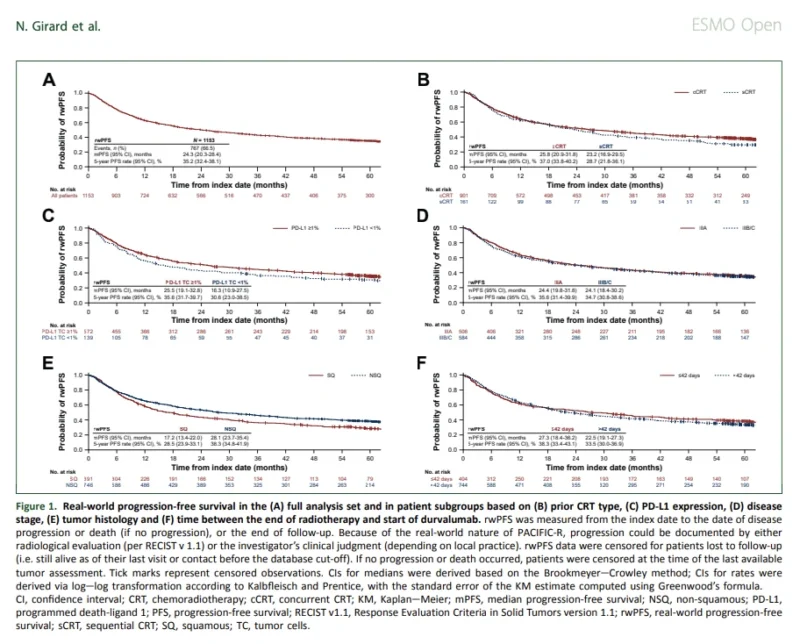
With median follow-up among censored patients of 63.5 months for real-world PFS and 67.5 months for overall survival, the final PACIFIC-R analysis provides mature long-term outcomes.
Median real-world PFS was:
- 24.3 months
- 95% CI, 20.3–28.4
- 5-year rwPFS rate was 35.2%.
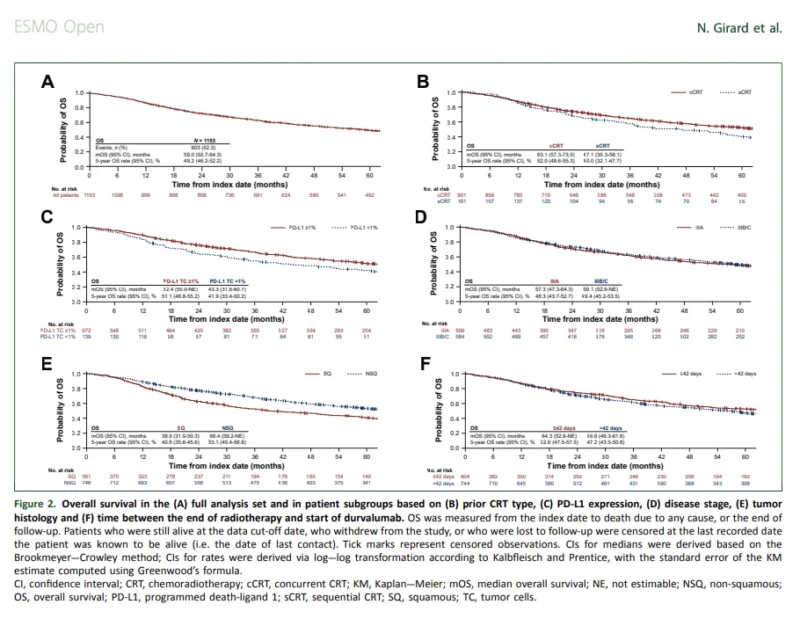
Median overall survival reached:
- 59.0 months
- 95% CI, 52.7–64.3
- 5-year OS rate of 49.2%
Those numbers are clinically striking for unresectable stage III NSCLC. Five years after beginning consolidation durvalumab, approximately one in two patients remained alive, and more than one in three remained alive without documented progression.
Real-World Outcomes Were Consistent With PACIFIC
Direct numerical comparison between a randomized trial and an observational cohort is inappropriate because the populations, follow-up procedures, and methods differ. Nevertheless, the long-term results were broadly consistent.
PACIFIC-R reported:
- 5-year rwPFS: 35.2%
- 5-year OS: 49.2%
whereas the durvalumab arm of PACIFIC reported:
- 5-year PFS: 33.1%
- 5-year OS: 42.9%.
Median rwPFS and OS were also numerically longer in PACIFIC-R—24.3 and 59.0 months, than the corresponding 16.9- and 47.5-month results reported in PACIFIC. The authors appropriately caution against interpreting this as evidence that real-world patients did better than patients enrolled in PACIFIC.
Observational studies can overestimate survival for several reasons, including differences in assessment frequency, patient selection, missing data, and immortal-time-related biases. The important conclusion is not superiority. It is consistency.
Sequential Chemoradiotherapy Produced Encouraging Long-Term Outcomes
One of the most clinically useful elements of PACIFIC-R is its inclusion of patients treated with sequential chemoradiotherapy. Concurrent chemoradiotherapy remains the preferred standard for medically fit patients with unresectable stage III NSCLC, but many patients in routine practice cannot tolerate concurrent treatment.
Median rwPFS was:
- 25.8 months after concurrent CRT
versus
- 23.2 months after sequential CRT.
Median OS was:
- 63.1 months
versus
- 47.1 months, respectively
At 5 years, overall survival was approximately 52.0% following concurrent CRT and 40.0% following sequential CRT. These should not be interpreted as randomized comparisons between concurrent and sequential treatment. Patients selected for sequential CRT were generally older and had more advanced disease, making direct comparisons vulnerable to confounding.
Nevertheless, the finding that roughly 40% of patients treated with sequential CRT remained alive at five years is clinically meaningful. The authors place these data alongside PACIFIC-6 and PACIFIC-5 and argue that consolidation durvalumab after sequential CRT represents a potential option for patients who are unable to receive concurrent chemoradiotherapy.
What About PD-L1–Negative Disease?
PACIFIC-R also offers important observational information for patients with PD-L1 expression below 1%.
Median rwPFS was:
- 25.5 months for PD-L1 ≥1%
versus
- 16.3 months for PD-L1 <1%.
Median OS was:
- 62.4 months
versus
- 43.3 months, respectively
Five-year OS was 51.1% in the PD-L1 ≥1% group and 41.9% in the PD-L1 <1% group. The ≥1% group had better outcomes, and PD-L1 ≥1% was independently associated with longer OS in the multivariable analysis. But the clinically relevant observation is that the PD-L1 <1% group still showed substantial long-term survival, with approximately 42% of patients alive at five years.
This is especially relevant because regulatory practice differs geographically. The FDA label includes patients irrespective of PD-L1 expression, whereas the European regulatory indication has historically restricted durvalumab in this setting to tumors with PD-L1 expression of at least 1% (Girard et al., 2026). However, because PACIFIC-R is observational and contains no untreated control group, it cannot determine the magnitude of durvalumab treatment benefit specifically in PD-L1–negative tumors.
Starting Durvalumab After 42 Days Did Not Eliminate Long-Term Benefit
The PACIFIC trial required treatment initiation within 42 days after chemoradiotherapy. Routine practice is often less predictable. In PACIFIC-R, nearly 65% of patients started durvalumab more than 42 days after completion of radiation. Despite this, outcomes remained encouraging.
Median rwPFS was:
- 27.3 months when durvalumab began within 42 days
versus
- 22.5 months when it began after 42 days.
Five-year rwPFS was 38.3% versus 33.5%, respectively. Median OS was:
- 64.3 months ≤42 days
versus
- 56.6 months >42 days,
with 5-year OS rates of 52.6% and 47.2%, respectively.
Again, this is not evidence that timing does not matter. Patients were not randomized according to treatment interval, and unmeasured confounders may influence both timing and survival. What the study does show is that patients who began durvalumab later than the PACIFIC trial window could still experience substantial long-term disease control.
That is reassuring for real-world practice, where recovery from chemoradiotherapy, toxicity, logistics, and reassessment can delay consolidation treatment.
Histology Was Associated With Different Outcomes
Outcomes also varied substantially according to histology. Patients with nonsquamous disease had:
- Median rwPFS: 28.1 months
versus
- 17.2 months with squamous histology.
Median OS was:
- 66.4 months
versus
- 38.9 months, respectively
Five-year OS remained 53.1% in nonsquamous disease and 40.6% in squamous disease. Nonsquamous histology was also independently associated with longer rwPFS and OS in multivariable models. These findings are prognostic rather than evidence that durvalumab itself has different treatment efficacy according to histology, since the study lacks an untreated comparator.
The Brain Remains a Major Site of Failure
Long-term disease control also reveals where the remaining unmet needs lie. Overall, 33.6% of patients developed distant metastases. Among patients with documented metastatic sites, the brain was the most common:
- Brain: 36.9%
- Lung: 26.2%
- Bone: 19.7%.
Local recurrence occurred in 21.2% of the overall cohort (Girard et al., 2026). The high frequency of CNS relapse is clinically important. As survival in stage III NSCLC improves, preventing or treating brain metastases becomes increasingly relevant. Better systemic CNS control, molecularly selected strategies, and optimal surveillance remain important areas for future investigation.
Almost Half Received Further Anticancer Therapy
Disease progression after durvalumab did not necessarily mark the end of active treatment. Overall, 43.7% of patients received subsequent anticancer treatment after durvalumab discontinuation. Among the full cohort:
- 39.1% received systemic therapy
- 14.8% received radiotherapy
- 4.7% underwent surgery
Among those receiving subsequent systemic treatment, 41.5% received another immunotherapy regimen. These data highlight another evolving question in locally advanced NSCLC: what constitutes optimal treatment after progression following definitive chemoradiation and durvalumab? This question has become particularly complex in the molecular era, especially for patients whose tumors harbor actionable alterations.
Treatment Completion in Routine Practice Was Imperfect
Patients received a median of 23 durvalumab infusions. Only 47.7% completed 12 months of therapy, while 22.1% received treatment for longer than 12 months because the early-access protocol initially permitted continuation beyond one year in some countries.
Among patients who stopped durvalumab, the most common reasons were:
- disease progression in 26.0%
- adverse events in 17.6%
- patient decision in 1.8%
- death in 1.8%
The study does not provide a randomized assessment of optimal durvalumab duration, and the >12-month exposure reflects the early-access programme rather than the contemporary standard. Still, these data illustrate an important feature of real-world oncology: not every patient completes the planned course, yet durable population-level outcomes remain possible.
PACIFIC-R Is Real-World Evidence, Not a Second PACIFIC Trial
The strengths of PACIFIC-R are its scale, international population, long follow-up, and inclusion of patients outside the strict eligibility and timing criteria of PACIFIC. Its limitations are equally important. It was observational and retrospective, with no control group.
Disease assessment occurred according to routine clinical practice rather than blinded central review, and progression may therefore have been detected later than it would have been in a clinical trial. Some early deaths in the UK and Germany could not be incorporated because local regulations did not permit consent waivers for deceased patients, creating a potential source of survival bias.
There were also missing data and heterogeneity in data collection across sites, while the COVID-19 pandemic may have affected the frequency of tumor assessments (Girard et al., 2026).
Sensitivity analyses, however, produced broadly similar estimates and did not substantially change the study’s conclusions. The correct interpretation is therefore not that PACIFIC-R re-proves the causal efficacy of durvalumab.
PACIFIC already did that.
PACIFIC-R answers a different question:
Can durable outcomes with the PACIFIC strategy be observed when the regimen is implemented across heterogeneous routine-care populations?
The answer appears to be yes.
The Bottom Line
The final PACIFIC-R analysis provides one of the strongest long-term real-world datasets supporting consolidation durvalumab after chemoradiotherapy for unresectable stage III NSCLC. Among 1,153 patients:
- Median rwPFS: 24.3 months
- 5-year rwPFS: 35.2%
- Median OS: 59.0 months
- 5-year OS: 49.2%
Importantly, durable outcomes were also observed among patients treated outside the strict PACIFIC trial framework, including those receiving sequential chemoradiotherapy, starting durvalumab more than 42 days after radiotherapy, and patients with PD-L1 expression below 1%. These subgroup observations should not be interpreted as randomized evidence of equivalent treatment benefit.
But they make the overall PACIFIC story more clinically relevant. The significance of PACIFIC-R is not that real-world outcomes were numerically better than those of PACIFIC. It is that five years after a practice-changing randomized trial, the survival plateau appears visible in routine oncology as well.
For unresectable stage III NSCLC, consolidation durvalumab is no longer supported only by trial efficacy. PACIFIC-R shows the durability of that strategy in the real world.
Reference
- Girard, N., Bar, J., Baas, P., Chouaid, C., Christoph, D. C., Field, J. K., Fietkau, R., Garassino, M. C., Garrido Lopez, P., Gregorc, V., et al. (2026). Real-world 5-year outcomes with durvalumab after chemoradiotherapy in unresectable stage III NSCLC. ESMO Open, 11(2), 106070. https://doi.org/10.1016/j.esmoop.2026.106070.