
The first-line treatment landscape for advanced non–small cell lung cancer without actionable genomic alterations has long been built around immune checkpoint inhibition, either alone or combined with chemotherapy according to PD-L1 expression and clinical characteristics. The phase III OptiTROP-Lung05 trial introduces a different strategy: replacing conventional chemotherapy with a TROP2-directed antibody–drug conjugate while maintaining PD-1 blockade.
In an interim analysis published in The Lancet, reported that first-line sacituzumab tirumotecan (sac-TMT) plus pembrolizumab significantly prolonged progression-free survival compared with pembrolizumab alone in patients with PD-L1–positive advanced NSCLC without targetable genomic alterations (Xiong et al., 2026).
The magnitude of the PFS effect was substantial: median PFS had not yet been reached with the combination compared with 5.7 months with pembrolizumab alone, corresponding to an HR of 0.35. Importantly, the benefit was observed not only in tumors with PD-L1 TPS 1–49%, but also in the ≥50% population where pembrolizumab monotherapy has traditionally represented an established first-line option.
The study therefore raises a broader question for immunotherapy-sensitive NSCLC: rather than asking whether chemotherapy should be added to pembrolizumab, could an ADC become a more effective cytotoxic partner?
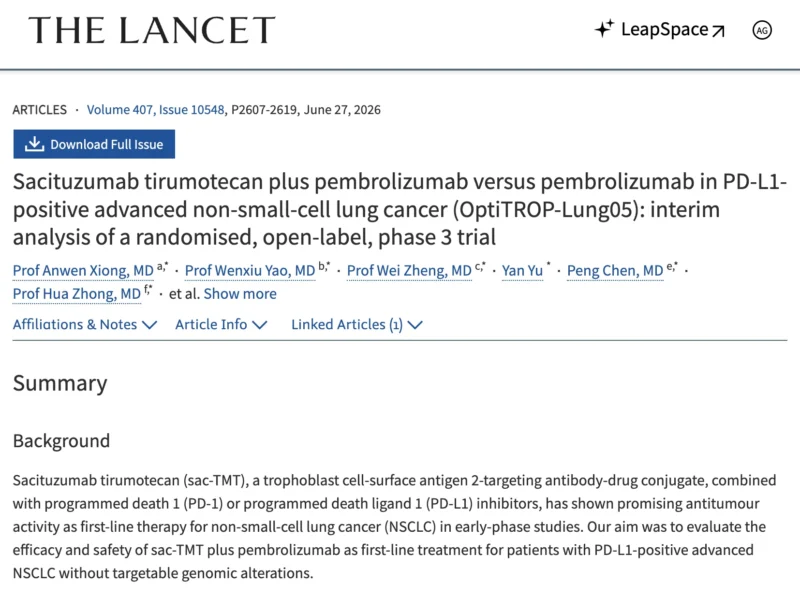
A Phase III Test of ADC–Immunotherapy in the First-Line Setting
OptiTROP-Lung05 was a randomized, open-label phase III study conducted across 68 hospitals in China. Eligible patients had locally advanced or metastatic NSCLC without targetable genomic alterations and a PD-L1 tumor proportion score of at least 1%.
Patients were randomized 1:1 to receive:
- sacituzumab tirumotecan 4 mg/kg on days 1, 15, and 29 plus pembrolizumab 400 mg on day 1
or
- pembrolizumab 400 mg alone
with treatment administered on a six-week cycle (Xiong et al., 2026). The primary endpoint was blinded independent central review–assessed progression-free survival in the intention-to-treat population. Recruitment is complete, but the trial remains ongoing and the final analysis has not yet been reported.
The Interim PFS Result Was Striking
Between June 7, 2024, and March 27, 2025, 413 patients were randomized:
- 208 to sac-TMT + pembrolizumab
and
- 205 to pembrolizumab alone.
At the prespecified interim analysis, median follow-up was 10.5 months (Xiong et al., 2026).
Median PFS was:
- Not reached with sac-TMT + pembrolizumab
versus
- 5.7 months with pembrolizumab alone
with:
- HR 0.35; 95% CI, 0.26–0.47; P<0.0001 (Xiong et al., 2026).
That corresponds to an estimated 65% reduction in the risk of progression or death at this interim analysis. The magnitude of this treatment effect makes OptiTROP-Lung05 one of the more notable phase III ADC–immunotherapy datasets in first-line NSCLC. However, the result remains an interim PFS analysis. Overall survival maturity and longer follow-up will be essential before determining the full clinical significance of the strategy.
The Benefit Was Particularly Strong in PD-L1 TPS 1–49%
One of the most clinically informative findings was the consistency of PFS benefit across PD-L1 subgroups.
Among patients with PD-L1 TPS 1–49%, the hazard ratio was:
- HR 0.28; 95% CI, 0.19–0.41
while among those with PD-L1 TPS ≥50%, the HR was:
- 0.47; 95% CI, 0.29–0.77
The signal in the 1–49% population is particularly relevant. Pembrolizumab monotherapy has historically been less compelling in this group than in tumors with very high PD-L1 expression, and many patients are treated with chemoimmunotherapy. OptiTROP-Lung05 suggests that an ADC–immunotherapy combination may potentially offer another way to intensify PD-1 blockade without relying on conventional platinum chemotherapy.
That does not mean the trial has established superiority over chemoimmunotherapy, it has not. The comparator was pembrolizumab alone, not pembrolizumab plus platinum-based chemotherapy. That distinction is critical for interpretation.
Even PD-L1–High Disease Appeared to Benefit
The results in the PD-L1 TPS ≥50% subgroup are also important. Pembrolizumab monotherapy is an established first-line approach in this population, particularly when rapid cytoreduction is not required. Despite this, the addition of sac-TMT was associated with a PFS HR of 0.47. This raises a clinically interesting issue: even in tumors considered highly immunotherapy-sensitive on the basis of PD-L1 expression, there may be considerable benefit from adding an effective ADC.
The eventual treatment decision, however, will depend on more than PFS. For patients with PD-L1-high tumors, pembrolizumab monotherapy offers the advantage of avoiding additional cytotoxic toxicity. Any intensified strategy must therefore demonstrate enough improvement in disease control, durability, and ideally survival to justify a higher adverse-event burden.
Why TROP2 May Be an Attractive Partner for Immunotherapy
Sacituzumab tirumotecan is a TROP2-directed antibody–drug conjugate. TROP2 is expressed across many epithelial malignancies, including a substantial proportion of NSCLC, and has become an increasingly important ADC target. The scientific interest in pairing an ADC with checkpoint inhibition extends beyond simple additive cytotoxicity.
ADC-mediated tumor-cell killing may alter antigen release and immune signaling within the tumor microenvironment, potentially creating conditions in which immune checkpoint blockade becomes more effective. The OptiTROP-Lung05 paper also places the study within a broader body of evidence exploring ADC–immunotherapy combinations across solid tumors.
The phase III PFS result now provides clinical evidence that the concept can translate into substantially improved disease control in PD-L1-positive NSCLC.
The Safety Trade-Off Is Substantial
The additional efficacy came with increased toxicity. Grade 3 or higher treatment-emergent adverse events occurred in:
- 55% of patients receiving sac-TMT + pembrolizumab
versus
- 31% receiving pembrolizumab alone
This difference is clinically important. Pembrolizumab monotherapy has long been attractive partly because of its relatively favorable treatment burden compared with multi-agent systemic therapy. Adding an ADC predictably changes that balance.
For patients with PD-L1 TPS ≥50%, particularly those with indolent disease, low tumor burden, or comorbidities, the question may therefore become one of incremental efficacy versus incremental toxicity. In contrast, for patients with rapidly progressive or highly symptomatic disease, a strategy capable of producing deeper and earlier disease control may be more attractive.
The final therapeutic value of OptiTROP-Lung05 will therefore depend on how PFS, OS, response durability, adverse events, quality of life, and treatment discontinuation ultimately align.
The Comparator Is the Main Limitation for Clinical Positioning
The most important issue when interpreting OptiTROP-Lung05 is its control arm. The study compared sac-TMT plus pembrolizumab with pembrolizumab monotherapy. This is a legitimate standard option for PD-L1-positive disease, but it does not represent the only contemporary first-line standard across the full PD-L1 ≥1% population.
For many patients with PD-L1 TPS 1–49%, platinum-based chemotherapy plus pembrolizumab remains a commonly used therapeutic benchmark. OptiTROP-Lung05 therefore establishes that adding sac-TMT is substantially better than pembrolizumab alone for PFS, but it does not directly answer whether sac-TMT + pembrolizumab is superior to chemoimmunotherapy.
That question is highly relevant to the next phase of ADC development. If ADCs are eventually going to replace chemotherapy rather than simply add another later-line option, randomized comparisons against modern chemoimmunotherapy standards will become increasingly important.
OptiTROP-Lung06 May Address the Next Question
The development programme is already moving in that direction. At ESMO 2026, OptiTROP-Lung06 is scheduled to compare sac-TMT plus pembrolizumab directly with chemotherapy plus pembrolizumab in first-line PD-L1-negative advanced nonsquamous NSCLC.
That makes OptiTROP-Lung05 and OptiTROP-Lung06 highly complementary. OptiTROP-Lung05 asks whether adding sac-TMT improves outcomes over immunotherapy alone in PD-L1-positive disease. OptiTROP-Lung06 asks whether an ADC can potentially replace the chemotherapy component of first-line chemoimmunotherapy in PD-L1-negative disease.
Together, these studies may help determine whether TROP2-directed ADCs can move from later-line therapy into the core first-line architecture of advanced NSCLC.
The Study Was Conducted Entirely in China
Another limitation is geographic generalizability. OptiTROP-Lung05 was conducted across 68 hospitals in China. There is no reason to assume that the biological activity of the regimen would necessarily be restricted to a Chinese population, but patient characteristics, treatment patterns, supportive care, subsequent therapy, and population genetics can affect outcomes.
Global data will therefore be important when positioning the combination internationally. This consideration is especially relevant when comparing the findings indirectly with trials conducted predominantly or entirely in other geographic populations.
Overall Survival Remains a Major Unanswered Question
The current publication reports an interim analysis focused primarily on PFS. That is sufficient to establish strong antitumor activity, but not enough to determine whether the combination ultimately produces a survival advantage over pembrolizumab alone.
OS is particularly important in first-line NSCLC because subsequent treatment can substantially influence survival. A regimen that produces a large PFS benefit but is followed by effective salvage therapy in the control arm may yield a smaller OS difference. Conversely, preventing early progression may ultimately translate into substantial survival improvement.
Until the final analysis is reported, OptiTROP-Lung05 should therefore be viewed as a strong PFS-positive trial with incomplete long-term survival characterization.
A Broader Shift From Chemotherapy to ADC-Based Cytotoxicity
The study also reflects a larger change in oncology drug development. For decades, first-line metastatic NSCLC treatment has evolved through different combinations of chemotherapy, targeted therapy, and immune checkpoint blockade. ADCs introduce another possibility: delivering cytotoxic payloads through tumor-associated surface targets rather than administering broadly distributed chemotherapy.
Whether this approach ultimately proves superior will depend on several factors:
- target expression
- payload potency
- bystander effect
- intratumoral heterogeneity
- resistance mechanisms
- toxicity
- interaction between ADC-induced tumor-cell death and the immune microenvironment
OptiTROP-Lung05 provides some of the strongest phase III evidence so far that this concept may be clinically meaningful in the first-line setting.
The Bottom Line
The interim phase III OptiTROP-Lung05 analysis demonstrates a substantial improvement in progression-free survival with sacituzumab tirumotecan plus pembrolizumab compared with pembrolizumab alone in previously untreated PD-L1-positive advanced NSCLC without targetable genomic alterations.
Among 413 randomized patients:
- Median PFS: not reached vs 5.7 months
- HR 0.35; 95% CI, 0.26–0.47
- P<0.0001
The benefit was observed across PD-L1 strata:
- TPS 1–49%: HR 0.28
- TPS ≥50%: HR 0.47.
The trade-off was greater toxicity, with grade ≥3 treatment-emergent adverse events occurring in 55% versus 31%. The study therefore establishes a compelling PFS signal but does not yet settle the first-line treatment question.
Longer follow-up is needed for overall survival, and comparisons against modern chemoimmunotherapy will be essential before determining whether sac-TMT can replace conventional chemotherapy in first-line NSCLC. Still, the direction of development is increasingly clear: ADCs are no longer being confined to salvage therapy. They are moving directly into the first-line treatment architecture of lung cancer.
Reference
- Xiong, A., Yao, W., Zheng, W., Yu, Y., Chen, P., Zhong, H., et al. (2026). Sacituzumab tirumotecan plus pembrolizumab versus pembrolizumab in PD-L1-positive advanced non-small-cell lung cancer (OptiTROP-Lung05): Interim analysis of a randomised, open-label, phase 3 trial. The Lancet, 407(10548), 2607–2619.