
For patients with resectable non-small-cell lung cancer, perioperative treatment has changed rapidly.
Neoadjuvant chemoimmunotherapy, combining platinum-doublet chemotherapy with an anti-PD-(L)1 antibody, has become a standard approach for early-stage, resectable non-oncogene-driven NSCLC. In many settings, treatment continues after surgery with adjuvant immunotherapy as part of a perioperative strategy.
These approaches have improved pathological response rates and long-term outcomes, including overall survival.
But an important question now sits at the center of early-stage lung cancer care: does every patient need the same perioperative treatment intensity?
A new Nature Reviews Clinical Oncology review examines how pathological response, circulating tumor DNA, radiomics, metabolic imaging and immune biomarkers could help move perioperative NSCLC treatment toward a more response-adaptive model.
The goal is not simply to intensify treatment for everyone. It is to identify who may benefit from more therapy, who may safely receive less, and who needs a different strategy altogether.
Why Perioperative Therapy Has Become a New Standard
Historically, surgery was the central curative-intent treatment for resectable NSCLC. Platinum-based chemotherapy improved outcomes for selected patients, but recurrence remained common.
The integration of immune checkpoint inhibitors into the neoadjuvant and perioperative setting has changed this landscape.
Neoadjuvant chemoimmunotherapy can reduce tumor burden before surgery, increase pathological response, and potentially activate systemic immune responses against residual micrometastatic disease. Perioperative regimens extend this strategy beyond surgery by continuing anti-PD-(L)1 treatment in the adjuvant setting.
The challenge is that resectable NSCLC is biologically heterogeneous.
Some tumors achieve deep pathological responses and may already have an excellent prognosis after surgery. Others show limited regression despite neoadjuvant chemoimmunotherapy and remain at substantial risk of recurrence.
Treating both groups in the same way may expose some patients to unnecessary treatment while failing to sufficiently support those at highest risk.
Why Pathological Complete Response Matters
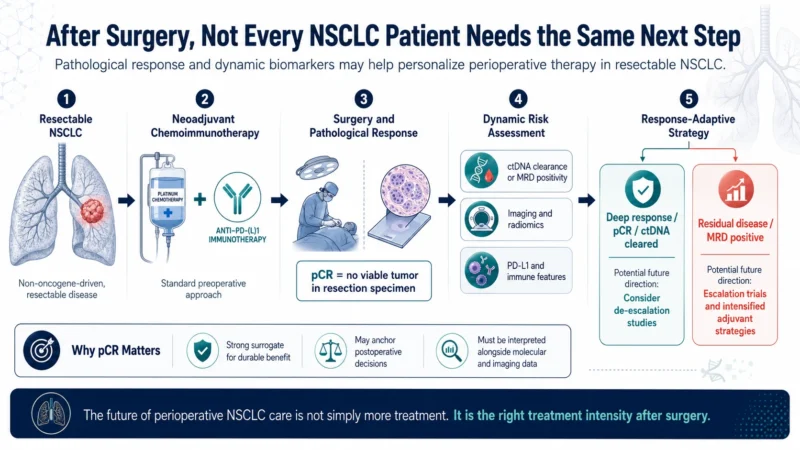
Pathological response has become one of the most important tools for assessing the effect of neoadjuvant therapy.
A pathological complete response, or pCR, refers to the absence of viable tumor cells in the resected primary tumor and sampled lymph nodes after preoperative treatment.
The review identifies pCR, when assessed using standardized criteria, as a robust and clinically meaningful surrogate for durable benefit after neoadjuvant chemoimmunotherapy in resectable non-oncogene-driven NSCLC.
This makes pCR more than a postoperative pathology result.
It may become an anchor for treatment decisions after surgery.
A patient who achieves pCR may have a lower risk of recurrence and could potentially be considered for treatment de-escalation in future trials. By contrast, a patient with residual viable tumor may require closer surveillance, more aggressive adjuvant strategies, or enrollment in studies testing novel treatment combinations.
However, pCR is not a complete answer.
Not every patient with pCR will remain disease-free, and not every patient with residual disease will relapse. This is why pathological response must be integrated with other dynamic biomarkers rather than used alone.
Can ctDNA Help Identify Minimal Residual Disease?
Circulating tumor DNA has emerged as one of the most promising biomarkers in early-stage lung cancer.
ctDNA testing can detect tumor-derived DNA fragments in the bloodstream. In the perioperative setting, ctDNA clearance during neoadjuvant treatment may provide an early indication of response. Persistent ctDNA after surgery may suggest molecular residual disease and a higher risk of recurrence.
The review emphasizes that ctDNA clearance is prognostic and can capture early treatment response. However, its clinical role is more nuanced than simply replacing pathological response.
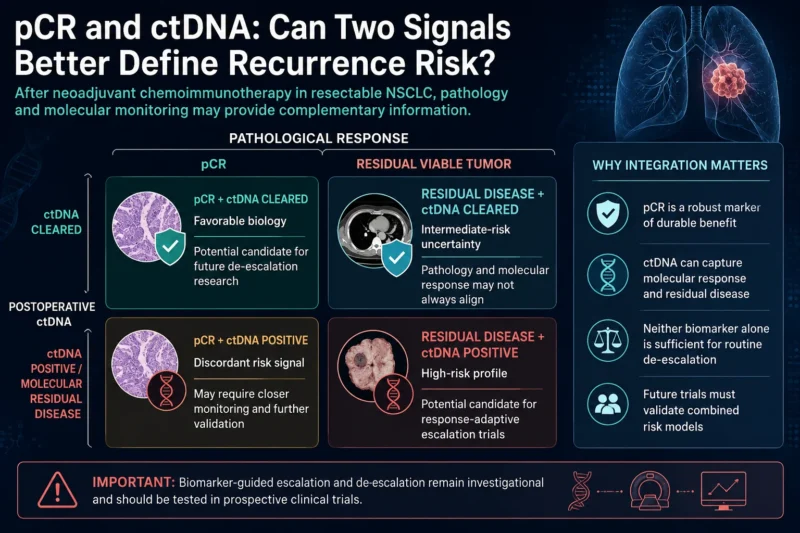
ctDNA may be most useful in situations of biomarker discordance.
For example, a patient may achieve pCR but remain ctDNA-positive after surgery. Conversely, a patient may have residual tumor in the surgical specimen but ctDNA clearance. These patients may not have the same risk profile.
The review notes that ctDNA currently lacks sufficient robustness to guide treatment de-escalation on its own. But it may provide important complementary information, particularly in patients with molecular residual disease after surgery.
This is where response-adaptive care becomes especially relevant.
Beyond Pathology: Imaging, Radiomics and Immune Biomarkers
The future of perioperative NSCLC treatment will likely depend on integrating multiple sources of information.
Baseline PD-L1 expression is one example. Higher tumor PD-L1 expression is associated with a greater likelihood of pCR after neoadjuvant chemoimmunotherapy. But PD-L1 alone is insufficient to decide who should receive more or less treatment.
A high PD-L1 result does not guarantee a deep pathological response. A low PD-L1 result does not mean a patient cannot benefit.
The review highlights the need for dynamic biomarkers that reflect treatment response as it happens.
Potential tools include:
- ctDNA dynamics, including clearance during treatment and molecular residual disease after surgery
- Radiomics, using computational analysis of imaging features to identify tumor biology and treatment response patterns
- Metabolic imaging, which may reveal changes in tumor activity not captured by conventional anatomical imaging
- Immune biomarkers, including baseline and on-treatment indicators of antitumor immune activity
- Molecular tumor features, which may identify resistance mechanisms or define biologically high-risk disease
The value of these approaches may lie in combination rather than isolation.
A patient’s pathology, ctDNA status, imaging response and immune profile may together provide a more accurate estimate of recurrence risk than any single test.
Who May Need Escalation After Surgery?
Patients with features linked to an inferior prognosis may be candidates for intensified postoperative treatment strategies.
The review highlights two particularly important high-risk features:
- Lack of pathological complete response
- Persistent minimal residual disease positivity after surgery
These findings may identify patients whose disease has not been fully controlled by neoadjuvant chemoimmunotherapy.
For these patients, future approaches could include additional adjuvant therapy, new immunotherapy combinations, antibody-drug conjugates, or molecularly directed strategies.
The objective is twofold: increase the chance of durable disease control and prevent recurrence before it becomes clinically apparent.
However, treatment escalation must be tested carefully.
More therapy is not always better. It can add immune-related toxicities, chemotherapy-related adverse effects, financial burden and reduced quality of life. Escalation strategies will need biomarker-enriched trials to ensure that additional treatment reaches patients most likely to benefit.
Could Some Patients Receive Less Treatment?
De-escalation is the other side of precision perioperative care.
For patients who achieve pCR, clear ctDNA, favorable imaging findings and low-risk clinical features, the question may eventually become whether prolonged adjuvant immunotherapy is necessary.
This is not yet established clinical practice.
Current perioperative strategies should continue to follow approved indications, trial evidence and multidisciplinary decision-making. But the concept is increasingly important.
Avoiding unnecessary treatment could reduce toxicity and preserve quality of life without compromising cure rates.
The key will be confidence.
Before de-escalation becomes routine, clinicians will need validated biomarkers that reliably identify patients with a sufficiently low recurrence risk.
Novel Strategies for Resistant Disease
The review also points toward a future beyond conventional chemoimmunotherapy.
Emerging neoadjuvant strategies include antibody-drug conjugates and novel immunotherapy combinations. These approaches may help overcome primary resistance in tumors that are unlikely to achieve pCR with standard chemoimmunotherapy alone.
But this will require more selective trial design.
Rather than testing intensified regimens broadly, future studies may need to enrich for patients with high-risk biological features, such as poor pathological response, persistent ctDNA, unfavorable immune profiles or molecular markers linked to resistance.
This could make perioperative therapy more efficient and more personalized.
The Bottom Line
Perioperative chemoimmunotherapy has improved outcomes for patients with resectable non-oncogene-driven NSCLC. The next step is refining how treatment is delivered.
Pathological complete response is emerging as a strong marker of long-term benefit and an important foundation for postoperative decision-making. Yet pathology alone is not enough.
ctDNA, radiomics, metabolic imaging and immune biomarkers may help identify patients who need escalation, patients who could potentially avoid unnecessary treatment, and those who require a different strategy from the start.
The future of perioperative NSCLC care may not be defined by giving more treatment to every patient.
It may be defined by giving the right treatment intensity to the right patient, at the right point in the curative-intent journey.