Stage III non–small cell lung cancer remains one of the most complex settings in thoracic oncology. The disease encompasses a wide spectrum of tumor and nodal involvement, ranging from tumors that are technically resectable at presentation to bulky or anatomically complex disease better managed with definitive chemoradiotherapy. The rapid integration of immunotherapy and targeted therapies has made these distinctions even more consequential, because the initial assessment of resectability, mediastinal disease burden, molecular status, and patient fitness can now determine fundamentally different therapeutic pathways.
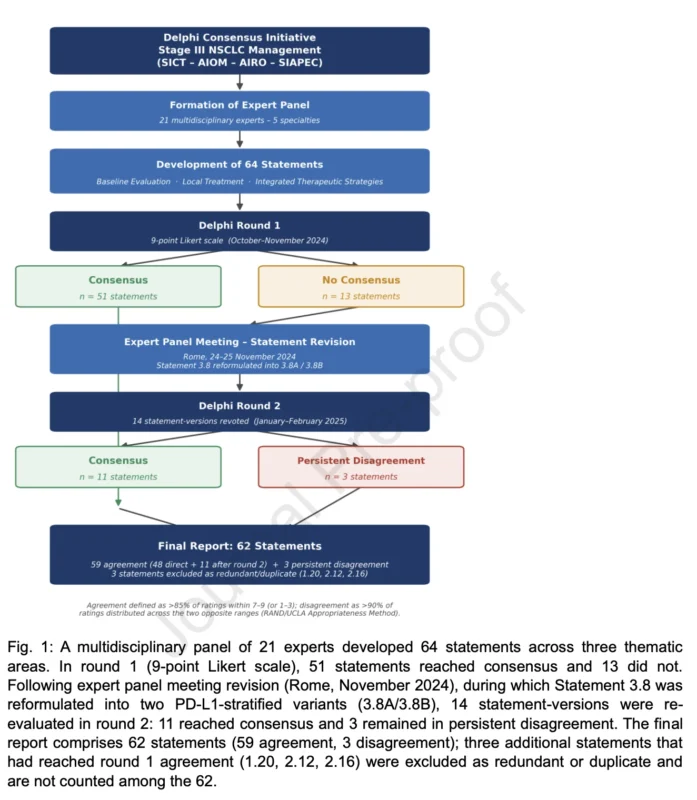
A 2026 multisocietal Italian Delphi consensus published in JTO Clinical and Research Reports attempts to bring greater structure to this increasingly complicated landscape. Developed jointly by experts representing AIOM, SICT, SIAPEC, and AIRO, the initiative involved thoracic surgeons, medical oncologists, radiation oncologists, interventional pulmonologists, and pathologists. The final report includes 62 statements, of which 59 achieved agreement and only three remained in persistent disagreement.
The importance of the consensus lies less in introducing an entirely new treatment algorithm than in clarifying how modern stage III NSCLC should be approached as a multidisciplinary disease from the moment of diagnosis. Accurate staging, pathological confirmation of mediastinal involvement, molecular profiling, assessment of technical resectability, cardiopulmonary fitness, and planning of systemic and local treatment are presented as interconnected decisions rather than sequential tasks performed by separate specialties.
Staging Must Be Comprehensive Before Treatment Begins
The consensus strongly supports a rigorous baseline staging process. Patients with suspected stage III NSCLC should undergo contrast-enhanced chest and abdominal CT, ^18F-FDG PET, and brain imaging, with contrast-enhanced MRI preferred for intracranial staging. The panel also recommends systematic invasive mediastinal assessment with EBUS-TBNA with or without EUS-FNA after radiological staging rather than relying exclusively on imaging.
The emphasis on systematic mediastinal staging is particularly relevant because the amount and distribution of N2 disease increasingly influence whether a patient enters a surgical or nonsurgical multimodal pathway. The panel recommends assessment of all accessible hilar and mediastinal stations rather than selective sampling of only the most suspicious nodes. When endosonographic sampling is inadequate despite strongly suspicious imaging, the diagnostic pathway should continue with repeat EBUS/EUS or surgical staging according to local expertise.
This approach reflects an important principle in stage III disease: inaccurate nodal staging is not simply a diagnostic error. It can fundamentally alter the entire therapeutic strategy.
Molecular Testing Now Belongs at the Beginning of Stage III Care
One of the clearest changes in contemporary stage III NSCLC is that molecular profiling can no longer be considered primarily a metastatic-disease exercise.
The panel considers PD-L1 assessment together with EGFR and ALK testing essential before treatment selection, while broader next-generation sequencing should be performed whenever feasible.
The reason is therapeutic rather than merely descriptive. Patients with actionable oncogenic alterations may follow very different curative-intent pathways from patients with driver-negative disease. The consensus notes that EGFR- or ALK-driven tumors have not shown the same clear benefit from neoadjuvant chemoimmunotherapy observed in unselected driver-negative populations, while targeted therapies have generated strong evidence in the postoperative setting.
For patients with common EGFR mutations or ALK rearrangements considered resectable, the panel supports upfront surgery followed by adjuvant targeted treatment with osimertinib for EGFR-mutated disease and alectinib for ALK-rearranged disease. Platinum-based chemotherapy may precede osimertinib in eligible EGFR-mutated patients.
This creates a practical distinction that should be established before neoadjuvant treatment begins: resectable stage III NSCLC is no longer one therapeutic population. Driver-positive and driver-negative disease may require different multimodal strategies from the outset.
Neoadjuvant Chemoimmunotherapy Becomes the Preferred Strategy in Resectable Driver-Negative Disease
For resectable stage III NSCLC without EGFR or ALK alterations, the consensus strongly favors neoadjuvant chemoimmunotherapy over chemotherapy alone and over immediate surgery. The panel also considered this strategy appropriate irrespective of baseline PD-L1 expression.
This reflects one of the most important changes produced by the perioperative immunotherapy era. Surgery remains central to cure in resectable disease, but it is increasingly positioned as one component of a planned multimodal strategy rather than necessarily the first therapeutic event.
The rationale extends beyond pathological response. Neoadjuvant treatment allows systemic therapy to address occult micrometastatic disease early while the primary tumor remains present as a source of tumor antigen. At the same time, response to treatment may provide information about tumor biology and can occasionally improve the technical conditions for surgery.
The panel nevertheless avoids treating the perioperative pathway as completely settled. Postoperative immunotherapy after neoadjuvant chemoimmunotherapy may be considered according to pathological response and clinical factors, but the authors explicitly acknowledge that current perioperative trials do not isolate the incremental contribution of the postoperative phase.
This remains an important unresolved question. The available trials demonstrate that perioperative strategies work, but they do not definitively establish how much additional benefit is produced by continuing checkpoint blockade after a patient has already received neoadjuvant immunotherapy and undergone complete resection.
Resectability Should Be Defined by an MDT, Not by Stage Label Alone
Perhaps the most clinically useful aspect of the consensus is its treatment of resectability as a multidisciplinary judgment rather than a fixed characteristic determined by TNM classification alone.
The panel states that resectability should be assessed by a thoracic surgeon at baseline within the multidisciplinary team. Importantly, multistation N2 disease was not considered an absolute technical contraindication to radical surgery, whereas bulky N2 disease was considered a reason to exclude surgery in most patients, except in carefully selected cases.
The distinction between multistation and bulky N2 disease is important. Recent perioperative trials have included selected patients with multistation nodal involvement, but the subgroup evidence remains exploratory and sometimes inconsistent. The authors therefore caution against using these analyses as definitive justification for surgery and emphasize that individual decisions should remain MDT-driven.
For borderline resectable disease, neoadjuvant chemoimmunotherapy followed by surgical reassessment was considered a reasonable alternative to immediate definitive chemoradiotherapy. Treatment should depend on disease distribution, technical feasibility of achieving an R0 resection, response to induction treatment, and patient-related factors.
This dynamic concept of resectability is likely to become increasingly important. A patient does not necessarily remain permanently categorized as either “surgical” or “nonsurgical” at baseline; selected borderline cases can be reassessed after induction therapy, provided that this possibility was anticipated within a multidisciplinary plan.
Surgery Should Aim for Radicality Without Unnecessary Loss of Lung
The consensus defines radical surgery according to IASLC R0 criteria and strongly favors anatomical lung resection, with lobectomy preferred when feasible. At the same time, the panel places particular emphasis on minimizing pneumonectomy through sleeve resections, vascular reconstruction, extended lobectomy, or other parenchymal-sparing approaches whenever oncologically appropriate.
Pneumonectomy is not prohibited, but it should be reserved for highly selected patients. For patients with poor functional reserve whose disease would require pneumonectomy, definitive chemoradiotherapy should also be considered, particularly when effective consolidation immunotherapy or targeted therapy is available.
This recommendation is especially relevant after neoadjuvant chemoimmunotherapy, where major pathological responses may permit less extensive surgery in some patients. The therapeutic objective is therefore not simply anatomical removal of the tumor but achievement of a complete oncologic resection with the lowest reasonable functional cost.
The consensus also recognizes an unresolved surgical issue: there is still insufficient harmonization regarding the minimum extent of systematic intraoperative nodal dissection after neoadjuvant therapy. Because postoperative radiotherapy decisions may depend heavily on whether residual or unsuspected N2 disease is identified, standardization of nodal assessment remains an important future priority.
Pathological Response Is Becoming Part of Postoperative Risk Assessment
Pathological assessment after neoadjuvant therapy has taken on much greater importance in the immunotherapy era. The consensus recommends standardized evaluation according to IASLC criteria and considers the degree of pathological response relevant for prognostic stratification. Additional sampling should be performed when viable tumor approaches the threshold used to define major pathological response.
The authors also emphasize that nodal response should be evaluated separately from primary-tumor response. A patient with a major response in the lung but persistent ypN2 disease may have a substantially different prognosis from one who achieves mediastinal nodal clearance.
This distinction may become increasingly important as postoperative therapy becomes more individualized. Pathological response, nodal status, molecular residual disease, and other biomarkers could eventually help determine who requires additional systemic or local treatment after surgery rather than applying the same postoperative strategy to every patient.
Restaging After Neoadjuvant Therapy Requires More Than RECIST
The consensus supports contrast-enhanced CT and RECIST-based response assessment after neoadjuvant treatment to exclude progression and confirm the previously planned multimodal strategy. Pathological mediastinal restaging should be considered when suspected nodal progression could change treatment.
However, the authors appropriately highlight the limitations of conventional radiology after immunotherapy. Treatment-related fibrosis, necrosis, inflammatory changes, and pseudoprogression can make radiographic tumor measurements an imperfect surrogate for pathological response. PET-CT is well established for baseline staging, but its incremental role in routine post-neoadjuvant restaging has not been clearly established.
The practical conclusion is important: imaging should inform surgical reassessment, but the decision to proceed to resection should not be made by RECIST criteria alone.
Unresectable Stage III Disease Retains a Clear Curative-Intent Standard
While resectable disease has undergone rapid therapeutic restructuring, the management of unresectable stage III NSCLC remains comparatively stable.
The panel strongly endorses concurrent chemoradiotherapy whenever the patient can tolerate it, with sequential chemoradiotherapy reserved for patients in whom concurrent treatment is unsuitable. Radiotherapy should generally deliver 60–66 Gy using modern intensity-modulated techniques such as IMRT or VMAT.
For patients without progression after chemoradiotherapy, one year of durvalumab consolidation is supported in PD-L1–positive disease within the European regulatory context reflected by the consensus. For patients with EGFR exon 19 deletion or L858R disease, maintenance osimertinib until progression or unacceptable toxicity is recommended.
Conversely, the panel did not support intensifying chemoradiotherapy by adding concurrent immunotherapy, reinforcing the principle that immunotherapy should not simply be moved earlier into every component of treatment without supporting evidence.
Postoperative Radiotherapy Is Becoming More Selective
The role of PORT has also become more nuanced.
The consensus strongly recommends postoperative radiotherapy after non-radical surgery with positive margins and/or extracapsular nodal extension. In contrast, PORT was not routinely recommended for an unforeseen pN2 finding after an otherwise radical resection. It may nevertheless be considered in patients with multistation nodal disease or persistent ypN2 involvement after neoadjuvant treatment to reduce locoregional recurrence risk.
These recommendations reflect the modern shift away from treating all postoperative N2 disease identically. The potential benefit of local control must be weighed against cardiopulmonary toxicity, systemic relapse risk, nodal burden, completeness of resection, and prior systemic therapy.
The Areas Without Consensus May Be the Most Informative
Only three issues remained in persistent disagreement after the Delphi process, and these areas help define where current evidence remains insufficient.
The first was adjuvant immunotherapy after chemotherapy in radically resected patients with PD-L1 expression of 1%–49% who had not received systemic therapy preoperatively. Agreement was only 68.2%. The uncertainty reflects inconsistent trial results across IMpower010, KEYNOTE-091, BR.31, and ALCHEMIST, particularly in intermediate PD-L1 populations.
The second concerned whether neoadjuvant chemoimmunotherapy could replace the historical strategy of chemoradiotherapy followed by surgery in Pancoast tumors. The panel did not endorse this approach because prospective evidence remains insufficient, leaving trimodality chemoradiotherapy and surgery as the established strategy.
The third unresolved issue involved patients with unresectable disease who are unable to receive chemotherapy. There was no consensus that definitive radiotherapy followed by durvalumab should become routine practice, because the evidence remains limited and the pivotal PACIFIC population received chemoradiotherapy rather than radiotherapy alone.
These disagreements are clinically valuable because they prevent the consensus from creating a false impression that every stage III scenario has already been solved.
The Multidisciplinary Team Is No Longer an Administrative Requirement
Perhaps the strongest message from this consensus is that MDT discussion in stage III NSCLC is not simply a recommendation to present a case at tumor board after diagnostic work is completed.
The MDT determines what diagnostic work needs to be completed in the first place. It influences mediastinal staging, tissue acquisition, molecular testing, technical resectability, functional operability, neoadjuvant strategy, extent of surgery, postoperative treatment, and whether a borderline patient should transition from a nonsurgical to surgical pathway.
The consensus therefore reframes multidisciplinary care as a continuous process rather than a single meeting.
That approach is particularly appropriate for stage III NSCLC because the treatment plan may need to evolve as new information becomes available, after EBUS, molecular testing, induction therapy, restaging, surgery, or final pathology.
The Bottom Line
The 2026 Italian multisocietal Delphi consensus reflects how profoundly immunotherapy and targeted therapy have changed the management of stage III NSCLC. The final framework emphasizes comprehensive staging, systematic pathological assessment of mediastinal nodes, PD-L1 and EGFR/ALK testing before treatment selection, and multidisciplinary evaluation of resectability and operability.
For most patients with resectable, EGFR/ALK-negative stage III NSCLC, neoadjuvant chemoimmunotherapy is now favored over chemotherapy alone or upfront surgery. Surgical treatment should prioritize complete R0 resection while preserving lung parenchyma whenever possible, and multistation N2 disease should not automatically exclude surgery when an MDT considers complete resection feasible.
For unresectable disease, concurrent chemoradiotherapy followed by consolidation therapy remains the curative-intent backbone, with durvalumab for appropriate PD-L1–positive disease and osimertinib defining a distinct post-chemoradiotherapy strategy for common EGFR-mutated tumors.
The most important conceptual change is therefore not the arrival of one new drug or procedure. It is that stage III NSCLC increasingly requires a biologically informed, dynamically reassessed multimodal strategy in which surgery, radiotherapy, immunotherapy, targeted therapy, pathology, and staging are planned together rather than sequentially.
In this setting, the quality of multidisciplinary decision-making may be as important as the quality of any individual treatment.
Reference
- Gallina FT, Ambrosi F, Marinelli D, et al. Multidisciplinary Management of Stage III Non-Small Cell Lung Cancer in the Immunotherapy Era: An Italian Delphi Consensus from AIOM, SICT, SIAPEC, and AIRO. JTO Clinical and Research Reports. 2026;101068. doi:10.1016/j.jtocrr.2026.101068. Accepted August 23, 2026.