
A new real-world study from Yale School of Medicine suggests that neoadjuvant immunotherapy-based treatment is associated with improved long-term overall survival and recurrence-free survival in patients with non-small cell lung cancer (NSCLC) undergoing surgical resection, without a significant increase in postoperative complications. The findings, published as an accepted manuscript in JTO Clinical and Research Reports, also reinforce the potential prognostic importance of major pathological response following neoadjuvant treatment.
Led by Theresa Ermer, MD, and colleagues, the retrospective study evaluated 95 patients who underwent surgery after neoadjuvant treatment between October 2015 and January 2025. Among these patients, 57 received immunotherapy-based neoadjuvant treatment, predominantly in combination with chemotherapy, while 38 received chemotherapy without immunotherapy.
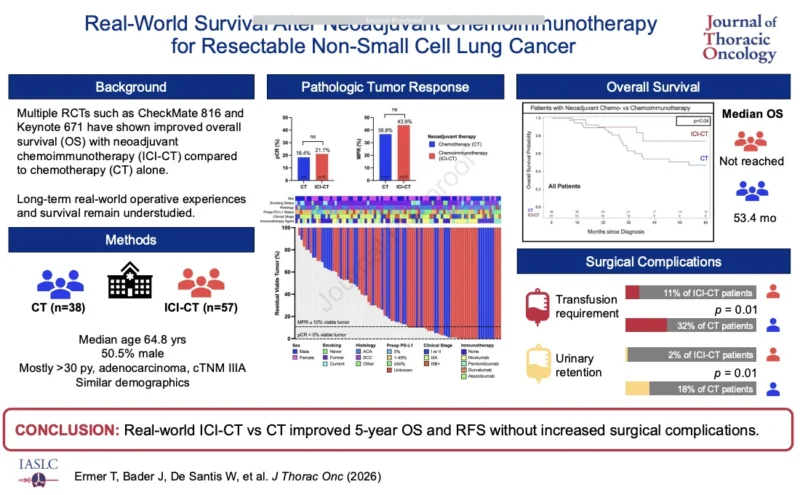
Estimated five-year overall survival (OS) reached 74.3% in the immunotherapy-based cohort compared with 47.3% in the chemotherapy cohort. Median OS was not reached with immunotherapy-based treatment versus 53.4 months with chemotherapy (p=0.04).
Recurrence-free survival (RFS) also favored the immunotherapy-based group, with a median of 60.0 months compared with 26.2 months (p=0.02).
Importantly, these improvements were observed without statistically significant differences in major surgical complications, operative duration, surgical approach, or the extent of resection.
However, because this was a small, retrospective, nonrandomized study involving patients who successfully proceeded to surgery, the findings should be interpreted as supportive real-world evidence rather than definitive proof of comparative treatment efficacy.
Why Real-World Evidence Matters in Resectable NSCLC
The treatment of resectable NSCLC has undergone a substantial transformation with the integration of immune checkpoint inhibitors into neoadjuvant and perioperative treatment strategies.
Randomized phase III trials, including CheckMate 816, KEYNOTE-671, AEGEAN, and CheckMate 77T, have demonstrated meaningful improvements in pathological response and event-free survival with immunotherapy-based regimens.
Longer follow-up from CheckMate 816 and KEYNOTE-671 has also confirmed overall survival benefits, strengthening the position of neoadjuvant and perioperative immunotherapy as important treatment strategies for appropriately selected patients without EGFR or ALK driver alterations.
Nevertheless, translating randomized clinical trial findings into routine clinical practice remains challenging.
Trial populations are generally selected according to predefined eligibility criteria and may underrepresent older adults, patients with substantial comorbidities, individuals with poorer performance status, or patients requiring technically complex surgery.
Another unresolved concern is whether immunotherapy-associated inflammatory and fibrotic changes increase the difficulty of subsequent pulmonary resection.
Although randomized trials have demonstrated the feasibility of surgery after chemoimmunotherapy, detailed real-world information regarding operative complexity, postoperative morbidity, and long-term survival remains relatively limited.
The Yale study sought to address these questions by comparing a decade of institutional experience with neoadjuvant immunotherapy-based treatment and chemotherapy alone.
Study Design and Patient Characteristics
The investigators conducted a retrospective longitudinal cohort study at Yale-New Haven Hospital, including consecutive patients with NSCLC who received neoadjuvant systemic treatment and subsequently underwent surgical resection.
Patients were treated between October 2015 and January 2025, with clinical outcomes assessed through June 2025.
The cohort included clinical stages IB through IV, incorporating selected patients with oligometastatic disease considered suitable for local treatment, particularly those with isolated brain metastases amenable to intervention.
Patients undergoing salvage surgery after treatment initially delivered without curative surgical intent were excluded. Known EGFR- or ALK-positive tumors were also excluded at treatment selection, although two patients in the chemotherapy cohort were subsequently found to harbor EGFR exon 19 deletions.
The final population included 95 patients, of whom 38 received chemotherapy alone and 57 received neoadjuvant immunotherapy with or without chemotherapy. The median age was 64.8 years, with approximately equal representation of men and women.
Most patients had a history of tobacco exposure, and adenocarcinoma represented the most common histological subtype, accounting for 57.9% of cases.
Clinical stage IIIA was the largest disease category, accounting for 53.7% of the population. Approximately one-quarter had stage I–II disease, while smaller proportions had stage IIIB or selected stage IV disease. Most patients had an ECOG performance status of 0 or 1.
Nivolumab was the most frequently administered immune checkpoint inhibitor, used in 54.4% of immunotherapy recipients, followed by pembrolizumab in 31.6%, atezolizumab in 10.5%, and durvalumab in 3.5%.
An important methodological distinction is that eight patients, representing approximately 14% of the immunotherapy-based cohort, received an immune checkpoint inhibitor without chemotherapy.
Therefore, although the study is described as an analysis of neoadjuvant chemoimmunotherapy, the investigational group was not composed exclusively of patients receiving combined chemotherapy and immunotherapy.
Overall Survival: Encouraging Long-Term Outcomes
The most clinically relevant observation was the association between immunotherapy-based neoadjuvant treatment and improved overall survival. Median OS had not been reached in the immunotherapy-based group, compared with 53.4 months in the chemotherapy group (95% CI 28.1 months to greater than 60 months; p=0.04).
Estimated five-year OS rates were 74.3% and 47.3%, respectively. At two years, the estimated OS rates were 90% with immunotherapy-based treatment and 81% with chemotherapy. These findings are broadly consistent with the direction of benefit observed in randomized neoadjuvant and perioperative immunotherapy trials.
However, the numerical magnitude of the differences should not be directly compared with results from CheckMate 816 or KEYNOTE-671 because the Yale study included a smaller and more heterogeneous population, selected only patients who underwent surgery, and incorporated different postoperative treatments.
In addition, the immunotherapy-based group was treated predominantly in more recent years, potentially introducing differences in staging, supportive care, surgical techniques, systemic therapies, and follow-up duration.
Accordingly, these results provide evidence of an association with improved survival in routine practice but cannot establish how much of the observed difference was attributable specifically to the addition of immunotherapy.
Recurrence-Free Survival More Than Doubles
The study also identified a statistically significant improvement in RFS. Median RFS reached 60.0 months in the immunotherapy-based group compared with 26.2 months in the chemotherapy group (p=0.02). The confidence intervals were 32.9 months to greater than 60 months and 12.8–51.0 months, respectively.
The study defined RFS from biopsy-confirmed diagnosis to recurrence, progression, or death, rather than using the date of surgery as the starting point. This endpoint definition is relevant when interpreting the results alongside trials using event-free survival or disease-free survival, which may differ in their starting points and event definitions.
The RFS findings suggest that the favorable outcomes observed with immunotherapy-based treatment extend beyond immediate pathological response and may translate into more durable disease control. Nevertheless, the retrospective design and variation in subsequent treatment remain important potential confounders.
Nearly half of the immunotherapy-based cohort received additional postoperative immunotherapy, meaning that the survival results cannot isolate the contribution of neoadjuvant treatment from that of the broader perioperative strategy.
Major Pathological Response Emerges as a Key Prognostic Marker
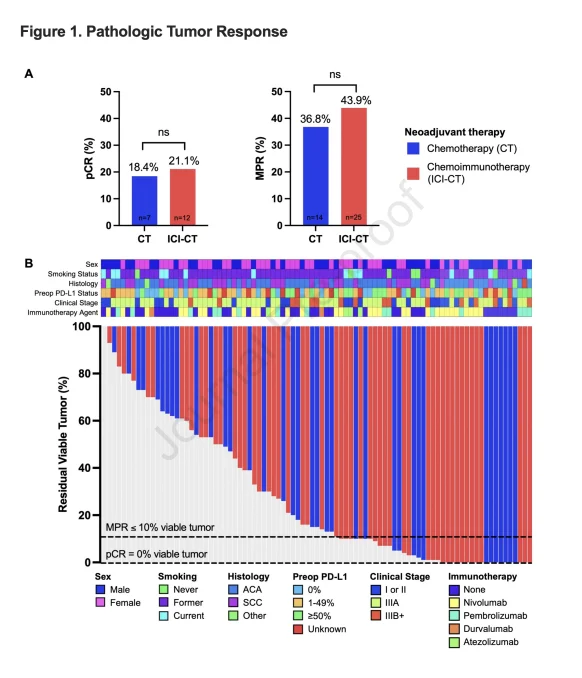
One of the most important findings concerned the relationship between major pathological response (MPR) and long-term outcomes. MPR was defined as 10% or less residual viable tumor in the resected primary lesion, while pathological complete response (pCR) required the absence of viable tumor in both the primary tumor and sampled regional lymph nodes.
MPR was observed in 43.9% of patients receiving immunotherapy-based treatment compared with 36.8% receiving chemotherapy alone. The corresponding pCR rates were 21.1% and 18.4%. Neither difference reached statistical significance, with p=0.77 for MPR and p=0.75 for pCR.
The relatively high pathological response rates in the chemotherapy group warrant consideration because 40% of those patients had received concurrent neoadjuvant chemoradiotherapy, compared with approximately 4% of immunotherapy-based recipients.
Despite the absence of a significant between-group difference in response rates, pathological response was strongly associated with subsequent survival among patients receiving immunotherapy-based treatment.
Median OS was not reached among immunotherapy recipients achieving MPR, compared with 45.7 months among those without MPR (p=0.01). The corresponding RFS analysis showed that median RFS remained unreached among patients achieving MPR, compared with 32.9 months among those without MPR (p=0.002).
The authors also reported five-year survival of at least 90% among immunotherapy-treated patients who achieved MPR. These observations support MPR as a clinically meaningful prognostic marker following immunotherapy-based neoadjuvant treatment.
However, the study does not establish MPR as a validated surrogate endpoint for overall survival or demonstrate that postoperative treatment can safely be omitted solely because MPR is achieved.
Pathological Complete Response and Nodal Downstaging
The investigators also explored the association between pCR and long-term outcomes. Across the combined cohort, patients achieving pCR demonstrated favorable survival compared with those who had residual viable tumor.
Among immunotherapy recipients achieving pCR, no deaths were observed during the available follow-up. However, the pCR subgroup was small, and many immunotherapy-treated patients had relatively immature follow-up.
The investigators therefore emphasized that detailed pCR-based survival analyses were limited by sample size. Nodal downstaging was another relevant outcome. Approximately 42% of the overall cohort demonstrated nodal downstaging following neoadjuvant treatment.
Among patients with pretreatment N2 disease, downstaging to N1 or N0 was observed in both treatment groups. Although the proportions were numerically favorable in some immunotherapy-treated subgroups, the overall differences between treatment strategies were not statistically significant.
These findings suggest that pathological and nodal responses may provide valuable information for postoperative risk assessment. Nevertheless, their use to individualize adjuvant immunotherapy duration or guide treatment de-escalation remains investigational.
Does Neoadjuvant Immunotherapy Make Lung Surgery More Difficult?
Concerns regarding surgical complexity remain a major consideration when introducing systemic therapy before lung resection. Immunotherapy can produce inflammatory changes, fibrosis, and alterations in tissue planes that may complicate hilar dissection or technically demanding operations.
However, the Yale study did not identify statistically significant differences in operative outcomes between the treatment groups. The median operative duration was 291 minutes following immunotherapy-based treatment and 266 minutes following chemotherapy alone (p=0.50).
The extent of resection was also broadly comparable. Lobectomy or less extensive resection was performed in 80.7% of immunotherapy recipients and 73.7% of chemotherapy recipients. Pneumonectomy rates were approximately 12% and 11%, respectively, while sleeve resections were performed in 14% and 11%.
Conversion from a minimally invasive approach to open surgery occurred in 7% of immunotherapy recipients versus 13% of chemotherapy recipients, without a significant difference. Similarly, surgical approach did not differ significantly between groups.
These results suggest that immunotherapy-based neoadjuvant treatment can be incorporated into multidisciplinary surgical practice without necessarily increasing operative duration or requiring more extensive resections. However, the study was not designed or powered to prove equivalence in surgical safety.
Postoperative Complications: No Significant Increase in Major Morbidity
Major postoperative complications were observed in 15.8% of patients receiving immunotherapy-based treatment and 13.2% receiving chemotherapy alone (p=0.78). The overall rate of recorded complications was 47.4% versus 63.2%, respectively, although this difference was not statistically significant (p=0.15).
Pneumonia was the most frequently reported major complication across the cohort. Rates of respiratory failure requiring reintubation, tracheostomy, pulmonary embolism, and unexpected return to the operating room did not differ significantly between groups.
Two postoperative outcomes were significantly more frequent among chemotherapy-only recipients. Blood transfusions were required in 31.6% of chemotherapy recipients versus 10.5% of immunotherapy-based recipients (p=0.01).
Postoperative urinary retention occurred in 18.4% versus 1.8%, respectively (p=0.01). The authors suggested that differences in preoperative anemia may have contributed to the transfusion findings.
The urinary retention difference may have reflected evolving enhanced recovery protocols and changes in urinary catheter management over the study period. Consequently, neither finding should be interpreted as direct evidence that immunotherapy prevents these complications.
Ninety-day mortality was 1.8% after immunotherapy-based treatment and 7.9% after chemotherapy alone, but the difference was not statistically significant (p=0.14).
Overall, the findings provide reassurance regarding the feasibility of surgery after neoadjuvant immunotherapy, while remaining insufficient to establish a definitive comparative safety advantage.
Postoperative Treatment May Have Influenced Survival
One particularly important limitation involves differences in treatment after surgery. Additional postoperative therapy was administered to approximately half of all patients. However, adjuvant immunotherapy was substantially more common in the neoadjuvant immunotherapy group, occurring in 45.6% versus 18.4% of patients (p=0.006).
Conversely, postoperative radiotherapy was more frequent in the chemotherapy group, at 21.1% versus 7%. These differences reflect the evolving treatment landscape during the decade-long study period. They also complicate interpretation of the survival findings.
Because almost half of patients receiving neoadjuvant immunotherapy continued immune checkpoint blockade after surgery, the analysis cannot determine whether the improved outcomes arose from neoadjuvant treatment alone, postoperative immunotherapy, or the combined perioperative strategy.
This distinction is particularly relevant as clinicians increasingly consider response-adapted approaches that might omit or intensify postoperative treatment based on pathological response or circulating tumor DNA.
The present study supports further investigation of such strategies but does not directly answer these treatment-sequencing questions.
Limitations: Important Considerations Before Changing Practice
The findings must be interpreted in the context of several methodological limitations. First, the study was conducted within a single healthcare system and included only 95 patients, limiting statistical power and the reliability of subgroup analyses. Second, patients were not randomly assigned to treatment.
Third, the chemotherapy and immunotherapy groups came predominantly from different treatment eras. This introduces potential confounding related to changes in surgical practice, imaging, molecular testing, supportive care, and systemic treatment.
Fourth, the chemotherapy cohort had substantially greater exposure to neoadjuvant chemoradiotherapy, while the immunotherapy cohort was considerably more likely to receive postoperative immunotherapy. Fifth, the immunotherapy-based group included patients receiving checkpoint inhibitor monotherapy, meaning the study did not evaluate a uniform chemoimmunotherapy regimen.
Sixth, the study included selected patients with stage IV oligometastatic disease, limiting direct generalization to conventional stage II–III resectable populations.
Most importantly, only patients who successfully underwent surgical resection were included in the survival analysis. Patients who began neoadjuvant immunotherapy but did not proceed to surgery because of progression, toxicity, or other reasons were not systematically evaluated.
This creates a selection effect that may favor patients who tolerated treatment and remained suitable for surgery. The study also relied primarily on unadjusted survival comparisons rather than a randomized or fully confounder-adjusted assessment.
Accordingly, its results should be considered complementary to, rather than a replacement for, evidence from large randomized trials.
Clinical Implications for Modern Perioperative NSCLC Management
Despite these limitations, the study provides clinically useful information. The survival findings are consistent with the broader evidence supporting immunotherapy-based neoadjuvant or perioperative treatment in appropriately selected patients with resectable NSCLC.
The absence of a significant increase in surgical morbidity is also reassuring for multidisciplinary teams concerned about operative complexity after immunotherapy. The association between MPR and improved long-term outcomes further supports the importance of standardized pathological assessment following neoadjuvant treatment.
However, several important questions remain unanswered. Can pathological response reliably identify patients who no longer require postoperative immunotherapy? Does circulating tumor DNA provide additional prognostic information beyond MPR and pCR?
Which patients are most likely to benefit from intensified systemic treatment after incomplete pathological response?
And can response-adapted approaches safely reduce treatment exposure without compromising long-term survival?
These questions will require larger prospective studies incorporating molecular profiling, standardized pathological evaluation, and longitudinal biomarker assessment.
OncoDaily Takeaway
This Yale real-world study provides encouraging evidence that immunotherapy-based neoadjuvant treatment is associated with improved five-year survival and recurrence-free survival in patients with NSCLC who proceed to surgery, without a statistically significant increase in major postoperative complications.
Five-year OS reached 74.3% versus 47.3%, while median RFS was 60.0 versus 26.2 months in the immunotherapy-based and chemotherapy groups, respectively. The study also identified a strong association between MPR and favorable long-term survival among immunotherapy-treated patients, reinforcing the potential prognostic value of pathological response.
Importantly, the findings do not establish a causal treatment effect or prove that immunotherapy-based treatment is surgically equivalent to chemotherapy. The small cohort, retrospective design, differences in treatment eras, and exclusion of patients who did not undergo surgery require cautious interpretation.
Nevertheless, the results add meaningful real-world support to the broader randomized evidence for immunotherapy integration in resectable NSCLC.
The clinical message is that neoadjuvant immunotherapy-based treatment can deliver encouraging long-term outcomes in routine thoracic oncology practice while maintaining feasible surgical management. The next priority is determining how pathological and molecular responses can guide more individualized perioperative treatment.
Source
- Ermer T, Bader JM, de Santis W, Asmelash S, Tremblay EE, Kim SY, Goldberg SB, Blasberg JD, Schalper KA, Dacic S, Woodard GA.
- Real-World Survival After Neoadjuvant Chemoimmunotherapy for Resectable Non-Small Cell Lung Cancer. JTO Clinical and Research Reports. 2026.