
The September 2026 update to the NCCN framework for metastatic non–small cell lung cancer reflects how rapidly precision oncology is expanding beyond the established EGFR, ALK, ROS1, RET, MET exon 14, BRAF, NTRK, HER2, and KRAS G12C treatment pathways.
Two developments are particularly relevant. Sevabertinib is incorporated as a first-line targeted option for HER2-mutated advanced NSCLC, following expansion of its FDA indication earlier this month. At the same time, daraxonrasib has entered the NCCN emerging-biomarker framework as an option to consider for previously treated KRAS-mutant NSCLC, despite remaining off-label in lung cancer.
The latter represents an especially important conceptual change. Until recently, effective RAS-directed treatment in NSCLC was largely confined to allele-specific inhibition of KRAS G12C. Daraxonrasib is designed to inhibit active RAS across multiple mutations, potentially extending pharmacologic RAS targeting to patients with G12, G13, and Q61 alterations for whom no mutation-specific targeted therapy may currently be available.
Together, the updates illustrate two different directions in precision lung cancer: movement of an established molecular therapy earlier in the treatment sequence and expansion of targeted therapy across a broader family of oncogenic variants.
Sevabertinib Moves From Later-Line Therapy to the First-Line HER2-Mutant Setting
Sevabertinib, marketed as Hyrnuo, is an oral kinase inhibitor targeting HER2 and EGFR alterations. Its role in NSCLC initially developed in previously treated HER2-mutant disease, but the regulatory landscape changed on September 9, 2026.
The FDA granted accelerated approval for sevabertinib in adults with locally advanced or metastatic non-squamous NSCLC harboring HER2/ERBB2 tyrosine kinase domain activating mutations, detected by an FDA-authorized test. Importantly, the expanded indication removed the previous requirement for prior systemic therapy, allowing use in treatment-naïve advanced disease.
The companion diagnostic indication covers activating ERBB2 alterations including single-nucleotide variants in exons 18–21 within the tyrosine kinase domain and exon 20 insertions. This regulatory change provides the foundation for sevabertinib’s movement into the first-line therapeutic framework.
SOHO-01 Provides the Clinical Basis for First-Line Sevabertinib
The accelerated approval is supported by SOHO-01, a multicohort study evaluating sevabertinib in HER2-mutant NSCLC. Among 69 previously untreated patients with locally advanced or metastatic HER2 TKD–mutated NSCLC, the confirmed objective response rate was 75%, with a 95% confidence interval of 64%–85%. Responses were also durable: 73% of responding patients remained in response for at least six months, and 38% remained in response for at least 12 months.
These results are consistent with the substantial activity previously observed with sevabertinib across HER2-mutant cohorts. Earlier SOHO-01 data published in the New England Journal of Medicine demonstrated response rates ranging from 38% to 71% across different molecular and treatment cohorts, supporting HER2 TKD mutations as a therapeutically actionable driver.
The approval remains accelerated rather than traditional. A randomized confirmatory study, SOHO-02, is intended to verify clinical benefit in previously untreated advanced HER2-mutant NSCLC.
That distinction is important. Sevabertinib is now a legitimate first-line therapeutic option, but comparative evidence against other contemporary first-line approaches will remain important for defining its ultimate position in the treatment sequence.
HER2 Testing Now Has Even Greater First-Line Consequences
The move of sevabertinib earlier reinforces the importance of comprehensive molecular testing before first-line systemic therapy. HER2 mutations in NSCLC should not be confused with HER2 protein overexpression or amplification. The relevant sevabertinib population consists specifically of tumors with activating HER2/ERBB2 tyrosine kinase domain mutations.
Historically, failure to obtain broad molecular profiling before treatment could result in a patient beginning chemoimmunotherapy before an actionable driver was identified. As more driver-directed therapies enter the first-line setting, that approach becomes increasingly difficult to justify.
The September update therefore strengthens a central principle of modern metastatic NSCLC management: molecular characterization should precede therapeutic commitment whenever clinically feasible.
Daraxonrasib Introduces a Different Kind of RAS Targeting
The daraxonrasib update is more exploratory but potentially broader in scope. Daraxonrasib, previously known as RMC-6236, is an oral RAS(ON) multiselective inhibitor. Unlike allele-specific KRAS G12C inhibitors, it targets the active GTP-bound form of RAS and has demonstrated activity across several RAS mutation classes.
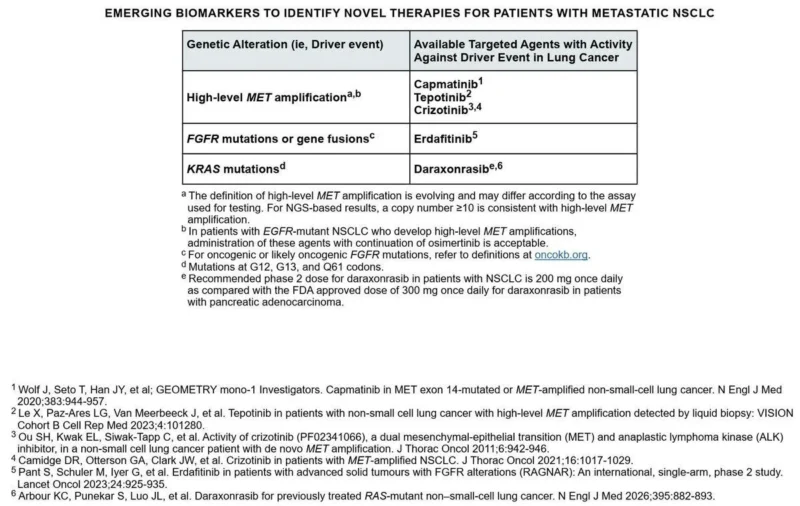
The NCCN table supplied in the September update places daraxonrasib within “emerging biomarkers to identify novel therapies for patients with metastatic NSCLC” and identifies KRAS alterations involving G12, G13, and Q61 codons as potentially relevant. The guideline also specifies a 200 mg once-daily phase II dose in NSCLC.
This recommendation needs an important qualifier: daraxonrasib is not currently FDA approved for NSCLC. Its use in lung cancer therefore remains off-label, and a clinical trial remains preferable when available.
Phase I/II Data Show Activity After Chemotherapy and Immunotherapy
The clinical rationale comes from the phase I/II RMC-6236-001 study, published in September 2026 in the New England Journal of Medicine. The study evaluated daraxonrasib in previously treated advanced RAS-mutant NSCLC across doses ranging from 10 to 400 mg once daily. Among 136 patients treated at doses of 300 mg or lower, confirmed objective responses were seen across dose levels: 31% at ≤120 mg, 34% at 160–220 mg, and 37% at 300 mg.
The clinically most relevant subgroup for the new NCCN discussion consisted of patients who had already received platinum-based chemotherapy and anti–PD-1/PD-L1 treatment, had not yet received docetaxel, and received daraxonrasib at 160–220 mg daily.
In these 38 patients, the confirmed objective response rate was 42%, with a disease-control rate of 89%. Median duration of response was 11.5 months, median progression-free survival 8.3 months, and median overall survival 16.0 months. For a molecularly heterogeneous population treated after platinum chemoimmunotherapy, this represents a meaningful signal of activity.
The Importance Extends Beyond KRAS G12C
The larger significance of daraxonrasib is biological. KRAS G12C inhibitors demonstrated that mutant RAS could be directly targeted, overturning the long-standing characterization of RAS as “undruggable.” But G12C represents only one subset of KRAS-mutant lung cancer.
Patients with KRAS G12D, G12V, G12A, G13, Q61, and other RAS alterations have remained without broadly applicable RAS-directed therapy. Daraxonrasib attempts to overcome this limitation by targeting active RAS across multiple variants rather than a single amino-acid substitution.
The emerging NCCN recognition therefore represents a shift from allele-specific precision medicine toward pathway-state precision medicine. Rather than asking only which KRAS codon is mutated, the therapeutic strategy targets the biologically active RAS(ON) state shared by multiple mutant proteins.
This Is Not Yet Equivalent to an Approved Standard Therapy
The distinction between NCCN consideration and FDA approval is important for clinicians and patients. Sevabertinib now has an FDA-approved first-line indication through the accelerated approval pathway.
Daraxonrasib does not.
The phase I/II study was nonrandomized, and its promising 42% response rate and approximately one-year response duration come from a relatively small, selected subgroup. The larger study population also demonstrated substantial toxicity, with grade 3 or higher adverse events occurring in 54% of patients treated at doses of 300 mg or less. Common toxicities included rash, diarrhea, nausea, vomiting, and mucositis or stomatitis.
The relevant randomized question is now being addressed in RASolve 301, which compares daraxonrasib directly with docetaxel in previously treated locally advanced or metastatic RAS-mutant NSCLC.
Until that evidence matures, daraxonrasib should be understood as a promising off-label option in carefully selected patients when an appropriate clinical trial is unavailable, rather than as a replacement for trial enrollment.
The NCCN Emerging-Biomarker Framework Is Becoming More Important
The September table also highlights several other molecular alterations that sit outside the most established NSCLC treatment algorithms. For high-level MET amplification, the guideline identifies capmatinib, tepotinib, and crizotinib as agents with activity. The definition of high-level amplification remains assay dependent, although the NCCN table notes that a copy number of at least 10 by NGS is consistent with high-level MET amplification.
For potentially oncogenic FGFR mutations or gene fusions, erdafitinib is identified as a therapy with activity based on broader FGFR-altered solid-tumor evidence.
These recommendations occupy a different evidentiary category from established FDA-approved biomarker-treatment pairs. Their inclusion illustrates how precision oncology increasingly has to manage a continuum between validated standard biomarkers, emerging actionable alterations, off-label evidence, and clinical-trial opportunities. That distinction should remain explicit in clinical decision-making.
What the September 2026 Update Means for Practice
The practical implication is not simply that two additional drugs have appeared in an NSCLC guideline. The update changes the molecular decision tree. For a patient with newly diagnosed metastatic non-squamous NSCLC, identification of a HER2 TKD activating mutation can now directly alter the initial systemic treatment strategy through sevabertinib.
For a patient with previously treated KRAS-mutant NSCLC without an established allele-specific therapy, identification of a G12, G13, or Q61 alteration may now open an additional therapeutic possibility through daraxonrasib, particularly when clinical trial access is limited. This places greater importance on comprehensive NGS rather than narrowly targeted testing panels.
It also emphasizes why molecular profiling should be revisited throughout the disease course. Precision oncology increasingly depends not only on identifying the classic first-line drivers but also on recognizing less common alterations that may become actionable after progression.
The Bottom Line
The September 2026 NCCN NSCLC updates reflect two important developments in molecularly targeted lung cancer. Sevabertinib has moved into the first-line HER2-mutant setting, supported by its September 9 FDA accelerated approval and a 75% response rate among previously untreated patients in SOHO-01.
Daraxonrasib has emerged as an off-label option to consider for selected KRAS-mutant NSCLC, extending the therapeutic concept of RAS inhibition beyond KRAS G12C. In previously treated, docetaxel-naïve patients receiving 160–220 mg after platinum chemotherapy and immunotherapy, the ORR was 42%, with median response duration of 11.5 months.
These changes illustrate where precision lung oncology is heading: not only toward more first-line targeted therapies, but toward progressively broader molecular definitions of actionable disease.
For HER2, the question is increasingly which targeted therapy should be used first. For RAS, the question is becoming much larger: how many previously untargetable RAS-mutant tumors can now become therapeutically actionable?