
Early circulating tumor DNA (ctDNA) clearance during neoadjuvant durvalumab plus chemotherapy was strongly associated with pathological complete response (pCR) and favorable preliminary survival outcomes in patients with resectable or borderline resectable stage IIB–IIIB non-small cell lung cancer (NSCLC), according to an exploratory biomarker analysis from the phase II MDT-BRIDGE trial presented at ESMO Congress 2026.
Presented by Jonathan Spicer, MD, PhD, the analysis demonstrated that molecular response could be detected after only one cycle of neoadjuvant chemoimmunotherapy. Using an ultrasensitive tumor-informed ctDNA assay, the positive predictive value of ctDNA clearance for pCR reached 83.3% after the first treatment cycle, suggesting the potential to identify patients with profound pathological responses early during treatment.
At the presurgical assessment, ctDNA clearance was observed in 76.0% of patients who ultimately achieved pCR compared with 20.9% of those without pCR.
Preliminary survival outcomes also favored patients with molecular clearance. Among patients undergoing surgery, none of the 28 patients with presurgical ctDNA clearance experienced an event-free survival (EFS) event during the available follow-up, compared with five events among 40 patients without clearance.
Although exploratory and based on relatively small populations, these results provide further evidence that dynamic molecular monitoring may help characterize treatment response before definitive local therapy.
Why MDT-BRIDGE Matters: Molecular Monitoring in a Complex Treatment Setting
The management of stage II–III NSCLC has become increasingly complex following the introduction of neoadjuvant and perioperative immune checkpoint inhibition.
Platinum-based chemotherapy combined with immunotherapy has improved pathological response rates and event-free survival in selected patients with resectable NSCLC. Nevertheless, important uncertainties remain regarding optimal treatment selection, particularly for patients whose tumors are considered borderline resectable at diagnosis.
Determining whether patients should proceed to surgery or definitive chemoradiotherapy requires careful multidisciplinary assessment of tumor extent, technical resectability, treatment response, and overall fitness.
Conventional radiological imaging remains central to this process, but anatomical changes do not always reflect the extent of viable residual tumor.
ctDNA offers a complementary approach by measuring tumor-derived genetic material circulating in plasma. During effective neoadjuvant treatment, decreasing ctDNA concentrations may indicate suppression of tumor burden, while complete molecular clearance may correlate with deeper pathological response.
Earlier perioperative NSCLC studies, including CheckMate 816, CheckMate 77T, and AEGEAN, have supported an association between ctDNA dynamics and pathological outcomes. However, assay sensitivity, optimal sampling time, and the clinical interpretation of persistent low-level ctDNA remain unresolved.
The MDT-BRIDGE analysis investigated whether an ultrasensitive, personalized ctDNA assay could identify early molecular responses and whether those responses were associated with pathological and preliminary survival outcomes.
Study Design and Treatment Strategy
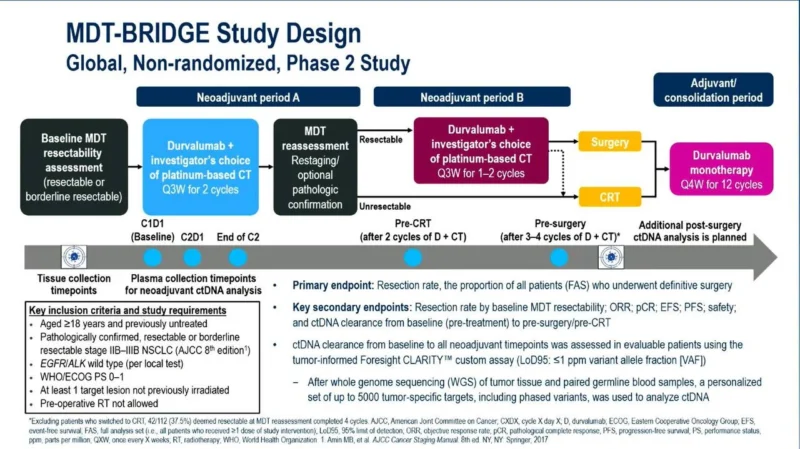
MDT-BRIDGE (NCT05925530) is a global, nonrandomized phase II study evaluating an adaptive multidisciplinary treatment strategy in previously untreated patients with pathologically confirmed, resectable or borderline resectable stage IIB–IIIB NSCLC.
Eligible patients had EGFR/ALK wild-type disease, ECOG/WHO performance status 0–1, and at least one measurable target lesion that had not previously received radiotherapy. All patients underwent multidisciplinary team (MDT) assessment of resectability before treatment.
Patients initially received two cycles of neoadjuvant durvalumab plus investigator-selected platinum-based chemotherapy every three weeks. Following these initial cycles, resectability was reassessed through multidisciplinary evaluation.
Patients considered resectable received an additional one or two cycles of neoadjuvant durvalumab plus chemotherapy before surgery. Patients considered unresectable proceeded to definitive chemoradiotherapy.
Following surgery or chemoradiotherapy, patients were scheduled to receive durvalumab every four weeks for up to 12 cycles.
The primary endpoint of the overall study was resection rate. Secondary endpoints included pathological complete response, objective response, EFS, progression-free survival (PFS), safety, and ctDNA clearance.
The current analysis focused on longitudinal ctDNA dynamics and their association with pathological response and early clinical outcomes.
Ultrasensitive ctDNA Assessment: Detecting Molecular Response During Treatment
The biomarker analysis used the tumor-informed Foresight CLARITY assay, which incorporates whole-genome sequencing of tumor tissue and matched germline samples to construct individualized ctDNA detection panels.
The assay can assess up to 5,000 tumor-specific genomic targets, including phased variants, with a reported 95% limit of detection of approximately one part per million or lower variant allele fraction. This analytical sensitivity enables detection of very low ctDNA concentrations that may not be identified through less sensitive approaches.
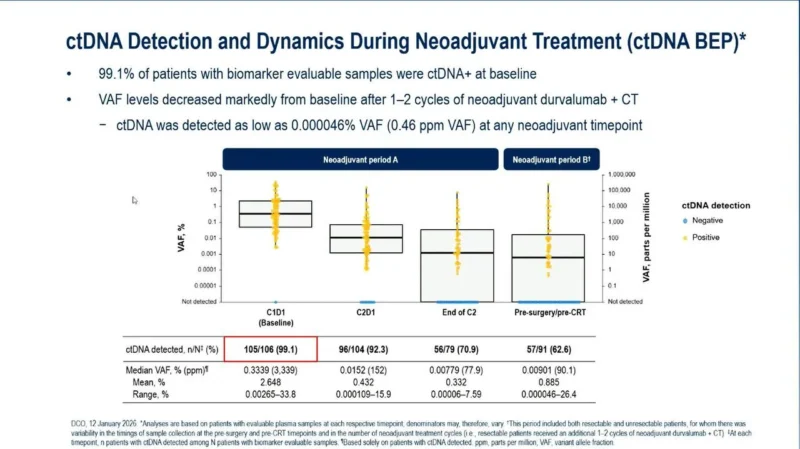
Among 142 patients in the full analysis set, personalized ctDNA assays were developed for 107 patients using pretreatment tumor tissue. At baseline, ctDNA was detected in 105 of 106 evaluable patients (99.1%), demonstrating exceptionally high baseline detection in this biomarker-evaluable population.
Longitudinal blood samples were collected before treatment, on cycle 2 day 1 following the first treatment cycle, after the second cycle, and before surgery or chemoradiotherapy.
This sampling strategy allowed investigators to assess the timing and magnitude of molecular response during neoadjuvant treatment.
Rapid Reduction in ctDNA After Neoadjuvant Chemoimmunotherapy
A marked reduction in circulating tumor DNA was observed early during neoadjuvant durvalumab plus chemotherapy. At baseline, the median variant allele fraction (VAF) among patients with detectable ctDNA was 0.3339%, equivalent to approximately 3,339 parts per million.
After one treatment cycle, at cycle 2 day 1, median VAF had decreased to 0.0152%, approximately 152 parts per million.
Following two cycles, median VAF among patients with detectable ctDNA was 0.00779%, while the corresponding value before surgery or chemoradiotherapy was 0.00901%. These findings indicate a substantial early reduction in circulating tumor-associated DNA, although detectable ctDNA persisted in many patients despite the decrease in concentration.
The proportion of evaluable patients with detectable ctDNA declined from 99.1% at baseline to 92.3% after one cycle, 70.9% after two cycles, and 62.6% at the presurgery or pre-chemoradiotherapy assessment.
Importantly, ctDNA remained detectable at concentrations as low as 0.000046% VAF, corresponding to 0.46 parts per million. This high analytical sensitivity is relevant because the definition of molecular clearance depends partly on the assay’s ability to identify residual circulating tumor DNA at extremely low concentrations.
ctDNA Clearance After One Cycle Strongly Associated With Pathological Complete Response
One of the most clinically interesting findings was the association between early ctDNA clearance and subsequent pCR. Differences in molecular clearance between patients who achieved pCR and those with residual viable tumor were already evident after the first treatment cycle.
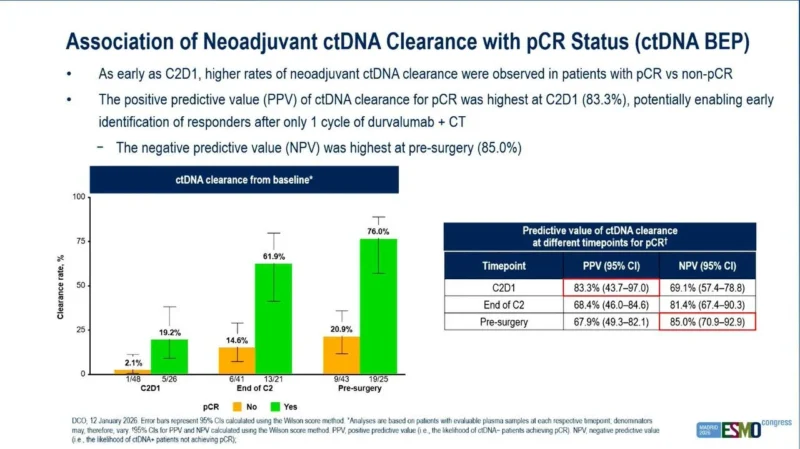
At cycle 2 day 1, ctDNA clearance occurred in 19.2% of patients who subsequently achieved pCR (5 of 26 patients), compared with only 2.1% of patients without pCR (1 of 48 patients). The positive predictive value of early ctDNA clearance for pCR was 83.3% (95% CI 43.7–97.0).
This suggests that when molecular clearance occurred after only one treatment cycle, patients were relatively likely to demonstrate a complete pathological response at surgery.
However, the result was based on only six patients with early clearance, producing a wide confidence interval. It should therefore be interpreted as an encouraging early signal rather than a validated predictive threshold.
The negative predictive value at this timepoint was 69.1% (95% CI 57.4–78.8), indicating that persistent ctDNA after one cycle did not reliably exclude the possibility of eventual pCR. These findings suggest that early molecular clearance may be more useful for identifying patients with a high likelihood of deep response than for identifying patients who will definitely fail to achieve pCR.
Molecular Clearance Becomes More Frequent With Continued Treatment
The association between ctDNA clearance and pathological response became more pronounced as treatment continued. After two cycles, ctDNA clearance was observed in 61.9% of patients who achieved pCR (13 of 21 patients), compared with 14.6% of patients without pCR (6 of 41 patients).
At the presurgical assessment, clearance rates reached 76.0% (19 of 25 patients) in the pCR group compared with 20.9% (9 of 43 patients) in the non-pCR group. The increasing clearance rate among patients with eventual pCR suggests that molecular response evolves during neoadjuvant treatment and becomes more detectable with additional treatment exposure.
The positive predictive value of ctDNA clearance was 68.4% after two cycles and 67.9% before surgery. Conversely, the negative predictive value increased over time, reaching 85.0% (95% CI 70.9–92.9) at the presurgical assessment.
The results highlight an important distinction between early and later molecular testing. Early clearance demonstrated a high positive predictive value for pCR, while persistent ctDNA closer to surgery showed a stronger association with the presence of residual viable tumor.
Both approaches could ultimately offer complementary information when assessing neoadjuvant treatment response.
Resectability and ctDNA Clearance
The analysis also explored whether molecular clearance differed according to resectability status. Across evaluable patients, ctDNA clearance before surgery or chemoradiotherapy was observed in 36.7%.
Clearance occurred in 40.6% of patients considered resectable at MDT reassessment compared with 23.8% of patients considered unresectable. These findings suggest an association between molecular response and the clinical or anatomical features informing resectability decisions.
However, the treatment pathways differed following reassessment. Patients proceeding toward surgery could receive additional neoadjuvant cycles, whereas patients considered unresectable transitioned to chemoradiotherapy.
Consequently, differences in treatment exposure and patient characteristics could contribute to the observed molecular clearance rates. The findings do not establish that ctDNA clearance can independently determine resectability or replace surgical and radiological assessment.
Preliminary Event-Free Survival: No Events Among Patients With Presurgical ctDNA Clearance
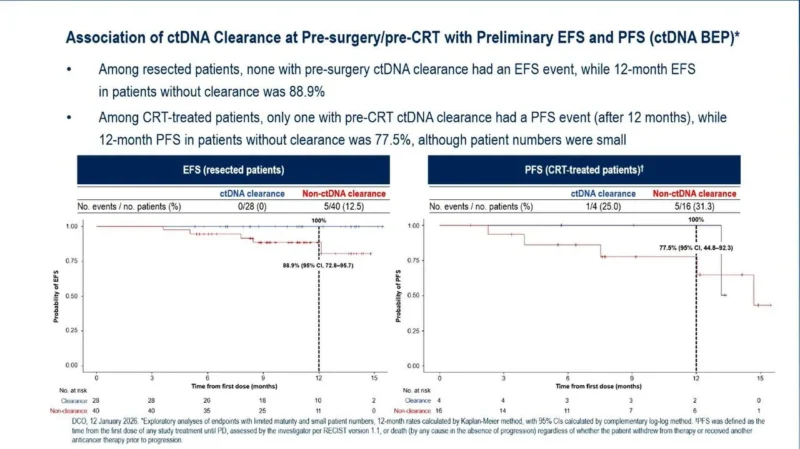
The relationship between ctDNA clearance and clinical outcomes was assessed in an exploratory survival analysis. Among patients who underwent surgical resection, none of the 28 patients with presurgical ctDNA clearance experienced an EFS event during the available follow-up.
In comparison, five events occurred among 40 patients without molecular clearance, corresponding to an observed event rate of 12.5%. The estimated 12-month EFS rate was 100% among patients with clearance and 88.9% (95% CI 72.8–95.7) among those without clearance.
These findings suggest that molecular clearance before surgery may identify patients with particularly favorable early outcomes following neoadjuvant chemoimmunotherapy.
However, interpretation requires caution because follow-up remains limited, event numbers are small, and the analyses were exploratory.
The absence of events among patients with molecular clearance should not be interpreted as evidence that these patients are cured or that additional postoperative therapy can safely be omitted. Longer follow-up will be essential to determine whether molecular clearance consistently predicts recurrence risk and survival.
Patients Receiving Chemoradiotherapy: An Early Prognostic Signal
MDT-BRIDGE also evaluated ctDNA clearance among patients who transitioned to definitive chemoradiotherapy after being considered unresectable. Among four patients with pre-chemoradiotherapy ctDNA clearance, one PFS event occurred after 12 months. The estimated 12-month PFS rate was therefore 100%.
Among 16 patients without clearance, five PFS events were reported, and estimated 12-month PFS was 77.5% (95% CI 44.8–92.3). Although the numerical findings favored molecular clearance, the extremely small sample sizes limit meaningful conclusions.
In particular, the clearance group contained only four patients, making the survival estimate highly unstable and unsuitable for guiding treatment decisions.
Nevertheless, these observations support further investigation of molecular response monitoring in patients receiving definitive chemoradiotherapy and consolidation immunotherapy, a setting where early detection of persistent residual disease could have important clinical implications.
Clinical Interpretation: Toward Earlier Molecular Response Assessment
The MDT-BRIDGE biomarker findings contribute to a growing body of evidence suggesting that ctDNA dynamics can provide clinically relevant information during neoadjuvant immunochemotherapy. A notable feature of the analysis is the ability to identify a molecular response after only one cycle of systemic treatment.
For patients with borderline resectable NSCLC, earlier knowledge of treatment response could eventually support multidisciplinary treatment planning, particularly when the timing of surgery or transition to chemoradiotherapy is uncertain. However, the present results establish association rather than clinical utility for treatment adaptation.
A high positive predictive value for pCR does not demonstrate that changing therapy based on ctDNA results improves outcomes. Similarly, persistent ctDNA does not necessarily indicate treatment failure, particularly during the early stages of neoadjuvant therapy.
The potential clinical applications include identifying patients with deep molecular responses, refining prognostic assessment, and selecting populations for future biomarker-guided clinical trials.
Prospective studies will be necessary to determine whether ctDNA-informed treatment intensification, de-escalation, or modification of local treatment strategies can safely improve long-term outcomes.
Limitations and Outstanding Questions
The biomarker findings should be interpreted in the context of several important limitations. MDT-BRIDGE is a nonrandomized phase II study, and the ctDNA analysis was exploratory. Consequently, molecular clearance cannot be established as an independent predictor of treatment benefit without additional validation.
Only 107 of 142 patients were included in the biomarker-evaluable population, and plasma availability varied across sampling timepoints.
The early positive predictive value for pCR was based on very few patients with molecular clearance, resulting in considerable statistical uncertainty. Similarly, the survival analyses involved limited numbers of patients and events, particularly in the chemoradiotherapy cohort.
Another important consideration is the sensitivity of the assay. More sensitive ctDNA detection can identify low-level residual disease that might otherwise be classified as molecular clearance, potentially affecting comparisons across different studies or testing platforms.
Finally, the current analysis does not establish whether ctDNA-guided treatment decisions improve resection rates, pathological response, recurrence outcomes, or survival.
OncoDaily Takeaway
The MDT-BRIDGE ctDNA analysis provides an important early signal that molecular response during neoadjuvant chemoimmunotherapy may help identify patients with deeper pathological responses and favorable clinical outcomes in stage IIB–IIIB NSCLC.
The most striking observation was the 83.3% positive predictive value of ctDNA clearance after only one treatment cycle, although this estimate was based on six early clearance cases. By the presurgical assessment, 76.0% of patients who achieved pCR had cleared ctDNA, compared with 20.9% of patients without pCR.
Preliminary survival findings were also encouraging. No EFS events occurred among 28 resected patients with presurgical molecular clearance during the available follow-up, while patients without clearance experienced a 12-month EFS rate of 88.9%.
These results strengthen the rationale for integrating dynamic molecular monitoring into prospective perioperative NSCLC research. However, ctDNA clearance is not yet a validated basis for omitting surgery, reducing adjuvant treatment, or changing definitive chemoradiotherapy decisions.
The central clinical message is that molecular response may become an important complement to imaging, pathology, and multidisciplinary evaluation. Whether its early detection can be translated into safer and more effective individualized treatment strategies remains a question for prospective interventional trials.
Source
- Spicer J, et al. ctDNA Clearance During Neoadjuvant Treatment and Its Association With Outcomes in Patients With Resectable/Borderline Resectable Stage IIB–IIIB NSCLC From MDT-BRIDGE.