
For decades, active lung cancer has largely been considered a contraindication to lung transplantation. The concern was clear: high recurrence risk, the need for lifelong immunosuppression, and the ethical challenge of allocating scarce donor lungs to patients with active malignancy.
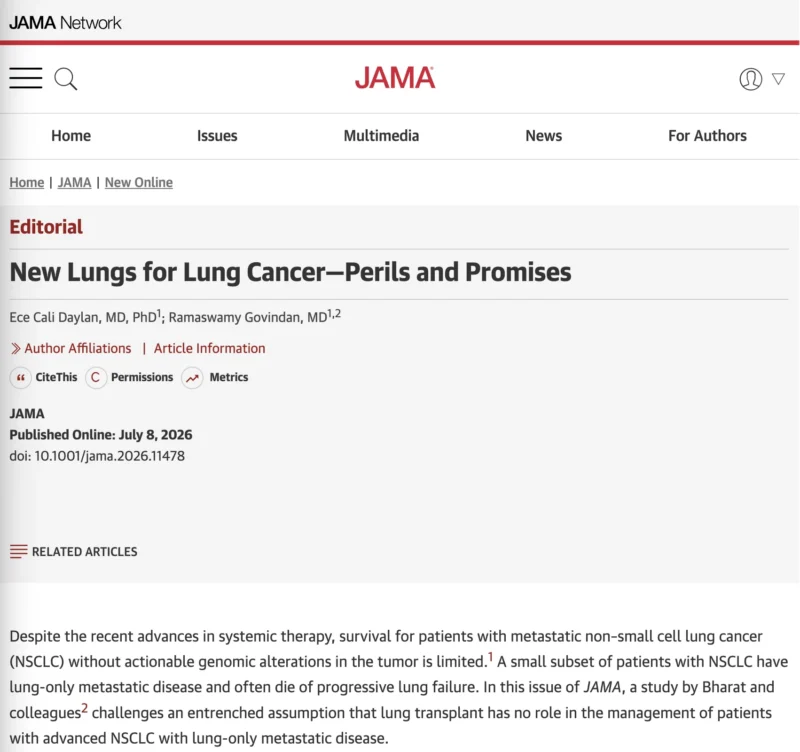
A new JAMA editorial by Ece Cali Daylan, MD, PhD, and Ramaswamy Govindan, MD, discusses a provocative study by Bharat and colleagues that challenges this long-standing assumption in a highly selected group of patients with medically refractory, lung-confined stage IV non-small cell lung cancer.
The question is no longer whether lung transplant is impossible in lung cancer. The question is whether it can be justified for a rare subset of patients whose cancer remains confined to the lungs despite systemic therapy.
A Rare Group With a Different Disease Course
Most patients with metastatic NSCLC eventually develop disease beyond the lungs. But a small subset has lung-only metastatic disease and may die from progressive respiratory failure rather than widespread systemic progression.
This is the population addressed in the JAMA discussion: patients with stage IV NSCLC that remained confined to the lungs, progressed despite guideline-directed systemic therapy, and had no evidence of mediastinal nodal or extrathoracic disease after intensive staging.
That distinction is critical. This is not a proposal for lung transplant in typical metastatic NSCLC. It is a possible strategy for a narrow biological and clinical subgroup.
What the Study Found
The study by Bharat and colleagues was a prospective, single-center registry study involving 404 patients.
Among them, 17 patients with medically refractory, lung-confined stage IV NSCLC underwent lung transplant. A comparator group of 81 similarly evaluated patients did not undergo transplant, and a third cohort included 306 lung transplant recipients without cancer.
The survival differences were striking.
One-year survival from eligibility evaluation completion was 100% in the transplant group compared with 40.8% among similarly evaluated patients who did not undergo transplant.
Posttransplant survival among cancer recipients was also reported as noninferior to lung transplant recipients without cancer, with 1-year posttransplant survival of 100% in the cancer cohort versus 88.1% in the non-cancer transplant cohort.
Clinically evident progression occurred in 4 of 17 transplant recipients compared with 74 of 81 patients who did not receive transplant.
One-year survival free of NSCLC recurrence or progression was 92.3% in the transplant cohort compared with 5.6% in the nontransplant cohort.
Selection Was Everything
The editorial emphasizes that these outcomes depended on extremely careful patient selection.
Patients considered for transplant had to have lung-only disease, progression despite standard systemic therapy, and rigorous staging. This included FDG-PET, brain MRI, and systematic invasive mediastinal evaluation.
The surgical approach also mattered. The transplant technique incorporated early pulmonary vein ligation and airway decontamination to reduce the risk of tumor dissemination during surgery.
These are not small details. They may define whether this approach is feasible at all.
Why the Results Should Be Interpreted Carefully
The findings are promising, but the editorial is careful not to overstate them.
First, lung-limited stage IV NSCLC is rare. The transplant cohort was not representative of the broader metastatic NSCLC population.
Second, the patients who underwent transplant appeared to have more favorable baseline features than many patients with advanced NSCLC. The editorial notes that 59% were never-smokers, the median age at diagnosis was 61 years, and comorbidities such as diabetes, chronic kidney disease, or emphysema were less common.
Third, the disease course appeared unusually indolent. The median time from diagnosis to lung transplant was 49 months, suggesting that these patients may have had biologically slower-moving disease.
Fourth, follow-up remains short. Median follow-up was 343 days from eligibility evaluation completion in the transplant cohort, limiting confidence about long-term recurrence, survival, and transplant-related complications.
The Recurrence Signal Matters
Even in this highly selected population, recurrence was not eliminated.
The editorial highlights that nearly 25% of patients in the transplant cohort could not undergo the dissemination-minimizing surgical technique because of anatomical restrictions. Three of those four patients developed lung cancer recurrence.
This observation raises an important possibility: the technical feasibility of tumor-spread-minimizing surgery may be central to whether lung transplant can safely be considered in this setting.
The Ethical Question Cannot Be Avoided
Lung transplantation occurs in a zero-sum system. Every donor lung allocated to one patient is unavailable to another.
That makes the ethical implications particularly important. Current organ allocation systems prioritize conditions with established and durable posttransplant outcomes. For lung cancer, the long-term durability of transplant benefit is still unknown.
The noninferiority comparison with non-cancer transplant recipients is therefore important, but not sufficient. Larger, multicenter studies with longer follow-up will be needed before this approach can move toward broader adoption.
A Possible Parallel With Liver Transplant
The editorial draws an analogy with liver transplantation for hepatocellular carcinoma and colorectal liver metastases.
In hepatocellular carcinoma, outcomes improved only after better patient selection, including the introduction of the Milan criteria. More recently, liver transplant has shown benefit in selected patients with unresectable liver-only colorectal metastases when strict selection criteria were applied.
The lesson is not that lung transplant should immediately follow the same path. Rather, it is that transplant oncology may become possible only when disease biology, staging, surgical technique, and selection criteria are tightly defined.
What Needs to Happen Next
Before lung transplant can be considered beyond exceptional cases, the editorial calls for larger, multicenter, well-controlled, randomized studies.
Future trials should include carefully selected patients with lung-confined metastatic, refractory NSCLC and no evidence of mediastinal nodal or extrathoracic disease. Modern imaging and ultrasensitive cell-free DNA testing may help refine eligibility further.
The field will need to answer several difficult questions: Who is truly eligible? How durable is disease control? Can recurrence be predicted? How should immunosuppression be managed? And how should transplant ethics be balanced against potential survival benefit?
The Bottom Line
Lung transplant for lung-limited stage IV NSCLC remains experimental, controversial, and relevant only to a rare subset of patients.
But the JAMA discussion marks an important shift. A strategy once considered almost unthinkable may deserve rigorous investigation in carefully selected patients with refractory disease confined to the lungs.
The promise is real: dramatic early survival signals in a population with few options.
The perils are also real: recurrence risk, immunosuppression, short follow-up, complex surgery, and scarce donor organs.
For now, lung transplant in stage IV NSCLC should not be viewed as a new standard. It should be viewed as a provocative research frontier where biology, surgery, oncology, and ethics intersect.
References
- Daylan EC, Govindan R. New lungs for lung cancer—perils and promises. JAMA. Published online July 8, 2026. doi:10.1001/jama.2026.11478.
- Bharat A, Kurihara C, Chung LIY, et al. Lung transplant for refractory lung-limited stage IV non–small cell lung cancer. JAMA. Published online July 8, 2026. doi:10.1001/jama.2026.8717.
- Garassino MC, Gadgeel S, Speranza G, et al. Pembrolizumab plus pemetrexed and platinum in nonsquamous non–small-cell lung cancer: 5-year outcomes from the phase 3 KEYNOTE-189 study. Journal of Clinical Oncology. 2023;41:1992-1998.
- Leard LE, Holm AM, Valapour M, et al. Consensus document for the selection of lung transplant candidates: an update from the International Society for Heart and Lung Transplantation. Journal of Heart and Lung Transplantation. 2021;40:1349-1379.
- Adam R, Piedvache C, Chiche L, et al. Liver transplantation plus chemotherapy versus chemotherapy alone in patients with permanently unresectable colorectal liver metastases. Lancet. 2024;404:1107-1118.