
For decades, lung cancer screening strategies have been primarily built around one dominant risk factor: tobacco exposure. While smoking remains the strongest established risk factor for lung cancer, the changing epidemiology of the disease has highlighted an important challenge, a growing number of lung cancers occur in individuals who do not fit traditional screening criteria.
Women represent a particularly important population in this discussion. Although smoking remains a major contributor to lung cancer risk, younger women and never-smokers continue to develop lung cancer, suggesting that additional biological, genetic, and environmental factors contribute to susceptibility.
A new study published in JTCVS Open evaluated whether a personal or family history of cancer is associated with an increased prevalence of new primary lung cancer among women, regardless of smoking status. Using data from more than 2.8 million women within the Kaiser Permanente Northern California healthcare system, the study found that previous malignancy and familial cancer history were associated with higher prevalence of lung cancer.
The findings raise an important question for lung cancer prevention:
Should lung cancer screening models incorporate cancer history alongside smoking exposure?
Lung Cancer Risk Assessment May Need a Broader Approach
Current lung cancer screening recommendations primarily identify candidates based on age and smoking history. Low-dose computed tomography (LDCT) screening has demonstrated mortality reduction through earlier detection of lung cancer in high-risk populations.
However, smoking history alone may not capture all individuals at meaningful risk.
Previous studies have suggested that family history of lung cancer, particularly among never-smokers and younger adults, may increase lung cancer risk. The authors of the current study aimed to examine whether broader cancer history — including previous breast, cervical, uterine, and ovarian cancers — may also identify women at increased risk for developing a future primary lung cancer.
This question is increasingly relevant as cancer survivorship continues to expand. Improvements in early diagnosis and treatment mean that more individuals live long enough to face the risk of developing second primary malignancies.
Large Real-World Analysis Identifies Increased Lung Cancer
Prevalence Among Women With Cancer History
The investigators performed a retrospective analysis using electronic health record data from Kaiser Permanente Northern California between 2010 and 2022.
The study included:
- Adult women aged 18 years or older
- No previous diagnosis of lung cancer
- At least one year of healthcare system membership during the study period
Among 2,866,410 women, 10,595 were diagnosed with lung cancer during follow-up.
The analysis used targeted maximum likelihood estimation to adjust for multiple factors, including:
- Age
- Race and ethnicity
- Smoking history
- Comorbidity burden
- Body mass index
- Neighborhood deprivation index
This approach allowed researchers to evaluate whether cancer history remained associated with lung cancer prevalence after accounting for other known risk factors.
- Previous Cancer History Was Associated With Higher Lung Cancer Prevalence
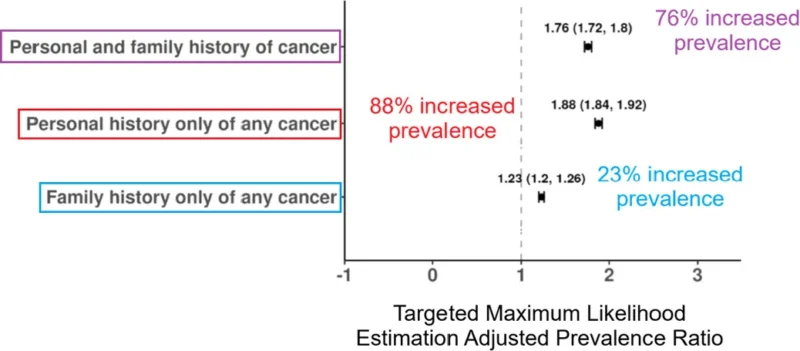
The strongest overall finding was that women with a previous personal history of cancer had a significantly higher prevalence of new primary lung cancer.
A personal history of any cancer was associated with an:
- 88% increased prevalence of lung cancer
(PR 1.88; 95% CI 1.84–1.92)
A family history of any cancer was also associated with increased prevalence:
- PR 1.23; 95% CI 1.20–1.26
Women with both personal and family cancer history had a prevalence ratio of:
- PR 1.74; 95% CI 1.70–1.78
These results suggest that cancer susceptibility may involve a broader combination of genetic, biological, and environmental factors rather than smoking exposure alone.
Breast Cancer History Emerges as an Important Risk Factor
Among specific cancer types evaluated, previous breast cancer was particularly relevant because breast cancer is the most common malignancy among women.
The study found that women with a personal history of breast cancer had an increased prevalence of future primary lung cancer:
- PR 1.56; 95% CI 1.48–1.63
Previous research has also reported increased risk of second primary lung cancer after breast cancer diagnosis. Possible explanations include shared biological pathways, treatment-related factors such as radiation exposure, genetic susceptibility, and common environmental influences.
The authors noted that prior studies have identified particularly elevated risks among certain breast cancer subgroups, including triple-negative breast cancer, although additional investigation is needed to clarify mechanisms.
Family History of Lung Cancer Shows Strong Association
The strongest association in the study was observed among women with a family history of lung cancer.
A family history of lung cancer was associated with:
- PR 2.40; 95% CI 2.30–2.50
This finding supports previous evidence that familial susceptibility contributes to lung cancer risk, particularly among never-smokers and women.
Potential explanations include inherited genetic variants, differences in DNA repair pathways, and germline alterations affecting cancer susceptibility.
Importantly, familial risk cannot be explained only by shared smoking behavior, particularly in populations where lung cancer occurs among never-smokers.
Implications for Lung Cancer Screening Guidelines
The current findings suggest that lung cancer risk assessment may require a more individualized approach.
The authors propose that screening models could potentially incorporate personal and family cancer history alongside traditional factors such as smoking exposure.
However, the study does not establish a new screening recommendation.
Several questions remain:
- Which cancer survivors have sufficient risk to benefit from
- LDCT screening?
- How should screening intervals be determined?
- Should certain breast cancer survivors receive additional lung cancer surveillance?
- How should genetic risk factors be incorporated?
Prospective studies will be needed before changes to screening guidelines can be implemented.
Breast and Lung Cancer Screening: An Opportunity for Integrated Prevention
An important aspect of this research is the possibility of combining existing cancer screening approaches.
Women already demonstrate relatively high participation in breast cancer screening compared with lung cancer screening. The authors highlight previous initiatives exploring combined breast and lung cancer screening approaches, including the Pink and Pearls Campaign, which evaluated the feasibility of integrating mammography with LDCT screening.
Such approaches could potentially improve identification of women who are eligible for lung cancer screening but are currently missed by smoking-based criteria.
However, practical challenges remain, including:
- Healthcare infrastructure
- Insurance coverage
- Patient access
- Appropriate risk stratification
Important Limitations and Future Research Directions
The study provides important insights but also has limitations.
The retrospective design means that researchers could identify associations but could not prove causation.
Additionally, increased medical surveillance among cancer survivors may contribute to earlier detection of lung cancers. Patients with previous malignancies often undergo more frequent imaging, which may increase detection rates.
The study population was also limited to women within one healthcare system, and further research is needed in broader populations, including men and diverse ethnic groups.
Future studies will need to determine whether incorporating personal cancer history into lung cancer screening models improves outcomes.
Conclusion
The study by Villanueva and colleagues highlights an important gap in current lung cancer risk assessment.
Among more than 2.8 million women, previous personal cancer history and family cancer history were associated with increased prevalence of new primary lung cancer, independent of smoking status.
A personal history of breast cancer, cervical cancer, uterine cancer, or ovarian cancer was associated with increased lung cancer prevalence, while family history of lung cancer showed the strongest association.
These findings suggest that future lung cancer screening strategies may need to move beyond smoking history alone and incorporate broader clinical and genetic risk factors.
As cancer survivorship continues to grow, identifying individuals at increased risk for second primary cancers will become an increasingly important component of precision prevention.
Reference
- Villanueva CA, Chervo T, Gochi A, Kwak H, Tucker LY, Velotta JB. The prevalence of primary lung cancer among women with previous personal and/or family history of cancer in an integrated health system.
JTCVS Open. 2026.