
A new review published in Current Opinion in Pulmonary Medicine highlights a central challenge in lung cancer screening: how to detect early-stage lung cancer efficiently while reducing unnecessary diagnostic procedures and avoidable harm.
The review, authored by Christopher R. Caruso and Roger Y. Kim, focuses on lung cancer screening diagnostic efficiency. The authors define this as the ability to improve early lung cancer detection while reducing diagnostic errors, including false negatives and false positives.
Low-dose computed tomography has already been shown to reduce lung cancer-specific mortality in major randomized trials, including the National Lung Screening Trial and the NELSON trial. However, translating this benefit into real-world practice requires more than ordering scans. It requires screening the right people, keeping them adherent to annual screening, and managing abnormal findings through a safe and effective diagnostic pathway.
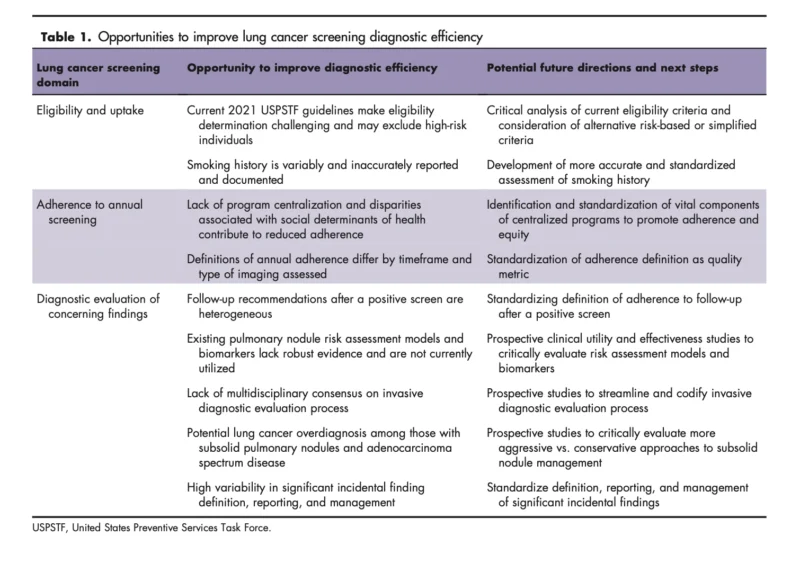
The authors identify three major targets for improving lung cancer screening diagnostic efficiency: eligibility and uptake, adherence to annual screening, and diagnostic evaluation of concerning findings.
Why Diagnostic Efficiency Matters
Lung cancer screening is designed to detect lung cancer earlier, when curative treatment is more likely.
But screening also creates clinical complexity. Low-dose CT can detect small pulmonary nodules, subsolid lesions, incidental findings, and abnormalities that may never become clinically dangerous. Some findings require follow-up imaging, while others lead to PET/CT, biopsy, bronchoscopy, or surgery.
The challenge is balance.
A high-quality lung cancer screening program must be sensitive enough to detect early-stage lung cancers, but careful enough to avoid unnecessary invasive testing for benign lesions.
This means diagnostic efficiency is not only about finding cancer. It is also about avoiding harm.
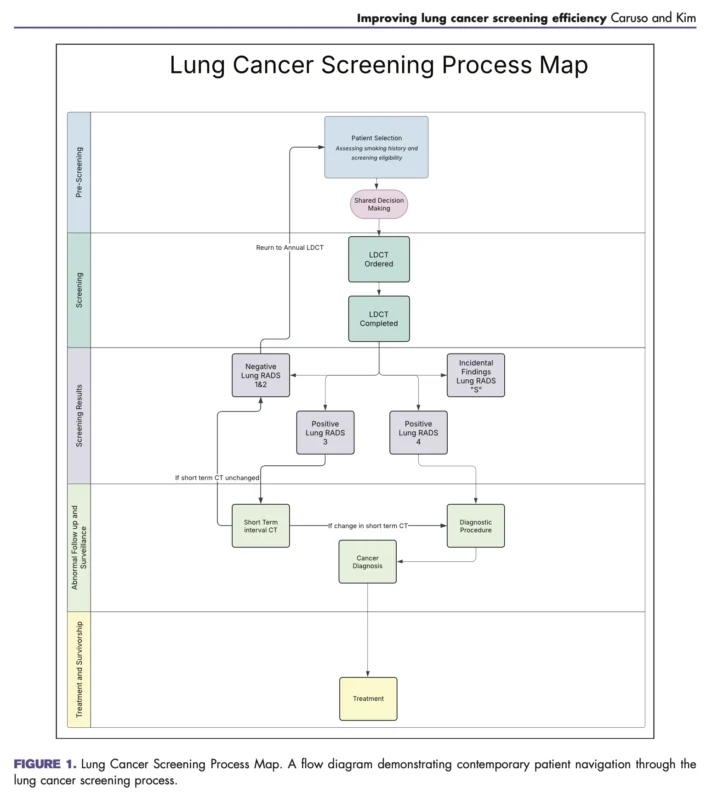
Three Domains of Lung Cancer Screening Efficiency
The review organizes lung cancer screening diagnostic efficiency into three domains.
The first is eligibility and uptake. This includes deciding who should be screened and making sure eligible individuals actually receive screening.
The second is adherence to annual screening. Lung cancer screening is not a one-time test. Its benefit depends on continued yearly participation and appropriate follow-up.
The third is diagnostic evaluation of concerning findings. Once a nodule or suspicious finding is detected, clinicians must decide whether surveillance, PET/CT, biopsy, specialist referral, or surgery is most appropriate.
Together, these domains define the real-world performance of a lung cancer screening program.
Eligibility and Uptake: Who Should Be Screened?
In the United States, lung cancer screening coverage is largely based on the 2021 United States Preventive Services Task Force criteria.
These criteria recommend screening adults aged 50 to 80 years who have at least a 20 pack-year smoking history, currently smoke or quit within the past 15 years, and participate in shared decision-making.
These recommendations expanded eligibility compared with the 2013 USPSTF criteria and were intended to improve lung cancer detection and reduce racial and sex disparities.
However, the review notes that eligibility remains an active area of debate.
Risk prediction models, such as PLCOM2012, may improve lung cancer detection by using additional demographic and clinical factors. These models have been adopted in some countries, including the United Kingdom, Canada, and Australia. However, they can be more complex to implement and may select older patients with more comorbidities, who may have competing risks of death.
Other proposed approaches aim to simplify eligibility criteria and reduce dependence on pack-years or quit-date details, because smoking history is often inconsistently documented in electronic health records.
The American Cancer Society has also removed the “quit within 15 years” requirement from its lung cancer screening guideline, reflecting evidence that lung cancer risk can remain elevated beyond 15 years after smoking cessation.
The practical message is clear: current eligibility criteria can miss some high-risk individuals and can be difficult to apply accurately in routine care.
Lung Cancer Screening Uptake Remains Low
Even when patients meet eligibility criteria, screening uptake remains suboptimal.
The review notes that real-world estimates of lung cancer screening uptake in the United States have varied widely, from as low as 4% to as high as 47%.
One reason for this variation is that it is difficult to know exactly who is eligible. Smoking history is often missing, incomplete, or inaccurate in electronic health records.
This creates a major implementation problem. If health systems cannot accurately identify eligible individuals, they cannot reliably offer screening.
The authors highlight the need for better smoking history documentation, standardized eligibility assessment, and electronic health record-based tools to identify screening-eligible populations more efficiently.
Annual Adherence: Screening Must Continue Over Time
Lung cancer screening benefit depends on repeated annual testing.
After a negative screen, such as Lung-RADS 1 or 2, repeat low-dose CT in 12 months is recommended. However, real-world adherence to annual screening varies widely.
The review reports that adherence estimates after negative baseline screens have ranged from 22% to 76%.
This matters because many screen-detected lung cancers in major trials were diagnosed during follow-up rounds, not only at baseline. Annual adherence is associated with increased lung cancer detection and may improve the likelihood of finding early-stage disease.
The authors note that centralized lung cancer screening programs appear to improve adherence. A recent meta-analysis found that patients screened through centralized programs were more than three times as likely to complete annual follow-up compared with those in decentralized programs.
Centralized programs may help with reminders, tracking, navigation, result communication, and follow-up coordination. However, they require resources and may not be feasible in every health system.
The review also emphasizes equity. Black patients and patients facing socioeconomic barriers may be less likely to complete annual follow-up screening. Centralized programs may reduce some disparities by standardizing access and follow-up.
Positive Screens: Managing Concerning Findings
When low-dose CT identifies a concerning finding, the next step depends on Lung-RADS category and clinical judgment.
Lung-RADS 3 usually leads to repeat low-dose CT in 6 months. Lung-RADS 4A may lead to 3-month low-dose CT or PET/CT. Lung-RADS 4B or 4X may require diagnostic chest CT, PET/CT, tissue sampling, or specialist referral.
This is where diagnostic efficiency becomes especially important.
Some concerning nodules are malignant and require timely diagnosis. Others are benign or indolent, and aggressive workup may expose patients to unnecessary harm.
The review highlights several opportunities to improve this part of the pathway: standardizing follow-up definitions, improving cancer risk assessment, streamlining invasive diagnostic evaluation, and reducing overdiagnosis.
Pulmonary Nodule Risk Assessment
Accurately estimating whether a nodule is cancerous is central to screening efficiency.
Several pulmonary nodule risk models exist, and biomarkers based on blood, airway samples, or CT imaging have become commercially available.
However, the review notes that current evidence remains limited. Many risk models and biomarkers are not routinely used in clinical practice, and prospective randomized trial evidence supporting their broad use is lacking.
Ongoing studies are evaluating radiomics-based tools, plasma biomarkers, and nasal swab biomarkers.
If validated, these tools could help clinicians decide which patients need biopsy and which can safely undergo surveillance.
Invasive Diagnostic Evaluation Needs Standardization
When biopsy is needed, clinicians may choose among bronchoscopy, transthoracic needle biopsy, and surgical lung biopsy.
Each approach has advantages and risks.
Historically, bronchoscopy has been favored for central or airway-centric lesions, while transthoracic needle biopsy has often been used for peripheral nodules. However, newer navigational bronchoscopy techniques have improved the diagnostic approach to peripheral lesions and may offer a safer profile in selected patients.
The review notes that there is still no multidisciplinary consensus pathway that clearly defines the best invasive diagnostic strategy for screen-detected concerning findings.
This creates variation in practice.
A more standardized approach could help reduce unnecessary procedures, avoid delays, improve diagnostic yield, and ensure that enough tissue is obtained for staging and biomarker testing when needed.
Avoiding Nonmalignant Resections
One important harm of lung cancer screening is surgery for a lesion that ultimately proves benign.
The nonmalignant resection rate has been proposed as a quality metric for lung cancer screening programs. It reflects the proportion of patients who undergo diagnostic surgical resection for a lesion that is benign on final pathology.
Published real-world estimates vary widely, from 1% to 35%.
The review explains that this metric can be difficult to interpret because studies may define surgical resections differently. Still, it remains a patient-centered measure of downstream harm.
Reducing nonmalignant resections requires better risk assessment, thoughtful use of biopsy, multidisciplinary decision-making, and careful attention to patient preferences.
Overdiagnosis and Subsolid Nodules
Subsolid pulmonary nodules are increasingly detected on CT.
Many persistent subsolid nodules represent adenocarcinoma spectrum disease, ranging from atypical adenomatous hyperplasia to adenocarcinoma in situ and invasive adenocarcinoma.
The difficulty is that many of these lesions remain indolent for years, and only a minority progress to metastatic disease.
This raises the risk of overdiagnosis: detecting and treating a cancer or precancerous lesion that would not have harmed the patient during their lifetime.
The review emphasizes that more research is needed to determine when subsolid nodules should be monitored conservatively and when more aggressive intervention is justified.
This is especially important because overtreatment can expose patients to surgery, radiation, anxiety, and long-term consequences without clear survival benefit.
Incidental Findings Add Another Layer
Low-dose CT is not specific to lung cancer. It frequently detects incidental findings outside the lung cancer pathway.
In the National Lung Screening Trial, 34% of low-dose CT scans identified significant incidental findings. In real-world practice, rates as high as 44% have been reported.
Some incidental findings may be clinically important. Others may trigger unnecessary testing, cost, and patient anxiety.
The review notes that significant incidental findings need more standardized definitions, reporting, and management pathways.
This is an important part of diagnostic efficiency because screening programs must manage not only lung nodules, but also the broader consequences of chest imaging.
Clinical Meaning
This review reframes lung cancer screening as a complete diagnostic system.
The benefit of screening depends on more than eligibility criteria or CT availability. It depends on whether eligible individuals can be identified, whether they complete annual screening, whether positive findings are managed correctly, and whether programs avoid unnecessary invasive procedures.
For healthcare systems, the message is practical.
Lung cancer screening programs need infrastructure. This includes registries, patient navigation, follow-up tracking, standardized reporting, multidisciplinary nodule review, and quality metrics.
For clinicians, the message is about balance. The goal is to detect early lung cancer without overdiagnosing indolent disease or overtreating benign lesions.
For patients, diagnostic efficiency means receiving the right test, at the right time, with the right follow-up.
Key Takeaway
Improving lung cancer screening diagnostic efficiency requires attention to every step of the screening pathway.
Eligibility criteria must identify high-risk individuals without creating unnecessary barriers. Screening uptake must improve. Annual adherence must be supported through programmatic systems. Positive findings require standardized follow-up and better cancer risk assessment. Invasive diagnostic testing should be streamlined and used carefully. Overdiagnosis, nonmalignant resection, and incidental findings must be monitored as real harms.
As lung cancer screening expands, quality will depend not only on how many people are screened, but on how efficiently and safely screening programs move patients from eligibility to diagnosis, treatment, or surveillance.