Exercise is increasingly recognized as more than an optional wellness recommendation for people with lung cancer.
Patients commonly enter treatment with low baseline physical activity and fitness, substantial symptom burden, particularly dyspnea and fatigue, and frequent cardiopulmonary comorbidities. Surgery, systemic therapy and radiotherapy can further contribute to deconditioning, functional decline and loss of independence.
The scientific question is therefore changing.
It is becoming less about whether exercise has a role in lung cancer care and more about how exercise can be prescribed safely, individualized appropriately and incorporated into routine oncology pathways worldwide.
A new article in JTO Clinical and Research Reports addresses precisely that challenge through the International Research Exercise in Lung Cancer initiative, or IREX-Lung. The initiative was established by the International Association for the Study of Lung Cancer to bring clinicians, rehabilitation specialists, researchers and patient advocates together around the development and implementation of lung cancer–specific exercise care.
The paper’s central message is practical. The evidence base for exercise has matured faster than the systems required to deliver it.
Exercise Has Clinical Value Across the Lung Cancer Continuum
The available evidence spans several phases of lung cancer care.
In patients undergoing lung resection, prehabilitation programs, often lasting only one to four weeks and incorporating aerobic exercise, can improve cardiorespiratory fitness and walking capacity. Systematic reviews have also reported reductions in postoperative pulmonary complications and hospital length of stay, although intervention designs remain heterogeneous.
Postoperative rehabilitation can support the recovery of physical function and daily activity, particularly when aerobic and resistance exercise are combined, sometimes with respiratory training.
During chemotherapy and radiotherapy, supervised aerobic or combined aerobic-resistance exercise has generally been feasible when patients are appropriately screened and programs are individualized. Reported benefits include improvements in fatigue, dyspnea, muscle strength, cardiorespiratory fitness and health-related quality of life.
These outcomes matter because successful cancer treatment is not defined solely by radiographic response. Maintaining functional independence, symptom control and the capacity to tolerate therapy are highly relevant components of cancer care.
Exercise Is Also Feasible in Advanced Lung Cancer
Exercise oncology is sometimes implicitly associated with survivors or patients undergoing curative-intent treatment. The paper challenges that assumption. Evidence in advanced and metastatic lung cancer suggests that appropriately tailored exercise can remain feasible and safe, with potential benefits for physical function, fatigue and quality of life.
A randomized trial involving 208 patients with advanced inoperable lung cancer receiving chemotherapy also demonstrated improvements in anxiety and depression after a 12-week structured exercise intervention.
This expands the clinical rationale for exercise. For patients with advanced disease, the objective may not be increasing maximal fitness. It may instead be maintaining mobility, preserving muscle function, reducing symptom burden and sustaining independence for as long as possible.
That requires a very different prescription from the one used in a fit patient preparing for lung resection. And that is exactly why generic advice to simply “exercise more” is inadequate.
The Next Challenge Is Precision Exercise Prescription
Modern lung cancer treatment is becoming increasingly individualized according to histology, stage, molecular drivers and immune biomarkers. Exercise prescription remains much less precise.
The authors argue that programs need to reflect the heterogeneity of lung cancer itself. The goals of exercise may differ substantially according to clinical context:
resectable disease: prehabilitation and postoperative recovery
active systemic therapy: symptom management and preservation of treatment tolerance
advanced disease: maintenance of physical function and independence
survivorship: restoration of fitness and long-term health.
Yet most recommendations remain extrapolated from broader oncology exercise guidelines rather than lung cancer–specific evidence. Important uncertainties persist around exercise modality, intensity, contraindications and monitoring in patients with common lung cancer characteristics such as COPD, dyspnea, cachexia risk, frailty and older age.
The future therefore lies less in prescribing one standardized exercise program and more in developing structured assessment algorithms followed by adaptable prescriptions.
Exercise Research Still Has Important Blind Spots
Despite growing evidence, several clinically relevant populations remain understudied. The authors specifically highlight limited evidence for:
- small cell lung cancer
- oncogene-driven NSCLC
- patients receiving modern targeted therapies and immunotherapy.
This is increasingly important.
The toxicity profile of lung cancer therapy has changed substantially. A patient receiving an EGFR inhibitor may face different exercise-related considerations from a patient receiving platinum-doublet chemotherapy, chemoimmunotherapy, thoracic radiotherapy or perioperative immunotherapy.
Likewise, the increasing complexity of treatment for resectable NSCLC creates new opportunities for prehabilitation during the interval between diagnosis and surgery. Exercise oncology now needs to evolve alongside systemic oncology.
Could Exercise Influence Treatment Tolerance?
One of the most interesting research questions is whether exercise can influence more than symptoms and quality of life.
There is growing interest in whether maintaining physical capacity might help patients:
- preserve treatment dose intensity
- reduce symptom-driven interruptions
- recover more effectively from surgery
- tolerate systemic treatment for longer
But current evidence is inconsistent and methodologically limited.
Similarly, hard oncology endpoints such as progression-free survival and overall survival remain infrequently studied in prospective exercise trials. Mechanistic studies integrating immune biomarkers, body composition, objective activity monitoring and inflammatory profiling are also relatively uncommon.
This distinction is important.
Observational studies associate greater physical activity or fitness with better survival, but confounding and reverse causation make causal interpretation difficult. Patients who are healthier may simply be more capable of exercising.
Exercise should therefore not be presented as an anticancer therapy proven to prolong survival in lung cancer. Its strongest current evidence concerns function, symptoms, fitness and quality of life.
Whether those benefits can ultimately translate into improved cancer-treatment delivery or survival remains a research question.
Implementation May Now Be the Largest Barrier
Perhaps the most important argument in the paper is that the evidence-to-practice gap has become one of the field’s central problems. Despite growing evidence supporting exercise, many patients with lung cancer remain insufficiently active.
Implementation barriers operate at multiple levels. Oncology teams may receive little formal education about exercise counseling and referral. Exercise professionals may lack specific training in managing lung cancer–related symptoms, cardiopulmonary disease and treatment toxicity.
Health systems may lack reimbursement structures, referral pathways or dedicated exercise-oncology services. Access becomes even more difficult in rural and resource-limited settings.
This means that publishing another positive exercise trial will not, by itself, make exercise part of routine lung cancer care. Clinical infrastructure is required.
One Model Will Not Work Everywhere
The global perspective of IREX-Lung is particularly important. Exercise programs developed in highly resourced comprehensive cancer centers cannot simply be exported unchanged to every health system.
High-resource environments may support supervised, multidisciplinary exercise programs embedded directly within oncology services. Lower-resource settings may require:
- home-based programs
- community-based rehabilitation
- hybrid models
- digitally supported exercise interventions.
The paper argues that these models should preserve core evidence-based principles while allowing local adaptation according to available workforce and resources.
This is an important distinction between standardizing principles and standardizing delivery. The principles of safe assessment and evidence-based exercise may be universal.
The way they are delivered cannot be.
IREX-Lung Aims to Build the Missing Infrastructure
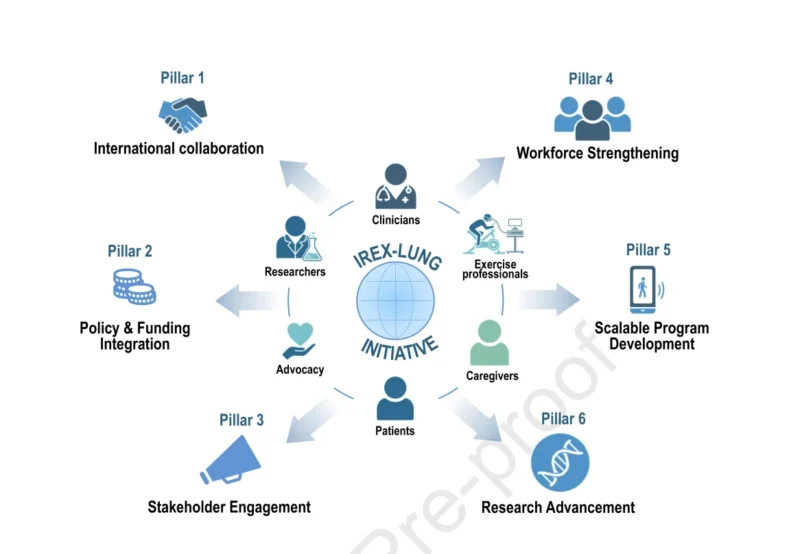
IREX-Lung was created as a global multidisciplinary response to this fragmented landscape. The initiative brings together clinicians, rehabilitation specialists, exercise professionals, researchers, caregivers, advocates and patients.
The framework illustrated on page 14 organizes the initiative around six interconnected areas:
- International collaboration
- Policy and funding integration
- Stakeholder engagement
- Workforce strengthening
- Scalable program development
- Research advancement
This structure is important because exercise integration is not simply a research problem. A randomized trial may establish efficacy. But implementation also requires trained professionals, reimbursement, clinical referral pathways, patient engagement and scalable delivery systems.
IREX-Lung therefore attempts to address the entire ecosystem rather than one isolated component.
The Next Two to Three Years Have Defined Deliverables
IREX-Lung is not described merely as an advocacy network. The initiative has specific planned outputs over the next two to three years.
These include an international survey of healthcare professionals, Delphi-based consensus recommendations for lung cancer–specific exercise assessment and prescription, educational materials for clinicians and patients, collaborative research projects addressing evidence gaps, and initiatives supporting international research collaboration, grant development and capacity building.
Success is intended to be measured not only through publications but through actual integration of exercise referral pathways and improved patient access to exercise services. That implementation focus distinguishes the initiative from a conventional academic working group.
Exercise Should Become Part of Multidisciplinary Lung Cancer Care
The broader clinical implication is straightforward.
We routinely discuss:
- systemic therapy
- radiotherapy
- surgery
- molecular testing
- nutrition
- pain management
- smoking cessation
- palliative care.
Physical function should increasingly enter the same multidisciplinary conversation. For some patients, the most meaningful exercise intervention may be intensive prehabilitation before surgery. For another, it may be maintaining walking capacity during chemotherapy.
For a patient with advanced disease and severe fatigue, the appropriate prescription may be modest, closely individualized activity aimed at preventing further functional decline.
Exercise oncology should therefore not be defined by athletic performance. It should be defined by preserving or restoring the physical capacity needed to live through cancer and its treatment.
Exercise Is Supportive Care, but Supportive Does Not Mean Secondary
The term “supportive care” can sometimes imply that an intervention is peripheral to cancer treatment. That is increasingly difficult to justify when physical deterioration itself can influence independence, quality of life and potentially the ability to continue therapy.
For lung cancer in particular, baseline cardiopulmonary impairment and symptom burden can make functional reserve clinically consequential. Exercise therefore belongs within a broader model of treatment optimization.
The central question should not necessarily be whether exercise directly kills tumor cells. It is whether a structured exercise intervention helps patients remain sufficiently functional to navigate cancer treatment with fewer symptoms and greater independence.
For those endpoints, the existing evidence is already meaningful.
The Bottom Line
Evidence supporting exercise in lung cancer has grown substantially. Across different stages of care, structured and appropriately tailored exercise can improve physical fitness, functional capacity, fatigue, dyspnea and health-related quality of life.
But important uncertainties remain around optimal dose, modality, timing, treatment-specific interactions, advanced disease, SCLC, oncogene-driven disease and hard cancer outcomes such as PFS and OS. The challenge is therefore evolving from:
Does exercise help patients with lung cancer?
toward:
How do we make the right exercise intervention available to the right patient, at the right point in treatment, anywhere in the world?
IREX-Lung represents an attempt to answer that second question.
Its ultimate success will not be measured simply by another guideline or publication. It will be measured by whether exercise becomes a routine, accessible and individualized component of lung cancer care.
Reference
- Curry J, Avancini A, Budolfsen T, Cardeña-Gutiérrez A, Cavalheri V, Collado Martínez D, et al. Toward Global Integration of Exercise in Lung Cancer Care: The IREX-Lung Initiative. JTO Clinical and Research Reports. 2026;101070. doi:10.1016/j.jtocrr.2026.101070. Accepted August 23, 2026.