
The year 2026 has marked a major turning point in the development of antibody-drug conjugates (ADCs) and bispecific antibodies for lung cancer. Positive phase III survival data, expanding regulatory approvals, and innovative biomarker strategies are transforming these agents from experimental treatments into increasingly important components of thoracic oncology. Yet a fundamental challenge remains: identifying which patients are most likely to benefit from each therapeutic platform.
The evidence presented at the 2026 World Conference on Lung Cancer (WCLC) in Seoul and ESMO Congress 2026 in Madrid has substantially reshaped the field.
In non-small cell lung cancer (NSCLC), the phase III OptiTROP-Lung06 trial demonstrated that sacituzumab tirumotecan combined with pembrolizumab significantly prolonged progression-free survival (PFS) compared with conventional chemoimmunotherapy. The final OptiTROP-Lung04 analysis established a sustained overall survival (OS) advantage for sacituzumab tirumotecan after EGFR-targeted therapy, while PANKU-Lung01 introduced compelling phase III evidence for an EGFR/HER3 bispecific ADC.
In small cell lung cancer (SCLC), the results were equally consequential. Two independent randomized phase III studies, ARTEMIS-008 and TAISHAN-302, demonstrated significant OS improvements with B7-H3-directed ADCs in relapsed disease. Meanwhile, DeLLphi-305 established a substantial survival advantage with DLL3-directed T-cell engagement combined with durvalumab in the first-line maintenance setting.
Beyond ADCs, the phase III HARMONi-2 trial reported statistically significant improvements in both PFS and OS with the PD-1/VEGF bispecific antibody ivonescimab compared with pembrolizumab in PD-L1-positive advanced NSCLC.
These advances illustrate the growing therapeutic relevance of antibody-based platforms, but they also expose important limitations of current biomarker strategies. While some agents require a validated molecular alteration or protein-expression threshold, others demonstrate substantial activity in populations not selected by expression of the antigen they target.
The central question in 2026 is therefore shifting from identifying target expression to understanding whether target abundance, cellular localization, tumor biology, or treatment history can reliably predict clinical benefit.
From Target Expression to Biomarker-Defined Treatment
The precision oncology model established by EGFR, ALK, ROS1, RET, and other oncogenic drivers relies on the identification of molecular alterations that frequently determine therapeutic sensitivity. ADCs introduce a different biological framework.
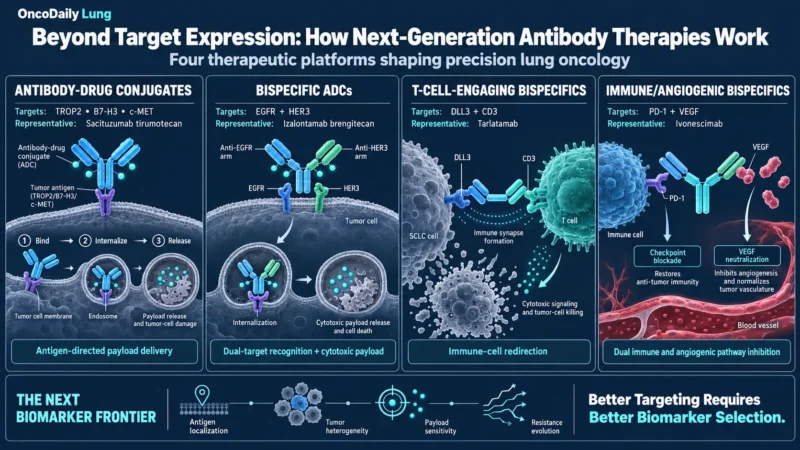
An ADC combines an antigen-binding monoclonal antibody with a cytotoxic payload through a chemical linker. Effective drug delivery depends on antigen accessibility, antibody binding, internalization, intracellular processing, linker cleavage, and payload sensitivity. Consequently, the relationship between antigen expression and ADC efficacy is not necessarily linear.
High antigen expression may facilitate drug delivery, but it does not guarantee response. Conversely, some ADCs demonstrate substantial activity in tumors with relatively low or heterogeneous antigen expression, potentially reflecting highly potent payloads and bystander cytotoxic effects.
Bispecific antibodies operate through distinct mechanisms. Some, such as amivantamab, target two oncogenic receptor pathways. Others, including tarlatamab, redirect immune effector cells toward tumor cells. A third category, represented by ivonescimab, combines immune checkpoint inhibition with VEGF blockade.
Bispecific ADCs further integrate dual-target recognition with cytotoxic payload delivery. These technologies require biomarker strategies tailored to the mechanism of action rather than a universal approach based on conventional immunohistochemistry.
By 2026, the most clinically relevant distinction is between three categories: established treatment-selection biomarkers, biomarkers used to define clinical trial populations, and exploratory biomarkers whose predictive utility remains unconfirmed.
HER2: Genomic Alterations and Protein Expression Are Not Interchangeable
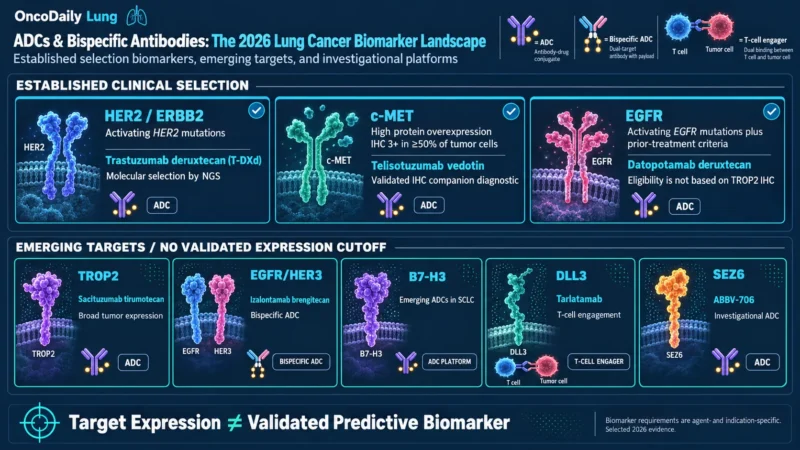
HER2 remains a foundational example of biomarker-directed ADC development in NSCLC. Trastuzumab deruxtecan (T-DXd) established the clinical relevance of HER2-directed ADC therapy in previously treated advanced NSCLC harboring activating ERBB2 mutations.
Unlike HER2-positive breast cancer, where protein overexpression and gene amplification have historically guided treatment selection, the original lung cancer indication for T-DXd was based on activating HER2 mutations.
This distinction remains fundamental. HER2 mutations, HER2 amplification, and HER2 protein overexpression represent different biological abnormalities and should not be treated as interchangeable therapeutic biomarkers.
The evolution of HER2-targeted therapies in 2026 has also intensified the competition between antibody-based and small-molecule approaches.
Newer HER2-selective inhibitors, including zongertinib and sevabertinib, have expanded treatment options for HER2-mutated NSCLC. Although these agents are not ADCs, their development raises important sequencing questions for HER2-directed antibody therapeutics.
For ADC development, the next challenge is determining whether HER2 protein expression, mutation subtype, amplification status, or combinations of these characteristics can identify distinct populations with greater sensitivity to specific payload platforms.
Prospective trials will be necessary to determine whether HER2-directed ADCs can be optimally positioned before or after newer HER2-selective kinase inhibitors.
TROP2: The Largest ADC Expansion Without a Validated Expression Threshold
Trophoblast cell-surface antigen 2 (TROP2), encoded by TACSTD2, remains one of the most actively investigated ADC targets in lung cancer. TROP2 is broadly expressed across NSCLC and other epithelial malignancies, providing an attractive delivery target for cytotoxic payloads.
However, unlike c-MET, TROP2 has not yet produced a routinely validated immunohistochemical threshold for selecting patients for approved lung cancer ADC treatment.
Datopotamab deruxtecan (Dato-DXd), a TROP2-directed ADC carrying a topoisomerase I inhibitor payload, received US accelerated approval in June 2025 for previously treated EGFR-mutated advanced NSCLC following EGFR-directed therapy and platinum-based chemotherapy.
Importantly, eligibility is defined by EGFR mutation status and prior treatment, not by a specific TROP2 expression score. This demonstrates that the clinically actionable biomarker may be a characteristic of the underlying cancer population rather than the antigen directly targeted by the ADC.
One of the most promising biomarker approaches involves quantitative assessment of TROP2 localization. Exploratory analyses from TROPION-Lung01 investigated quantitative continuous scoring–normalized membrane ratio (QCS-NMR), a computational pathology method measuring membrane-associated TROP2 relative to cytoplasmic expression.
In the TROP2 QCS-NMR-positive subgroup, datopotamab deruxtecan demonstrated a favorable PFS effect compared with docetaxel, with an HR of approximately 0.57.
However, these findings remain exploratory. Assay standardization, prospective validation, reproducibility across institutions, and demonstration of treatment-by-biomarker interaction remain essential before implementation in routine practice.
The emerging lesson is that membrane localization may be more clinically informative than total antigen abundance alone.
OptiTROP-Lung06: TROP2 ADCs Challenge First-Line Chemoimmunotherapy
One of the most important 2026 developments was the phase III OptiTROP-Lung06 trial, presented at ESMO Congress and simultaneously published in the New England Journal of Medicine.
The study evaluated sacituzumab tirumotecan (sac-TMT) plus pembrolizumab versus platinum-based chemotherapy plus pembrolizumab in previously untreated PD-L1-negative advanced nonsquamous NSCLC without actionable genomic alterations.
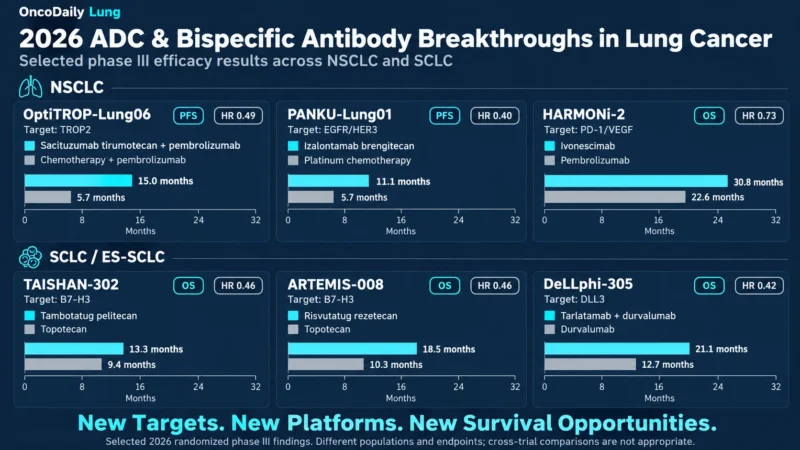
Median PFS was 15.0 months with sac-TMT plus pembrolizumab versus 5.7 months with conventional chemoimmunotherapy, corresponding to an HR of 0.49. Although objective response rates were broadly similar, response durability was substantially greater with the ADC-based combination.
These findings suggest that replacing conventional chemotherapy with targeted cytotoxic payload delivery may improve disease control even without selecting patients by a specific TROP2 expression threshold.
However, overall survival data remain immature. The biomarker implications are equally important. PD-L1 negativity defined the clinical population, while TROP2 expression was not established as a validated predictive biomarker.
Consequently, the trial demonstrates clinical activity in a biomarker-defined treatment setting but does not establish that TROP2 expression itself predicts treatment benefit.
OptiTROP-Lung04: Mature Survival Evidence After EGFR-Targeted Therapy
The final OS analysis of OptiTROP-Lung04 provided further evidence supporting TROP2-directed therapy.
Presented at ESMO 2026, the trial evaluated sacituzumab tirumotecan versus platinum-based chemotherapy in patients with EGFR-mutated advanced nonsquamous NSCLC after EGFR-TKI progression.
With a median follow-up of 32.3 months, median OS was 25.9 months with sac-TMT versus 17.4 months with chemotherapy (HR 0.69; 95% CI 0.54–0.89). At 24 months, estimated OS was 54.1% versus 37.2%, respectively. The results establish a sustained survival advantage for sac-TMT in this molecularly defined population.
However, EGFR mutation status functions primarily as a treatment-history and disease-context biomarker in this trial rather than proving that EGFR signaling directly predicts sensitivity to TROP2-targeted payload delivery.
This distinction matters as ADCs become increasingly integrated into post-targeted-therapy treatment pathways. Future studies must determine whether acquired resistance alterations, histological transformation, TROP2 localization, and prior treatment exposure influence ADC sensitivity.
c-MET: The Clearest Example of Protein Expression as an Actionable ADC Biomarker
Among emerging ADC targets, c-MET provides one of the strongest examples of clinically validated immunohistochemistry-based patient selection.
In May 2025, the US FDA granted accelerated approval to telisotuzumab vedotin, a c-MET-directed ADC carrying a microtubule inhibitor payload, for previously treated advanced nonsquamous NSCLC with high c-MET protein overexpression.
The approved biomarker requirement is strong (3+) c-MET staining in at least 50% of tumor cells, assessed using an FDA-approved companion diagnostic. The VENTANA MET (SP44) RxDx assay provides a standardized method for identifying this population.
This represents a major distinction from ADCs developed in broadly antigen-expressing populations without mandatory expression thresholds. However, MET protein overexpression should not be confused with MET exon 14 skipping mutations or MET amplification.
These alterations affect different aspects of MET biology and have distinct therapeutic implications. The successful implementation of a c-MET expression threshold also raises questions about whether comparable quantitative approaches could improve selection for other ADC targets.
Importantly, thresholds validated for telisotuzumab vedotin should not automatically be extrapolated to newer MET-directed ADCs, including telisotuzumab adizutecan, because differences in payload, linker design, and pharmacology may affect the relationship between antigen expression and clinical activity.
Bispecific EGFR/HER3 ADCs: PANKU-Lung01 Establishes Phase III Proof of Concept
The phase III PANKU-Lung01 trial presented at ESMO 2026 represents a major milestone for bispecific ADC development. Izalontamab brengitecan (iza-bren), also known as BL-B01D1, is a bispecific ADC targeting EGFR and HER3 and carrying a topoisomerase I inhibitor payload.
The study enrolled patients with EGFR-mutated advanced nonsquamous NSCLC who had progressed after third-generation EGFR tyrosine kinase inhibitors. A total of 432 patients were randomized to iza-bren or platinum-based chemotherapy.
Median PFS by blinded independent central review reached 11.1 months with iza-bren versus 5.7 months with chemotherapy, corresponding to an HR of 0.40 (95% CI 0.31–0.51; p<0.0001). Confirmed objective response rates were 60.2% versus 34.5%, while median duration of response reached 10.4 versus 5.7 months.
Overall survival remained immature. The trial provides compelling randomized evidence that dual EGFR/HER3-targeted payload delivery can substantially improve disease control after EGFR-TKI progression.
However, it does not establish EGFR or HER3 protein expression as an independently validated predictive biomarker. The study population was primarily selected by activating EGFR mutations and prior treatment history.
Determining whether receptor coexpression, HER3 localization, EGFR mutation subtype, or specific resistance mechanisms can improve patient selection will be a major focus of future translational research.
B7-H3: Two Phase III Survival Breakthroughs Transform Relapsed SCLC
One of the most important developments in 2026 came from B7-H3-directed ADCs. B7-H3, encoded by CD276, is broadly expressed in SCLC and numerous other malignancies. Its expression across tumor cells and the tumor microenvironment makes it an attractive target for ADC delivery.
At the 2026 World Conference on Lung Cancer, two separate phase III studies demonstrated significant survival benefits for B7-H3-directed ADCs in relapsed SCLC.
In TAISHAN-302, tambotatug pelitecan (Tam-Peli, YL201) was compared with topotecan in 451 patients previously treated with platinum chemotherapy. Median OS was 13.3 months versus 9.4 months (HR 0.46; 95% CI 0.35–0.62; p<0.001).
Median PFS was 7.4 versus 2.8 months (HR 0.29), while confirmed objective response rates were 59.1% versus 9.7%. In ARTEMIS-008, another B7-H3-directed ADC, risvutatug rezetecan (Ris-Rez, HS-20093), was evaluated against topotecan in 461 patients.
Median OS reached 18.5 months versus 10.3 months (HR 0.46; 95% CI 0.35–0.62; p<0.001). Median PFS was 7.2 versus 3.0 months, while objective response rates were 58.3% and 12.6%, respectively. Both trials demonstrated a lower incidence of severe treatment-related adverse events than topotecan, although substantial hematologic toxicity remained.
These findings establish strong phase III evidence supporting B7-H3-directed ADC treatment in relapsed SCLC. However, they do not establish a validated B7-H3 expression cutoff for patient selection.
Nor can their different median survival estimates be used to claim that one agent is superior to the other, because no direct randomized comparison has been performed.
The emerging clinical challenge will be optimizing sequencing between B7-H3-directed ADCs, DLL3-directed immunotherapy, and other salvage treatments.
SEZ6: A Promising SCLC Target Without a Clear Expression–Response Relationship
Seizure-related homolog 6 (SEZ6) has emerged as another promising ADC target in neuroendocrine malignancies, particularly SCLC. A 2026 phase I study published in Nature Medicine evaluated ABBV-706, a SEZ6-directed ADC carrying a topoisomerase I inhibitor payload, in relapsed or refractory SCLC and other advanced malignancies.
Exploratory tissue analysis demonstrated detectable SEZ6 expression in approximately 93% of evaluable SCLC tumors using a low immunohistochemical positivity threshold. The study also reported substantial antitumor activity in previously treated SCLC.
However, an important observation was that treatment responses occurred across different SEZ6 expression levels. Baseline SEZ6 H-scores did not demonstrate a consistent relationship with response, PFS, or OS in the exploratory analyses.
These findings illustrate a recurring challenge in ADC biomarker development: widespread expression can establish target suitability without providing a reliable method for identifying which patients will benefit most.
The investigators also observed early reductions in ctDNA among responding patients, suggesting that dynamic molecular response may provide additional information beyond static antigen expression. Nevertheless, these biomarker findings remain exploratory and require prospective validation.
SEZ6 is therefore a promising therapeutic target, but not yet an established clinical selection biomarker.
DLL3: Bispecific T-Cell Engagement Delivers a Major Survival Advance
Delta-like ligand 3 (DLL3) has become one of the most clinically important targets in SCLC. Unlike ADCs, DLL3-directed bispecific T-cell engagers use the target antigen to recruit immune effector cells toward malignant cells.
Tarlatamab is a DLL3/CD3 bispecific antibody that brings T cells into proximity with DLL3-expressing tumor cells, enabling immune-mediated killing. The drug received traditional US FDA approval in November 2025 for extensive-stage SCLC progressing on or after platinum-based chemotherapy.
At ESMO 2026, the phase III DeLLphi-305 trial substantially extended the evidence supporting DLL3-directed therapy.
The trial evaluated tarlatamab plus durvalumab versus durvalumab alone as first-line maintenance therapy following induction durvalumab and platinum–etoposide chemotherapy. Among 563 randomized patients, median OS was 21.1 months versus 12.7 months, with an HR of 0.42 (95% CI 0.32–0.54; p<0.001).
Median PFS was 7.4 versus 1.9 months (HR 0.34). These results represent a major advance in SCLC immunotherapy. However, the treatment population was not selected using a validated quantitative DLL3 expression threshold.
The findings therefore establish DLL3 as a clinically successful therapeutic target without proving that higher DLL3 expression predicts greater treatment benefit.
From a biomarker perspective, additional work is needed to determine whether antigen density, tumor immune characteristics, T-cell function, or the molecular subtypes of SCLC influence response to DLL3-directed engagement.
The practical implications also extend to toxicity. Cytokine release syndrome remains an important adverse event requiring specific monitoring and management protocols. The emerging question is whether molecular and immune profiling can improve the selection of patients who achieve durable benefit while minimizing treatment burden.
PD-1/VEGF Bispecific Antibodies: Ivonescimab Changes the Immunotherapy Landscape
Not all clinically important bispecific antibodies rely on tumor-associated antigen expression. Ivonescimab represents a different therapeutic strategy by combining PD-1 blockade with inhibition of vascular endothelial growth factor (VEGF).
This design aims to integrate immune checkpoint inhibition with modification of the tumor vasculature and microenvironment.
The phase III HARMONi-2 trial, conducted in China, compared ivonescimab with pembrolizumab in previously untreated advanced NSCLC with PD-L1 expression of at least 1% and no EGFR or ALK alterations.
At the September 2026 presentation of the prespecified OS analysis, median OS reached 30.8 months with ivonescimab versus 22.6 months with pembrolizumab (HR 0.73; 95% CI 0.57–0.95; p=0.009). The trial had previously demonstrated a PFS improvement of 11.1 versus 5.8 months (HR 0.51).
These findings establish a significant efficacy advantage in the studied population and support the relevance of dual immune and angiogenic pathway inhibition. However, the biomarker implications require careful interpretation.
PD-L1 expression was used to define eligibility, but this does not establish the optimal PD-L1 threshold for selecting patients who derive greater incremental benefit from ivonescimab. Similarly, VEGF pathway activity has not been validated as a routine predictive biomarker for this bispecific platform.
The global phase III HARMONi trial, evaluating ivonescimab plus chemotherapy after EGFR-TKI progression, demonstrated significant PFS improvement, but its prespecified primary OS analysis did not meet statistical significance.
Later survival analyses showed favorable numerical trends, but these should be distinguished from formally confirmed survival benefits.
The broader lesson is that bispecific immunotherapy may improve treatment outcomes without relying on a single tumor antigen, increasing the importance of immune signatures, angiogenic markers, and tumor microenvironment profiling.
Why Not Every Promising ADC Target Succeeds: SigVie-002
The growing number of positive ADC trials must also be interpreted alongside negative phase III evidence. The phase III SigVie-002 trial evaluated sigvotatug vedotin, an integrin β6-directed ADC, against docetaxel in previously treated advanced nonsquamous NSCLC.
Despite encouraging earlier development data, the trial failed to demonstrate a statistically significant OS improvement in the overall population. The results illustrate the limitations of assuming that tumor-associated antigen expression and early response activity will necessarily translate into a clinically meaningful survival advantage.
Differences in antigen accessibility, target heterogeneity, payload sensitivity, drug exposure, and resistance mechanisms may all influence efficacy. SigVie-002 reinforces the importance of prospective biomarker validation and randomized comparisons rather than relying exclusively on target prevalence or early-phase objective response rates.
The Next Generation of Biomarkers: Spatial, Dynamic, and Multidimensional
As the number of ADCs and bispecific platforms increases, conventional single-marker immunohistochemistry may become insufficient for optimal treatment selection. Several complementary approaches are emerging.
Quantitative digital pathology can evaluate antigen localization, staining intensity, and intratumoral heterogeneity more precisely than conventional scoring systems. Spatial proteomics may identify whether relevant antigens are concentrated within tumor cells, invasive regions, or the surrounding microenvironment.
Circulating tumor DNA could provide dynamic information about treatment response, acquired resistance, and molecular evolution during therapy. RNA-based profiling may identify transcriptional programs associated with target expression, immune activity, or sensitivity to specific cytotoxic payloads.
Functional biomarkers may also become relevant. For example, topoisomerase I inhibitor sensitivity, DNA damage response pathways, and mechanisms of drug efflux could influence response to ADC payloads independently of the antibody’s target. Importantly, these approaches remain at different stages of development.
A biomarker associated with response in a single-arm study is not necessarily predictive of relative benefit over another treatment. Establishing predictive utility requires prospective validation, standardized assays, and ideally evidence that treatment effects differ meaningfully according to biomarker status.
A further challenge is the dynamic nature of antigen expression. Prior targeted therapy, chemotherapy, or ADC exposure may alter tumor-cell phenotype and surface-antigen expression, potentially reducing the reliability of archival tissue samples.
As a result, the optimal timing of biopsy and the role of repeat molecular testing will become increasingly important.
Clinical Implications: What Is Actionable in 2026?
By October 2026, the biomarker landscape for ADCs and bispecific antibodies can be divided into distinct levels of clinical maturity. HER2 activating mutations remain an established molecular selection criterion for trastuzumab deruxtecan in appropriately eligible NSCLC.
High c-MET protein overexpression is a validated expression-based selection criterion for telisotuzumab vedotin, supported by an approved companion diagnostic.
EGFR mutations guide eligibility for established amivantamab-based treatment strategies and define the approved population for datopotamab deruxtecan after prior EGFR-directed therapy and platinum chemotherapy.
By contrast, TROP2 expression, HER3 expression, B7-H3 expression, SEZ6 expression, and quantitative DLL3 expression do not yet represent universally validated clinical selection biomarkers for their respective therapeutic platforms.
Recent positive phase III trials establish the activity of several agents in defined clinical populations, but do not automatically establish antigen expression as a predictive biomarker. Moreover, regulatory status differs geographically. Some ADCs have received approval in China, while remaining investigational in the United States or European Union for the same indication.
The distinction between clinical efficacy, biomarker validation, and regulatory authorization is essential when translating trial findings into routine treatment.
OncoDaily Takeaway
The 2026 clinical trial landscape marks a major evolution in ADC and bispecific antibody treatment for lung cancer, with several therapeutic platforms now demonstrating substantial randomized survival benefits.
In NSCLC, OptiTROP-Lung06 and OptiTROP-Lung04 strengthen the clinical evidence for TROP2-directed ADCs, while PANKU-Lung01 establishes compelling phase III activity for dual EGFR/HER3-targeted payload delivery.
In SCLC, two phase III studies—ARTEMIS-008 and TAISHAN-302—demonstrate that B7-H3-directed ADCs can significantly prolong overall survival compared with conventional salvage chemotherapy. Meanwhile, DeLLphi-305 provides strong survival evidence for earlier DLL3-directed T-cell engagement.
The HARMONi-2 results further extend the landscape beyond tumor-antigen-directed therapeutics, demonstrating the potential of bispecific antibodies combining immune checkpoint and angiogenic pathway inhibition.
However, these advances reveal an important paradox. The success of a targeted antibody therapeutic does not necessarily mean that expression of its target has become a validated predictive biomarker.
While HER2 mutations and high c-MET protein overexpression provide clinically established selection strategies for specific ADC indications, many other agents demonstrate meaningful activity without a defined antigen-expression threshold.
The next phase of precision oncology must therefore move beyond conventional antigen positivity toward more sophisticated biomarkers incorporating protein localization, tumor heterogeneity, molecular context, payload sensitivity, and dynamic treatment response.
For oncologists, the immediate priority remains accurate molecular profiling, appropriate immunohistochemical testing when clinically indicated, and careful distinction between approved treatment-selection biomarkers and investigational markers.
For researchers, the challenge is to incorporate prospective, standardized biomarker validation into future clinical trials rather than treating molecular analyses as secondary exploratory endpoints.
The next generation of ADCs and bispecific antibodies will not be defined solely by new targets or more potent payloads. Their greatest clinical impact will depend on understanding why individual tumors respond, how resistance develops, and how biomarkers can guide the right treatment to the right patient at the right time.
Sources
This review integrates clinical and regulatory evidence available through October 31, 2026, particularly the following developments:
- Zhou C, et al. Sacituzumab Tirumotecan Plus Pembrolizumab in PD-L1–Negative Advanced NSCLC. New England Journal of Medicine. 2026. DOI: 10.1056/NEJMoa2611280. OptiTROP-Lung06.
- Fang W, et al. OptiTROP-Lung04 final OS analysis. ESMO Congress 2026, LBA67.
- Zhang L, et al. Izalontamab Brengitecan Versus Platinum-Based Chemotherapy in EGFR-Mutated Advanced NSCLC. The Lancet. 2026. PANKU-Lung01.
- Zhao et al. Tambotatug Pelitecan in Small-Cell Lung Cancer After Platinum-Based Therapy. New England Journal of Medicine. 2026. DOI: 10.1056/NEJMoa2610229. TAISHAN-302.
- Wang J, et al. ARTEMIS-008: Risvutatug rezetecan versus topotecan in relapsed SCLC. IASLC World Conference on Lung Cancer 2026.
- SEZ6-Targeting Antibody–Drug Conjugate ABBV-706 in Advanced Small Cell Lung Cancer and Solid Tumors: A Phase 1 Trial. Nature Medicine. 2026. DOI: 10.1038/s41591-026-04452-0.
- Sands J, et al. Tarlatamab–Durvalumab Maintenance for Extensive-Stage Small-Cell Lung Cancer. New England Journal of Medicine. 2026. DOI: 10.1056/NEJMoa2609482.
- Zhou C, et al. HARMONi-2 final reported interim OS analysis. IASLC World Conference on Lung Cancer 2026.
- US Food and Drug Administration. Regulatory approvals for datopotamab deruxtecan, telisotuzumab vedotin, tarlatamab, and amivantamab-based NSCLC treatment.
- SigVie-002 phase III results, ESMO Congress 2026.