A new study published in Clinical Cancer Research provides one of the largest molecular and clinical analyses of patients with KRAS Q61 mutant NSCLC, a rare and heterogeneous KRAS-mutant subgroup with limited treatment-specific evidence.
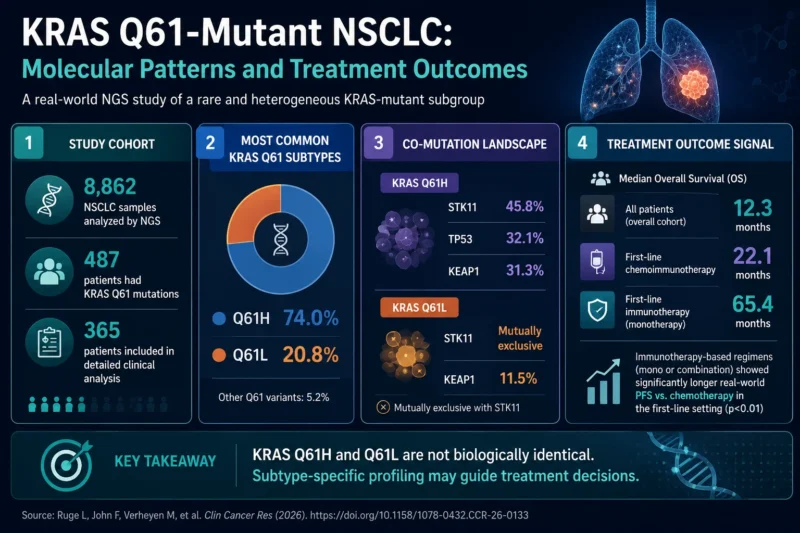
The study, led by Lea Ruge and colleagues, analyzed diagnostic samples from patients with NSCLC tested by next-generation sequencing between 2011 and 2023. Among 8,862 analyzed samples, investigators identified 487 patients with KRAS Q61 mutations, representing 5.5% of the tested cohort. Clinical and molecular outcomes were further evaluated in 365 patients.
The findings suggest that KRAS Q61-mutant NSCLC is not a single uniform disease group. The two dominant subtypes, KRAS Q61H and KRAS Q61L, showed distinct clinical and co-mutational profiles. Importantly, immunotherapy-based first-line treatment was associated with more favorable outcomes than chemotherapy alone.
A Rare KRAS Subgroup With Limited Evidence
KRAS is one of the most common oncogenic drivers in NSCLC. Most clinical attention has focused on KRAS G12C, largely because specific KRAS G12C inhibitors have become available in clinical practice.
KRAS Q61 mutations are less common. They account for approximately 1% to 7% of all KRAS mutations in NSCLC, according to the study. Their prognostic meaning and response to different treatment approaches have remained unclear.
This makes KRAS Q61 clinically important. These patients do not fit neatly into the KRAS G12C treatment paradigm, and they currently lack mutation-specific targeted treatment options.
Study Design
The investigators analyzed NSCLC diagnostic samples tested by next-generation sequencing from 2011 to 2023.
Molecular findings were linked with clinical records, and survival outcomes were assessed using Kaplan-Meier estimates. The study focused on clinical features, smoking history, co-occurring mutations, overall survival, and real-world progression-free survival across treatment strategies.
Of 8,862 analyzed samples, 487 patients had KRAS Q61 mutations. A total of 365 patients were included in the detailed clinical and molecular analysis.
KRAS Q61H and Q61L Were the Dominant Subtypes
Most KRAS Q61-mutant NSCLC cases were driven by two subtypes.
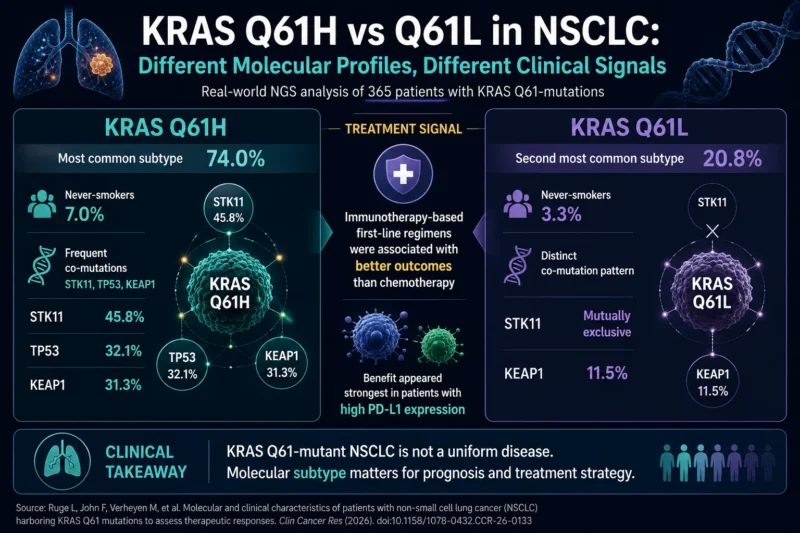
KRAS Q61H was the most frequent alteration, found in 74.0% of cases. KRAS Q61L was the second most common, found in 20.8% of cases.
These two subgroups showed different clinical and molecular features.
Never-smoking history was uncommon in both groups, but slightly more frequent in KRAS Q61H than KRAS Q61L. Never-smokers accounted for 7.0% of Q61H cases and 3.3% of Q61L cases.
The co-mutational patterns were also different.
In KRAS Q61H-mutant NSCLC, the most frequent co-mutations were:
- STK11 in 45.8%
- TP53 in 32.1%
- KEAP1 in 31.3%
By contrast, KRAS Q61L was mutually exclusive with STK11 and had a lower rate of KEAP1 co-mutation, reported at 11.5%.
This difference matters because STK11 and KEAP1 co-mutations are often associated with distinct tumor biology and may influence response patterns to systemic therapy.
Survival Outcomes
Median overall survival for the entire KRAS Q61-mutant cohort was 12.3 months.
However, survival appeared more favorable among patients who received immunotherapy-based first-line treatment.
Patients treated with combined chemoimmunotherapy in the first-line setting had a median overall survival of 22.1 months. Patients treated with first-line immunotherapy alone had a median overall survival of 65.4 months.
The investigators also reported that real-world progression-free survival was significantly longer among patients receiving immunotherapy, either as monotherapy or in combination with chemotherapy, compared with chemotherapy alone in the first-line setting.
This difference was statistically significant, with p<0.01.
Immunotherapy Signal Appears Clinically Relevant
The study suggests that immunotherapy-based regimens may be associated with better outcomes in KRAS Q61-mutant NSCLC than chemotherapy alone.
This finding is particularly relevant because KRAS Q61 mutations do not currently have approved mutation-specific targeted therapies comparable to KRAS G12C inhibitors.
The benefit appeared especially important in patients with high PD-L1 expression, according to the authors.
This supports a practical clinical message: KRAS Q61-mutant NSCLC should not be grouped broadly with all KRAS-mutant lung cancers without considering subtype, PD-L1 expression, and co-mutational context.
Why Co-Mutations Matter
The contrast between KRAS Q61H and Q61L is one of the most important findings of the study.
KRAS Q61H was frequently associated with STK11, TP53, and KEAP1 co-mutations. KRAS Q61L, however, was mutually exclusive with STK11 and had fewer KEAP1 co-mutations.
These differences may help explain clinical heterogeneity within KRAS Q61-mutant NSCLC.
In lung cancer, co-mutations can influence tumor immune environment, prognosis, and treatment response. STK11 and KEAP1 alterations have been linked in several studies to more aggressive disease biology and reduced benefit from immunotherapy in some KRAS-mutant populations.
The current analysis suggests that KRAS Q61 subtype-specific biology may be important when interpreting outcomes and designing future studies.
Clinical Meaning
This study adds needed real-world evidence for a rare KRAS-mutant NSCLC subgroup.
For clinicians, the findings suggest three practical points.
First, KRAS Q61-mutant NSCLC should be molecularly characterized beyond simply labeling it as “KRAS-mutant.” Q61H and Q61L appear to differ in co-mutational background and clinical behavior.
Second, immunotherapy-based treatment may be an important first-line strategy, especially for patients with high PD-L1 expression.
Third, chemotherapy alone may be less favorable than immunotherapy-containing regimens in this population, based on the observed real-world progression-free survival difference.
Still, these findings should be interpreted with caution. The study was retrospective, and treatment groups may have differed by clinical factors such as PD-L1 expression, performance status, disease burden, and comorbidities.
Prospective studies are needed to define optimal treatment strategies for KRAS Q61-mutant NSCLC.
Key Takeaway
KRAS Q61-mutant NSCLC represents a rare but clinically meaningful molecular subgroup.
In this large NGS-based cohort, KRAS Q61H and KRAS Q61L were the dominant subtypes and showed distinct molecular patterns. Q61H was frequently associated with STK11, TP53, and KEAP1 co-mutations, while Q61L was mutually exclusive with STK11 and had fewer KEAP1 co-mutations.
Median overall survival for the full cohort was 12.3 months, but outcomes were more favorable among patients receiving first-line immunotherapy-based regimens.
The study supports subtype-specific molecular characterization of KRAS Q61-mutant NSCLC and suggests that immunotherapy-based treatment may offer clinically relevant benefit compared with chemotherapy alone.