The phase III KEYNOTE-671 trial provided one of the pivotal demonstrations that immune checkpoint inhibition can be successfully integrated across the perioperative treatment course of resectable non–small cell lung cancer. Rather than limiting immunotherapy to either the neoadjuvant or adjuvant setting, the study tested a complete perioperative strategy: pembrolizumab combined with cisplatin-based chemotherapy before surgery, followed by surgery and continued pembrolizumab after resection.
In the first prespecified interim analysis published in The New England Journal of Medicine, perioperative pembrolizumab significantly improved event-free survival, major pathological response, and pathological complete response compared with neoadjuvant chemotherapy followed by surgery alone. At 24 months, 62.4% of patients receiving pembrolizumab were alive without an event compared with 40.6% in the control group, corresponding to an event-free survival hazard ratio of 0.58.
The trial established a major principle in early-stage NSCLC: systemic therapy around surgery is no longer simply an adjunct to local treatment. For selected patients with stage II–III disease, perioperative immunotherapy can become an integral component of curative-intent management.
A Perioperative Strategy Rather Than a Single Treatment Phase
KEYNOTE-671 enrolled patients with previously untreated, resectable stage II, IIIA, or IIIB disease with N2 involvement according to the eighth edition AJCC staging system. Patients were required to have ECOG performance status 0 or 1 and tumors considered resectable after surgical assessment. NEJMoa2302983
A total of 797 patients were randomized:
- 397 to perioperative pembrolizumab
and
- 400 to placebo-based treatment.
Patients received four cycles of pembrolizumab 200 mg every three weeks or placebo together with cisplatin-based chemotherapy. Squamous tumors were treated with cisplatin plus gemcitabine, while nonsquamous tumors received cisplatin plus pemetrexed. Surgery was followed by pembrolizumab or placebo every three weeks for up to 13 cycles.
The dual primary endpoints were event-free survival and overall survival, with major pathological response and pathological complete response among the key secondary endpoints. NEJMoa2302983 This design distinguished KEYNOTE-671 from neoadjuvant-only approaches by testing immunotherapy both before and after surgery.
Event-Free Survival Improved Substantially
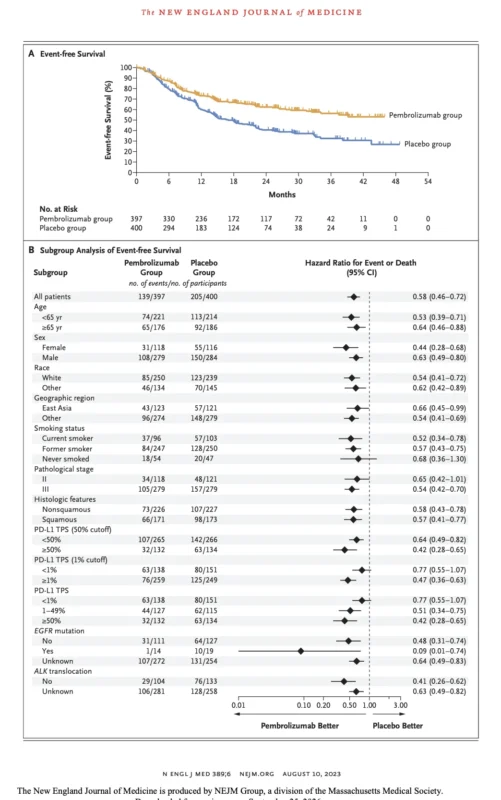
At a median follow-up of 25.2 months, 344 patients had experienced an event or died.
Two-year EFS was:
- 62.4% with perioperative pembrolizumab
versus
- 40.6% with placebo.
Median EFS had not been reached in the pembrolizumab group and was 17.0 months in the control group.
The hazard ratio for progression, recurrence, or death was:
- HR 0.58; 95% CI, 0.46–0.72; P<0.001.
The Kaplan–Meier curve shown on page 8 demonstrates early separation between the two treatment groups, beginning within the first several months and persisting during follow-up. This magnitude of benefit was clinically important because the EFS definition captured events occurring across the entire curative-intent pathway—including progression that prevented planned surgery, unresectable disease, postoperative recurrence, or death. The endpoint therefore reflected more than postoperative relapse alone.
Pathological Response Was Also Markedly Improved
Pembrolizumab substantially increased pathological tumor clearance at surgery.
Major pathological response, defined as no more than 10% viable tumor in the resected primary tumor and lymph nodes, occurred in:
- 30.2% with pembrolizumab
versus
- 11.0% with placebo.
Pathological complete response occurred in:
- 18.1%
versus
- 4.0%.
The approximately fourfold increase in pCR provided strong evidence that adding PD-1 blockade to neoadjuvant chemotherapy produced substantially deeper tumor eradication before surgery. But KEYNOTE-671 also demonstrated an important point: the clinical benefit of perioperative pembrolizumab was not limited to patients achieving pCR.
Patients Without pCR Still Appeared to Benefit
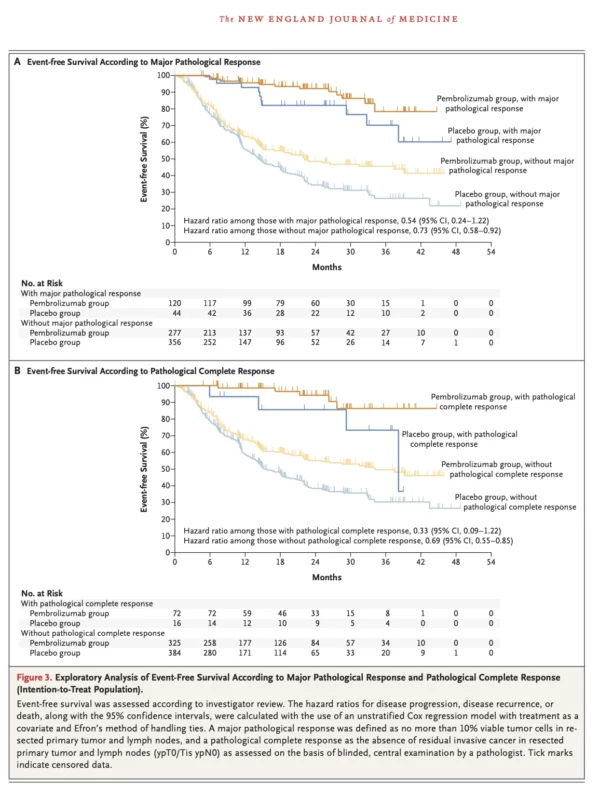
Exploratory analyses examined event-free survival according to pathological response. Among patients achieving pCR, the HR for an EFS event was 0.33, although the confidence interval was wide because relatively few events occurred. Among patients without pCR, the HR was 0.69 (95% CI, 0.55–0.85).
A similar pattern was observed when patients were analyzed according to major pathological response. This finding is clinically relevant because pCR is strongly prognostic after neoadjuvant therapy, but it does not completely define benefit from the entire perioperative strategy.
Patients with residual tumor after surgery still appeared to derive an EFS advantage from pembrolizumab. That observation also raises one of the most important unresolved questions in perioperative NSCLC: how much of the benefit comes from the neoadjuvant component, and how much comes from continuing immunotherapy after surgery?
The Adjuvant Contribution Cannot Be Isolated
KEYNOTE-671 was designed to evaluate a complete perioperative regimen, not to compare neoadjuvant versus adjuvant immunotherapy separately. Patients who received pembrolizumab before surgery continued pembrolizumab afterward, while patients receiving neoadjuvant placebo also received adjuvant placebo.
The investigators therefore could not determine the independent contribution of postoperative pembrolizumab. They explicitly identify this as a major limitation. Answering the question directly would have required additional randomized groups receiving neoadjuvant pembrolizumab followed by adjuvant placebo or neoadjuvant placebo followed by adjuvant pembrolizumab.
The exploratory EFS benefit observed among patients without pCR suggests that postoperative therapy may contribute additional protection against recurrence, but this does not prove that all patients require adjuvant immunotherapy after successful neoadjuvant chemoimmunotherapy. This question remains fundamental to future treatment de-escalation strategies.
Pembrolizumab Did Not Compromise Surgery
An important concern with neoadjuvant immunotherapy is whether inflammatory or fibrotic treatment effects could make surgery more difficult or reduce the likelihood of resection. KEYNOTE-671 provided reassuring data. Among patients beginning treatment, 82.1% in the pembrolizumab arm and 79.4% in the control arm underwent surgery. Among those undergoing surgery, complete R0 resection was achieved in:
- 92.0% with pembrolizumab
versus
- 84.2% with placebo. NEJMoa2302983
The investigators concluded that neoadjuvant pembrolizumab did not meaningfully reduce chemotherapy exposure, compromise the ability to undergo surgery, alter surgical approach, or increase surgical complications. This is particularly important in a curative-intent population, where any systemic treatment benefit must be balanced against the risk of delaying or preventing definitive local therapy.
Benefit Was Seen Across Major Clinical Subgroups
The EFS benefit generally favored pembrolizumab across the major subgroups evaluated. The effect appeared similar in squamous and nonsquamous NSCLC. The treatment effect also appeared to increase with higher PD-L1 expression:
- PD-L1 TPS <1%: HR 0.77
- PD-L1 TPS 1–49%: HR 0.51
- PD-L1 TPS ≥50%: HR 0.42.
However, the confidence intervals overlapped, and the study was not designed to establish PD-L1 as a definitive treatment-selection biomarker. Most importantly, even patients with PD-L1 TPS <1% showed a numerical treatment effect favoring pembrolizumab. The data therefore support perioperative immunotherapy as a strategy broader than a PD-L1-high population.
Stage III Disease Appeared to Derive Particularly Strong Benefit
Approximately 70% of participants had stage III disease at baseline, including a large population with N2 involvement. In subgroup analysis, the EFS HR was approximately:
- 0.65 in stage II disease
and
- 0.54 in stage III disease. NEJMoa2302983
The investigators cautioned against overinterpreting differences between subgroups because some contained relatively few events. Nevertheless, the substantial representation of stage III disease makes KEYNOTE-671 particularly important for multidisciplinary decision-making in patients whose tumors remain technically resectable but carry a high risk of systemic recurrence.
EGFR and ALK Remain Important Caveats
Molecular testing was not mandatory in KEYNOTE-671. Only a small number of patients were identified as having EGFR mutations or ALK rearrangements, while molecular status remained unknown in the majority of participants. The investigators therefore explicitly state that the study provides limited insight into these oncogene-driven populations.
This limitation is even more relevant in current practice than when the trial was designed.
For resectable EGFR-mutant and ALK-positive NSCLC, highly effective targeted strategies have established distinct perioperative treatment pathways. Comprehensive molecular testing before initiating neoadjuvant immunotherapy is therefore increasingly important.
KEYNOTE-671 should principally inform management of resectable NSCLC without an established actionable oncogenic driver for which a targeted perioperative strategy is preferred.
Overall Survival Was Immature in the Initial Publication
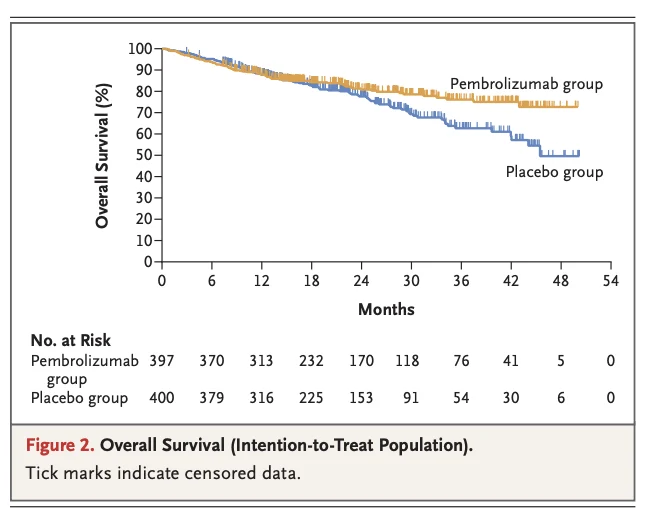
At this first interim analysis, 177 deaths had occurred. Estimated 24-month OS was:
- 80.9% with pembrolizumab
versus
- 77.6% with placebo.
The reported P value was 0.02, which did not cross the prespecified statistical boundary for significance at this interim analysis. It is important to describe this result according to the paper being reviewed: this initial NEJM publication established significant EFS and pathological-response benefits, while OS was not yet statistically significant at that analysis.
The trial was designed with continued follow-up for subsequent overall-survival analyses.
Toxicity Increased With the Perioperative Strategy
The EFS benefit came with additional toxicity. Treatment-related adverse events of grade 3 or higher occurred in:
- 44.9% with pembrolizumab
versus
- 37.3% with placebo.
Serious treatment-related adverse events occurred in:
- 17.7% vs 14.3%.
Treatment-related toxicity led to discontinuation of all protocol treatment in:
- 12.6% vs 5.3%.
Treatment-related deaths were uncommon and numerically similar:
- 1.0% with pembrolizumab
versus
- 0.8% with placebo.
The most common toxicities largely reflected the chemotherapy backbone, including nausea, neutropenia, anemia, leukopenia, and fatigue. Potentially immune-mediated events occurred more frequently with pembrolizumab, including thyroid dysfunction and pneumonitis. For a potentially curable population, these trade-offs remain important when deciding how much perioperative treatment is necessary.
KEYNOTE-671 Helped Shift Early NSCLC Toward Perioperative Immunotherapy
When KEYNOTE-671 was reported, evidence was already emerging that immune checkpoint inhibition could improve outcomes when used either before or after surgery. CheckMate 816 had established neoadjuvant nivolumab plus chemotherapy, while IMpower010 and PEARLS/KEYNOTE-091 had demonstrated benefits from postoperative checkpoint inhibition in selected resected populations.
KEYNOTE-671 asked the next logical question: could immunotherapy be integrated on both sides of surgery? Its positive EFS and pathological-response results, together with contemporaneous findings from AEGEAN and Neotorch, provided strong evidence supporting perioperative immune checkpoint inhibition in resectable stage II–III NSCLC.
The treatment paradigm consequently evolved from a simple sequence of chemotherapy followed by surgery toward a coordinated multidisciplinary strategy in which systemic immune therapy begins before resection and continues afterward.
The Remaining Question Is No Longer Whether Perioperative Immunotherapy Works
KEYNOTE-671 answered an important question: adding perioperative pembrolizumab to chemotherapy and surgery can substantially reduce the risk of progression, recurrence, or death. The current challenge is more nuanced. Should every patient receive postoperative immunotherapy after neoadjuvant chemoimmunotherapy?
Can pCR, major pathological response, or ctDNA-defined molecular residual disease identify patients who can safely stop treatment after surgery? Should patients with persistent viable tumor receive continuation of the same checkpoint inhibitor or treatment escalation using a different strategy?
And how should perioperative immunotherapy be integrated with increasingly important molecularly targeted approaches? The original KEYNOTE-671 design could not answer these questions, but its success created the clinical setting in which they now need to be addressed.
The Bottom Line
The first interim analysis of KEYNOTE-671 established perioperative pembrolizumab as a highly active curative-intent strategy for resectable stage II–III NSCLC. Among 797 randomized patients:
- 24-month EFS: 62.4% vs 40.6%
- HR: 0.58
Major pathological response: 30.2% vs 11.0%
Pathological complete response: 18.1% vs 4.0%.
The treatment effect was observed across major clinical subgroups and appeared present even among patients who did not achieve pCR. Pembrolizumab did not compromise surgical feasibility, but the regimen increased grade ≥3 and immune-mediated toxicity.
The major unresolved issue is the contribution of the postoperative component. Because KEYNOTE-671 randomized an entire perioperative strategy, it cannot determine which patients truly require continued pembrolizumab after surgery. That question now sits at the center of early-stage NSCLC research.
The next evolution of perioperative therapy may therefore be less about proving that immunotherapy works and more about determining how much treatment each individual patient actually needs to maximize the probability of cure.
Reference
- Wakelee H, Liberman M, Kato T, Tsuboi M, Lee S-H, Gao S, Chen K-N, Dooms C, Majem M, Eigendorff E, Martinengo GL, Bylicki O, Rodríguez-Abreu D, Chaft JE, Novello S, Yang J, Keller SM, Samkari A, Spicer JD, for the KEYNOTE-671 Investigators. Perioperative Pembrolizumab for Early-Stage Non–Small-Cell Lung Cancer. N Engl J Med. 2023;389:491–503. doi:10.1056/NEJMoa2302983.