A phase II study published in Nature Medicine reports encouraging pathological responses with perioperative ivonescimab, a bispecific antibody targeting PD-1 and VEGF, in patients with resectable stage II–IIIB non-small cell lung cancer (NSCLC). Neoadjuvant ivonescimab combined with platinum-based chemotherapy achieved a major pathological response (MPR) rate of 70.1% and a pathological complete response (pCR) rate of 50.7% among patients who underwent surgery, while demonstrating a manageable safety profile and limited treatment-related disruption to surgical treatment.
The multicenter study, led by Xiaoliang Zhao, Bin Zhang, Chenguang Li, and colleagues from China, investigated perioperative ivonescimab monotherapy or ivonescimab combined with chemotherapy, followed by surgical resection and adjuvant ivonescimab.
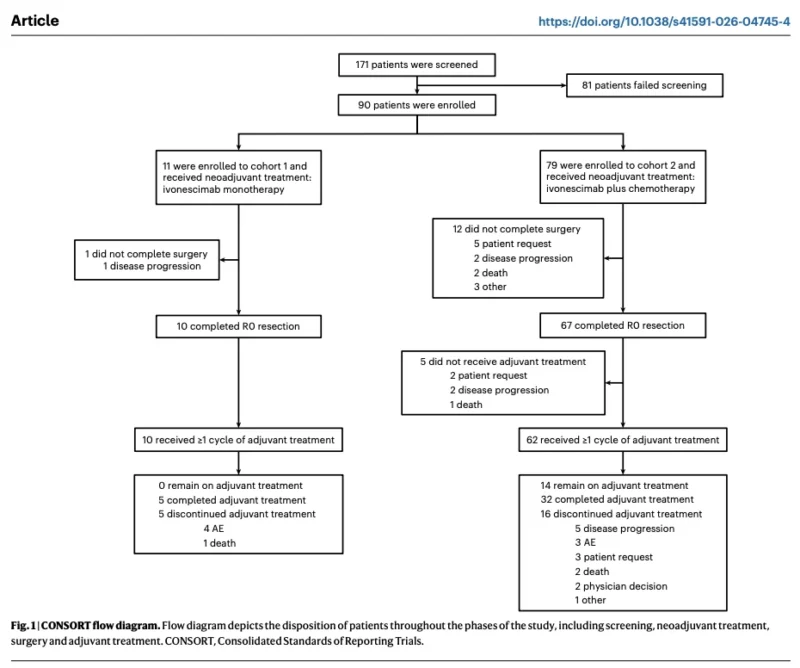
The trial enrolled 90 patients, including 11 who received ivonescimab alone and 79 who received ivonescimab plus chemotherapy. All eligible patients had resectable stage II–IIIB NSCLC without sensitizing EGFR mutations or ALK rearrangements.
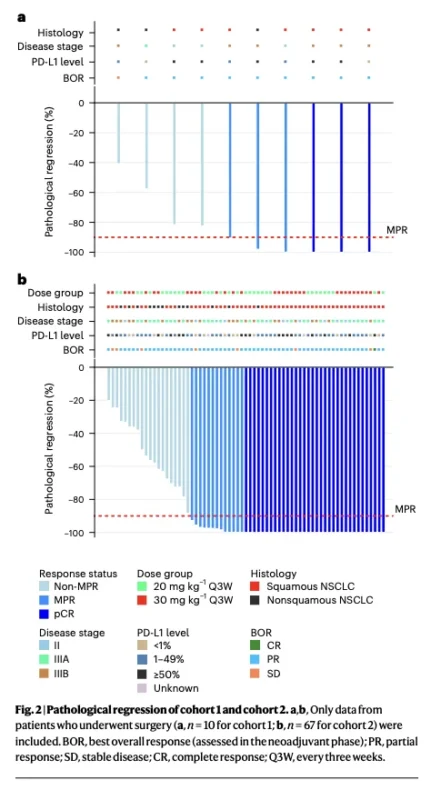
In the combination cohort, 47 of 67 patients undergoing surgery achieved MPR (70.1%; 95% CI 57.7–80.7), meeting the study’s prespecified primary efficacy benchmark against a historical MPR rate of 41%. Pathological complete response was observed in 34 of 67 surgically treated patients (50.7%; 95% CI 38.2–63.2).
Notably, all patients who underwent surgery achieved an R0 resection, and only one patient experienced a treatment-related surgical delay.
These findings introduce an important investigational strategy for perioperative NSCLC treatment, although the nonrandomized, noncomparative study design prevents conclusions regarding superiority over established chemoimmunotherapy regimens.
Why Dual PD-1 and VEGF Targeting Matters in Resectable NSCLC
The integration of immune checkpoint inhibitors into neoadjuvant and perioperative treatment has transformed the management of resectable NSCLC.
Randomized phase III trials, including CheckMate 816, KEYNOTE-671, AEGEAN, CheckMate 77T, and RATIONALE-315, have demonstrated improved pathological response and event-free survival with immunotherapy-based treatment.
Several studies have also established overall survival benefits, strengthening the role of perioperative immune checkpoint blockade in appropriately selected patients. However, recurrence remains a significant concern, even after complete surgical resection and contemporary systemic treatment.
Ivonescimab introduces a different immunotherapeutic approach by simultaneously targeting programmed cell death protein 1 (PD-1) and vascular endothelial growth factor (VEGF). PD-1 blockade is designed to restore antitumor T-cell activity, while VEGF inhibition may help counteract tumor-associated angiogenesis and the immunosuppressive tumor microenvironment.
VEGF signaling can contribute to abnormal tumor vasculature, impaired immune-cell infiltration, and reduced effectiveness of antitumor immune responses. Simultaneous inhibition of PD-1 and VEGF therefore offers a biological rationale for improving immune activity while modifying the vascular environment in which tumor cells survive.
Ivonescimab combines these mechanisms within a tetravalent bispecific antibody. Evidence from advanced NSCLC, including the phase III HARMONi program, has supported interest in this therapeutic platform. The new phase II study extends that concept into the potentially curative perioperative setting.
Study Design: Two Treatment Cohorts Without a Formal Head-to-Head Comparison
The study, registered as NCT05247684, was an open-label, multicenter phase II investigation conducted in China. Patients were eligible if they had previously untreated, resectable stage II–IIIB NSCLC and were considered suitable for definitive surgical treatment.
The investigation included two cohorts. Cohort 1 received neoadjuvant ivonescimab monotherapy for three or four cycles, followed by surgery and adjuvant ivonescimab. Cohort 2 received neoadjuvant ivonescimab combined with platinum–paclitaxel chemotherapy for three or four cycles, followed by surgery and adjuvant ivonescimab.
The chemotherapy backbone included cisplatin or carboplatin together with paclitaxel. Ivonescimab was administered every three weeks, using 20 mg/kg in the monotherapy cohort and 20 or 30 mg/kg in the combination cohort according to the study protocol and its amendments.
Patients were scheduled to undergo surgery approximately four to six weeks after completing neoadjuvant treatment, with postoperative ivonescimab planned for up to 16 cycles. The primary endpoints were MPR and safety, while secondary endpoints included pCR, event-free survival (EFS), objective response rate, tumor downstaging, and R0 resection.
Importantly, although the original protocol included an exploratory randomized phase, subsequent amendments discontinued monotherapy enrollment and expanded the combination cohort without randomization.
Consequently, the final study was analyzed as a nonrandomized, noncomparative trial. The two cohorts were not designed to establish whether adding chemotherapy improves outcomes compared with ivonescimab monotherapy.
Patient Characteristics: A Predominantly Squamous and Stage III Population
The study enrolled 90 patients between March 2022 and August 2024. Eleven patients received ivonescimab monotherapy, while 79 received the combination with chemotherapy. Median age was 64 years in both cohorts.
Most patients had squamous NSCLC, accounting for 72.7% of the monotherapy group and 78.5% of the combination group. Stage III disease was present in 72.7% and 81.0%, respectively.
The combination cohort included a substantial proportion of patients with mediastinal nodal involvement, including 70.9% with N2 disease. Approximately 72.2% of patients in the combination cohort had PD-L1 tumor proportion scores of at least 1%.
These characteristics are important because the study population was heavily weighted toward squamous histology and locally advanced disease. The results should therefore not be assumed to apply equally to all histological subtypes or patients with earlier-stage tumors.
Primary Endpoint: 70.1% Major Pathological Response With Combination Therapy
The main efficacy finding was the high MPR rate observed with ivonescimab plus chemotherapy. Among 67 patients in the combination cohort who underwent surgery, 47 achieved MPR, corresponding to 70.1% (95% CI 57.7–80.7).
MPR was defined as 10% or less residual viable tumor in the resected primary tumor and lymph nodes. The study met its prespecified primary efficacy criterion because the lower bound of the two-sided 80% confidence interval exceeded the historical control rate of 41%.
Among patients achieving MPR in the combination cohort, 46 of 47 had 5% or less residual viable tumor. This represents 68.7% of the surgically treated combination population. In the monotherapy cohort, six of ten surgically treated patients achieved MPR, corresponding to 60.0% (95% CI 26.2–87.8).
Five of these patients had 5% or less residual viable tumor. However, the monotherapy cohort was extremely small, and its confidence interval was correspondingly wide. Furthermore, the headline pathological response rates were calculated among patients who completed surgery.
When all treated patients were considered, MPR rates were 54.5% with monotherapy and 59.5% with combination treatment.
This distinction is essential because surgery-completed analyses exclude patients who did not undergo resection, potentially producing more favorable response estimates than those derived from the full treated population.
Pathological Complete Response Reached 50.7%
The combination regimen also demonstrated encouraging pCR activity. Among patients who underwent surgery, 34 of 67 achieved pCR (50.7%; 95% CI 38.2–63.2). In the monotherapy cohort, three of ten patients achieved pCR, corresponding to 30.0%.
When calculated using all enrolled and treated patients, pCR rates were 43.0% in the combination group and 27.3% with monotherapy. These results are notable in the context of contemporary perioperative immunotherapy research.
However, comparisons with pCR rates from KEYNOTE-671, CheckMate 77T, AEGEAN, or other randomized studies must be interpreted cautiously. Differences in patient characteristics, treatment regimens, histological composition, staging, and response-analysis populations prevent valid conclusions about relative efficacy.
Although the pathological responses are promising, the study does not establish that ivonescimab is superior to pembrolizumab, nivolumab, durvalumab, or other perioperative immune checkpoint inhibitors. Such conclusions require adequately powered randomized trials.
Squamous NSCLC Demonstrates Particularly High Pathological Response Rates
One of the most intriguing exploratory findings was the difference in pathological response according to tumor histology. In the combination cohort, patients with squamous NSCLC achieved an MPR rate of 81.5% (44/54) and a pCR rate of 61.1% (33/54).
By comparison, patients with nonsquamous NSCLC had an MPR rate of 23.1% (3/13) and a pCR rate of 7.7% (1/13). These numerical differences suggest that tumor histology may influence response to the combination.
However, the nonsquamous subgroup included only 13 surgically treated patients, and the analysis was exploratory. The findings are also relevant because antiangiogenic therapy has historically raised safety concerns in squamous NSCLC, particularly the risk of severe pulmonary hemorrhage associated with bevacizumab.
In this study, no grade 3 or higher hemorrhagic events were reported. Nevertheless, the small sample size and single-arm combination design cannot establish that the potential hemorrhagic risks of VEGF pathway inhibition have been eliminated.
The high response rate observed in squamous disease provides a rationale for further investigation, but it should not yet be considered evidence of a histology-specific standard of care.
PD-L1 Expression and Pathological Response
The investigators also evaluated outcomes according to baseline PD-L1 tumor proportion score. In the combination cohort, MPR rates were identical among surgically treated patients with PD-L1 expression below 1% and those with expression of at least 1%: 69.2% in both groups.
However, pCR rates were numerically higher among patients with PD-L1 expression of at least 1%, reaching 55.8%, compared with 30.8% among PD-L1-negative patients. These findings suggest that meaningful pathological responses may occur even in tumors without detectable PD-L1 expression by the study’s threshold.
However, the exploratory analysis does not establish PD-L1 negativity or positivity as a predictive biomarker for incremental benefit from ivonescimab. Without a randomized comparator, it is not possible to determine whether PD-L1 expression modifies the relative efficacy of the bispecific antibody compared with other perioperative regimens. Further prospective biomarker research is therefore required.
Surgical Feasibility: R0 Resection in All Operated Patients
The study also provides preliminary evidence regarding surgical feasibility after dual PD-1/VEGF blockade. Of the 90 enrolled patients, 77 proceeded to surgery. Ten of 11 patients in the monotherapy cohort and 67 of 79 patients in the combination cohort underwent resection.
All 77 surgically treated patients achieved R0 resection. Lobectomy was the most common operation. The objective response rate during neoadjuvant treatment was 81.8% with monotherapy and 81.0% with the combination.
Clinical tumor downstaging was observed in both cohorts. Only one patient in the combination cohort experienced a treatment-related delay in surgery, associated with impaired respiratory function following neoadjuvant treatment. No treatment-related adverse event directly resulted in surgery cancellation.
However, 13 patients did not undergo surgery for various reasons, including disease progression, patient preference, death unrelated to study treatment, and other medical circumstances. Therefore, the 100% R0 rate describes patients who actually underwent resection and should not be interpreted as an R0 rate of 100% for the entire enrolled population.
These findings support the feasibility of surgery following ivonescimab-based treatment in selected patients, but larger studies are required to establish comparative surgical safety.
Safety: VEGF-Related Events Require Continued Attention
Safety represents a particularly important consideration when introducing VEGF blockade before thoracic surgery. In the study, grade 3 or higher treatment-related adverse events occurred in 36.4% of patients receiving ivonescimab monotherapy and 30.4% receiving ivonescimab plus chemotherapy.
In the combination cohort, the most common severe treatment-related adverse events included decreased neutrophil count and decreased white blood cell count. Proteinuria, hypertension, and hemorrhage were monitored as adverse events potentially associated with VEGF inhibition.
In the combination cohort, proteinuria was reported in 22.8% of patients when all VEGF-related events were considered. Hemorrhagic events occurred in 6.3%, with no grade 3 or higher hemorrhage reported. Hypertension occurred in 6.3% of patients.
No treatment-related deaths were observed. Among patients who underwent surgery, ivonescimab-related surgery-associated adverse events were reported in approximately 10% of each cohort, without grade 3 or higher events attributed to ivonescimab.
However, grade 3 or higher surgery-related adverse events from any cause were observed in 40.0% of the small monotherapy cohort and 13.4% of the combination cohort. These different safety classifications should not be conflated.
Overall, the findings provide an encouraging preliminary safety signal but do not establish equivalence or superiority over existing perioperative treatment options.
ctDNA Dynamics Suggest an Emerging Biomarker Opportunity
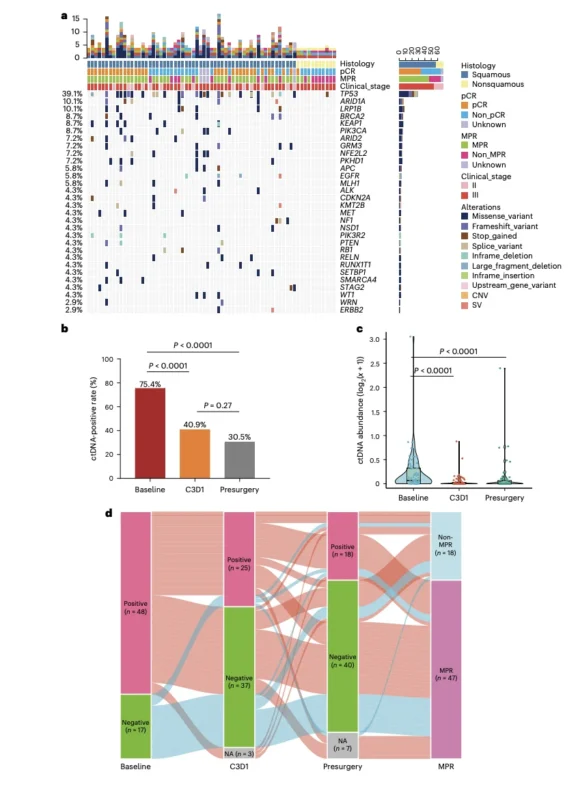
A particularly relevant translational component involved serial circulating tumor DNA (ctDNA) assessment. The investigators analyzed baseline samples from 69 patients, of whom 52 (75.4%) had detectable ctDNA.
The proportion of patients with detectable ctDNA declined during treatment, reaching 40.9% before the third neoadjuvant cycle and 30.5% before surgery. Among 43 patients with detectable ctDNA at baseline and evaluable presurgical samples, 28 achieved ctDNA clearance (65.1%).
The clearance rate was 66.7% in the combination group and 50.0% in the small monotherapy subgroup. Importantly, ctDNA status was associated with pathological response. Before surgery, the pCR rate was 57.5% among ctDNA-negative patients compared with 33.3% among those with detectable ctDNA.
Patients who remained ctDNA-negative throughout the evaluated treatment period had the highest pCR rate, reaching 69.2%. These findings suggest that longitudinal molecular monitoring may provide additional information about treatment response beyond conventional imaging.
However, ctDNA clearance is not equivalent to pathological complete response, and baseline ctDNA negativity may also reflect limited tumor DNA shedding rather than complete absence of residual disease.
The results remain exploratory and do not establish a validated approach for modifying perioperative treatment according to ctDNA status. Further studies will need to determine whether ctDNA dynamics predict EFS and OS and whether molecular response-guided treatment strategies improve clinical outcomes.
Event-Free Survival Remains Immature
Although pathological response provides an early measure of antitumor activity, the ultimate objective of perioperative treatment is to reduce recurrence and improve survival. At the August 2025 data cutoff, median EFS had not matured in either cohort.
The estimated 12-month EFS rate was 81.8% with monotherapy and 83.3% with combination treatment. Median follow-up was 36.7 months in the monotherapy cohort and 24.15 months in the combination cohort.
Despite these preliminary findings, the study does not provide a mature assessment of long-term disease control. Overall survival results were also not reported. Consequently, high MPR and pCR rates should not be interpreted as definitive evidence that the ivonescimab strategy improves EFS or OS compared with established perioperative regimens. Longer follow-up and randomized comparisons will be essential.
How Does This Fit Into the Broader Ivonescimab Development Program?
The perioperative findings add to the growing clinical evidence for dual PD-1/VEGF inhibition in lung cancer. In advanced NSCLC, the randomized phase III HARMONi-2 trial demonstrated improved PFS and OS with ivonescimab compared with pembrolizumab in PD-L1-positive disease.
These findings support the biological and clinical relevance of combined immune checkpoint and VEGF pathway blockade. However, efficacy in metastatic NSCLC cannot be directly extrapolated to the curative-intent setting.
Resectable disease introduces distinct considerations, including surgical timing, perioperative complications, wound healing, and the impact of systemic treatment on long-term recurrence. The current phase II results therefore represent an early step toward determining whether dual-pathway inhibition can improve perioperative outcomes.
Ivonescimab remains investigational for perioperative resectable NSCLC, and this study does not establish a new treatment standard.
Limitations and Future Research Priorities
Several limitations require emphasis. The study was small, particularly the 11-patient monotherapy cohort. Its final design was nonrandomized and noncomparative, preventing formal treatment-effect estimation between monotherapy and combination therapy.
The use of a historical MPR benchmark cannot replace a contemporaneous randomized control group. Pathological response was primarily assessed among patients who successfully proceeded to surgery, producing more favorable estimates than analyses that included all treated patients.
The population was predominantly squamous, limiting generalizability to nonsquamous NSCLC. Ivonescimab dosing evolved during the trial, introducing further heterogeneity. Additionally, EFS remained immature, OS was not reported, and the ctDNA findings were exploratory.
The study was supported by Akeso Biopharma, which participated in study design, data collection, analysis, interpretation, and manuscript preparation. Future randomized trials should directly compare ivonescimab-based perioperative regimens with contemporary standards, using EFS and OS as clinically meaningful endpoints.
Prospective evaluation of PD-L1, ctDNA, histology, and tumor microenvironment characteristics may also help identify patients most likely to benefit.
OncoDaily Takeaway
The phase II Nature Medicine study provides encouraging early evidence that perioperative ivonescimab, particularly in combination with platinum-based chemotherapy, can produce substantial pathological responses in resectable stage II–IIIB NSCLC while maintaining feasible surgical management.
Among surgically treated patients receiving ivonescimab plus chemotherapy, MPR reached 70.1% and pCR reached 50.7%. All operated patients achieved R0 resection, and treatment-related surgical delays were uncommon.
Exploratory findings suggested particularly high pathological response rates in squamous NSCLC and identified an association between sustained ctDNA negativity and pathological complete response. However, the nonrandomized design, small cohort sizes, differences in response-analysis populations, and immature survival data limit conclusions regarding clinical superiority.
The next essential step is randomized phase III validation to determine whether the promising pathological activity of dual PD-1/VEGF inhibition translates into durable improvements in event-free and overall survival.
For now, ivonescimab represents a promising investigational perioperative strategy rather than an established replacement for current immunotherapy-based treatment.
Sources
- Zhao X, Zhang B, Li C, et al. Perioperative Ivonescimab With or Without Chemotherapy in Resectable Non-Small Cell Lung Cancer: A Phase 2 Trial. Nature Medicine. Accepted October 7, 2026. DOI: 10.1038/s41591-026-04745-4