Patients with EGFR-variant advanced non–small cell lung cancer often achieve meaningful disease control with EGFR tyrosine kinase inhibitors. However, acquired resistance remains nearly inevitable, and treatment options after progression are still limited.
The phase 3 HARMONi-A trial provides new evidence for combining chemotherapy with dual PD-1 and VEGF inhibition in this setting. Ivonescimab plus pemetrexed and carboplatin significantly improved overall survival compared with chemotherapy alone in patients whose disease had progressed after EGFR-TKI therapy.
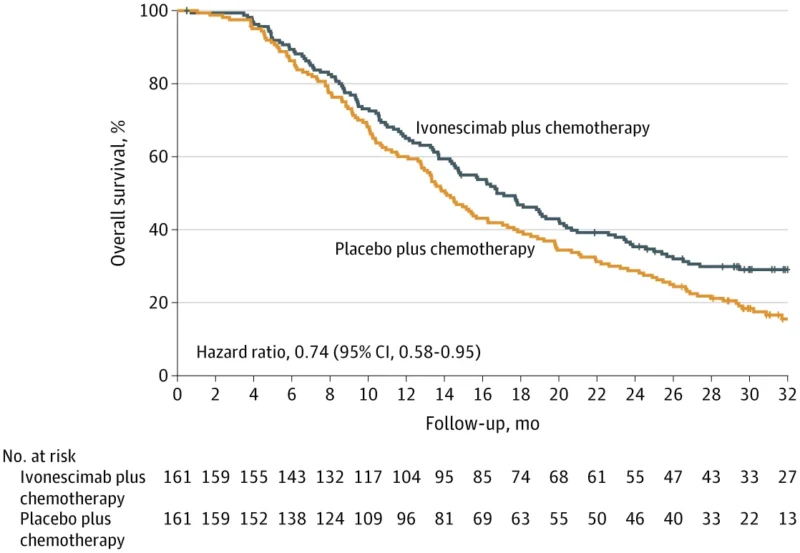
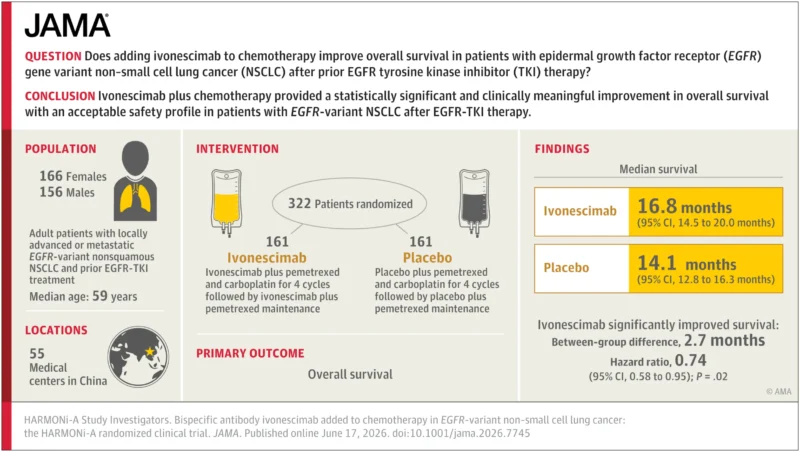
Median overall survival reached 16.8 months with ivonescimab plus chemotherapy versus 14.1 months with chemotherapy alone, corresponding to a hazard ratio of 0.74. Although the absolute median gain was 2.7 months, the difference became more pronounced with longer follow-up: the estimated 30-month survival rate was 29.1% versus 18.4%.
The findings establish ivonescimab plus chemotherapy as an effective post-TKI strategy in the population studied, while raising important questions about applicability outside China and its position within a rapidly changing EGFR-mutant treatment pathway (HARMONi-A Study Investigators, 2026).
Why Is Treatment After EGFR-TKI Progression Difficult?
Third-generation EGFR TKIs, including osimertinib, have become a standard first-line approach for advanced EGFR-variant NSCLC. These therapies can delay progression and improve survival compared with earlier-generation EGFR inhibitors.
Resistance nevertheless develops through diverse and sometimes unidentified mechanisms. Once the disease progresses, treatment selection becomes more difficult because no single resistance pathway explains all cases.
Historically, platinum-based chemotherapy has been one of the main post-TKI treatment options. Previous studies combining chemotherapy with PD-1 or PD-L1 inhibition did not demonstrate a clear survival advantage in EGFR-mutant disease.
More complex regimens incorporating both immunotherapy and antiangiogenic therapy have produced encouraging progression-free survival signals. However, earlier trials such as IMpower150, ATTLAS, and ORIENT-31 did not establish a statistically significant overall survival benefit in this population.
HARMONi-A therefore addressed an important unresolved question: could a single bispecific antibody targeting both PD-1 and VEGF improve outcomes when added to chemotherapy?
How Was the HARMONi-A Trial Designed?
HARMONi-A was a randomized, double-blind, placebo-controlled phase 3 trial conducted at 55 centers in China.
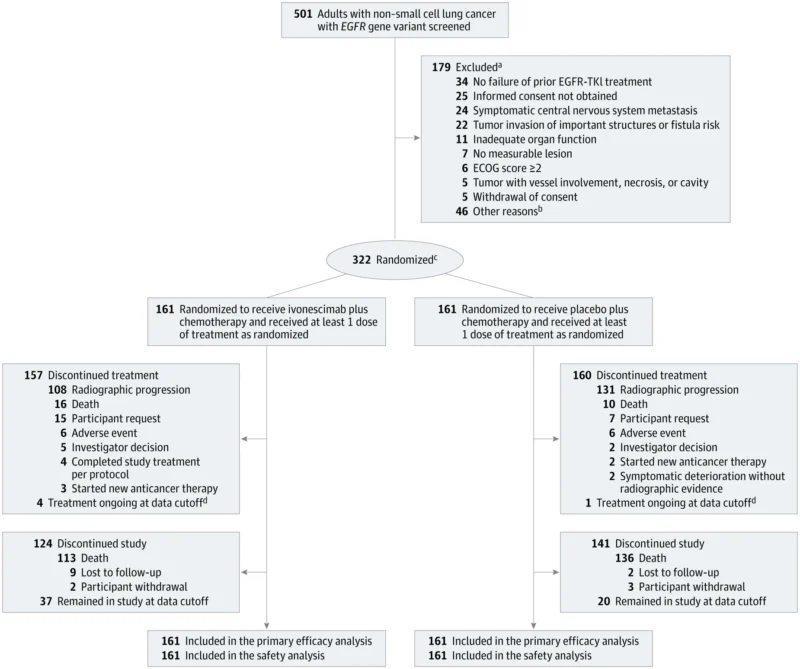
The study enrolled 322 adults with locally advanced or metastatic EGFR-variant nonsquamous NSCLC that had progressed after EGFR-TKI therapy. Patients were randomly assigned in a 1:1 ratio to receive ivonescimab or placebo in combination with pemetrexed and carboplatin.
Ivonescimab was administered at 20 mg/kg every three weeks. Both groups received four cycles of platinum-pemetrexed chemotherapy, followed by maintenance treatment with pemetrexed plus either ivonescimab or placebo.
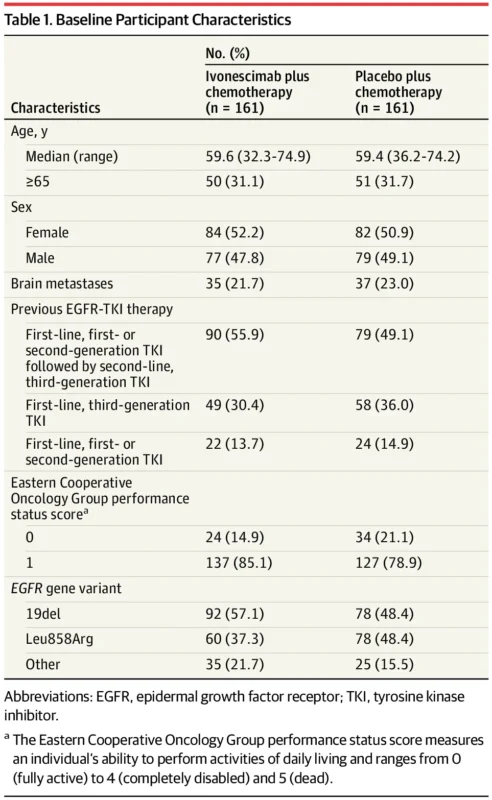
Most patients had previously received a third-generation EGFR TKI. Baseline brain metastases were present in approximately 22% of patients, and clinical characteristics were generally balanced between treatment groups.
The primary endpoint was independently assessed progression-free survival. The final report focused on overall survival, which was tested hierarchically after the progression-free survival endpoint had already been met.
How Much Did Ivonescimab Improve Survival?
At a median follow-up of 32.5 months, 249 deaths had occurred.
Median overall survival was:
- 16.8 months with ivonescimab plus chemotherapy
- 14.1 months with placebo plus chemotherapy
The stratified hazard ratio for death was 0.74, with a 95% confidence interval of 0.58 to 0.95 and a P value of .02.
The absolute difference in median survival was modest at 2.7 months, but the survival curves separated early and remained apart through extended follow-up.
At 24 months, estimated overall survival was 35.3% with ivonescimab versus 28.8% with chemotherapy alone. At 30 months, the corresponding rates were 29.1% and 18.4%, creating a 10.7-percentage-point difference.
This longer-term separation is clinically relevant because median survival alone may not fully capture the proportion of patients who achieve prolonged benefit.
Was the Benefit Consistent Across Subgroups?
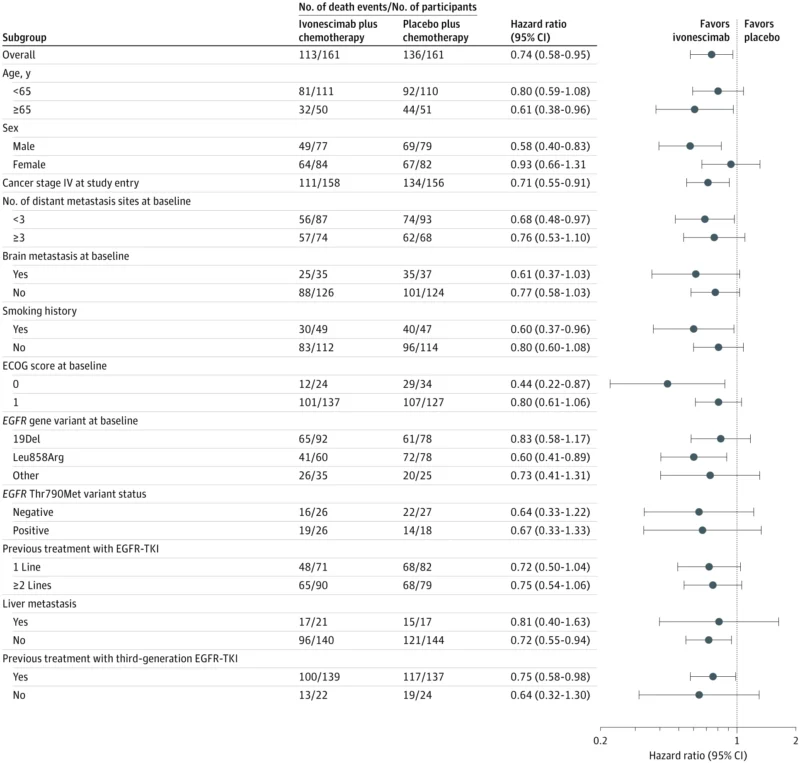
The overall survival effect generally favored ivonescimab across the prespecified clinical subgroups.
Among patients with baseline brain metastases, the hazard ratio was 0.61, although the confidence interval crossed 1 because of the smaller subgroup size. Among those without brain metastases, the hazard ratio was 0.77.
Patients with an EGFR L858R variant appeared to experience a more pronounced survival effect, with a hazard ratio of 0.60.
The benefit was also observed among patients previously treated with a third-generation EGFR TKI, where the hazard ratio was 0.75.
These analyses support consistency of the treatment effect but should not be used to define superiority in specific molecular or clinical subgroups without further prospective confirmation.
Why Might Dual PD-1 and VEGF Blockade Matter?
EGFR-mutant NSCLC is often described as immunologically “cold,” with a tumor microenvironment that may be less responsive to PD-1 inhibition alone.
This has been reflected in previous clinical trials. Adding nivolumab or pembrolizumab to chemotherapy after EGFR-TKI progression did not produce a survival benefit.
Ivonescimab differs because it simultaneously targets PD-1 and VEGF. VEGF inhibition may modify the tumor microenvironment, affect tumor vasculature, and potentially improve immune-cell access to the tumor.
The HARMONi-A results suggest that combining these mechanisms within a bispecific antibody may produce a clinically meaningful effect where conventional immunotherapy-chemotherapy combinations have previously failed.
The study does not establish which component drove the benefit or whether the bispecific format is superior to separately administered PD-1 and VEGF-directed agents. It does, however, support continued investigation of combined immune and angiogenic blockade in EGFR-mutant disease.
What Did the Trial Show About Progression-Free Survival?
The earlier HARMONi-A analysis had already demonstrated a significant progression-free survival benefit.
The hazard ratio for disease progression or death was 0.46, with a median progression-free survival improvement of 2.3 months.
The final overall survival analysis adds an important layer to that earlier result. Previous immunotherapy-based regimens had improved progression-free survival without establishing a significant survival advantage.
HARMONi-A is therefore notable because both progression-free survival and overall survival favored the ivonescimab regimen.
What Were the Safety Trade-Offs?
The survival improvement came with increased toxicity.
Grade 3 or higher treatment-emergent adverse events occurred in 67.1% of patients receiving ivonescimab plus chemotherapy, compared with 54.7% receiving chemotherapy alone.
Grade 3 or higher treatment-related adverse events occurred in 59.6% and 44.7%, respectively. Treatment discontinuation because of adverse events was reported in 11.8% of patients in the ivonescimab group and 8.1% in the control group.
Hematologic toxicity was common in both arms. Grade 3 or higher neutrophil count reduction occurred in 31.7% with ivonescimab versus 21.1% with placebo, while grade 3 or higher platelet count reduction occurred in 18.0% and 11.8%.
Immune-related adverse events were more frequent with ivonescimab, occurring in 29.2% compared with 8.1%. However, discontinuation due to immune-related toxicity was uncommon, and no immune-related deaths were reported.
VEGF-associated adverse events were also more frequent with ivonescimab. Proteinuria occurred in 20.5%, hypertension in 10.6%, and hemorrhage in 8.1%. Severe VEGF-related events remained relatively uncommon.
The longer median treatment exposure in the ivonescimab group—10.5 cycles compared with 8.2 cycles—also needs to be considered when interpreting raw adverse-event rates.
Did Quality of Life Improve?
Health-related quality of life was evaluated as an exploratory endpoint.
Median time to deterioration was numerically longer with ivonescimab, at 9.5 months versus 7.3 months with chemotherapy alone.
However, the difference was not statistically significant. The hazard ratio was 0.86, with a P value of .41.
The result suggests that the addition of ivonescimab did not produce a clearly demonstrated quality-of-life advantage, despite extending survival. At the same time, the increased toxicity did not translate into a statistically significant earlier deterioration in global health status.
Further patient-reported outcome analyses will be important when determining the practical value of this regimen.
Where Could Ivonescimab Fit in the Current Treatment Landscape?
The clinical context has changed since HARMONi-A began enrollment in 2022.
First-line treatment is increasingly being intensified through regimens such as osimertinib plus chemotherapy or amivantamab plus lazertinib. These approaches may alter what patients have already received by the time they experience progression.
The HARMONi-A results are most directly applicable to patients who remain chemotherapy-naive after EGFR-TKI therapy and are candidates for platinum-pemetrexed treatment.
It remains uncertain whether ivonescimab plus chemotherapy would provide a similar benefit after first-line osimertinib plus chemotherapy or after amivantamab-lazertinib.
TROP-2 antibody-drug conjugates have also entered the post-EGFR-TKI treatment landscape. The study authors described these therapies and ivonescimab as mechanistically distinct and potentially complementary rather than directly redundant.
Future sequencing decisions may depend on prior chemotherapy exposure, resistance mechanisms, toxicity profiles, brain metastases, access, and patient preferences.
What Are the Main Limitations?
The study was conducted exclusively in China. Its applicability to non-Asian populations and healthcare systems remains uncertain.
The chemotherapy backbone was carboplatin plus pemetrexed, and the findings cannot automatically be extended to other treatment regimens.
Postprogression therapies were not randomized and could have influenced overall survival. More patients in the control group received subsequent treatment, although the difference does not fully explain the observed survival effect.
The ongoing global HARMONi study is expected to provide further evidence regarding international generalizability.
The evolving first-line treatment landscape is another major limitation. Many future patients will have received more intensive combinations before progression than those enrolled in HARMONi-A.
The Bottom Line
In the phase 3 HARMONi-A trial, adding ivonescimab to pemetrexed and carboplatin significantly improved overall survival in EGFR-variant nonsquamous NSCLC after EGFR-TKI progression.
Median overall survival increased from 14.1 to 16.8 months, with a hazard ratio of 0.74. The 30-month survival rate was 29.1% with ivonescimab versus 18.4% with chemotherapy alone.
The regimen produced a higher rate of grade 3 or greater adverse events, but treatment discontinuations remained relatively infrequent and no new safety signals emerged.
These findings support dual PD-1 and VEGF inhibition with chemotherapy as an effective post-TKI strategy in the population studied. Its position after newer intensified first-line regimens and its applicability outside China still require prospective evaluation.
References
- HARMONi-A Study Investigators. Bispecific antibody ivonescimab added to chemotherapy in EGFR-variant non–small cell lung cancer: the HARMONi-A randomized clinical trial. JAMA. 2026;336(4):306–314. doi:10.1001/jama.2026.7745.
- Fang W, Zhao Y, Luo Y, et al. Ivonescimab plus chemotherapy in non–small cell lung cancer with EGFR variant: a randomized clinical trial. JAMA. 2024;332(7):561–570.
- Mok T, Nakagawa K, Park K, et al. Nivolumab plus chemotherapy in EGFR-mutated metastatic NSCLC after progression on EGFR tyrosine kinase inhibitors: final results of CheckMate 722. Journal of Clinical Oncology. 2024;42(11):1252–1264.
- Yang JC, Lee DH, Lee JS, et al. Pemetrexed and platinum with or without pembrolizumab for TKI-resistant EGFR-mutant metastatic NSCLC: KEYNOTE-789. Journal of Clinical Oncology. 2024;42(34):4029–4039.