The US Food and Drug Administration has issued a Complete Response Letter for ivonescimab plus platinum-based chemotherapy in EGFR-mutated advanced non-small-cell lung cancer following EGFR tyrosine kinase inhibitor treatment. Announced by Summit Therapeutics on November 15, 2026, the decision follows the global phase III HARMONi trial, which demonstrated a significant progression-free survival benefit but failed to achieve a statistically significant overall survival improvement at its primary analysis. The regulatory setback raises an important question for thoracic oncology: when a new treatment substantially delays progression, what additional evidence is needed to establish a favorable benefit–risk profile?
The development of bispecific antibodies targeting programmed cell death protein 1 (PD-1) and vascular endothelial growth factor (VEGF) has emerged as one of the most closely watched areas of lung cancer therapeutics.
By combining immune checkpoint blockade with inhibition of tumor-associated angiogenesis, these agents aim to address two biological processes that contribute to tumor progression and immune resistance. Among the leading candidates is ivonescimab, developed by Akeso and partnered with Summit Therapeutics across several international markets.
Clinical studies conducted in China and globally have demonstrated encouraging activity across multiple NSCLC populations. However, the drug’s first proposed US approval in EGFR-mutated disease has encountered a significant regulatory obstacle.
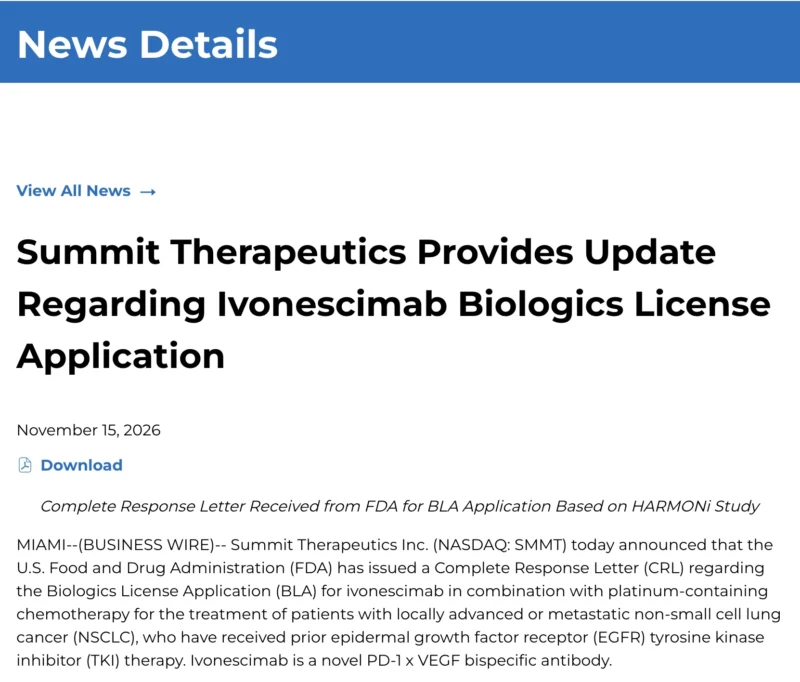
On November 15, 2026, Summit announced that the FDA had issued a Complete Response Letter concerning its biologics license application for ivonescimab in combination with platinum-containing chemotherapy.
The proposed indication involved patients with locally advanced or metastatic EGFR-mutated NSCLC who had received prior EGFR-directed tyrosine kinase inhibitor therapy.
According to Summit’s description of the letter, the agency determined that the submitted evidence did not establish a sufficiently favorable benefit–risk profile without a statistically significant improvement in overall survival.
The decision does not mean ivonescimab has been proven ineffective. Rather, it means the FDA did not consider the evidence sufficient to approve the proposed regimen in its submitted form.
What Exactly Did the FDA Decide?
A Complete Response Letter is issued when the FDA completes its review of an application but determines that approval cannot be granted in its current form. It is not the same as a permanent prohibition on further development or a conclusion that the drug lacks all clinical activity.
However, it prevents the requested approval from proceeding unless the regulatory concerns are adequately addressed. In this case, Summit reported that the central issue was the relationship between progression-free survival and overall survival.
HARMONi met its prespecified PFS endpoint, demonstrating a statistically significant improvement when ivonescimab was added to chemotherapy. The overall survival analysis, however, showed a numerical advantage that did not reach statistical significance.
According to the company, the FDA concluded that the PFS finding alone did not establish a positive benefit–risk profile sufficient for approval. This assessment is particularly consequential because HARMONi had two primary endpoints: PFS and OS.
The regulatory decision therefore centers on the maturity, magnitude, and statistical interpretation of the clinical evidence rather than on a failure to demonstrate any treatment effect. The full FDA review is not reproduced in the company announcement, and the precise regulatory reasoning beyond the reported statements should not be inferred.
Why Ivonescimab Generated Such High Expectations
Ivonescimab is a tetravalent bispecific antibody designed to simultaneously target PD-1 and VEGF. PD-1 blockade aims to restore antitumor immune activity by interrupting inhibitory signaling that suppresses T-cell function.
VEGF inhibition addresses tumor angiogenesis and may influence the immunosuppressive properties of the tumor microenvironment. The combination is biologically relevant because abnormal tumor vasculature, hypoxia, and VEGF-associated signaling may reduce immune-cell infiltration and contribute to resistance to immune checkpoint blockade.
A molecule engaging both targets could potentially alter this environment while promoting antitumor immunity. However, ivonescimab’s proposed cooperative binding properties and biological advantages remain mechanistic hypotheses unless translated into superior clinical outcomes.
The strategy is particularly interesting in EGFR-mutated NSCLC. Although immune checkpoint inhibitors have transformed treatment for many patients without actionable molecular drivers, their activity in EGFR-mutated disease has generally been less consistent.
Following progression on modern EGFR inhibitors, patients frequently require chemotherapy-based treatment, and the optimal integration of additional targeted or immune-directed agents remains an important clinical challenge.
HARMONi: The Global Phase III Trial Behind the Application
The global HARMONi trial was a randomized, double-blind, placebo-controlled phase III study conducted at 114 cancer centers and hospitals across Asia, Europe, and North America. The study enrolled 438 patients with locally advanced or metastatic nonsquamous EGFR-mutated NSCLC whose disease had progressed after treatment with a third-generation EGFR TKI.
Patients were randomized equally. A total of 219 received ivonescimab plus platinum-doublet chemotherapy, while 219 received placebo plus chemotherapy. The trial evaluated the addition of ivonescimab to a platinum–pemetrexed treatment backbone.
The study population included 273 patients from Asia and 165 patients from Western regions. This geographic distribution became particularly relevant during subsequent analyses because the investigators examined whether longer follow-up could clarify the overall survival pattern across regions.
The study’s two primary efficacy endpoints were progression-free survival and overall survival. The primary results were published in The Lancet Oncology in August 2026, with Xiuning Le and colleagues reporting the clinical efficacy and safety findings.
A Clear Progression-Free Survival Benefit
The strongest efficacy result in HARMONi was progression-free survival. Median PFS was 6.8 months with ivonescimab plus chemotherapy, compared with 4.4 months with placebo plus chemotherapy. The hazard ratio was 0.52, with a 95% confidence interval of 0.41–0.66 and P less than 0.0001.
This represented a 48% relative reduction in the hazard of disease progression or death. The difference in median PFS was 2.4 months. From a clinical perspective, delaying progression after third-generation EGFR inhibitor failure is potentially meaningful.
Patients in this setting may have progressive thoracic or extrathoracic disease, limited subsequent options, and substantial treatment-related morbidity. Nevertheless, a statistically significant PFS result does not automatically demonstrate a survival advantage.
PFS and OS measure different aspects of treatment benefit, and improvements in one endpoint do not invariably translate into improvements in the other. For HARMONi, that distinction became central to the regulatory outcome.
The Overall Survival Result That Changed the Regulatory Picture
At the primary analysis, median overall survival was 16.8 months with ivonescimab plus chemotherapy versus 14.0 months with chemotherapy alone. The hazard ratio was 0.79, with a 95% confidence interval of 0.62–1.01. The reported P value was 0.057.
Although the result numerically favored the ivonescimab regimen, it did not meet the conventional threshold for statistical significance. Importantly, the confidence interval included the possibility of no survival advantage.
The study therefore did not establish a statistically significant OS improvement at its primary analysis. This does not prove that the treatment has no effect on survival. It indicates that the available data, evaluated according to the relevant statistical framework, did not provide sufficiently strong evidence to conclude that an OS benefit had been demonstrated.
The distinction is important for accurate communication of negative or inconclusive endpoints.
Updated Analyses Showed a More Favorable Survival Signal
Following the primary analysis, Summit conducted additional survival evaluations with longer follow-up. At an updated September 2025 analysis, the company reported a global OS hazard ratio of 0.78, with a nominal P value of 0.0332.
A further post-hoc analysis incorporating additional Western-patient follow-up through June 2026 reported an OS hazard ratio of 0.76 in the overall intention-to-treat population. The corresponding 95% confidence interval was 0.61–0.95, with a nominal P value of 0.0151.
Summit also reported similar numerical hazard ratios across Asian and Western patient groups These observations suggest that the survival signal remained favorable as additional follow-up became available. However, their statistical interpretation differs from the original prespecified analysis. The updated results were post-hoc, and the reported P values were nominal.
A nominal P value below 0.05 does not necessarily establish success against a trial’s prospectively controlled primary endpoint, particularly when analyses involve additional follow-up, changes in data maturity, or multiple statistical comparisons.
Furthermore, the Western subgroup estimate was less precise than the global estimate. The later analyses therefore provide supportive information but should not be described as definitively converting the original OS result into a successfully met prespecified endpoint.
The FDA’s Complete Response Letter indicates that these additional analyses were insufficient to resolve the agency’s concerns about the evidence supporting approval.
Why HARMONi-A Cannot Be Treated as the Same Trial
An important distinction concerns HARMONi-A, a separate randomized phase III study conducted in China. HARMONi-A also evaluated ivonescimab plus chemotherapy after EGFR TKI progression. Its final overall survival analysis, published in JAMA in July 2026, demonstrated a statistically significant survival improvement.
Median OS was 16.8 months with ivonescimab plus chemotherapy versus 14.1 months with chemotherapy alone. The hazard ratio was 0.74, with a 95% confidence interval of 0.58–0.95 and P = 0.02.
These results provide additional evidence supporting the biological and clinical activity of ivonescimab in EGFR-mutated NSCLC. However, HARMONi-A and HARMONi are distinct trials involving different study populations and regulatory contexts.
Their datasets cannot be combined informally to claim that the global HARMONi study met its OS endpoint. The statistically significant OS result from the China-based trial is relevant supportive evidence, but it does not override the statistical conclusions of the separate global registration study.
The regulatory decision illustrates why the consistency, generalizability, and prespecified analysis of multinational trial results can be critical.
Was Safety the Main Obstacle?
Summit’s announcement did not identify a newly emerging safety signal as the central reason for the Complete Response Letter. Nevertheless, the safety profile remains part of any benefit–risk assessment. In HARMONi, treatment-related adverse events led to discontinuation of ivonescimab in 16 patients, corresponding to 7.3%.
In the placebo-plus-chemotherapy group, 11 patients, or 5.0%, discontinued placebo because of treatment-related adverse events. Treatment-related deaths occurred in four patients receiving ivonescimab plus chemotherapy and five receiving placebo plus chemotherapy.
The most frequently reported grade 3–4 treatment-related adverse events included neutropenia, leukopenia, thrombocytopenia, and anemia. Grade 3–4 decreased platelet counts occurred in 12% of patients receiving ivonescimab versus 6% in the control group.
The overall safety results were considered manageable by the investigators, with no unexpected new safety signals highlighted in the company announcement. However, manageability does not mean toxicity is irrelevant.
When a novel treatment adds potential adverse effects and healthcare burden, regulators must assess whether the demonstrated clinical benefit justifies those risks. According to Summit’s account, the FDA concluded that the PFS advantage without a statistically significant OS benefit was insufficient to establish that balance for the requested indication.
What Does This Mean for Patients With EGFR-Mutated NSCLC?
The immediate implication is that ivonescimab plus chemotherapy is not an FDA-approved treatment for the requested post-EGFR-TKI indication. The Complete Response Letter does not establish that patients should receive ivonescimab outside approved jurisdictions or applicable clinical research pathways.
For patients whose disease progresses after a third-generation EGFR inhibitor, treatment remains dependent on the mechanism of resistance, prior therapy, performance status, disease burden, and available approved options.
Molecular reassessment remains clinically important because some patients develop potentially actionable acquired alterations. Platinum–pemetrexed-based treatment and other approved strategies may be considered according to individual circumstances and current regulatory indications.
The findings from HARMONi cannot be used to justify replacing established post-progression treatment pathways with ivonescimab in the United States. However, the regulatory decision also does not invalidate the broader strategy of combining immune checkpoint and VEGF inhibition.
The clinical potential of this mechanism continues to be investigated across multiple tumor types and treatment settings.
The Wider Ivonescimab Development Program Continues
Summit has indicated that it intends to continue ivonescimab development despite the HARMONi regulatory setback. Several ongoing studies are assessing the agent in different settings. HARMONi-3 is investigating ivonescimab plus chemotherapy in first-line metastatic NSCLC, with separate squamous and nonsquamous cohorts.
HARMONi-7 is examining ivonescimab monotherapy in previously untreated metastatic NSCLC with high PD-L1 expression. Additional trials are evaluating ivonescimab in colorectal, urothelial, and renal cell carcinomas.
The company is also exploring combinations with emerging antibody–drug conjugates and targeted agents. These include planned or ongoing collaborations involving datopotamab deruxtecan, B7-H3-directed ADC approaches, and RAS-directed treatments.
However, the outcome of the FDA review for HARMONi should not be extrapolated automatically to these other programs. Each proposed indication will require evidence from its relevant clinical studies, including appropriate efficacy, safety, and regulatory endpoints.
China Approval Does Not Equal US or European Authorization
Ivonescimab first received marketing authorization in China in May 2024. It is being used clinically there under Chinese regulatory oversight. However, as of the November 15, 2026 announcement, the agent had not been approved in the United States or Europe.
The existing Chinese authorization therefore should not be interpreted as evidence of FDA or European Medicines Agency approval. Differences in clinical datasets, indications, treatment standards, and regulatory assessment can influence decisions across jurisdictions.
The FDA’s decision reinforces the importance of evaluating the specific evidence supporting each proposed indication rather than relying on approvals obtained in other settings.
What Must Happen Next?
The immediate regulatory question is how Summit can address the deficiencies identified in the Complete Response Letter. Potential pathways may depend on further discussions with the agency, additional clinical analyses, or new clinical evidence.
However, the company’s November 15 announcement did not establish a definitive resubmission strategy or timeline. It would therefore be premature to predict when or whether ivonescimab could receive US approval for this indication.
More broadly, HARMONi highlights the complexity of regulatory decisions in a treatment landscape where PFS, OS, toxicity, subsequent therapies, and regional consistency must all be considered. The clinical importance of delaying progression is undeniable for many patients.
Yet demonstrating that an additional agent improves the overall balance of efficacy and safety remains the central requirement for a new treatment to enter routine practice.
OncoDaily Takeaway
The FDA’s Complete Response Letter represents a significant setback for the proposed US approval of ivonescimab plus chemotherapy following EGFR TKI progression. In the global phase III HARMONi trial, the regimen significantly improved median PFS from 4.4 to 6.8 months, with an HR of 0.52.
However, the primary overall survival analysis showed a numerical but statistically nonsignificant difference of 16.8 versus 14.0 months, with an HR of 0.79 and P = 0.057. Later post-hoc analyses reported a more favorable OS hazard ratio of 0.76, but these findings did not resolve the FDA’s concerns.
Separate survival-positive results from the China-based HARMONi-A trial support continued interest in the mechanism but cannot be substituted for the global trial’s primary endpoint.
The central clinical lesson is that a statistically significant progression-free survival benefit does not automatically establish a favorable regulatory benefit–risk profile, particularly when overall survival is a co-primary endpoint and the submitted evidence does not meet the required standard.
Ivonescimab remains under active development internationally, but its role in US clinical practice will depend on whether future evidence can address the regulatory uncertainties.
Sources
- Summit Therapeutics. Summit Therapeutics Provides Update Regarding Ivonescimab Biologics License Application. November 15, 2026.
- Le X, Passaro A, Zhao Y, et al. Ivonescimab Plus Chemotherapy Versus Placebo Plus Chemotherapy in Patients With Advanced EGFR-Mutated Non-Small-Cell Lung Cancer After Disease Progression on EGFR Tyrosine Kinase Inhibitor Therapy (HARMONi): A Multicentre, Randomised, Double-Blind, Phase 3 Trial. The Lancet Oncology. 2026;27(9):1094–1109. DOI: 10.1016/S1470-2045(26)00282-2
- Summit Therapeutics. Updated HARMONi Data Presented at the IASLC World Conference on Lung Cancer 2026. September 2026. China-Based Phase III HARMONi-A
- Bispecific Antibody Ivonescimab Added to Chemotherapy in EGFR-Variant Non-Small Cell Lung Cancer: The HARMONi-A Randomized Clinical Trial. JAMA. 2026;336(4):306–314. DOI: 10.1001/jama.2026.7745