Calculators
 OncoCalendar





Low-dose computed tomography screening reduces lung cancer mortality among people at elevated risk. However, current eligibility criteria rely mainly on age, smoking intensity, and time since smoking cessation.
These categorical thresholds miss a substantial proportion of future lung cancers while referring many lower-risk individuals for screening. Questionnaire-based prediction models improve risk assessment, but they still depend on self-reported clinical and smoking information.
A study published in JAMA evaluated whether circulating proteins could provide a more precise way to identify people most likely to benefit from low-dose CT screening.
The protein-based Integrative Analysis of Lung Cancer Risk and Etiology model, known as INTEGRAL-Risk, identified 85% of lung cancers diagnosed within one year when selecting the same proportion of people for screening as the 2021 US Preventive Services Task Force criteria.
By comparison, the questionnaire-based PLCOm2012 model identified 70% of cases, while the USPSTF 2021 criteria identified 63%.
The findings suggest that a blood-based risk model could improve screening selection. However, INTEGRAL-Risk is intended to guide referral to low-dose CT—not replace imaging as the screening test—and prospective implementation studies are still required (Zahed et al., 2026).
Why Do Current Lung Screening Criteria Miss Cases?
The 2021 USPSTF criteria recommend annual low-dose CT screening for adults aged 50 to 80 years who have at least a 20 pack-year smoking history and currently smoke or stopped within the previous 15 years.
These criteria provide a practical screening framework but do not fully capture individual lung cancer risk.
Some people who fall below the required pack-year threshold or stopped smoking more than 15 years earlier remain at substantial risk. Others who meet the eligibility criteria may have a comparatively low probability of developing lung cancer.
Previous analyses suggest that current criteria fail to identify approximately one-third of future lung cancers among people with a smoking history.
The PLCOm2012 model offers greater personalization by incorporating smoking exposure, age, health history, and other questionnaire-derived factors. The INTEGRAL investigators tested whether adding biological information from circulating proteins could improve this assessment further.
How Was the INTEGRAL-Risk Model Developed?
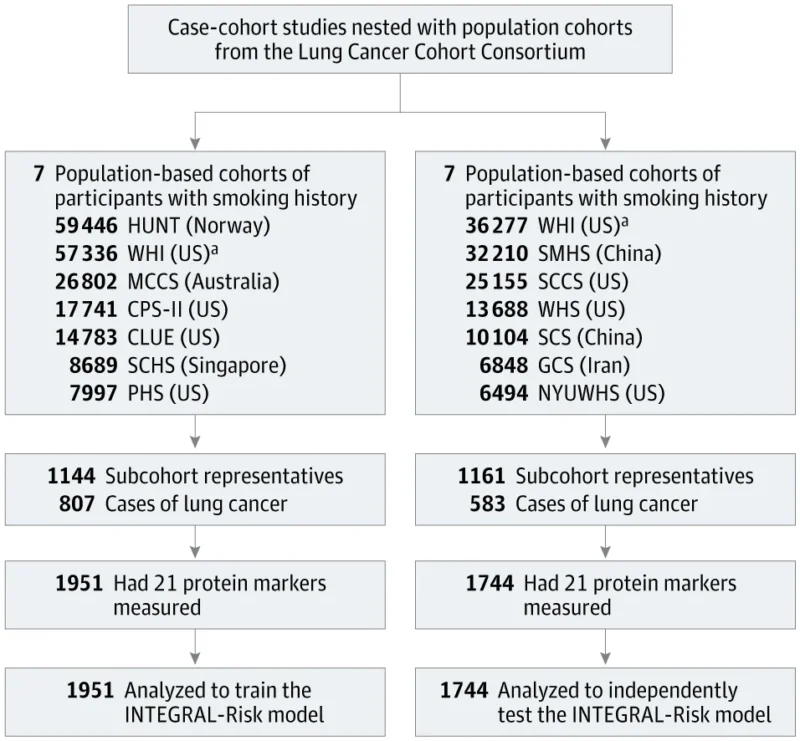
The study used data from the international Lung Cancer Cohort Consortium, which included population cohorts from the United States, Europe, Asia, and Australia.
Participants had been recruited between 1985 and 2009, provided blood samples and smoking information, and were subsequently followed for cancer and other health outcomes through 2021.
The analysis included 3,695 participants with a smoking history. Among them, 1,390 were diagnosed with lung cancer within three years after blood collection.
The investigators separated the data into independent development and validation populations. The training set included 1,951 participants, of whom 807 developed lung cancer. The testing set included 1,744 participants, including 583 lung cancer cases.
After statistical weighting, the combined cohorts represented a background population of approximately 323,570 people.
The final INTEGRAL-Risk model incorporated age, smoking duration, cigarettes smoked per day, and concentrations of 13 circulating proteins. The model estimated the absolute probability of a lung cancer diagnosis within one, two, or three years after blood collection (Zahed et al., 2026).
How Accurately Did the Blood-Based Model Predict Lung Cancer?
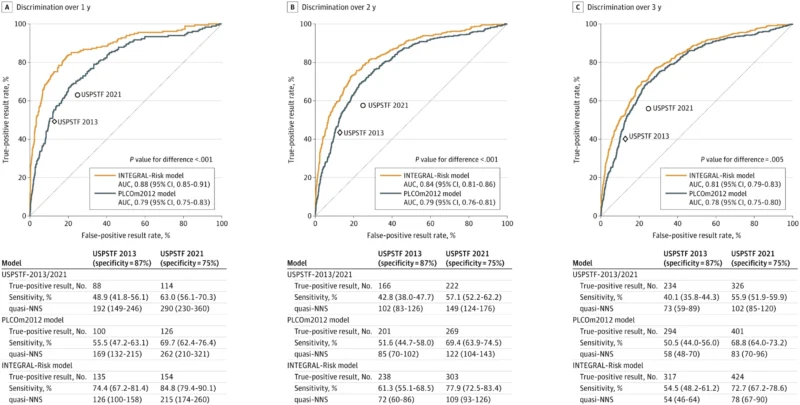
The strongest performance was observed for lung cancers diagnosed within one year.
The area under the receiver operating characteristic curve was:
- 0.88 with INTEGRAL-Risk, compared with 0.79 with PLCOm2012.
An area under the curve closer to 1 indicates greater ability to distinguish between people who will and will not be diagnosed with lung cancer.
The difference between the two models was statistically significant.
Performance declined as the prediction period became longer. The INTEGRAL-Risk area under the curve was 0.84 at two years and 0.81 at three years.
The model therefore appeared most informative for identifying people at imminent or near-term risk rather than estimating longer-term risk.
Several proteins, including CEACAM5, WFDC2, TRAILR2, and LAMP3, contributed strongly to risk discrimination. After statistical scaling, some protein markers were more strongly associated with short-term lung cancer risk than age or smoking exposure alone.
Could INTEGRAL-Risk Find More Cancers Without Screening More People?
The investigators compared the models at thresholds that selected the same proportion of people for low-dose CT screening.
At the specificity achieved by USPSTF 2021 criteria, the proportion of lung cancers diagnosed within one year that would have been identified was:
- 85% with INTEGRAL-Risk
- 70% with PLCOm2012
- 63% with USPSTF 2021 criteria
This means the blood-based model captured an additional 22 percentage points of lung cancer cases compared with the current USPSTF approach without increasing the number of people referred for screening.
The estimated number needed to screen to identify one person who would develop lung cancer was also lower.
The quasi-number needed to screen was 215 with INTEGRAL-Risk, compared with 262 using PLCOm2012 and 290 using USPSTF 2021 criteria.
These values were modeled estimates because participants were not actually enrolled in a screening program. They indicate potential efficiency rather than proven clinical performance.
The Model Substantially Reclassified Screening Eligibility
INTEGRAL-Risk did not simply add more people to the current screening population. It identified a meaningfully different group.
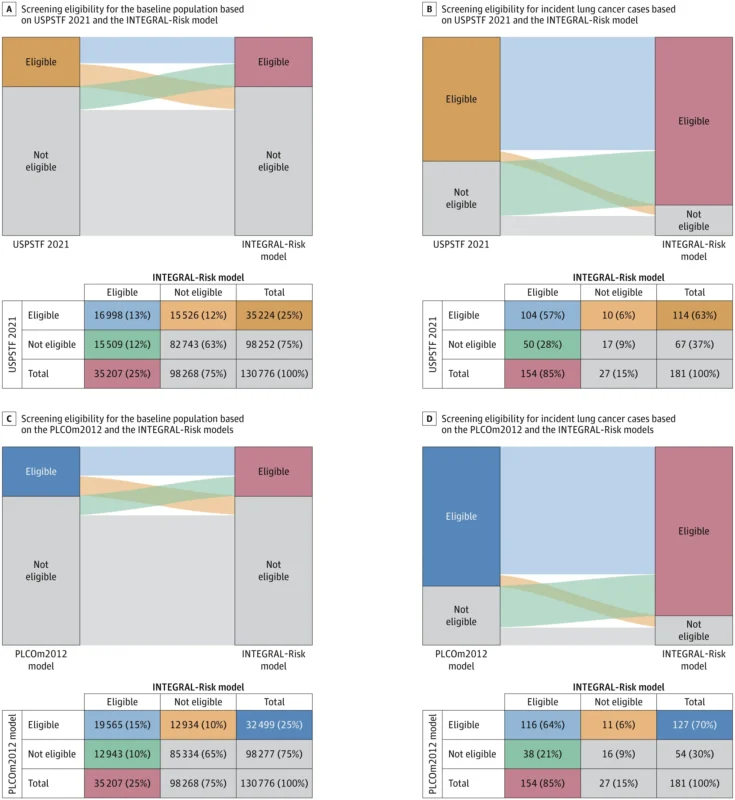
When compared with the USPSTF 2021 criteria, only around half of those classified as eligible under the existing approach remained eligible under the biomarker-based model.
Among people diagnosed with lung cancer within one year, 57% were eligible under both approaches. Another 28% were identified by INTEGRAL-Risk but missed by USPSTF criteria.
Only 6% were identified by USPSTF criteria but not by INTEGRAL-Risk, while 9% were missed by both approaches.
This suggests that biological risk information could redirect screening toward individuals whose short-term risk is underestimated by age and smoking thresholds.
Did the Model Perform Across Different Populations?
INTEGRAL-Risk consistently showed greater one-year discrimination than PLCOm2012 across age, sex, smoking status, chronic obstructive pulmonary disease history, and USPSTF eligibility groups.
The model also outperformed PLCOm2012 among Asian, non-Hispanic Black, and non-Hispanic White participants.
The one-year area under the curve was 0.88 among Asian participants, 0.90 among non-Hispanic Black participants, and 0.88 among non-Hispanic White participants.
However, the model underestimated absolute risk in Asian and non-Hispanic Black participants. This indicates that recalibration may be required before clinical implementation in different populations.
The study population was also predominantly non-Hispanic White, and the numbers available for several other racial and ethnic groups were too small for reliable analysis.
Could the Model Help People Who Do Not Meet Current Criteria?
One of the most relevant findings involved people who were not eligible for screening under the USPSTF 2021 criteria.
In this population, the one-year area under the curve was 0.85 with INTEGRAL-Risk, compared with 0.72 with PLCOm2012.
This suggests that protein biomarkers could identify high-risk individuals whose smoking exposure, age, or time since quitting excludes them from current screening pathways.
The model also improved prediction among people aged 55 years or younger, a group that may gain many life-years if lung cancer is detected at a curable stage.
However, the model was developed only in people with a smoking history. It cannot currently be applied to individuals who have never smoked.
Is INTEGRAL-Risk a New Lung Cancer Screening Test?
No.
INTEGRAL-Risk is a prescreening risk-assessment tool. It is designed to determine who should be referred for low-dose CT.
The blood test does not diagnose lung cancer and does not replace imaging.
A practical pathway could involve using the protein-based model among people with a smoking history, identifying those whose short-term risk exceeds a defined threshold, and then referring those individuals for standard low-dose CT screening.
The optimal threshold would depend on the goal of the screening program. A program could prioritize finding more cancers, screening fewer people while maintaining sensitivity, or expanding screening to groups excluded by current criteria.
These decisions require prospective evaluation rather than retrospective modeling alone.
Could Better Eligibility Improve Early Detection?
The study demonstrated improved prediction of lung cancer diagnosis, but it did not establish that INTEGRAL-Risk would increase the detection of curable disease.
Information on cancer stage was incomplete. In the available subgroup analysis, the model appeared more effective at predicting cancers later diagnosed at an advanced stage than those diagnosed at an early stage.
It also showed greater discrimination among patients with shorter survival after diagnosis, which may indicate that some protein signals reflect biologically aggressive or already developing disease.
This could still be clinically valuable if the model directs patients toward imaging before symptoms develop. However, screening benefit ultimately depends on detecting cancer early enough to improve treatment and survival.
Prospective studies need to determine whether the additional cancers identified by INTEGRAL-Risk are found at a stage where curative treatment remains possible.
What Questions Remain Before Clinical Use?
The study did not evaluate whether the model reduces lung cancer mortality. It also did not assess screening harms such as false-positive CT findings, unnecessary procedures, invasive biopsies, anxiety, or overdiagnosis.
The practicality, cost, reimbursement, and acceptability of integrating a 13-protein panel into screening programs remain unknown.
The model also requires recalibration in some racial and ethnic groups and validation in contemporary populations with current smoking patterns and healthcare practices.
Finally, the analysis used blood samples collected from cohorts recruited between 1985 and 2009. Although follow-up and biomarker testing were rigorous, prospective implementation in present-day screening settings is necessary.
What This Means for Lung Cancer Screening
The study addresses one of the central limitations of current lung cancer screening: eligibility is based largely on historical exposure rather than current biological risk.
INTEGRAL-Risk combines both types of information.
The model could potentially identify people whose risk is underestimated by conventional criteria while avoiding screening among some people with lower biomarker-defined risk.
This could make screening more efficient and equitable, particularly for individuals who remain at high risk despite not meeting fixed smoking thresholds.
However, improved statistical prediction does not automatically translate into improved clinical outcomes.
The next step is an adequately powered prospective study comparing biomarker-guided screening selection with current eligibility strategies in real-world practice.
The Bottom Line
The protein-based INTEGRAL-Risk model improved short-term lung cancer prediction among people with a smoking history.
For cancers diagnosed within one year, the model achieved an area under the curve of 0.88, compared with 0.79 for the questionnaire-based PLCOm2012 model.
When selecting the same number of people for low-dose CT as the USPSTF 2021 criteria, INTEGRAL-Risk identified 85% of lung cancer cases, compared with 70% using PLCOm2012 and 63% using USPSTF criteria.
The findings support a more biologically informed approach to screening eligibility. However, INTEGRAL-Risk remains investigational, does not replace low-dose CT, and requires prospective validation before routine clinical implementation.
References
- Zahed H, Feng X, Alcala K, et al. Biomarker-based eligibility for lung cancer screening: validation of the protein-based INTEGRAL-Risk model. JAMA. 2026;336(4):323–333. doi:10.1001/jama.2026.8044.
- Krist AH, Davidson KW, Mangione CM, et al. Screening for lung cancer: US Preventive Services Task Force recommendation statement. JAMA. 2021;325(10):962–970.
- Tammemägi MC, Katki HA, Hocking WG, et al. Selection criteria for lung-cancer screening. New England Journal of Medicine. 2013;368(8):728–736.
- Fahrmann JF, Marsh T, Irajizad E, et al. Blood-based biomarker panel for personalized lung cancer risk assessment. Journal of Clinical Oncology. 2022;40(8):876–883.