How long should immune checkpoint inhibition continue in a patient with metastatic non-small cell lung cancer whose disease remains controlled after first-line chemoimmunotherapy?
The phase II portion of the randomized IFCT-2103 DIAL trial presented at ESMO Congress 2026 provides one of the most provocative prospective datasets addressing that question.
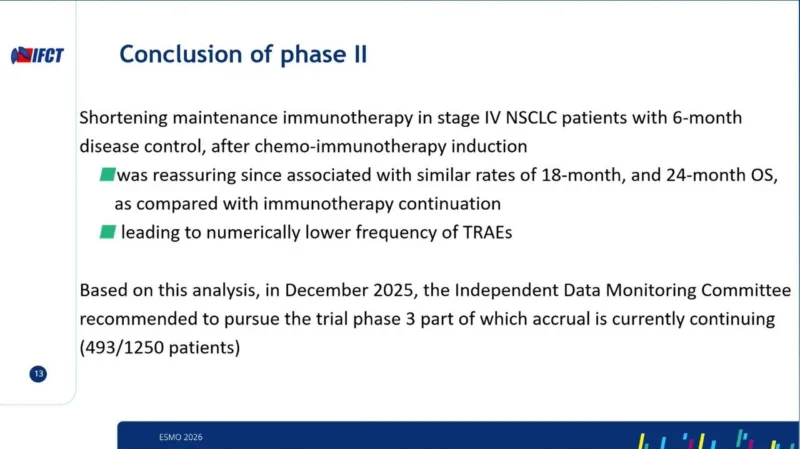
Among patients with metastatic NSCLC who remained progression free six months after starting platinum-based chemotherapy plus pembrolizumab, stopping pembrolizumab at six months was associated with 18-month and 24-month overall survival rates broadly similar to those observed with pembrolizumab continuation, while reducing treatment-related and pembrolizumab-related toxicity.
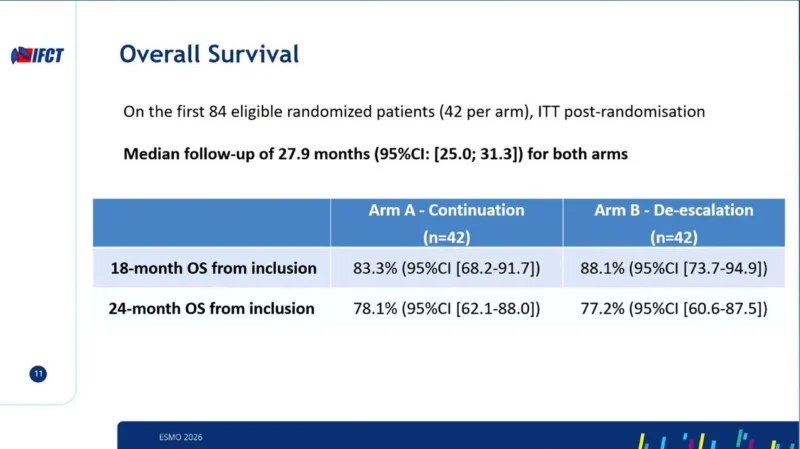
At 18 months from initial trial inclusion, overall survival was 83.3% with pembrolizumab continuation and 88.1% with de-escalation. At 24 months, survival remained very similar: 78.1% versus 77.2%, respectively.
These results are reassuring, but they should not yet be interpreted as proof that six months of immunotherapy is equivalent to the conventional longer treatment strategy.
The phase II component was designed to determine whether proceeding to the definitive phase III trial was reasonable. It was not powered as a formal non-inferiority comparison. That definitive question is now being pursued in the ongoing phase III part of DIAL.
Why Immunotherapy Duration Has Become an Important Question
Pembrolizumab-based chemoimmunotherapy transformed first-line treatment of metastatic NSCLC without actionable oncogenic drivers.
But the duration of checkpoint inhibition has largely been inherited from pivotal clinical trial designs rather than established through direct randomized comparison.
In major KEYNOTE studies, pembrolizumab was generally administered for up to 35 cycles, approximately two years. The optimal biological duration of treatment remains uncertain, and clinical experts have long recognized that prolonged intravenous treatment creates cumulative burden even in patients who remain progression free.
For patients who have already achieved sustained disease control, continued treatment creates several challenges.
Immune-related adverse events can emerge late. Regular infusions continue to consume patient time and healthcare resources. Treatment can affect work, travel and quality of life. And substantial drug costs accumulate during a period in which some patients may already have achieved durable immune control.
The central DIAL question is therefore a classic de-escalation question: are all of those additional months of pembrolizumab necessary for every patient?
DIAL Randomizes Only Patients With Six-Month Disease Control
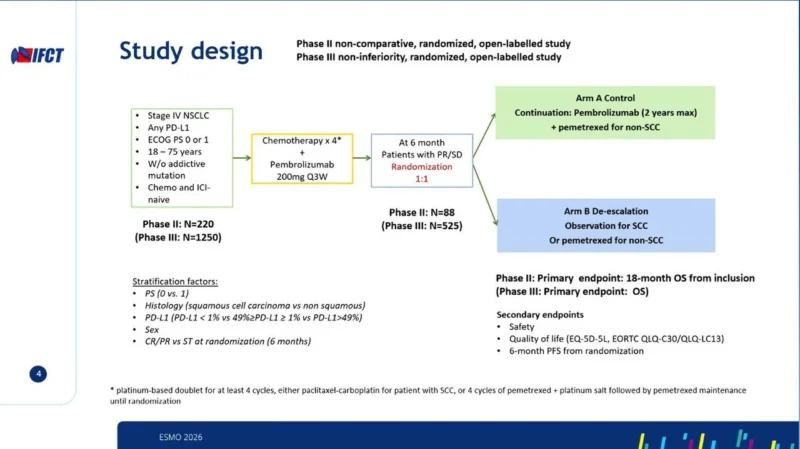
The trial design is critical to understanding the results. Patients entered DIAL with previously untreated stage IV NSCLC, ECOG performance status 0 or 1 and no actionable driver alteration requiring targeted therapy.
Patients could have squamous or nonsquamous histology and were eligible regardless of PD-L1 expression. They first received standard first-line platinum-based chemotherapy plus pembrolizumab.
Only patients who remained in complete response, partial response or stable disease at six months proceeded to randomization. At that point, they were assigned 1:1 either to continue pembrolizumab or to stop it. For patients with nonsquamous NSCLC, pemetrexed could continue in both strategies. Therefore, the de-escalation arm should not be interpreted as complete systemic treatment cessation for every patient.
In squamous NSCLC, the de-escalation strategy consisted of observation after pembrolizumab discontinuation.
This is a crucial distinction: DIAL is primarily testing shortened immunotherapy duration, not necessarily complete maintenance-treatment withdrawal.
The Phase II Analysis Included 84 Eligible Randomized Patients
The ESMO phase II analysis focused on the first 84 eligible randomized patients, with 42 assigned to each strategy. Median follow-up was 27.9 months in both groups.
The groups were reportedly balanced for relevant clinical and biological factors. The trial stratified randomization according to performance status, histology, PD-L1 expression, sex and depth of response at the six-month landmark.
This landmark design enriches the randomized population for patients already demonstrating benefit from first-line therapy. Accordingly, the survival percentages should not be interpreted as outcomes for all patients starting chemoimmunotherapy. They apply to the selected population that successfully reached six months without progression.
18-Month Survival Was 83.3% Versus 88.1%
The primary phase II endpoint was overall survival at 18 months from study inclusion. In the continuation arm, 83.3% of patients were alive at 18 months, with a 95% CI of 68.2% to 91.7%. In the de-escalation arm, 88.1% were alive, with a 95% CI of 73.7% to 94.9%.
Numerically, the rate was actually higher after pembrolizumab discontinuation. That should not be interpreted as evidence that stopping pembrolizumab improves survival. The groups were small, confidence intervals were broad and substantially overlapping, and the study was not designed to establish superiority of de-escalation.
The appropriate conclusion is considerably more restrained: there was no obvious early survival penalty from stopping pembrolizumab at six months in this selected population.
The Reassurance Persisted at 24 Months
The 24-month data provide another important perspective. Overall survival at two years was 78.1% with continued pembrolizumab and 77.2% with de-escalation.
The near-identical rates strengthen the argument that the 18-month finding was not simply the result of a transient early imbalance. Still, only a much larger randomized non-inferiority analysis can determine whether clinically important differences emerge over longer follow-up.
This is particularly relevant with immunotherapy, where survival curves can evolve slowly and durable immune effects may continue long after treatment has stopped.
Toxicity Was Lower After Pembrolizumab De-Escalation
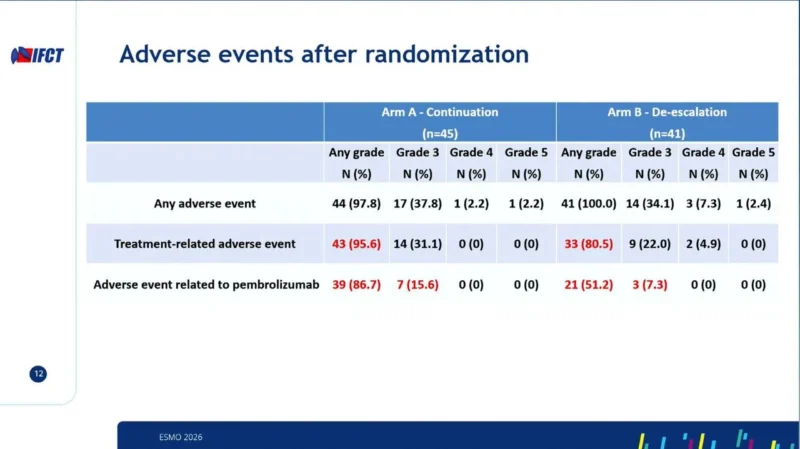
The toxicity findings provide the clearest immediate advantage of shortening therapy. After randomization, treatment-related adverse events occurred in 95.6% of evaluable patients in the continuation group compared with 80.5% in the de-escalation group.
Grade 3 treatment-related adverse events occurred in 31.1% versus 22.0%, respectively. Events considered specifically related to pembrolizumab occurred in 86.7% of patients continuing pembrolizumab compared with 51.2% in the de-escalation strategy.
Grade 3 pembrolizumab-related events occurred in 15.6% versus 7.3%. The continued presence of some pembrolizumab-attributed adverse events after discontinuation is not surprising because immune-mediated toxicities can persist or emerge after the final dose.
Nevertheless, the overall difference illustrates the core rationale for de-escalation: less drug exposure can translate into less treatment-related morbidity.
Why Six Months?
Six months is an ambitious stopping point. Current trial-derived practice commonly allows pembrolizumab treatment to continue for up to two years, meaning DIAL is not testing a modest reduction from 24 months to 18 months.
It is asking whether immunotherapy can be stopped after only approximately one quarter of that conventional maximum duration in patients who have already demonstrated disease control.
Biologically, the concept is plausible. Checkpoint inhibitors do not act like conventional cytotoxic therapies that require continued drug exposure to maintain direct tumor-cell killing. They activate or restore antitumor immune responses that can persist after drug discontinuation.
Durable responses after immunotherapy cessation have been repeatedly observed across tumor types and in long-term NSCLC follow-up.
What remains unknown is how early treatment can safely be stopped and which patients have generated sufficiently durable immune control by that point.
PD-L1 May Matter, but the Phase II Dataset Cannot Answer That Yet
One of the most important future questions will be whether de-escalation works equally well across PD-L1 subgroups. DIAL includes patients regardless of PD-L1 expression and stratifies according to PD-L1 level.
That makes the phase III trial particularly valuable. A patient with PD-L1 TPS ≥50% whose cancer may be strongly immunotherapy sensitive could theoretically behave differently from a patient with PD-L1-negative disease whose response was generated through combined chemotherapy and checkpoint inhibition.
Similarly, patients with deep objective responses may differ from those whose best response at six months is stable disease.
The current phase II population is too small to define reliable predictive subgroups. The phase III study should be better positioned to explore whether clinical or biomarker-defined groups can safely undergo early treatment discontinuation.
De-Escalation Is Not the Same as Undertreatment
De-escalation trials in metastatic cancer can be counterintuitive because clinicians are understandably reluctant to stop a treatment that appears to be working.
But the fundamental question is not whether pembrolizumab is effective. Its first-line benefit is well established. The question is whether continued exposure is necessary once the biological effect has already been established.
If six months proves sufficient for a large proportion of patients, additional treatment may provide little incremental benefit while still producing toxicity, inconvenience and cost.
Conversely, if continued therapy meaningfully reduces later relapse risk, stopping prematurely could sacrifice durable disease control.
Only randomized prospective evidence can resolve that trade-off.
The Phase III Trial Is Continuing
The independent data monitoring committee reviewed the phase II analysis in December 2025 and recommended continuation into the phase III component.
The ESMO presentation reported that 493 of the planned 1,250 patients had been accrued to the phase III program. Current European trial registry data confirm that DIAL remains an ongoing, recruiting integrated phase II/III study with a planned population of 1,250 participants across approximately 55 sites.
The phase III primary endpoint is overall survival. This larger trial is essential because the clinical bar for treatment de-escalation must be high. A strategy that reduces toxicity is valuable only if survival is not meaningfully compromised.
What Could DIAL Change?
If the phase III study confirms non-inferior survival with six months of pembrolizumab, the implications could extend well beyond a single treatment regimen.
A shorter immunotherapy course could substantially reduce cumulative immune toxicity, infusion burden and healthcare utilization. It could also reshape how clinical trials think about checkpoint inhibitor duration.
For years, two-year treatment schedules have been repeated across oncology largely because that was how pivotal studies were designed. DIAL challenges the assumption that trial duration automatically represents biologically necessary treatment duration.
The study is therefore addressing a broader question in immuno-oncology: when has enough immunotherapy become enough?
Important Limitations of the Phase II Result
The current findings should not change routine practice by themselves. Only 84 eligible patients were included in the primary phase II analysis. The trial randomized patients only after they had already demonstrated six months of disease control, meaning the findings cannot be generalized to patients with early progression.
The phase II portion was not a formal non-inferiority study. Confidence intervals remain wide.
In nonsquamous disease, pemetrexed could continue after pembrolizumab discontinuation, meaning the experimental strategy was not complete treatment cessation. And longer follow-up remains important because delayed separation of survival curves cannot yet be excluded.
For now, continuing pembrolizumab according to established treatment protocols remains the evidence-based approach outside a clinical trial.
OncoDaily Takeaway
The phase II portion of IFCT-2103 DIAL provides prospective evidence that stopping pembrolizumab after six months may be feasible in carefully selected patients with metastatic NSCLC who have already achieved sustained disease control after first-line chemoimmunotherapy.
At 18 months from initial treatment inclusion, OS was 83.3% with continued pembrolizumab and 88.1% after de-escalation.
At 24 months, survival was almost identical at 78.1% versus 77.2%. At the same time, treatment-related adverse events fell from 95.6% to 80.5%, while pembrolizumab-related adverse events declined from 86.7% to 51.2%.
The message is encouraging, but not yet practice changing. DIAL phase II demonstrates that early pembrolizumab discontinuation is sufficiently plausible to justify definitive testing. It does not prove that six months is equivalent to two years.
That answer now depends on the ongoing phase III trial. If confirmed, DIAL could challenge one of the most deeply embedded assumptions in modern immunotherapy: that patients benefiting from checkpoint inhibition necessarily need to remain on treatment for years.
The future of immunotherapy optimization may therefore involve not only deciding who should receive it, but also learning when it is safe to stop.
Source
- Toffart AC, et al. Analysis of the phase 2 part of IFCT-2103 DIAL phase 2–3 randomized trial, comparing continuation pembrolizumab ± pemetrexed up to 2 years versus observation ± pemetrexed in patients with metastatic NSCLC with disease control at 6 months. Presented at ESMO Congress 2026, October 25, 2026. Clinical trial identifier NCT05255302.