
Surgery is usually considered sufficient treatment for patients with completely resected stage IA non-small cell lung cancer. Adjuvant chemotherapy is generally not recommended in this setting, and current evidence supporting postoperative EGFR-targeted therapy has largely focused on stage IB–IIIA disease.
However, stage IA lung adenocarcinoma is not biologically uniform. Tumors with lymphovascular invasion, spread through air spaces, poor differentiation, solid or micropapillary components, and other high-risk features may still recur after apparently curative surgery.
A real-world study published as a journal pre-proof in Clinical Lung Cancer suggests that adjuvant icotinib, a first-generation EGFR tyrosine kinase inhibitor, may reduce recurrence risk in selected patients with completely resected stage IA EGFR-mutant lung adenocarcinoma.
After propensity score matching, the three-year disease-free survival rate was 100% with adjuvant icotinib versus 86.8% with clinical observation. Overall survival, however, was not significantly different, and the retrospective findings require prospective confirmation before they can influence routine practice.
Why Stage IA Disease May Still Carry Recurrence Risk
Stage IA lung adenocarcinoma generally has a favorable prognosis after complete resection. Five-year overall survival remains high, particularly in stage IA1 disease, but progressively decreases across IA2, IA3, and stage IB.
This pattern reflects the biological diversity within early-stage disease. Some patients have indolent, ground-glass-predominant tumors, while others have solid nodules, invasive histologic patterns, lymphovascular invasion, or spread through air spaces.
These higher-risk features may indicate residual microscopic disease even when surgical margins are clear and lymph nodes are negative.
Adjuvant chemotherapy has not demonstrated a clear enough benefit-risk balance to support routine use in stage IA NSCLC. Its toxicity may outweigh its limited potential benefit in a population with otherwise favorable outcomes.
The success of postoperative EGFR inhibition in more advanced resected disease has therefore raised a new question: could selected high-risk stage IA patients also benefit from targeted treatment?
A Real-World Comparison of Icotinib and Observation
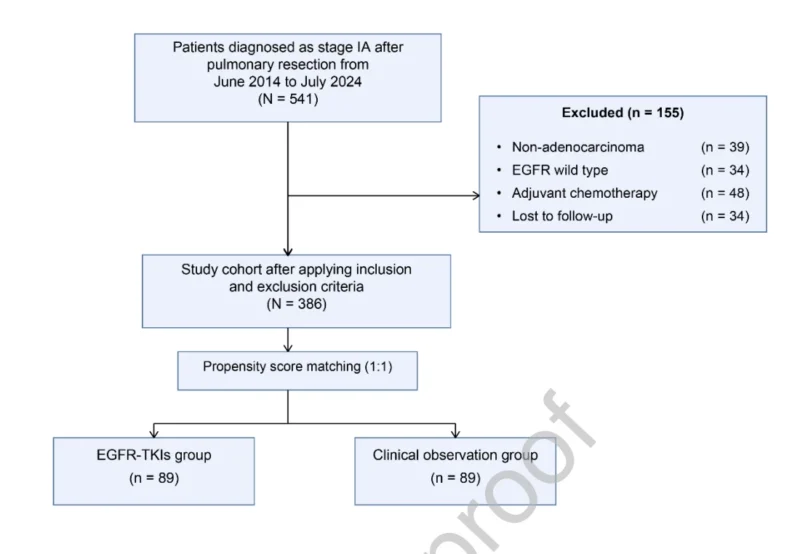
The study retrospectively included 386 patients with pathologically confirmed stage IA lung adenocarcinoma who underwent complete resection between June 2014 and July 2024.
Eligible procedures included lobectomy and sublobar resection, with mediastinal and hilar lymph node sampling or dissection. All patients had pathologically confirmed node-negative disease.
Among the study population:
- 128 patients received adjuvant icotinib.
- 258 patients underwent clinical observation.
Patients selected for targeted therapy had confirmed EGFR mutations, including exon 19 deletions, exon 21 L858R, and less common sensitizing variants such as G719X, S768I, and L861Q.
Icotinib was started within six weeks after surgery at 125 mg three times daily. Treatment was generally planned for approximately 12 months, although duration varied in routine practice.
Because treatment was not randomly assigned, the investigators used 1:1 propensity score matching to reduce differences between groups. This produced 89 matched patients in each arm.
The matching model included age, sex, smoking history, tumor size, consolidation-to-tumor ratio, differentiation, lymphovascular invasion, spread through air spaces, multiple primary lung cancers, and surgical approach.
A Marked Difference in Recurrence After Matching
The median follow-up for the overall cohort was 35.88 months.
Before matching, recurrence or metastasis occurred in:
- 1 of 128 patients, or 0.8%, in the icotinib group.
- 26 of 258 patients, or 10.1%, in the observation group.
After propensity score matching, recurrence was documented in:
- 1 patient, or 1.1%, receiving icotinib.
- 12 patients, or 13.5%, undergoing observation.
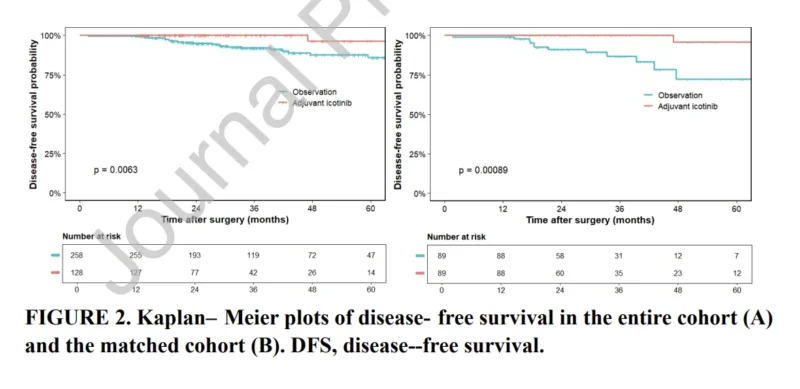
Three-year disease-free survival was:
- 100.0% with adjuvant icotinib
- 86.8% with clinical observation
The hazard ratio for recurrence or death was 0.07 with a 95% confidence interval of 0.01–0.50 and a P value of 0.008.
The Kaplan–Meier curves shown on page 17 of the paper demonstrate early and sustained separation between adjuvant icotinib and observation, both in the full population and the matched cohort.
In multivariable analysis, adjuvant targeted therapy remained independently associated with improved disease-free survival, with a hazard ratio of 0.08.
These estimates suggest a large relative reduction in recurrence risk. However, they are based on a small number of events and should not be interpreted as definitive evidence of treatment efficacy.
Distant Recurrence Was More Common With Observation
The recurrence pattern also differed between groups.
In the matched observation cohort, 12 patients developed recurrence or metastasis:
- Nine had distant metastases.
- Two had local recurrence.
- One had both local and distant recurrence.
The only recurrence in the icotinib group was local.
Central nervous system metastasis occurred in one patient in the observation group and in no patients receiving icotinib.
These findings are clinically relevant because distant recurrence is the event adjuvant systemic therapy is intended to prevent. Still, the number of recurrences was too small to determine whether icotinib specifically reduces distant or central nervous system relapse.
The recurrence pattern should therefore be considered hypothesis-generating.
No Overall Survival Benefit Was Demonstrated
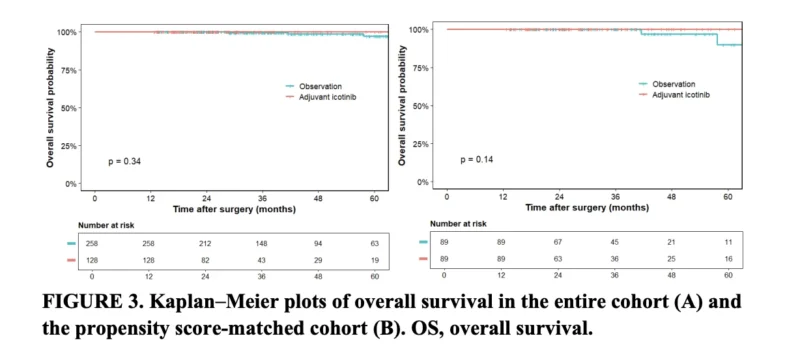
Overall survival did not differ significantly between treatment groups.
In the full cohort, the P value for overall survival was 0.34. In the propensity score-matched population, the P value was 0.14.
Median disease-free survival and overall survival had not been reached.
The absence of an overall survival difference is not unexpected given the relatively short follow-up, the favorable prognosis of stage IA disease, and the limited number of deaths. Only three lung cancer-related deaths were reported in the observation group.
Many patients who relapsed during observation subsequently received an EGFR inhibitor, potentially reducing any survival difference between the initial treatment strategies.
Longer follow-up is therefore required before conclusions can be drawn about overall survival.
Which Pathologic Features Were Associated With Recurrence?
The study identified several clinicopathologic characteristics associated with poorer disease-free survival.
On univariate analysis, recurrence risk was associated with larger tumor diameter, poor differentiation, lymphovascular invasion, spread through air spaces, solid-predominant nodule morphology, and the absence of adjuvant targeted therapy.
In multivariable analysis, two features remained independently associated with worse disease-free survival:
Lymphovascular invasion was associated with a hazard ratio of 2.88.
Solid-predominant nodule morphology was associated with a hazard ratio of 4.27.
These findings support the view that stage IA disease includes biologically higher-risk subgroups that may not be adequately defined by tumor size alone.
Future treatment strategies may therefore depend on integrating stage with histology, radiographic appearance, lymphovascular invasion, spread through air spaces, molecular findings, and possibly postoperative circulating tumor DNA.
Icotinib Was Generally Well Tolerated
Safety was assessed in all 128 patients who received icotinib.
At least one adverse event was reported in 54.7% of patients. Most events were grade 1 or 2.
The most common adverse events were:
- Rash: 22.7%
- Diarrhea: 7.8%
- Oral ulcers or mucositis: 5.5%
- Increased alanine aminotransferase: 5.4%
Only two grade 3 or higher adverse events occurred, both grade 3 rash, corresponding to 1.6% of the treated population.
No treatment-related deaths, drug-induced interstitial lung disease, dose reductions, or treatment discontinuations due to toxicity were reported.
This favorable tolerability profile is relevant in stage IA disease, where the threshold for accepting treatment-related toxicity is particularly low.
Treatment Duration Remains Undefined
Icotinib was generally recommended for approximately one year, consistent with the treatment schedule used in the CORIN study of resected stage IB EGFR-mutant NSCLC.
However, actual treatment duration varied.
An exploratory analysis found no significant disease-free survival difference among patients treated for less than six months, six to less than 24 months, or 24 months or longer.
This result cannot establish the optimal treatment duration because recurrence events were very uncommon. A longer course could provide greater suppression of microscopic disease, but it could also delay rather than prevent recurrence.
Only a prospective randomized trial can determine whether adjuvant EGFR inhibition is necessary in stage IA disease and, if so, how long it should continue.
Why the Findings Are Not Yet Practice-Changing
The study provides an important signal, but several limitations prevent immediate clinical adoption.
It was a retrospective, single-center, non-randomized analysis. The decision to prescribe icotinib was influenced by EGFR status, pathological risk factors, patient preference, and clinician judgment.
Although propensity score matching improved group balance, unmeasured confounding may remain. Patients receiving icotinib could have differed from observed patients in surveillance intensity, access to care, adherence, comorbidities, or other factors not included in the matching model.
The matched analysis included only 178 patients and 13 recurrence or metastasis events. The very low event count produced wide confidence intervals around the estimated treatment effect.
Overall survival was immature, and the findings do not demonstrate that adjuvant icotinib extends life.
The treatment was also used off-label, and current guidelines do not recommend routine adjuvant EGFR-targeted therapy for stage IA NSCLC.
A Risk-Adapted Question for Future Trials
The study does not suggest that every patient with resected stage IA EGFR-mutant lung adenocarcinoma should receive an EGFR inhibitor.
Instead, it supports a more focused question: can postoperative targeted therapy improve outcomes in a carefully selected high-risk subgroup?
Potential selection factors could include lymphovascular invasion, solid or micropapillary histology, spread through air spaces, higher consolidation-to-tumor ratio, stage IA3 disease, incomplete biological risk reduction after sublobar resection, or detectable postoperative minimal residual disease.
Prospective studies will need to determine whether these factors can identify patients whose recurrence risk is high enough to justify systemic therapy.
The Bottom Line
In this real-world study, adjuvant icotinib was associated with improved disease-free survival after complete resection of stage IA EGFR-mutant lung adenocarcinoma.
Following propensity score matching, three-year disease-free survival was 100% with icotinib versus 86.8% with observation, with a hazard ratio of 0.07.
Treatment was generally well tolerated, with grade 3 toxicity reported in only 1.6% of patients and no discontinuations because of adverse events.
However, the findings are not practice-changing. The retrospective design, small number of recurrence events, variable treatment duration, and immature overall survival require cautious interpretation.
For now, surgery and surveillance remain the standard approach for most patients with stage IA disease. Randomized prospective trials are needed to determine whether selected high-risk patients with EGFR-mutant tumors should receive adjuvant targeted therapy.
References
- Luo SS, Zhong LQ, Liu X, Li SN, Zhang X, Ao Y, et al. Clinical efficacy and safety of icotinib as adjuvant therapy for resected stage IA lung adenocarcinoma: A real-world study. Clinical Lung Cancer. 2026. doi:10.1016/j.cllc.2026.07.006.
- Herbst RS, Wu YL, John T, et al. Adjuvant osimertinib for resected EGFR-mutated stage IB–IIIA non-small-cell lung cancer: Updated results from the phase III ADAURA trial. Journal of Clinical Oncology. 2023;41:1830–1840.
- Ou W, Li N, Wang BX, et al. Adjuvant icotinib versus observation in patients with completely resected EGFR-mutated stage IB NSCLC: The CORIN trial. EClinicalMedicine. 2023;57:101839.