
The treatment landscape of extensive-stage small cell lung cancer (ES-SCLC) has expanded in recent years, but outcomes after progression remain poor, particularly for patients with platinum-resistant disease, central nervous system metastases, or impaired performance status. The Jazz EMERGE 402 study provides prospective real-world evidence on lurbinectedin in precisely this broader and more clinically heterogeneous population.
In the phase IV observational study, lurbinectedin produced an overall response rate of 29%, median progression-free survival (PFS) of 3.3 months, and median overall survival (OS) of 7.6 months among patients with previously treated SCLC. Outcomes were less favorable among patients with baseline CNS metastases and those with platinum-resistant disease, highlighting the persistent clinical challenge represented by these subgroups.
Importantly, the study included patients often underrepresented in registrational trials, including older adults, patients with ECOG performance status ≥2, CNS metastases, and individuals receiving treatment beyond the second line. The results were accepted in October 2026 for publication in Lung Cancer.
Why Real-World Evidence Matters in Relapsed SCLC
Small cell lung cancer remains one of the most aggressive thoracic malignancies. Most patients with ES-SCLC initially respond to platinum-etoposide-based chemotherapy combined with an immune checkpoint inhibitor, but disease recurrence is common and often occurs within months. Once progression develops, prognosis deteriorates rapidly.
Historically, therapeutic options in the relapsed setting were extremely limited. Topotecan remained one of the few approved standards for decades, while more recent approvals of lurbinectedin and tarlatamab have broadened the treatment armamentarium.
Lurbinectedin received accelerated FDA approval in 2020 for metastatic SCLC progressing on or after platinum-based chemotherapy following a phase II basket study in which the drug produced an ORR of approximately 35%.
However, that trial enrolled a relatively selected population. Patients were generally younger, most received lurbinectedin in second line, and patients with CNS involvement or poor performance status were excluded. Clinical practice is considerably more complex.
Patients with relapsed SCLC are frequently older, have multiple comorbidities, deteriorating performance status, brain metastases, and rapidly progressive disease. Jazz EMERGE 402 was therefore designed to determine how lurbinectedin performs outside the more restrictive environment of a conventional registration trial.
A Prospective Phase IV Real-World Study
Jazz EMERGE 402 was a prospective, observational, multicenter phase IV study conducted at more than 50 centers across the United States and Canada. Patients had previously received platinum-based chemotherapy for ES-SCLC and had already been prescribed lurbinectedin according to routine clinical practice before enrollment.
This design is important: investigators did not assign treatment according to a protocol-driven experimental strategy. Instead, the study observed the effectiveness and safety of lurbinectedin as it was actually being used in clinical practice. The primary endpoint was overall response rate. Secondary endpoints included:
- PFS
- OS
- duration of response
- disease control rate
- safety and tolerability
Tumor assessments were performed according to local clinical practice and evaluated using RECIST 1.1 when measurable disease was available.
A More Challenging Patient Population
As of July 17, 2025, 267 patients had received at least one dose of lurbinectedin. Median age was 67 years, and 62% of patients were aged 65 years or older.
Importantly:
- 19% had ECOG performance status ≥2
- 25% had baseline CNS metastases
- 31% had liver metastases
- 33% had platinum-resistant disease, defined by a chemotherapy-free interval of <90 days.
The treatment setting was also heterogeneous. Approximately 63% received lurbinectedin in second line, 29% in third line, and 7% in fourth line or beyond. This contrasts with the pivotal phase II trial, in which the vast majority of patients received second-line treatment and patients with major adverse prognostic characteristics were less represented.
The broader population makes EMERGE 402 particularly useful for understanding how lurbinectedin performs in routine oncology practice.
Overall Response Rate Reached 29%
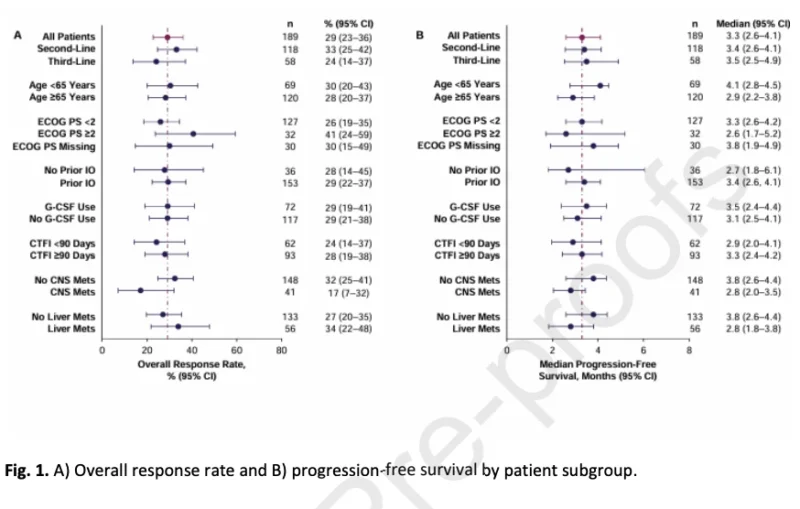
Among 189 patients with measurable disease assessed according to RECIST 1.1, the investigator-assessed ORR was 29% with a 95% confidence interval of 23%–36%. Complete responses occurred in 4%, while partial responses were observed in 25%. The disease control rate was 49%. Median duration of response was 3.9 months.
These results are somewhat lower than the approximately 35% response rate reported in the original phase II basket trial, which is unsurprising given the poorer prognosis and greater clinical heterogeneity of patients enrolled in EMERGE 402. Nevertheless, the study demonstrates that meaningful tumor responses remain achievable in routine practice.
Second-Line Treatment Produced Higher Response Rates
Treatment appeared somewhat more active when lurbinectedin was used earlier. Among patients receiving lurbinectedin in the second-line setting, ORR was:
- 33%
compared with:
- 24%
in patients receiving the drug in third line. Disease control rates were 51% and 48%, respectively.
Median PFS was similar, however:
- 3.4 months in second line
versus
- 3.5 months in third line.
These findings suggest that earlier use may increase the likelihood of tumor response, although the observational nature of the study prevents firm conclusions regarding the optimal treatment sequence.
Median PFS Was 3.3 Months
Across the overall measurable population, median PFS was:
- 3.3 months
The estimated probability of remaining progression-free was approximately 24% at 6 months and 9% at 9 months.
Although these durations remain modest, they need to be interpreted in the context of recurrent SCLC, where disease progression can be extremely rapid and patients often have limited opportunities to receive multiple subsequent therapies.
Brain Metastases Were Associated With Lower Response
One of the clearest findings from Jazz EMERGE 402 involved patients with CNS disease. Patients with baseline brain metastases had an ORR of:
- 17%
compared with:
- 32%
among patients without CNS metastases. After multivariable adjustment, baseline CNS metastases remained associated with a substantially lower probability of response. The difference was also reflected in PFS.
Median PFS was:
- 2.8 months with baseline CNS metastases
versus
- 3.8 months without CNS metastases.
Among patients treated in second line, response rates were similarly lower in those with CNS involvement. This finding reinforces the continuing unmet need for more effective systemic strategies with meaningful intracranial activity in relapsed SCLC.
Platinum Sensitivity Remained a Major Prognostic Factor
Platinum sensitivity remains one of the most clinically important prognostic variables in relapsed SCLC. In the overall analysis, tumor response rates were not dramatically different according to platinum sensitivity. However, survival clearly diverged.
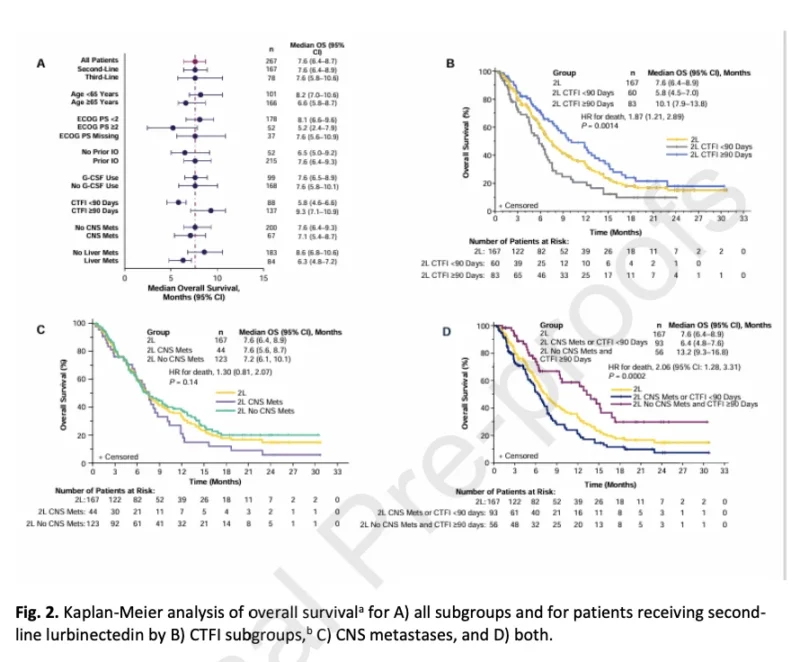
Median OS was approximately:
- 5.8 months in platinum-resistant disease
versus
- 9.3 months in platinum-sensitive disease
Platinum-resistant disease was associated with a 63% greater risk of death compared with platinum-sensitive disease. In the second-line population, the difference became even more pronounced 5.8 months median OS in platinum-resistant disease versus 10.1 months in platinum-sensitive disease.
This confirms that the chemotherapy-free interval continues to provide important prognostic information even in the era of newer therapies. The Combination of CNS Disease and Platinum
Resistance Identified a Particularly High-Risk Group
The study also examined combinations of adverse prognostic characteristics. Among second-line patients with either platinum-resistant disease or baseline CNS metastases, median PFS was approximately 2.9 months.
By comparison, patients with platinum-sensitive disease and no baseline CNS involvement had median PFS of approximately 4.2 months. The survival separation was even more substantial.
Patients with platinum-resistant disease or CNS metastases had median OS of:
- 6.4 months
compared with:
- 13.2 months
among patients with platinum-sensitive disease and no CNS metastases. This more than twofold difference illustrates the considerable biological heterogeneity that exists even within relapsed ES-SCLC. It also highlights why treatment outcomes from highly selected clinical trial populations may not always translate directly to individual patients encountered in routine practice.
Performance Status Also Influenced Survival
ECOG performance status remained another important predictor of outcome. Patients with ECOG PS ≥2 had significantly shorter survival than those with ECOG PS 0–1. The adjusted hazard ratio for death was approximately 1.81.
This finding is clinically intuitive but important. Patients with poorer functional status are frequently excluded from randomized trials, yet they represent a substantial proportion of patients with recurrent SCLC. EMERGE 402 therefore provides useful evidence regarding treatment in a group for whom prospective data have traditionally been limited.
Prior Immunotherapy Did Not Appear to Eliminate Lurbinectedin Activity
Most contemporary patients with ES-SCLC receive atezolizumab or durvalumab with first-line platinum-etoposide. Accordingly, the effectiveness of subsequent therapies after prior immune checkpoint inhibition has become highly relevant.
In EMERGE 402, prior immunotherapy was not clearly associated with inferior response or survival with lurbinectedin.
This finding should not be interpreted as evidence of equivalence between prior-IO and IO-naïve populations, because the study was observational and subgroup analyses were not randomized. Nevertheless, it supports the continued clinical activity of lurbinectedin in a population increasingly representative of contemporary first-line treatment patterns.
Median Overall Survival Was 7.6 Months
Across the entire 267-patient cohort, median OS was:
- 7.6 months
Importantly, median survival exceeded seven months across many of the assessed prognostic subgroups. The result is lower than the 9.3-month median OS reported in the earlier phase II registration cohort, but EMERGE 402 enrolled a substantially less selected population.
For a prospective real-world study including patients with ECOG PS ≥2, CNS metastases, platinum resistance, and later-line treatment, this difference is clinically understandable.
Safety Was Manageable in Routine Practice
Another important finding was the relatively manageable safety profile. Treatment-related adverse events occurred in 33% of patients. The most common treatment-related adverse events were:
- Anemia — 8%
- Neutropenia — 7%
Serious treatment-related adverse events occurred in 11%. Dose reductions due to adverse events were required in approximately 5%, while 8% discontinued lurbinectedin because of adverse events.
Fatal treatment-related events occurred in approximately 1% of patients. No new safety signals were identified.
Why Were Hematologic Toxicities Lower Than Expected?
Interestingly, hematologic adverse events were reported less frequently than in the original phase II lurbinectedin trial. The investigators provide several possible explanations.
First, laboratory monitoring differed. In the pivotal trial, hematologic assessments were performed more frequently, particularly during early cycles. In EMERGE 402, blood counts were generally obtained before each treatment cycle, consistent with routine clinical practice.
Because lurbinectedin-related neutrophil nadirs may occur between scheduled cycle assessments, some transient hematologic abnormalities might not have been captured.
Second, G-CSF use was considerably more common. Overall, 37% of patients received G-CSF, including approximately 27% receiving primary prophylaxis. Primary G-CSF prophylaxis had not been permitted in the pivotal phase II trial.
Therefore, the lower incidence of reported myelosuppression should not necessarily be interpreted as evidence that lurbinectedin is intrinsically less myelosuppressive in real-world practice.
How Do the Results Compare With the Registration Trial?
The original phase II basket trial that led to accelerated approval reported:
- ORR: 35%
- Median duration of response: 5.3 months
- Median OS: 9.3 months
Jazz EMERGE 402 reported:
- ORR: 29%
- Median duration of response: 3.9 months
- Median PFS: 3.3 months
- Median OS: 7.6 months
The modestly lower outcomes in EMERGE 402 are consistent with the inclusion of patients with less favorable prognostic characteristics. Rather than contradicting the registration study, the results help define what clinicians can reasonably expect when lurbinectedin is used in a more representative patient population.
LAGOON Complicates the Second-Line Evidence
The interpretation of lurbinectedin in relapsed SCLC has become more complex following the reported top-line results from the randomized phase III LAGOON trial.
According to results cited in the EMERGE 402 paper, neither lurbinectedin monotherapy nor lurbinectedin plus irinotecan demonstrated a statistically significant OS improvement compared with physician’s choice of topotecan or irinotecan.
Reported median OS was:
- 8.7 months with lurbinectedin monotherapy
- 10.9 months with lurbinectedin + irinotecan
- 10.7 months with physician’s-choice chemotherapy.
The unusually strong performance of the control arm influenced the comparison. Importantly, median OS with lurbinectedin monotherapy in LAGOON remained broadly consistent with the survival observed in the original phase II study and EMERGE 402.
Thus, EMERGE 402 supports real-world antitumor activity, but it does not establish superiority over alternative second-line treatment options. That distinction is essential.
The Relapsed SCLC Landscape Is Also Changing
Lurbinectedin now exists within a more crowded therapeutic landscape. The availability of tarlatamab has introduced a new treatment class, while lurbinectedin-based immunotherapy combinations are also being investigated.
The phase I/II LUPER study evaluated lurbinectedin plus pembrolizumab in previously treated, immunotherapy-naïve SCLC. Among platinum-sensitive patients, the combination achieved:
- ORR 57%
- Median PFS 8.0 months
- Median OS 15.7 months
In platinum-resistant patients:
- ORR 29%
- Median PFS 2.8 months
- Median OS 7.1 months
The 2SMALL study evaluated lurbinectedin plus atezolizumab and also reported encouraging early activity. These results remain investigational and should not be directly compared across trials, but they reinforce interest in combining lurbinectedin’s transcriptional inhibition with immune checkpoint blockade.
Lurbinectedin Has Also Moved Into First-Line Maintenance
Another major change is that lurbinectedin is no longer exclusively a post-progression treatment. The phase III IMforte trial demonstrated improved PFS and OS with lurbinectedin plus atezolizumab maintenance compared with atezolizumab alone following first-line induction therapy.
The combination subsequently became an FDA-approved maintenance strategy for adults with ES-SCLC. This development is particularly relevant because many patients with SCLC deteriorate rapidly at progression and never receive second-line therapy.
Using an active treatment during maintenance, before clinical progression, therefore represents a fundamentally different strategy from waiting until relapse.
Jazz EMERGE 402 should consequently be viewed as evidence supporting the real-world activity of lurbinectedin monotherapy after progression, while IMforte represents the newer strategy of moving lurbinectedin earlier into maintenance treatment. These are complementary but clinically distinct settings.
Important Limitations
Jazz EMERGE 402 was not a randomized trial. There was no comparator arm, meaning the study cannot determine whether lurbinectedin is superior to another available therapy. Treatment selection occurred according to physician judgment, creating the potential for selection bias and residual confounding.
Tumor response and progression were investigator assessed rather than centrally reviewed, and imaging schedules reflected routine clinical practice rather than a rigid trial schedule. Subgroup findings should also be interpreted cautiously, particularly when patient numbers were small.
Additionally, safety capture in observational practice may differ from the intensive surveillance used in registration trials. For these reasons, the study is most informative as a description of effectiveness and tolerability in routine practice, rather than as comparative evidence of treatment efficacy.
OncoDaily Takeaway
Jazz EMERGE 402 provides one of the most clinically relevant prospective assessments of lurbinectedin in relapsed SCLC because it included many patients who would typically be underrepresented in randomized trials. In a 267-patient real-world cohort, lurbinectedin produced a 29% response rate, median PFS of 3.3 months, and median OS of 7.6 months, with relatively low rates of dose reduction and treatment discontinuation.
The results confirm that lurbinectedin retains clinically meaningful activity outside highly selected trial populations. At the same time, the study clearly identifies where the unmet need remains greatest. Patients with baseline CNS metastases were less likely to respond and had shorter PFS, while platinum-resistant disease and poor performance status were associated with inferior survival.
The broader clinical context is also evolving rapidly. LAGOON did not demonstrate an OS superiority signal for second-line lurbinectedin over physician’s-choice chemotherapy, newer agents such as tarlatamab are changing post-progression treatment, and IMforte has moved lurbinectedin into the first-line maintenance setting in combination with atezolizumab. The role of lurbinectedin should therefore no longer be viewed through a single treatment-line framework.
Jazz EMERGE 402 shows that the drug remains an active and generally manageable option in previously treated SCLC, but future treatment decisions will increasingly depend on platinum sensitivity, CNS involvement, performance status, prior therapy, access to competing agents, and whether lurbinectedin has already been incorporated into first-line maintenance.
Source
Badin FB, Lammers PE, Liu G, et al. Real-world effectiveness and safety of lurbinectedin in previously treated small cell lung cancer: results from Jazz EMERGE 402. Lung Cancer. 2026. DOI: 10.1016/j.lungcan.2026.109644.