
Adjuvant osimertinib has transformed the management of resected EGFR-mutant non–small cell lung cancer, but the current treatment framework remains largely stage based. Patients with the same pathological stage can experience markedly different outcomes, while a substantial proportion may remain disease free for years after surgery without adjuvant EGFR-targeted therapy. This creates an increasingly relevant precision-oncology question: can tumor biology identify which patients are truly at high risk of recurrence beyond what pathological stage alone can tell us?
A new study accepted in the Journal of Thoracic Oncology provides an important step toward answering that question. Stephanie P.L. Saw, Mengyuan Pang, and colleagues integrated clinical, genomic, and transcriptomic data from 400 patients with resected stage IA–IIIA EGFR-mutant lung adenocarcinoma and developed EGFR-specific recurrence-risk models that were subsequently evaluated across independent cohorts.
The central finding is clinically provocative: an integrated multi-omic model stratified recurrence risk within individual pathological stages, including stage I disease, and outperformed models based on clinical or genomic variables alone. In exploratory analyses, patients classified as molecularly high risk appeared to derive greater disease-free survival benefit from adjuvant EGFR TKI, whereas low-risk patients had similar short-term DFS regardless of TKI exposure.
The study does not provide a basis for withholding standard adjuvant osimertinib today. It is retrospective, and the treatment-predictive analysis involved a small number of patients. But it illustrates how early-stage EGFR-mutant lung cancer may eventually move from stage-defined adjuvant therapy toward biologically informed risk-adapted treatment.
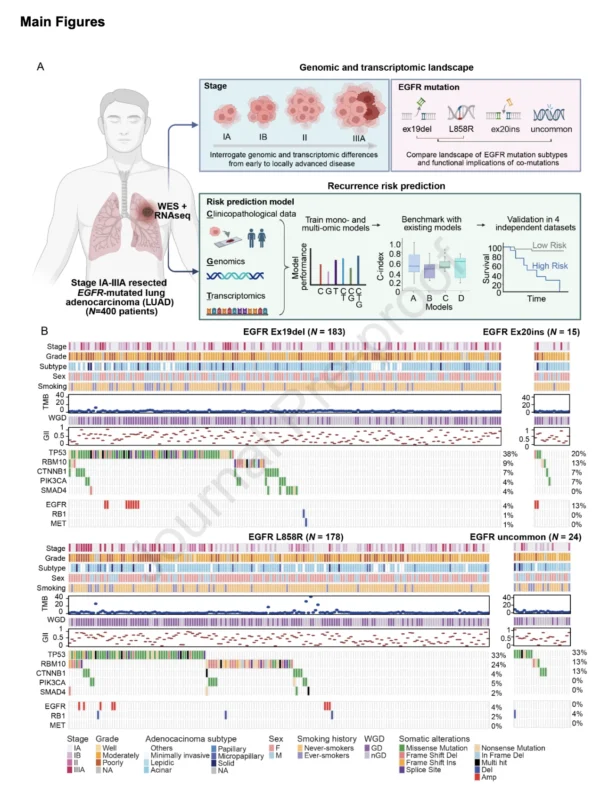
Pathological Stage Does Not Capture the Full Recurrence Risk
The investigators begin from an important clinical observation. Following ADAURA, three years of adjuvant osimertinib became a standard treatment for appropriately selected patients with completely resected stage IB–IIIA EGFR-mutant lung adenocarcinoma. Yet outcomes within each stage remain heterogeneous, and the authors cite real-world data indicating that up to 40% of patients with stage IB–IIIA disease may remain disease free at five years without adjuvant osimertinib.
Conversely, some patients with apparently favorable stage I disease recur despite having been classified clinically as lower risk. This suggests that pathological stage is important but biologically incomplete. The study therefore asked whether genomic instability, co-mutations, transcriptomic programs, and other molecular features could improve recurrence prediction beyond anatomy alone.
The Study Integrated Clinical, Genomic, and Transcriptomic Data
The Singapore cohort included 400 patients with resected stage IA–IIIA EGFR-mutant lung adenocarcinoma treated with curative-intent surgery. The population was predominantly female and never-smoking: 64% were women and 83% were never-smokers. Stage IA represented 46.5% of cases, stage IB 26.3%, stage II 15.3%, and stage IIIA 12.0%. EGFR exon 19 deletions were present in 45.8%, while L858R mutations accounted for 44.5%.
Tumor tissue underwent whole-exome sequencing and RNA sequencing, which were integrated with clinicopathological information. For recurrence-model development, patients with classical EGFR exon 19 deletion or L858R mutations, adequate postoperative follow-up, and no adjuvant EGFR TKI exposure were divided into training and internal-validation cohorts. The models were then evaluated in three external EGFR-mutant datasets.
This disease-specific approach is relevant because models developed in unselected lung adenocarcinoma populations may not adequately capture the biology of EGFR-driven disease.
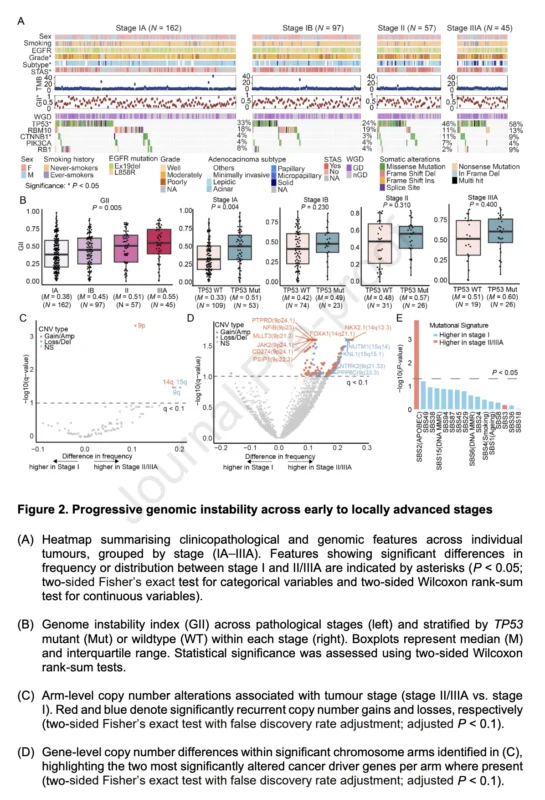
Genomic Instability Increased With Pathological Stage
The molecular analysis revealed progressive genomic complexity as tumors advanced from stage I toward stage II–IIIA. Higher-stage tumors showed greater TP53 co-mutation frequency, genome instability, copy-number alterations, and APOBEC-associated mutational activity.
The APOBEC signal was particularly striking. The proportion of tumors demonstrating an APOBEC mutational signature increased from 43.2% in stage IA to 82.2% in stage IIIA. The genomic analysis also identified recurrent copy-number changes, including gains involving NKX2-1 and FOXA1 and losses involving KNL1.
These findings provide a molecular explanation for at least part of the clinical relationship between advancing pathological stage and recurrence: tumors appear to accumulate progressively greater genomic instability and subclonal complexity. But stage was not the entire story.
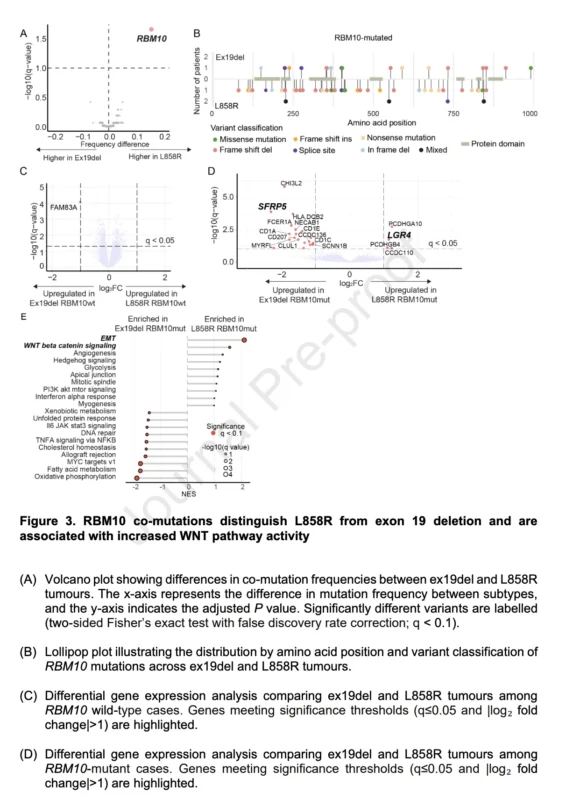
L858R and Exon 19 Deletion Show Different Biology
The study also explored whether the two dominant sensitizing EGFR mutations represent biologically distinct early-stage diseases. RBM10 emerged as the only gene with a significantly different co-mutation frequency between exon 19 deletion and L858R tumors.
RBM10 mutations occurred in:
- 24.2% of L858R tumors
versus
- 8.7% of exon 19 deletion tumors.
Interestingly, broad transcriptomic differences between L858R and exon 19 deletion were limited among RBM10-wildtype tumors. In RBM10-mutated tumors, however, the molecular differences became much more pronounced. L858R/RBM10-mutated tumors demonstrated enrichment of epithelial, mesenchymal transition and WNT/β-catenin signaling, accompanied by higher LGR4 and lower SFRP5 expression.
The investigators appropriately characterize these findings as exploratory, but they reinforce a growing concept in EGFR-mutant lung adenocarcinoma exon 19 deletion and L858R should not necessarily be considered biologically interchangeable simply because both respond to EGFR inhibition.
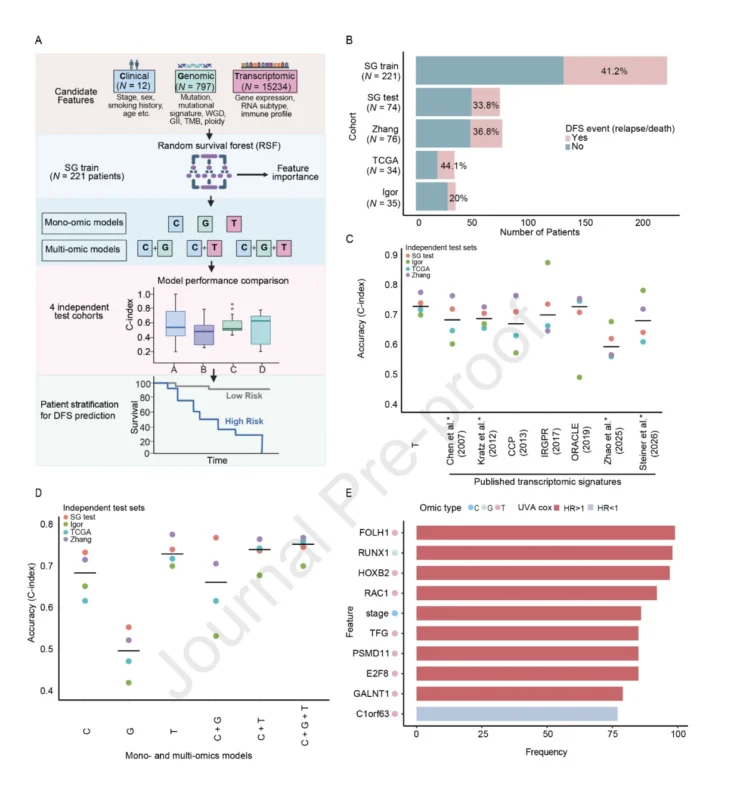
Transcriptomics Carried More Prognostic Information Than Clinical or Genomic Variables Alone
The recurrence-risk modeling produced one of the study’s most important observations. Among the different mono-omic approaches, the transcriptomic-only model performed better than clinical or genomic models alone, achieving a median concordance index of 73.0% across four independent EGFR-mutant lung adenocarcinoma datasets.
When clinical, genomic, and transcriptomic data were combined, performance improved further. The integrated clinical + genomic + transcriptomic model achieved a median C-index of 75.4%, with results ranging from 70.1% to 77.0% across validation datasets.
Importantly, the same model performed substantially worse in EGFR-wildtype lung adenocarcinoma, with a C-index of 55.3%. That finding suggests the model is capturing biological features specifically relevant to EGFR-mutant lung adenocarcinoma rather than simply identifying generic markers of aggressive lung cancer. Among the most informative features were pathological stage, RUNX1 mutation, FOLH1 expression, HOXB2 expression, and RAC1 expression.
Molecular Risk Could Be More Informative Than Stage Alone
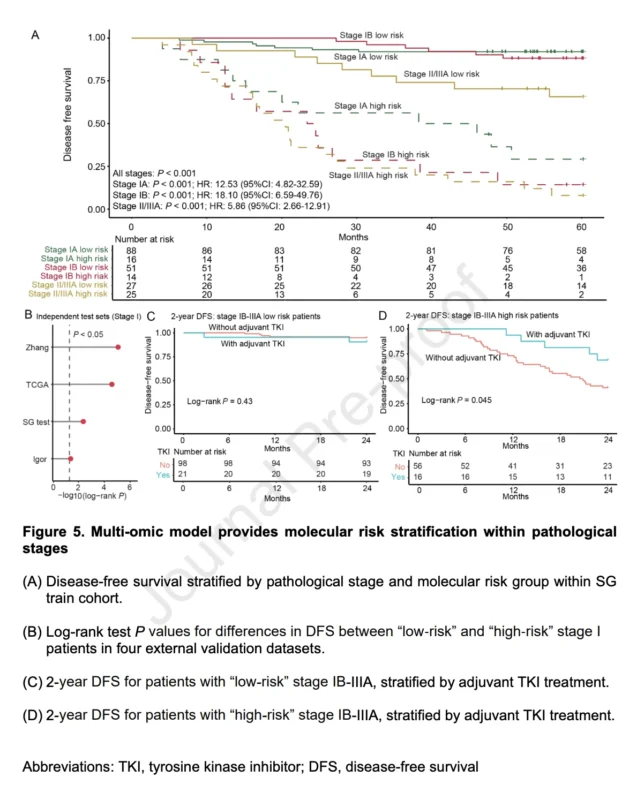
The most clinically interesting analysis examined recurrence risk within individual pathological stages. Patients were categorized as high or low risk according to the integrated multi-omic score. The model separated DFS outcomes across all pathological stages and remained independently associated with recurrence after adjustment for stage.
High-risk patients had approximately a seven-fold higher hazard of recurrence than low-risk patients, independent of pathological stage. Perhaps the most striking observation was that some high-risk stage IA patients had poorer DFS than low-risk stage II–IIIA patients.
This directly challenges the assumption that anatomical stage alone necessarily reflects biological recurrence risk. The findings were also reproduced among stage I patients across four independent validation datasets.
If prospectively confirmed, this could have important implications at both ends of the treatment spectrum: selected early-stage patients might warrant therapeutic escalation, while biologically low-risk patients at a conventionally treatment-eligible stage might potentially avoid unnecessary therapy.
Could Some Stage IB Patients Be Receiving More Therapy Than They Need?
The model classified 78.5% of stage IB patients as molecularly low risk. That observation is potentially important because stage IB patients with qualifying EGFR mutations may currently be considered for adjuvant osimertinib. The authors argue that biological risk stratification could potentially identify a subgroup whose excellent postoperative prognosis makes the absolute benefit of prolonged adjuvant EGFR inhibition relatively small. They note that real-world data similarly suggest many stage IB patients remain disease free without adjuvant osimertinib.
However, this is precisely where clinical caution is most important. The study does not demonstrate that molecularly low-risk patients can safely omit osimertinib. The model has not been prospectively used to assign treatment, and recurrence reduction with osimertinib cannot be inferred from retrospective untreated cohorts alone.
The result therefore supports a future de-escalation hypothesis, not an immediate change in standard care.
Exploratory TKI Analysis Suggests the Model Could Become Predictive
The investigators also asked whether recurrence risk might identify patients more likely to benefit from adjuvant EGFR TKI. Thirty-seven stage IB–IIIA patients who received adjuvant TKI were compared with 154 stage-matched patients who did not. Among patients classified as low risk, DFS was similar regardless of adjuvant TKI exposure at two and three years. Among high-risk patients, adjuvant TKI was associated with significantly better DFS at both time points:
- 2-year P=0.045
- 3-year P=0.026.
This is an intriguing signal because a useful clinical assay should ideally do more than predict prognosis. It should help determine whether treatment changes that prognosis. But this part of the study remains highly exploratory.
Only 37 patients received adjuvant EGFR TKI, treatment was not randomized, and confounding by indication is unavoidable. The data therefore cannot establish that low-risk patients do not benefit from osimertinib or that the model is definitively predictive of treatment benefit. Prospective validation is essential before such a model could influence adjuvant treatment decisions.
High-Risk Stage I Tumors Have a Distinct Biological Phenotype
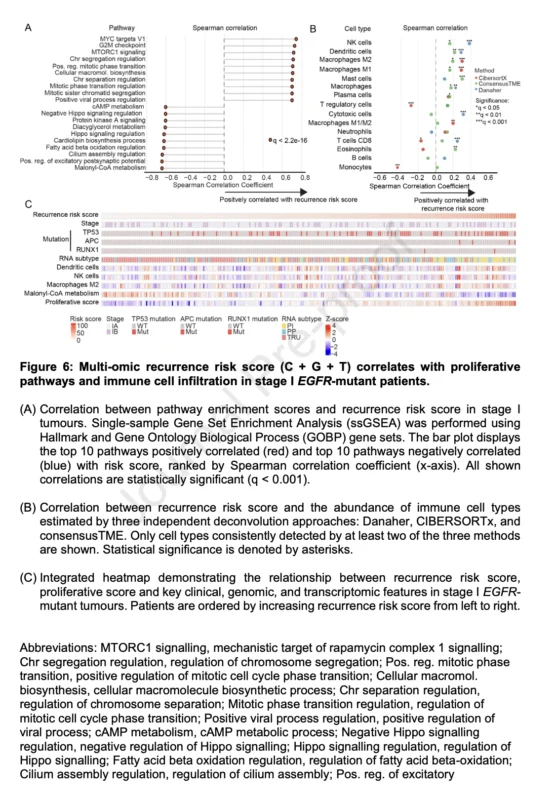
The investigators went further by characterizing the biology underlying the high-risk molecular phenotype. Within stage I disease, higher recurrence scores correlated strongly with proliferative pathways, including MYC targets and G2M checkpoint signaling.
High-risk tumors also demonstrated a distinct immune landscape characterized by increased abundance of dendritic cells, natural killer cells, and M2 macrophages. The authors interpret the pattern as reflecting an altered, potentially dysfunctional immune microenvironment rather than necessarily stronger antitumor immunity. TP53 co-mutations were also associated with higher-risk biology.
The result is important because the risk score appears to reflect an underlying molecular phenotype rather than functioning purely as a statistical classifier. High-risk stage I EGFR-mutant lung adenocarcinoma appears biologically more proliferative and immunologically altered than its pathological stage would suggest.
Tissue-Based Risk Models May Complement MRD
Minimal residual disease detection with circulating tumor DNA is another rapidly developing strategy for postoperative risk assessment. However, the authors note that ctDNA-based MRD currently has limited sensitivity in resected EGFR-mutant lung adenocarcinoma, particularly in low-volume early-stage disease.
This creates a potential role for tissue-based multi-omic profiling. The two approaches need not be competitive. A future framework could combine baseline biological risk derived from the resected tumor with longitudinal ctDNA monitoring after surgery:
- tumor multi-omics → baseline recurrence probability → postoperative MRD → dynamic treatment adaptation.
Such a model could theoretically identify patients with biologically aggressive tumors even when ctDNA is initially undetectable while also providing a way to monitor residual disease over time. That concept remains prospective, but it represents a logical direction for future studies.
ADAURA2 Makes Stage I Risk Stratification Particularly Relevant
The ongoing ADAURA2 trial is evaluating adjuvant osimertinib in stage IA2–IA3 EGFR-mutant NSCLC. That makes the present findings especially timely. If stage I disease contains both biologically indolent and highly aggressive molecular subgroups, expanding adjuvant therapy to even earlier pathological stages could increase both the opportunity for cure and the risk of overtreatment.
The multi-omic model consistently separated high- and low-risk stage I patients across multiple datasets, suggesting that future adjuvant trials may benefit from incorporating biological risk rather than relying exclusively on tumor size and pathological stage.
The goal would not be to replace staging. It would be to make stage more informative by adding tumor biology.
This Is Not Yet a Clinical Decision Tool
The study has several important limitations. It is retrospective, and the principal Singapore cohort was predominantly stage I. The event number was therefore relatively modest, limiting subgroup analyses. Some external validation datasets were small and lacked complete information on adjuvant treatment and comorbidities. The authors also note that model feature selection may not yet have fully stabilized at the available sample size.
Most importantly, the model has not been prospectively tested as a treatment-selection strategy.
A clinically useful risk classifier would ultimately require prospective demonstration that using the model to escalate or de-escalate therapy produces outcomes that are at least as good as, and ideally better than, conventional stage-based management.
Until then, adjuvant therapy should continue to follow established evidence-based indications rather than this experimental risk classification.
The Bottom Line
This study provides one of the most comprehensive molecular analyses to date of resected EGFR-mutant lung adenocarcinoma.
Across 400 stage IA–IIIA tumors, the investigators demonstrated progressive genomic instability with advancing stage, identified distinct RBM10-associated biology in L858R disease, and developed an integrated clinical-genomic-transcriptomic recurrence model with a median C-index of 75.4% across independent validation cohorts.
Most importantly, the model separated recurrence risk within individual pathological stages. High-risk patients had approximately seven times the hazard of recurrence of low-risk patients after adjustment for stage, and even stage IA tumors could demonstrate molecularly aggressive behavior.
The exploratory adjuvant-TKI analysis adds an intriguing therapeutic signal: molecularly high-risk patients appeared to benefit from EGFR TKI, while low-risk patients did not show a clear short-term DFS difference. But the retrospective design and small treated cohort make this hypothesis-generating rather than practice-changing.
The broader implication is important.
The next phase of adjuvant precision oncology in EGFR-mutant lung cancer may move beyond asking whether a patient has an EGFR mutation and what stage the tumor is. It may ask how biologically likely that individual tumor is to recur, and whether that risk is high enough to justify treatment intensification.
Pathological stage will remain fundamental. But this study suggests that stage may ultimately become the beginning, rather than the end, of postoperative risk assessment.
Reference
- Saw SPL, Pang M, Yeo JC, Alvarez JJS, Sim NL, Guo AY, Kadioglu S, Lau ELY, Lau YT, Odinokov D, Getty V, Lai GGY, Lim DWT, Kanesvaran R, Ang M-K, Ng QS, Tan WL, Tan WC, Tan AC, Wong SYN, Seet AOL, Hoo R, Ong B-H, Lim TKH, Skanderup AJ, Tan DSW. Integrated multi-omic profiling enables recurrence risk stratification beyond pathological stage in resected EGFR-mutant lung adenocarcinoma. Journal of Thoracic Oncology. 2026. doi:10.1016/j.jtho.2026.104204. The manuscript was accepted September 7, 2026 and is currently available as a journal pre-proof.