
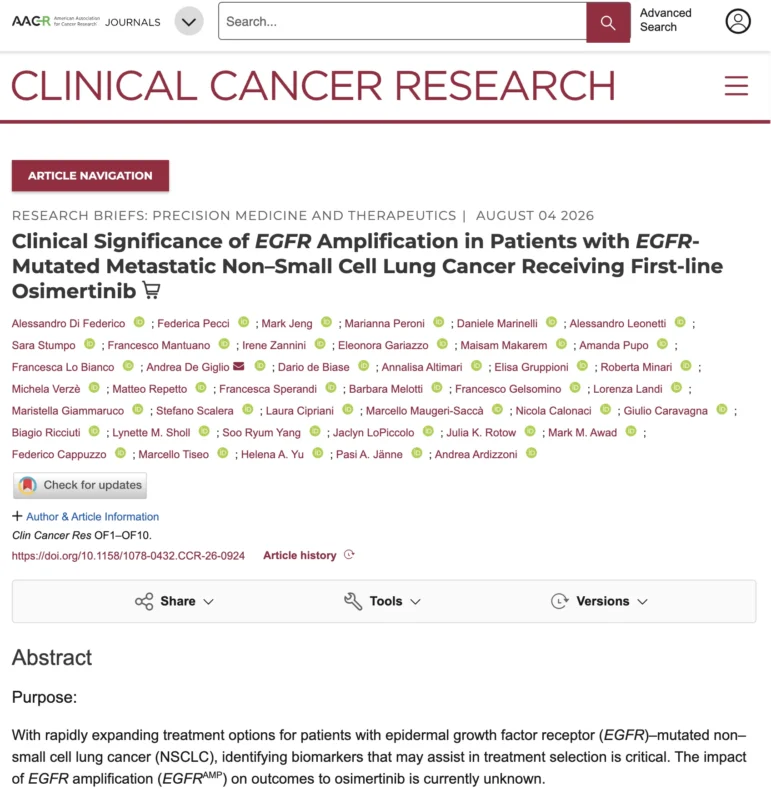
EGFR amplification was associated with substantially shorter progression-free survival and overall survival among patients with EGFR-mutated metastatic non–small cell lung cancer receiving first-line osimertinib, despite similarly high initial response rates.
The analysis included 473 patients who underwent baseline next-generation sequencing capable of assessing EGFR copy number. EGFR amplification, defined as an EGFR copy number of 6 or higher, was identified in 81 patients, or 17.1%.
Patients with EGFR amplification achieved an objective response rate of 88%, compared with 83% among those without amplification. However, median progression-free survival was 11.6 versus 19.0 months, and median overall survival was 34.0 versus 40.1 months, respectively.
The findings suggest that EGFR amplification may identify a clinically distinct, higher-risk subgroup whose tumors remain initially responsive to osimertinib but experience earlier disease progression (Di Federico et al., 2026).
Why Was EGFR Amplification Investigated?
Treatment options for EGFR-mutated metastatic NSCLC are expanding, increasing the need for biomarkers that can distinguish patients with different expected outcomes and potentially support future treatment selection.
Osimertinib produces responses in many patients with EGFR-mutated disease, but the duration of disease control varies.
The clinical significance of EGFR amplification at the start of first-line osimertinib had not been clearly defined. The investigators therefore examined whether increased EGFR copy number was associated with baseline clinical characteristics, treatment response, progression-free survival, overall survival, and genomic findings at acquired resistance.
Importantly, EGFR amplification was evaluated separately from the activating EGFR mutation that established eligibility for osimertinib treatment.
How Was EGFR Amplification Defined?
Patients were required to have metastatic EGFR-mutated NSCLC, first-line treatment with osimertinib, and baseline next-generation sequencing that included an assessment of EGFR amplification.
The investigators defined EGFR amplification as:
- EGFR copy number ≥6
Among the 473 patients included:
- 81 patients had EGFR amplification
- 392 patients had non-amplified EGFR
This placed the prevalence of baseline EGFR amplification at 17.1% in the osimertinib-treated cohort.
Was EGFR Amplification Associated With More Advanced Disease?
Patients with EGFR amplification had several clinical and molecular features associated with more extensive disease at baseline.
Compared with patients without amplification, those with EGFR amplification more frequently had:
TP53 comutations
- EGFR amplification: 80.0%
- Non-amplified EGFR: 55.4%
- P<0.001
Brain metastases
- 50.6% versus 34.3%
- P=0.008
Liver metastases
- 25.9% versus 13.5%
- P=0.009
Bone metastases
- 65.4% versus 51.3%
- P=0.028
These findings indicate that EGFR amplification was not an isolated genomic observation. It was associated with a distinct baseline profile characterized by more frequent TP53 alterations and a higher prevalence of metastatic involvement in several clinically important organs (Di Federico et al., 2026).
Did EGFR Amplification Reduce the Initial Response Rate?
No statistically significant difference was observed in objective response rate.
The objective response rate was:
- 88% with EGFR amplification
- 83% without EGFR amplification
- P=0.23
The similarly high response rates indicate that baseline EGFR amplification did not prevent an initial radiographic response to first-line osimertinib.
However, response rate alone did not reflect the subsequent duration of disease control.
The separation between response and survival outcomes is one of the most clinically relevant findings of the analysis. Patients with amplified tumors frequently responded, but their responses were followed by earlier progression.
How Much Shorter Was Progression-Free Survival?
Median progression-free survival was substantially shorter among patients with EGFR amplification:
- 11.6 months with EGFR amplification
- 19.0 months without EGFR amplification
The hazard ratio for progression or death was:
- HR 1.77; P<0.0001
This corresponds to a 7.4-month difference in median progression-free survival between the groups.
The investigators also found that EGFR amplification remained associated with worse progression-free survival regardless of the presence of a TP53 comutation.
This is important because TP53 alterations were considerably more common in the amplified group. The persistent association across TP53-defined subgroups suggests that the progression-free survival finding was not explained solely by the higher prevalence of TP53 comutations.
Was Overall Survival Also Shorter?
Overall survival was also shorter among patients with EGFR amplification.
Median overall survival was:
- 34.0 months with EGFR amplification
- 40.1 months without EGFR amplification
The hazard ratio for death was:
- HR 1.40; P=0.040
The difference was smaller than that observed for progression-free survival but remained statistically significant in the reported analysis.
Together, the progression-free and overall survival findings support the conclusion that EGFR amplification is associated with a less favorable clinical course during first-line osimertinib treatment.
Did the Association Differ by EGFR Mutation Type?
The prognostic association was not uniform across the two major sensitizing EGFR mutation groups.
EGFR amplification was associated with worse progression-free and overall survival among patients with an EGFR exon 19 deletion.
In contrast, EGFR amplification was not associated with significantly worse progression-free or overall survival among patients with an EGFR L858R mutation.
This subgroup difference suggests that the clinical importance of amplification may depend partly on the underlying activating EGFR alteration.
However, the abstract does not provide subgroup sample sizes, median survival values, hazard ratios, or interaction testing for these comparisons. The exon 19 deletion and L858R findings should therefore be interpreted as subgroup observations rather than definitive evidence that amplification has no clinical importance in L858R-mutated disease.
Did the Degree of Amplification Matter?
Within the EGFR-amplified group, outcomes were not identical.
A higher EGFR copy number was associated with poorer outcomes. The study also distinguished between amplification affecting the mutant EGFR allele and amplification involving the wild-type allele.
Amplification of the mutant EGFR allele was associated with inferior outcomes compared with wild-type EGFR amplification.
This finding suggests that the biological and clinical significance of amplification may depend not only on whether copy-number gain is present, but also on:
The magnitude of the copy-number increase
Whether the activating mutant allele is preferentially amplified
The abstract does not provide a separate threshold beyond the study definition of copy number 6 or higher, nor does it report detailed survival estimates for mutant-allele versus wild-type amplification.
Was EGFR Amplification Linked to MET Alterations at Resistance?
Post-progression next-generation sequencing was available for 113 patients who were reassessed after developing resistance to osimertinib.
Acquired MET alterations were identified more frequently among patients who had EGFR amplification at baseline:
- 29% with baseline EGFR amplification
- 12% without baseline amplification
- P=0.04
The association raises the possibility that baseline EGFR amplification identifies tumors with a greater tendency to develop MET-related genomic changes during osimertinib resistance.
However, the study demonstrates an association rather than proving that EGFR amplification directly causes MET alterations or determines the resistance pathway.
The abstract also does not specify the individual MET alterations included, their timing, or whether they were detected in tissue, plasma, or both.
Could EGFR Amplification Become a Treatment-Selection Biomarker?
The study identifies EGFR amplification as a potential risk-stratification biomarker, but it does not establish it as a validated predictive marker for choosing one first-line therapy over another.
Every patient in the analysis received first-line osimertinib. There was no alternative-treatment comparator.
The study can therefore show that EGFR amplification is associated with worse outcomes within an osimertinib-treated population. It cannot determine whether patients with amplification would derive greater relative benefit from another regimen.
Additional prospective studies would be needed to establish whether baseline EGFR amplification can guide treatment intensification, combination therapy, surveillance, or clinical-trial selection.
Why Does Copy-Number Reporting Matter?
Comprehensive next-generation sequencing reports often focus on actionable mutations and rearrangements. The current findings suggest that copy-number information may also provide clinically relevant prognostic context in EGFR-mutated disease.
In this cohort, identifying an activating EGFR mutation alone did not fully define the expected clinical course.
Patients with coexisting EGFR amplification had:
- Similar initial response rates
- Shorter progression-free survival
- Shorter overall survival
- More frequent TP53 comutations
- More frequent brain, liver, and bone metastases
- More frequent acquired MET alterations at resistance
These findings support further evaluation of EGFR copy number as part of the molecular characterization of EGFR-mutated metastatic NSCLC.
They do not yet establish a specific treatment change based solely on an EGFR copy number of 6 or higher.
What Are the Main Limitations?
Only the abstract was available for this article, and several methodological details were not reported in the supplied material.
The abstract does not specify:
- The participating institutions or geographic distribution
- The exact study period
- Adjustment variables used in survival analyses
- Whether amplification testing was performed uniformly across NGS platforms
- The distribution of EGFR copy numbers above the threshold
- Detailed outcomes for individual EGFR mutation subgroups
- The precise definitions of acquired MET alterations
- Treatment received after osimertinib progression
The cohort also included only patients treated with osimertinib, preventing an assessment of whether EGFR amplification is specifically predictive of reduced osimertinib benefit or is more broadly associated with aggressive disease biology.
These unanswered questions do not negate the reported association, but they affect how immediately the findings can be translated into treatment decisions.
The Bottom Line
EGFR amplification was identified in 17.1% of 473 patients with EGFR-mutated metastatic NSCLC receiving first-line osimertinib.
Although objective response rates were similar at 88% versus 83%, patients with EGFR amplification had substantially shorter median progression-free survival:
- 11.6 versus 19.0 months; HR 1.77; P<0.0001
Median overall survival was also shorter:
- 34.0 versus 40.1 months; HR 1.40; P=0.040
EGFR amplification was associated with more frequent TP53 comutations and brain, liver, and bone metastases. Its adverse survival association was observed in patients with EGFR exon 19 deletion but not in those with L858R in the reported subgroup analysis.
Higher EGFR copy number and amplification of the mutant allele were linked to inferior outcomes. At osimertinib resistance, acquired MET alterations were more frequent among patients with baseline EGFR amplification.
The findings identify EGFR amplification as a potential marker of higher-risk disease but do not yet establish how it should alter first-line treatment selection.
Reference
- Di Federico A, Pecci F, Jeng M, Peroni M, Marinelli D, Leonetti A, Stumpo S, Mantuano F, Zannini I, Gariazzo E, Makarem M, Pupo A, Lo Bianco F, De Giglio A, de Biase D, Altimari A, Gruppioni E, Minari R, Verzè M, Repetto M, Sperandi F, Melotti B, Gelsomino F, Landi L, Giammaruco M, Scalera S, Cipriani L, Maugeri-Saccà M, Calonaci N, Caravagna G, Ricciuti B, Sholl LM, Yang SR, LoPiccolo J, Rotow JK, Awad MM, Cappuzzo F, Tiseo M, Yu HA, Jänne PA, Ardizzoni A. Clinical significance of EGFR amplification in patients with EGFR-mutated metastatic non–small cell lung cancer receiving first-line osimertinib. Clinical Cancer Research. 2026. doi:10.1158/1078-0432.CCR-26-0924.