The phase III DeLLphi-305 trial has delivered one of the most striking survival improvements seen in the first-line treatment course of extensive-stage small-cell lung cancer, moving DLL3-directed T-cell engagement from the relapsed setting into maintenance therapy after initial chemoimmunotherapy.
Presented during the ESMO Congress 2026 Presidential Symposium and published simultaneously in The New England Journal of Medicine, DeLLphi-305 showed that adding tarlatamab to durvalumab maintenance significantly prolonged both overall survival and progression-free survival compared with durvalumab alone in patients who had not progressed after initial durvalumab plus platinum-etoposide.
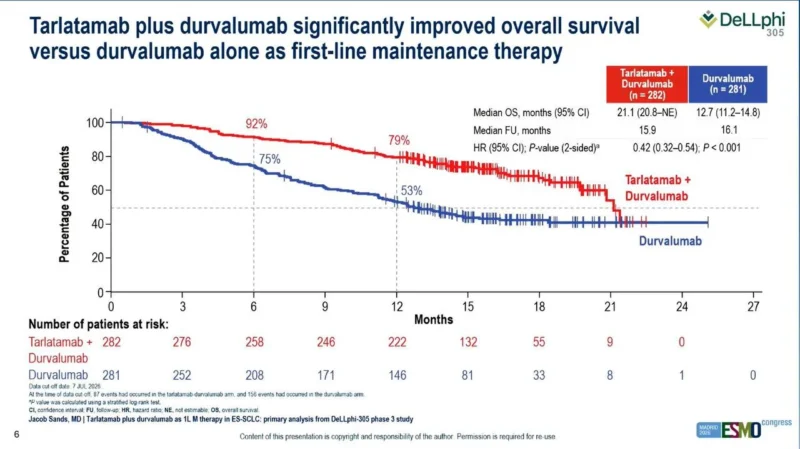
Median overall survival was 21.1 months with tarlatamab plus durvalumab versus 12.7 months with durvalumab alone, corresponding to a hazard ratio for death of 0.42 (95% CI 0.32–0.54; P<0.001).
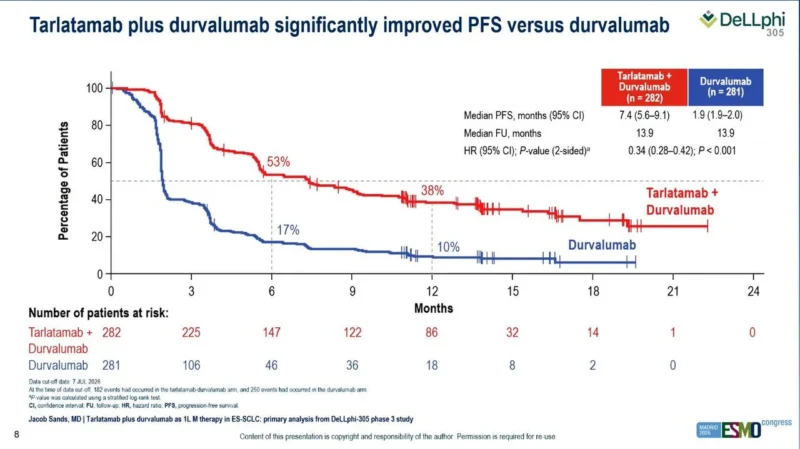
That represents a 58% reduction in the hazard of death. Median progression-free survival also increased substantially, from 1.9 months to 7.4 months, with an HR of 0.34 (95% CI 0.28–0.42; P<0.001).
The magnitude of the result positions tarlatamab plus durvalumab as an important new first-line maintenance strategy for appropriately selected patients with extensive-stage SCLC.
However, one detail is essential when interpreting the headline survival number: overall survival in DeLLphi-305 was measured from randomization at the beginning of maintenance therapy, not from the initial diagnosis or start of first-line chemotherapy. The 21.1-month median OS therefore should not be directly compared with conventional first-line studies that measure survival from treatment initiation without accounting for this difference in trial design.
Moving Tarlatamab Earlier in the SCLC Treatment Course
Tarlatamab is a DLL3-targeted bispecific T-cell engager that simultaneously binds DLL3 on small-cell lung cancer cells and CD3 on T cells, redirecting cytotoxic T-cell activity toward the tumor. DLL3 is highly expressed in SCLC and has become one of the most important therapeutic targets to emerge in the disease.
Tarlatamab had already demonstrated clinically meaningful activity in previously treated SCLC, including a survival advantage over standard chemotherapy in the second-line setting. DeLLphi-305 addresses a different strategy.
Rather than waiting for relapse and introducing tarlatamab after progression, the trial used the drug during the period of initial disease control achieved with chemotherapy and durvalumab.
This is particularly relevant in SCLC because a substantial proportion of patients deteriorate rapidly after first-line progression and never receive an effective second-line therapy. The biological and clinical rationale is therefore to deploy an active DLL3-directed treatment before resistant disease re-emerges, rather than waiting until relapse.
Who Was Enrolled in DeLLphi-305?
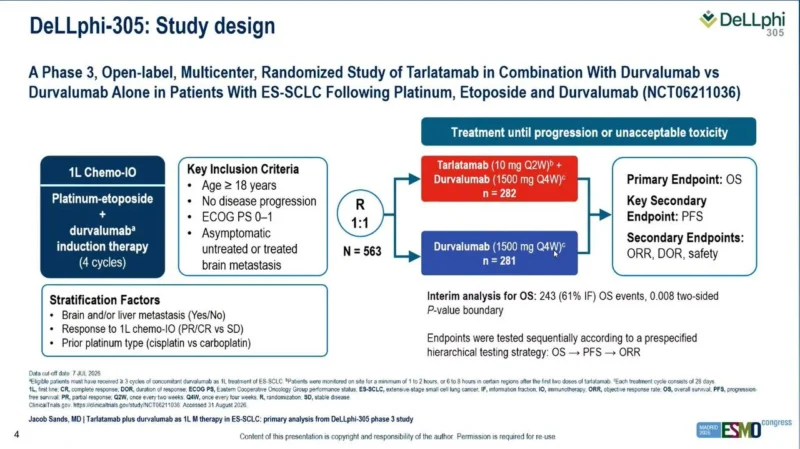
The international, open-label phase III study randomized 563 patients at 175 sites across 29 countries. All patients had extensive-stage SCLC without progression after four cycles of platinum-etoposide chemotherapy, with at least three cycles administered concurrently with durvalumab.
Patients were randomized 1:1 to tarlatamab plus durvalumab or durvalumab maintenance alone. Tarlatamab was administered using step-up dosing: 1 mg on cycle 1 day 1, followed by 10 mg on days 8 and 15, and then 10 mg every two weeks.
Durvalumab was administered at 1500 mg every four weeks in patients weighing at least 30 kg. Patients had ECOG performance status 0 or 1, and importantly, the trial allowed patients with asymptomatic treated or untreated brain metastases. Symptomatic brain metastases were excluded.
Approximately 20% of randomized patients had previous or current brain metastases, while about one-third had previous or current liver metastases. Most patients—approximately 85%—had achieved a partial response to initial chemoimmunotherapy before entering maintenance.
Overall Survival Was the Primary Endpoint
At the July 7, 2026 interim-analysis cutoff, 243 deaths had occurred. Median follow-up was 15.9 months in the tarlatamab–durvalumab arm and 16.1 months with durvalumab alone.
Median OS reached 21.1 months with the combination compared with 12.7 months with durvalumab. The HR for death was 0.42, and the result crossed the prespecified interim efficacy boundary.
The difference was also visible in landmark survival. At six months from maintenance randomization, OS was 91.5% with tarlatamab plus durvalumab compared with 74.6% with durvalumab.
At 12 months, the corresponding rates were 79.4% versus 53.3%. The 12-month separation is particularly important because SCLC has historically been characterized by rapid relapse even after an initial chemotherapy response.
The data suggest that adding DLL3-directed immune engagement during maintenance does more than temporarily delay progression; the PFS effect is translating into a large early survival advantage.
PFS Improved From 1.9 to 7.4 Months
The progression-free survival result was similarly substantial. Median PFS increased from 1.9 months with durvalumab alone to 7.4 months with tarlatamab plus durvalumab. The HR was 0.34, corresponding to a 66% reduction in the hazard of progression or death.
At six months, 53.4% of patients receiving tarlatamab plus durvalumab remained progression free compared with 17.2% receiving durvalumab alone. At 12 months, the difference was 38.4% versus 9.5%.
The durability of the PFS separation is clinically relevant because maintenance durvalumab alone provided limited control once the initial chemotherapy effect began to fade.
DeLLphi-305 suggests that active immune redirection against DLL3 can substantially extend this period of disease control.
Responses Continued During Maintenance
Patients were randomized only after completing initial chemotherapy, so many had already experienced tumor shrinkage before maintenance began. Even within this setting, additional tumor responses occurred.
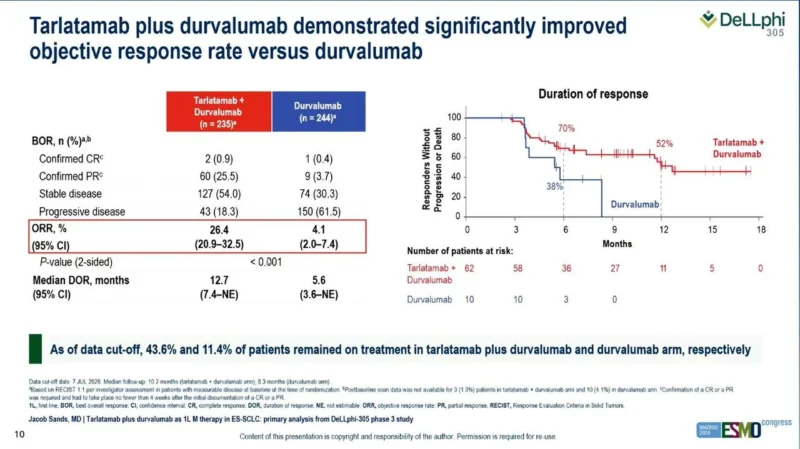
Among patients with measurable disease at maintenance randomization, confirmed ORR was 26.4% with tarlatamab plus durvalumab compared with 4.1% with durvalumab alone.
Median duration of response was 12.7 months versus 5.6 months. At 12 months, approximately 51.8% of responders in the combination arm remained in response, compared with no patients in the durvalumab-alone response group based on the available estimate.
This indicates that the maintenance regimen was not simply preserving responses generated by chemotherapy. Tarlatamab could produce additional antitumor activity in residual measurable disease after induction treatment.
Benefit Extended to High-Risk Clinical Subgroups
The published analysis reported generally favorable treatment effects across prespecified subgroups. This included patients with clinical characteristics traditionally associated with worse outcomes, such as brain metastases, liver metastases and less pronounced response to initial chemoimmunotherapy.
The subgroup analyses were not powered individually, so precise estimates should be interpreted cautiously. Nevertheless, the signal in patients with brain metastases is particularly important.
DeLLphi-305 included patients with treated or untreated asymptomatic CNS disease, and outcomes appeared to favor tarlatamab plus durvalumab in this group. The authors note that this observation is consistent with previous evidence of intracranial activity with tarlatamab in SCLC.
For a disease in which CNS progression remains frequent and clinically devastating, activity across both systemic and intracranial compartments may be an important component of the regimen’s value.
CRS Was Common, but Predominantly Low Grade
The principal treatment-specific toxicity was cytokine release syndrome. CRS occurred in 49.6% of patients receiving tarlatamab plus durvalumab, compared with 1.4% receiving durvalumab alone.
However, almost all events were low grade. Grade 1 CRS occurred in 41.8%, grade 2 in 7.4%, and only one patient, or 0.4%, experienced grade 3 CRS. There were no grade 4 or fatal CRS events.
CRS occurred mainly after the first two tarlatamab doses, with a median onset approximately 22.5 hours after the most recent dose. Most events resolved with supportive care.
Glucocorticoids were used in 21.6% of patients, tocilizumab in 3.9%, low-flow oxygen in 1.4%, and vasopressors in 0.4%.
This timing pattern is important for implementation because toxicity monitoring is particularly concentrated around early step-up dosing rather than being uniformly distributed throughout treatment.
ICANS Was Uncommon
Immune effector cell-associated neurotoxicity syndrome occurred in 1.1% of patients receiving tarlatamab plus durvalumab. Only one event was grade 2, and there were no grade ≥3, serious or fatal ICANS events.
A broader search for potentially treatment-associated neurologic events identified events in 9.6% versus 6.8% of patients in the combination and control groups, respectively, but no fatal events occurred.
The relatively low rate of clinically significant ICANS is reassuring, although neurological surveillance remains an important component of bispecific T-cell engager therapy.
Overall Toxicity Was Higher but Treatment Discontinuation Remained Low
Grade ≥3 adverse events occurred in 46.8% with tarlatamab plus durvalumab versus 40.6% with durvalumab alone. Serious adverse events occurred in 41.8% versus 31.7%.
The most common high-grade events with the combination included decreased neutrophil count, decreased white blood cell count and pneumonia. Despite the higher overall toxicity burden, adverse events led to discontinuation of tarlatamab in only 5.7% of patients.
Dysgeusia was also prominent, occurring in nearly half of treated patients, but was predominantly grade 1 and rarely led to discontinuation.
The practical challenge is therefore less about frequent permanent discontinuation and more about managing predictable early CRS, taste changes, appetite effects and other chronic treatment burdens while maintaining long-term treatment exposure.
How Should DeLLphi-305 Be Compared With IMforte?
The maintenance landscape has recently changed with the phase III IMforte trial, which demonstrated benefit from lurbinectedin plus atezolizumab after first-line chemoimmunotherapy. The DeLLphi-305 investigators note that direct cross-trial comparisons are inappropriate.
IMforte and DeLLphi-305 differed in trial design, eligibility criteria, induction immunotherapy and timing. The DeLLphi-305 publication specifically identifies the absence of an IMforte-like active comparator as a limitation because the trial was initiated before that maintenance strategy became established.
The control group was durvalumab alone, which was the relevant standard when DeLLphi-305 was designed. Therefore, the magnitude of the DeLLphi-305 benefit is impressive, but it does not directly prove superiority over lurbinectedin plus atezolizumab.
Treatment choice between contemporary maintenance strategies will ultimately require consideration of efficacy, toxicity, logistics, eligibility and future comparative evidence.
Another Limitation: This Is a Selected Maintenance Population
DeLLphi-305 randomized only patients who had not progressed after initial chemoimmunotherapy. Patients with primary refractory disease or rapid progression during the induction phase were not represented.
This selection is unavoidable in a maintenance trial but matters when interpreting the survival data. The remarkable 21.1-month median OS applies to patients who had already demonstrated sufficient disease control to reach maintenance randomization.
It should therefore not be presented as the expected overall survival of every newly diagnosed patient with ES-SCLC starting first-line treatment.
The investigators are already evaluating tarlatamab earlier in the disease course, including upfront combinations and studies in limited-stage disease after chemoradiotherapy.
OncoDaily Takeaway
DeLLphi-305 represents a major shift in the treatment strategy for extensive-stage small-cell lung cancer.
Rather than reserving tarlatamab for relapse, the phase III trial introduced DLL3-directed T-cell engagement during first-line maintenance, when disease remained controlled after platinum-etoposide plus durvalumab.
The result was a substantial improvement across every major efficacy endpoint. Median OS increased from 12.7 to 21.1 months, with a 58% reduction in the hazard of death. Median PFS improved from 1.9 to 7.4 months, with a 66% reduction in progression risk.
Additional objective responses occurred in 26.4% versus 4.1% of patients with measurable residual disease at maintenance randomization. CRS occurred in approximately half of patients, but almost all events were grade 1 or 2, while severe ICANS was not observed.
The central clinical message is that many patients with SCLC never reach effective second-line therapy. DeLLphi-305 addresses that problem by moving one of the disease’s most active newer treatments earlier, before relapse rather than after it.
The main caveats are equally important: this was a selected population of patients who had already avoided progression during induction chemoimmunotherapy, survival was measured from the start of maintenance, and the trial did not directly compare tarlatamab–durvalumab with the newer lurbinectedin–atezolizumab maintenance strategy.
Within those boundaries, however, the randomized evidence is compelling.
Tarlatamab plus durvalumab establishes DLL3-directed therapy as a major component of the first-line maintenance landscape in extensive-stage SCLC.
Source
- Pérol M, Yoshida T, Ahn M-J, et al. Tarlatamab–Durvalumab Maintenance for Extensive-Stage Small-Cell Lung Cancer. New England Journal of Medicine. Published October 24, 2026. DOI: 10.1056/NEJMoa2609482. DeLLphi-305; NCT06211036.